Author Archives | newsdesk

‘Hair Salon’: Architecture professor explores Black culture in new exhibit

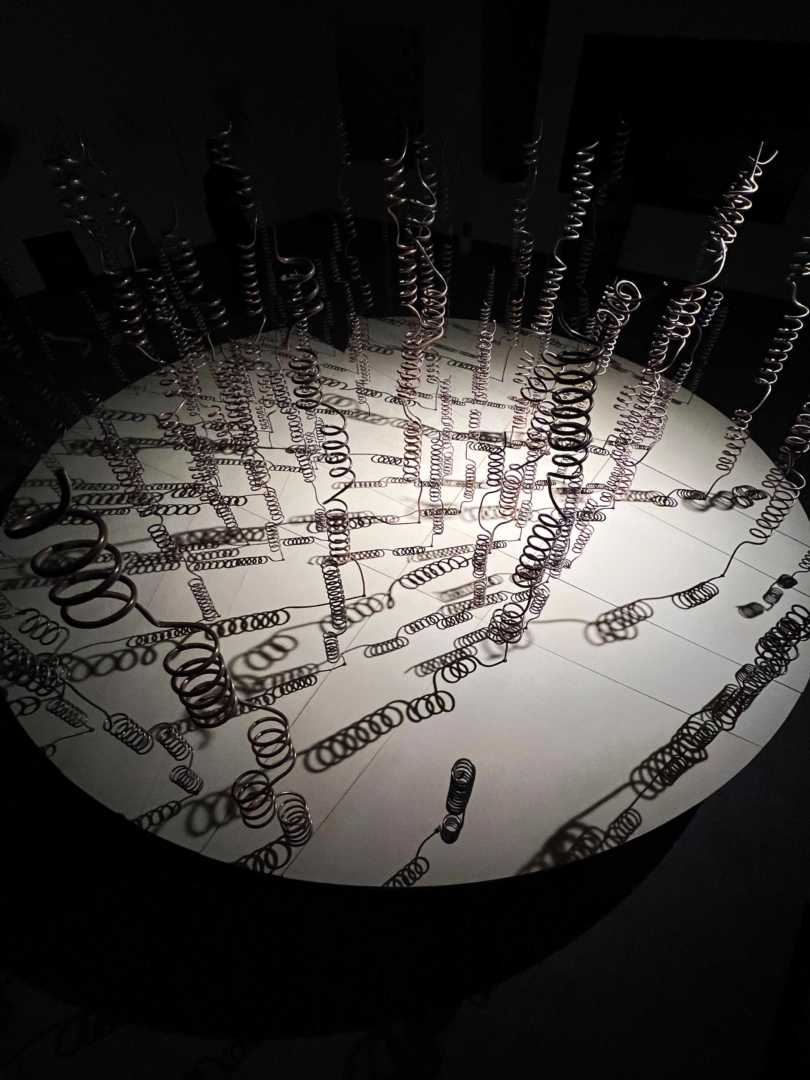
The piece, titled “Hair Salon,” is a sprawling landscape of folds and coils. It is eye-catching from any angle and was designed to emulate the unique material properties of Black hair.|Photo courtesy of Nicholas Nguyen

The University officially opened the newest exhibition at the Gerald D. Hines College of Architecture and Design On Thursday. 

The piece, titled “Hair Salon,” is a sprawling landscape of folds and coils and was designed to emulate the unique material properties of Black hair. 

The design team behind “Hair Salon” included multiple professionals from various backgrounds but was primarily headed by Sheryl Tucker De Vasquez, interim director of the interior architecture program at UH.

Vasquez has a history of working on projects involving Black culture that dates back to her involvement with the Project Row houses in 1993. She had just returned to the houses to do further work in 2020 when she was uniquely inspired by the patterns in the hair of the women around her.

“I wanted to do something related to domestic activities,” Vasquez said. “As an architect, I wanted to look at African threading and braiding hair as a way of integrating distinct materials together to create spacial enclosures.” 

Vasquez decided she would need help on the project, so she reached out to several colleagues, including computational design specialist Felicia Davis and architecture professor William D. Williams. 

She received funding from the Graham foundation to begin the project, the African American studies department helped fund her photographer Melissa Dugger, and several other schools offered some funding towards the piece. 

Vasquez says much of her inspiration came from the photographs of J. D. ‘Okhai Ojeikere, a Nigerian photographer whose work was on display at the Museum of Fine Arts. Ojeikere’s work placed a special emphasis on postcolonial African hairstyles.

“After Nigeria achieved its independence from Britain, many of them were able to wear hairstyles that had been banned for years,” Vasquez said. “The hairstyles were spatial. They suggested or implied enclosure of spaces.” 

Vasquez was quick to note that contentious issues around Black hair remained somewhat common in culture, and she specifically referenced the Crown Act. This legislation would prevent discrimination against Black people for wearing their hair in a natural style.

She also noted that, in many ways, Black hair serves as an artifact of many Black people’s past.

“There’s so little that was able to survive the Atlantic Slave Trade, but this is still something that’s active across the Black diaspora,” Vasquez said. “Every Black American can relate to a hair story. When you’re a minority in this country, and your hair is different, it resonates.” 

Vasquez said it was challenging putting the piece together since each contributor had to meet on Zoom, but in her opinion, that allowed for more unique takes on each part of the exhibit. Her and her team plan to display the piece at other universities after its time at UH concludes.

For now, “Hair Salon” will be on display until the end of February to commemorate Black History Month. Vasquez said that she was stunned by the level of support she received from the Black community as they saw her piece. She encouraged students to see themselves in the piece.

“Consider leaning into what makes you unique and what you’re passionate about,” she said. “You don’t have to conform to the discipline as it is. You can be a disruptor.”

news@thedailycougar.com

—
“‘Hair Salon’: Architecture professor explores Black culture in new exhibit” was originally posted on The Cougar

Posted in UncategorizedComments Off on ‘Hair Salon’: Architecture professor explores Black culture in new exhibit

‘Sondheim on Sondheim’ show honors composer creatively

The value of an arts education

The value of an arts education

Juana Garcia/The Cougar

The Moores Opera House’s “Sondheim on Sondheim” honored the work of the late Stephen Sondheim with style and theatrical whimsy.

Sondheim was an American composer born in New York on March 22, 1930. He won countless awards for his contributions to broadway including eight Tony Awards.

Some of his notable works include “Sweeney Todd,” “Into the Woods” and “West Side Story.” Later in his life, he opened up about being gay and his first intimate relationship. On Nov. 26, 2021, he passed away at his home in Roxbury, Connecticut.

“Sondheim” was delivered by the music students and staff of Moores School of Music. The production was organized and choreographed thoroughly where every aspect complemented each other. From the chemistry and dedication of the performers, the dazzling orchestra, the befitting costumes props and the music score. 

In the musical number, “You Could Drive A Person Crazy,” theatre juniors, Jude Herbert and Miranda Keating showcased their talent with eloquence. Their chemistry and pitches presented on stage were on point. They moved with poise across the stage and exhibited spatial intelligence as they interacted with their bodies and the props. 

My favorite performance of the night was ‘Epiphany’ by music senior Sean Holshouser. I had goosebumps watching him be possessed by the demented character he was depicting. I could hear his baritone voice coming from deep within. 

Although buried underneath the visible stars, the orchestra was just as brilliant. They carried the show, and I glanced every now and then to see the composer gleaming with pride.

The production staff should be proud of their contributions to helping their performers shine. The costume and prop design were a perfect ensemble for the cast. They helped to set the mood and time period. 

For example, for the musical number, “Waiting for the Girls Upstairs,” the wardrobe is strategically used to distinguish the younger couples from the older couples. The younger women wore flapper dresses to signify that they were from the 1920s, and the older women wore cloche hats to signify that they were in the 1930s.

The spectacular music showcased Sondheim’s impeccable aptitude for the musical arts.

Through the use of clips of interviews, Sondheim, the man behind the music, is highlighted as the ultimate star of the show

The most memorable aspects of this play are the thoughts Sondheim had on his life and work. It’s an intimate look into the mind and experiences of a musical genius. 

The audience learns interesting things about the famed composer, such as that he only wanted to be a songwriter because his childhood friend wanted to be one, and he had a dark yet optimistic outlook on life, an element reflected in his music.

Overall, the performance did a splendid job of impressing upon the audience an appreciation for Sondheim’s work and musical theatre in general.

arts@thedailycougar.com

—
“‘Sondheim on Sondheim’ show honors composer creatively” was originally posted on The Cougar

Posted in UncategorizedComments Off on ‘Sondheim on Sondheim’ show honors composer creatively

Law student decries Iranian regime in op-ed

The author, Mahsa Monshizadegan, called on officials to help defend human rights in her home nation and surrounding countries.|Photo courtesy of Mahsa Monshizadegan

A UH law student was recently recognized in a student spotlight for her op-ed article, “We Must Fight for Human Rights in Iran,” published in the Austin Chronicle. 

The author, Mahsa Monshizadegan, called on officials to help defend human rights in her home nation and surrounding countries. As an Iranian American immigrant, she always had a passion for studying law and amplifying the voices of people who could not speak on their own behalf. 

“It has always been my passion to do something for people who cannot speak up for themselves. Because living in an oppressed country, you grew up with all the adults around you doing things hiddenly; they’re always scared to be caught by the government and by the rules,” Monshizadegan said. 

Monshizadegan has lived in Houston for over a decade. She was born and raised in Iran and moved to the U.S. in 2013 at age 24. She moved alone, leaving her family behind because she disagreed with the cultural differences from her native home. 

“There’s a lot of issues and obstacles for women living there, and my mentality was not in the same line with all the rules, regulations and oppression that was going on,” Monshizadegan said. 

She graduated from the Marilyn Davies College of Business at UH Downtown, where she received her bachelor’s in international business. Now she’s in her second year of law school at UH. 

In September of 2022, when 22-year-old Mahsa Amini died in custody after being captured by the morality police in the capital city of Tehran for allegedly showing her hair and violating Iranian laws requiring women to wear headscarves which sparked worldwide protests, is what influenced Monshizadegan to speak up. 

“Seeing what’s going on in my country just creates more concern for me because I have all my family and relatives living there. And it concerns me,” Monshizadegan said. “What’s going on to a girl like Mahsa Amini could have happened to my sister, my brother or my cousin.” 

She said the Iranian people have been suffering for over 40 years ever since the Islamic Republic assumed power in 1979. 

It was associate professor of Law Zachary D. Kaufman, who influenced her to write the op-ed article to gain the attention of state lawmakers, she said.  

“I wanted this to be something that people who come across the op-ed, they understand what’s going on in Iran. And also, a way for me to address senators in the state of Texas, that this is time for you to show how much in a democracy you believe in,” Monshizadegan said. 

Monshizadegan said this is a new revolution, and Iranians believe the government is done. It is only a matter of time before leaders begin to flee the country or are captured by the people.  

Now, she is working on future articles and looking to get into public speaking to share her story. In the hope of spreading awareness of the issues affecting Iran. 

Although the conflict isn’t on U.S. soil, these are still our brothers and sisters being oppressed, and we should all be invested in this, she said. 

“This is not the issue of one country. This is the issue of human rights.” Monshizadegan said. “You’re not only a citizen of your country, but you’re also a citizen of the world. And what’s going on in another state, country and place matters. It matters and impacts your life too. Maybe not now, but definitely in the future.”

news@thedailycougar.com

—
“Law student decries Iranian regime in op-ed” was originally posted on The Cougar

Posted in UncategorizedComments Off on Law student decries Iranian regime in op-ed

Fast fashion is harmful to the environment, experts say

Juana Garcia/The Cougar

The fast fashion industry is a key cause of clothing waste resulting in landfills being overfilled and greenhouse gas emissions increasing.

 The production and effects of fast fashion are no different from single-use disposable plastics.  Used a few times, discarded and then eventually polluting the environment. 

In short terms, fast fashion is defined as an approach to producing trendy designs quickly and affordable to consumers. However, the environmental effects put this production in a negative light, according to experts. 

Madeleine MacGillivray, Seeding Sovereignty climate advocate and plastics campaign coordinator, shared that fast fashion impacts the environment throughout all production phases. 

“Most of the fast fashion is made from synthetic textiles,” MacGillivray said. “So that just means plastic which comes from oil and gas. When it’s produced, greenhouse gas emissions are generated.”

MacGillivray said that typically the garments people purchase for lower costs and are used only a few times, end up shedding lots of plastic microfibers into the environment, making up 35 percent of the overall microplastics. 

MacGillivray highlights the lack of compensation factory workers in the industry receive alongside the harsh working conditions are another factor to the issues within its production process. 

“Social justice implications of fast fashion are really a critical component to this,” MacGillivray said. “So when we fight for more sustainably made clothes, we should really just as much if not more be fighting for a livable wage and safe working conditions for the people who make our clothes.”

Where these large amounts of synthetic textiles eventually get ‘dumped’ in are in landfills in countries outside of the U.S. and Europe, such as Ghana and Chile, MacGillivray said. The unusable clothing deteriorates into their oceans, becoming toxic waste in the environment.

                                                                                                                                                                                                                                                                                                                                                                              “Oftentimes these countries have less sort of power and are less developed in the sense that it’s hard for them to say no,” MacGillivray said. “So I think that all of these clothes are having a detrimental effect on people who are not responsible for getting these clothes.”  

Staff scientist at Healthy Gulf, Naomi Yoder details how the production affects the environment even beyond the microplastics.  

“Once the plastic is made, then we have several scenarios where those chemicals can enter the environment,” Yoder said. “That garment will start to break down over time and could also attract animals to eat it.”

Yoder stated that essentially what happens is a biological and weathering process co-occurring. The material, plastic polymer, gets broken down and further distributed throughout the environment and transformed into chemicals.  

“Houston is the export capital for polyethylene which is like the building block for a lot of plastic materials,” Yoder said. “There are other chemicals that are produced along the Gulf Coast. It’s especially important for us to think about limiting production so we can have healthier communities.” 

Ethically made clothing can carry a higher price compared to the mass production of cheaper garments, so the question now is how to be sustainable in clothing and garment purchases. 

 “Politicians have to enact legislation that demands companies to change, and technology and design need to improve so that things are made way more efficiently and items and materials are innovated in such a way that uses less energy, don’t use nearly as much plastic and can be upcycled and recycled,” MacGillivray said.

MacGillivray stated that college is a unique place for community, a foundation of solutions and finding people who are like-minded and can demand change from sharing that emotional burden of the impact of fast fashion. Whether it be organizing around campus, hosting clothing swaps and living a sustainable life to halt the climate crisis. 

“Fast fashion is accelerating many negative aspects of our world,” said biochemistry freshman Tarun Pandey. “For example, climate change and exploitation of workers is increasing including child labor. Many of the youth are unaware of fast fashion and the detrimental and irreversible effects that it has.  A lot of them contribute to fast fashion as trend cycles change so quickly. Clothes weren’t massed produced as they are now.”

Pandey shared his ways of combatting feeding into fast fashion including shopping secondhand/ thrifting at local Goodwill bins.

MacGillivray emphasized that the realities of seeing change lie within companies producing less and consumers purchasing a lot less. 

“I also think that there is a beauty in understanding our own agency,” MacGillivray said. “Kind of my main message is when you think about what can I do to try and help fight the climate crisis or to help fight social injustice, its a really personal answer.”

news@thedailycougar.com

—
“Fast fashion is harmful to the environment, experts say” was originally posted on The Cougar

Posted in UncategorizedComments Off on Fast fashion is harmful to the environment, experts say

Time management tips to balance courses, life

Jose Gonzalez-Campelo/The Cougar

As the first few weeks of school come to a close, it’s easy to get sucked into all the fun of meeting friends, getting free stuff and trying not to drown in the tornado puddles. You might almost forget the reason you’re here: pesky schoolwork.

The good news is that, with a few fancy time management tricks, you can shape your future and get back to jumping in the fountains in no time. (Please don’t actually jump in the fountains).

Don’t multi-task

Seriously, just don’t. As much as you might swear up and down that you’re able to flip through tinder, catch up on “The Last of Us” and study for that organic chemistry test, you’re not doing yourself any favors.

In fact, most research says that multi-tasking actually makes you less productive. Humans are “natural mono-taskers”, which means we naturally focus on one task at a time. 

One study showed that students who multitasked actually got lower grades on average. So when you’re studying, consider turning off a device or two and picking one thing to focus on.

Find a study buddy

Grab a couple of those newfound friends that you likely made at one of UH’s many fine back-to-school events and get ready to hit the books, because evidence shows that studying with someone else can help you be more productive.

The technique is called ‘body doubling,’ and it’s exactly what it sounds like. The other person acts as your ‘double,’ providing a calming presence and modeling on-task behavior to help you stick to what you’re working on.

Of course, this only works if your friend isn’t also distracting to you, so consider studying with your less interesting friends (but maybe don’t tell them you think of them that way).

Take breaks (wisely)

Obviously, you shouldn’t be taking breaks every five minutes for two hours, but there’s a lot to be said for taking breaks strategically. In fact, there’s an entire study method created around taking breaks. 

The “Pomodoro Method” involves spending 25 minutes working on a task, then taking a 5-minute break. After four of these sessions, you take a longer, 15-30 minute break. This helps you break up longer tasks into more manageable segments. 

And it’s named after the Italian word for tomato, so you can pretend you’re getting a cultural education out of it too!

Have fun!

Seriously! Don’t forget that college is about a lot more than just grades, and make sure to take time to make new connections that might just last a lifetime. Take a deep breath, grab another espresso shot and we’ll all make it to the end somehow.

arts@thedailycougar.com

—
“Time management tips to balance courses, life” was originally posted on The Cougar

Posted in UncategorizedComments Off on Time management tips to balance courses, life

UHPD incident with theatre students sparks outrage: ‘Vests wont change the color of my skin’

Vests

Jose Gonzalez-Campelo/The Cougar

In early November, a UHPD officer pointed his weapon at a student who a witness mistakenly believed was assaulting a woman on campus. The lead officer arrived to find what was reported to be an assault was actually a rehearsal. 

The incident has sparked outrage among students across campus and has only been compounded by the School of Theatre and Dance’s solution to the issue. Their answer? Distribute brightly-colored vests to students, so UHPD knows not to shoot them.

Domonique Champion, the student who was mistakenly believed to be attacking his rehearsing partner, has attended UH off and on for more than 10 years and is pursuing a master’s degree in acting and theatre. When he saw the officer bearing down on him with his gun drawn, he knew immediately it was a matter of life or death. 

“It was generations of instinct just thrust upon you, and the only thing that I could do is drop to my knees and yell: ‘We’re rehearsing!’” Champion said. “ It wasn’t until I heard the voice of a Black sergeant that I finally felt at ease.” 

The witness who reported the crime said Champion was armed. The supposed weapon was a folded piece of white paper, which he was holding in plain view above his head. 

The incident aside, the vests provided to prevent future incidents were seen as a slap in the face for students like theatre senior Brandon Sanders. Sanders quickly took the issue to social media, where it has since gained traction on platforms such as Twitter and YouTube. 

“A bright green vest will not change the color of my skin,” Sanders said. “I saw it as the utmost disrespect. These vests aren’t bulletproof. All they do is make me stand out.”

Sanders learned about the incident when he was handed a vest on his first day back in class. He felt blindsided and took the issue to the UH faculty. He demanded they inform the student body by sending out an alert to all students enrolled. 

While the School of Theatre and Dance has held several meetings for concerned students, Sanders said they had revealed more issues than they have solved. Most notably, in a video posted to his YouTube, UHPD Chief Caesar Moore said his department had not even been informed of the vest situation. 

“When I talked to the dean, there were a lot of things that came to light that I wasn’t happy about,” Moore said. “The green vests. I didn’t agree with that. I didn’t approve of that. I didn’t know about that.” 

Moore described it as a “horrible miscommunication” between UHPD and the School of Theatre and Dance. For Moore, the issues lie at the administrative level. 

“There may need to be some discussion about how higher-level decisions are made to ensure greater inclusion,” Moore said. “If that inclusion and equality are not perceived to be there, then that trust is not there.” 

Despite his procedural objections, Moore recommended students wear the vests for the time being.

For Sanders and many other students at the School of Theatre and Dance, the vests represent a much bigger issue, one of representation.

“There is no person of color on the School of Theatre and Dance faculty at all,” Sander said. “ How can your administration look like all white people when the demographics of your student body do not reflect that?”

Sanders ultimately sees the vests as the type of solution only those with the ignorance and privilege of not having to worry about the color of their skin could concoct. For him, the lime-green vest is a symbol of deep-seated institutional failure. 

Champion echoed Sander’s concerns regarding racial representation. While he generally likes his professors and believes they are qualified, he questions the extent to which the University prioritizes diversity within its staff. 

“I can’t help the fact that the faculty is white. They’re good at their jobs. They teach good shit,” Champion said. “But I know there are people out there who look like me who can do it just as well.”

Since the incident, Champion has struggled with post-traumatic stress disorder and suicidal ideation. He has had difficulty eating and suffers from frequent panic attacks. 

“I was struggling with suicidal ideation,” Champion said. “I kept seeing this image of a gun and almost hoping something would happen to me. I realized it was because I was carrying this survivor’s guilt with me.” 

Champion’s survivor’s guilt stems from the pattern and history of police brutality directed toward Black Americans. He was lucky, Champion said, but many others that look like him have not been so lucky. The fatal beating of Tyre Nichols at the hands of Memphis police officers has only made it more difficult.

The moment the officer pointed his gun at him, Champion felt he was handed a responsibility. Where before his primary concern was completing school, now a cause has been thrust upon him. One which he’s not entirely sure he has the strength to carry. 

“There’s this societal expectation to be strong, to keep pushing. To keep going,” Champion said. “But I am physically, mentally and emotionally spent, and I don’t know how much more of myself to give to make sure that, whatever this is supposed to be for, actually ends in success.” 

Years of fighting, generations of struggle, and still an issue lies latent at the core of American society. Champion, already contending with issues at home and academic stress is now expected to shoulder the burden of a cause that began hundreds of years before his birth. 

Yet he is not alone. Students and friends like Sanders have given fuel to Champion’s sputtering flame and have stood up alongside him to demand better from the administration. What they want is simple: Better. They are tired of institutions failing them, tired of being swept under the rug and tired of fighting a seemingly endless war. 

“I want the students to be informed, and I want them to know how much power they have,” Sanders said. “Because they need to understand that their lives are at risk.”

news@thedailycougar.com

—
“UHPD incident with theatre students sparks outrage: ‘Vests wont change the color of my skin’” was originally posted on The Cougar

Posted in UncategorizedComments Off on UHPD incident with theatre students sparks outrage: ‘Vests wont change the color of my skin’

Lynn Eusan: Looking back at her life, legacy and impact

Eusan’s approach to affecting change fostered progress from the bottom up, a task many before her had tried and failed to accomplish. | File photo

Lynn Eusan, the University’s first Black homecoming queen, was a force to be reckoned with. A champion of equality, Eusan waged war against prejudiced institutions, racial bias and a long-established history of injustice in American culture at the time. 

And she won.

In honor of Black History Month, The Cougar explored Eusan’s life and legacy, from her election as homecoming queen to her untimely death at 23.

Background

The tail end of the 1960s was a time of social upheaval. The Cold War continued to test the limits of American democracy as the Vietnam War reached its peak with the Tet Offensive. The fighting brought heightened American casualties, shaking the public’s faith in the Johnson administration’s optimistic outlook on the war. 

On the home front, the death of Martin Luther King Jr. led to widespread protest and renewed demands for equality now, not later. A few months later, Sen. Robert Kennedy would also die, leading to an all-too-familiar public demand for gun reform. 

The nature of the times bled into every aspect of society. Here, students freely discussed topics such as civil rights, social justice and reform, subjects that just a decade earlier would draw censure and even violence from the public at large. 

An editorial published in the then-Daily Cougar on Sep. 17, 1968, quotes an article from a recent edition of Newsweek that decried the global trend of student activism.

“From Pomona to Paris to Peking, students are turning the establishment upside down,” the article reads. “Students today are rebelling on issues ranging from food in the cafeteria to academic reform to the foundations of society itself.”

Though the editorial dismissed Newsweek’s portrayal of peaceful activism as rebellion, the author did concede that students nationwide were no longer afraid to voice their opinions. 

The intellectual atmosphere surrounding campus life naturally left many to question established norms, and UH quickly found itself host to the same unrest seen in universities nationwide. 

Subversive organizations like Students for a Democratic Society drew cries of treason from some, while others identified with the organization’s egalitarian message. Meanwhile, a coalition of Black students and white sympathizers grappled with the then prominent Greek organizations intent on maintaining their hegemony over campus. 

With sides drawn and the board set, the Fall semester of 1968 would play host to a battle for the University’s future, with Eusan on the front lines. 

The emergence of the Black student body

In the years leading up to her coronation, Eusan was a leading voice in the community and well known for her activism on campus. Eusan, alongside other prominent Black student leaders such as Dwight Allen, who now goes by Omowale Luthuli-Allen, and Gene Locke, formed the vanguard in the fight to amplify Black voices at UH.

The University had only just begun accepting Black undergraduates in 1963, almost a full decade after the Supreme Court’s decision in Brown v. The Board of Education. Even then, the initial cohorts were small, and many Black students felt uncomfortable on the predominantly white campus. 

In a letter to the editor published in The Cougar on Sep. 18, 1968, a student named Cheryl Hall expressed frustration with what she saw as apathy on behalf of white students toward their Black classmates. 

“Many members of the Caucasian race accustomed to being one of the majority are completely unaware or unconcerned about the tremendous emotional turmoil which the black student goes through,” Hall said. 

Whether innocently unaware or intentionally apathetic, it was this sentiment that Eusan sought to address when she helped to form the Committee on Better Race Relations in 1967. Later, in the spring of 1968, the COBRR would successfully petition the University to establish a Black history course. 

Eusan wouldn’t stop fighting there, however. In an article published in The Cougar on June 27, 1968, Eusan criticized the University for its decision to hire a white professor to teach the class.

“Most Black students in the course wanted a Black professor,” Eusan said. “It’s a ridiculous situation that a school the size of UH can’t find a Black man to teach the course.”

Questionable hiring decisions aside, the course was received favorably by many students and would eventually go from being a single course to the department it is today.

What this ultimately represented was the transformation of the Black student body at UH from a small minority to a strong community. Eusan, Allen and Locke formed the foundation for which other Black students centered around, and amplified voices calling for change. 

Road to victory; war with Greeks

In 1968, change was coming, and it was coming fast. With the rise of Black nationalist movements across the U.S., the fight for civil rights took on a new, more determined approach to achieving its goals. In an interview with the University, Locke described the speed of progress in the late 1960s. 

“The difference between 1964 and 1967-68 is like two different worlds,” Locke said. “Society was changing and changing rapidly. It was not gradual change in the ‘60s.” 

This social renaissance put the adaptability of many legacy institutions to the test. Primarily white Greek life organizations, in particular, struggled to modernize. The vast majority still clung to a policy of segregation and most vehemently resisted integration. 

This inflexibility bred dissent among Black students and others who had grown resentful of the dominance hegemonic Greek organizations seemed to hold over campus. Traditionally, sororities had dominated the race for homecoming queen, but this year was different. This year the Greeks felt genuinely threatened. 

Their unease came to a head after the endorsement of Eusan in the Nov. 20, 1968 issue of The Cougar. The editorial called on students to stand for equality and prevent the crowning of yet another white Greek homecoming queen. 

“If YOU do not go to the polls today or tomorrow, then YOU will be endorsing whoever a minority of hard-working campus Greeks want for homecoming queen,” the endorsement reads. “Today is the day, and this hour is the hour to exercise student power.” 

This endorsement, however, went largely unread. The following day, another editorial titled “Papers Fly?” claimed that many Cougar newsstands were left pillaged shortly after delivery. While blame is not directly assigned, the thinly-veiled suspicion directed towards UH Greeks borders on outright accusal. 

These suspicions were all but confirmed in an issue published two days later, when Interfraternity Council Vice President Reggie Hirsch said he would be turning the matter over to campus authorities. 

“I have no choice but to turn this matter over to Safety and Security,” Hirsch said. “I consider it out-and-out theft. We do not condone it.” 

Despite attempts at reconciliation with the UH student body, white-dominated Greek life at UH continued to face scrutiny. Letters to the editor decrying fraternities for alleged racist behavior were commonplace. One, submitted by David Johnson several days after Eusan’s victory, lambasted Greek life for what he saw as a long-standing pattern of discrimination.

“Since you Greeks seem to be so anti-Black, I would suggest you and your queen-candidate retreat to Mississippi,” Johnson said. “There you can together with other narrow-minded bigots.” 

In many ways, the bickering that dominated much of the editorial and letter to the editor sections implied an anti-Greek sentiment more than a pro-Black one. Greek organizations were painted as “the man,” and their campaign against Eusan only encouraged students to stand against what was now seen as a war against a racist, antiquated power structure.

On Saturday, Nov. 23, Eusan made history.  

The people’s queen

Fall of 1968 was a good time to be a Cougar. During halftime, in what turned out to be a blowout 100-6 victory for the Cougars over Tulsa, Eusan was crowned homecoming queen.

An interview was published in The Cougar on the following Tuesday. In it, Eusan spoke about her excitement, pride and genuine appreciation for the students of UH. 

“What made me the happiest was that Blacks on this campus got together so well to push this through,” Eusan said. “They have not been that much together on any issue before.” 

While Eusan acknowledged the significance of being the first Black homecoming queen, it wasn’t at the forefront of her mind. For Eusan, the joy of simply being homecoming queen was enough. 

“Many people think I should feel different because I’m Black, and this victory is symbolic, but I feel just as anyone would feel, black or white, – happy,” Eusan said. 

Eusan saw her victory as a combination of factors. Negative public opinion towards Greek life, a desire to appease Black athletes and one simple but powerful truth about the University as a whole. 

“We aren’t prejudiced,” Eusan said. “It’s simply a reaffirmation of what the University has been saying all along.”

Death and legacy

Eusan’s accomplishments did not end with her queen title. She continued to fight for Black rights at UH until her graduation in 1970. She went on to work for a local paper, Voice of Hope, serving the Fifth-ward area. 

One rainy day in September of 1971, the unthinkable happened. Eusan allegedly accepted a ride from a man named Leo Jackson Jr. Shortly afterward, Jackson ran a stop sign, colliding with the vehicle of an HPD detective. Eusan’s body was found in Jackson’s backseat and had wounds consistent with self-defense, according to a JET magazine article. 

Many assumed the case was a slam dunk, and the family and friends of Eusan had faith that justice would soon be served. Jackson had 14 prior arrests for rape, assault and armed robbery. 

His defense? She stabbed herself.

According to Jackson, Eusan was hysterical and assaulted him as he was trying to drive her to the hospital. Detective D. L. Collier said that Jackson claimed Eusan suddenly started “screaming and stabbing herself in the back.” 

Though the evidence seemed stacked against Jackson, in a shocking turn of events, the jury voted to acquit him on all charges less than a year later. No one else was ever charged in the case, and Eusan’s death remains a mystery to this day. 

Her death may be a mystery, but her life serves as a model for social activism in the face of institutional oppression. Eusan’s calculated yet relentless approach to effecting change fostered progress from the bottom up, a task many before her had tried and failed to accomplish.  

Eusan’s legacy would be memorialized in 1976 when the Board of Regents approved the naming of the campus park in her honor. Her legacy, however, goes far beyond a green space. The life of Eusan endures through the student body, our values and our commitment to diversity.

Speaking to The Cougar, Eusan once remarked that she’d like to be remembered for “the cause of justice and equality for all people in this society.”

news@thedailycougar.com

—
“Lynn Eusan: Looking back at her life, legacy and impact” was originally posted on The Cougar

Posted in UncategorizedComments Off on Lynn Eusan: Looking back at her life, legacy and impact

Dear Denise 11: long-distance relationships, parents

Dear Denise

Jose Gonzalez-Campelo/The Cougar

In The Cougar’s bi-weekly anonymous advice column, I talk about worldwide love and the fear of disappointing parents.  To submit your questions for future issues, click the Dear Denise button on our home page.

Dear Denise, I’m talking to this guy that lives halfway across the world, and he wants me to visit him, but I’m scared. What do I do? 

Hey, friend. I think you flying halfway around the world to meet him is a bad idea if you have just started talking. In the same way you wouldn’t meet up with a stranger super quick if you don’t know them in America, definitely don’t do it outside the country.

I know a friend who did something similar, but she did not make it just about the guy. The visit was also a girl’s trip. If you have never been to this country, maybe use the effort you are spending on getting there for good. Make a list of places you would like to see and restaurants you would like to visit. This way, just in case things don’t go as planned, you can still make the trip worth it. 

Stay safe!    

I’m worried my parents aren’t happy with the career path I’ve chosen. It’s not a promising medical or engineering career. It’s more unpredictable and not so guaranteed, but it makes me happy. What do I do?

Now, this is a good question. Am I qualified to answer this? I’m not sure, but I’m going to try. I completely understand not being in the STEM community, and as a public relations major myself; I’m all too familiar with the doubt others have about my future success. 

Firstly, I’m so happy you have been able to identify a career that makes you happy. So much of our independent adult lives are surrounded around work, so it’s extremely important to do what you love. The joy you get from that is what’s going to motivate you to continue. I know it’s probably hard to act against the wishes or expectations of your parents, but if you feel it’s the best for you, then they will have to be okay. At the end of the day, your parents will not be holding your hand and making decisions for you forever. You have to mature and make choices that benefit you, and that may not be the popular decision.  

Have a sit-down conversation with your parents and let them know you understand what you have gotten yourself into and that you are looking for their support throughout this new transition period in your life. 

Good luck!

arts@thedailycougar.com

—
“Dear Denise 11: long-distance relationships, parents” was originally posted on The Cougar
Posted in UncategorizedComments Off on Dear Denise 11: long-distance relationships, parents

Students express frustration over the removal of Graduate College of Social Work dean

The students, most wearing red in solidarity, gathered at the GCSW building before the protest and briefly went over plans before marching as a unified mass into Farish Hall. | Malachi Key/The Cougar

Students at the Graduate College of Social Work gathered with supporters last week to protest the removal of the college’s dean last month. 

The students, most wearing red in solidarity, gathered at the GCSW building and marched to Farish Hall in solidarity with Alan Dettlaff, the college’s ousted dean. As supportive faculty held the doors for them, they quietly filed in and took their seats.

Robert McPherson, UH’s interim provost, stepped up to the podium and apologized for canceling the previously scheduled meeting. The mass of students sat attentively and listened as he explained the process of the dean’s removal.

“The decision to ask him to step down was not reached lightly,” said McPherson. “There was information that came to light, and it reached a point where I had serious concerns about the future of the college, and I made a decision to ask him to step down.”

As McPherson explained that Dettlaff had refused to step down and was demoted to faculty, various students interjected. Several complained that the Provost had been unresponsive to their emails and felt like they were being ignored.

“You have been acting as if you were our interim dean, but in reality, we have not had an interim dean,” said social work graduate student Violet Peterson.

Other students demanded the right to participate in the process of selecting a new dean. As McPherson asked if the students had anyone in mind, one interjected to suggest restoring Dettlaff, to which McPherson noted the irregularity of their request.

“You’re asking for something that has never existed when you suggest interviewing a new dean candidate as students,” McPherson said. “We don’t have the time or capacity to incorporate all the student voices in the process.”

Some students expressed concern that Dettlaff was removed for his commitment to radical ideas like prison abolition. They said they were afraid that his successor would not share the same commitment to those ideas. 

“If the concern is controversy, will the administration choose a less controversial candidate?” social work graduate student Khadesia Nedd asked. “Will the candidate still be aligned with the goal of abolition?”

McPherson denied that Dettlaff’s removal was due to his ideology, instead alleging that Dettlaff was involved in significant conflict amongst faculty that threatened the stability of the GCSW.

He noted the multiple perspectives embraced throughout the college but said that all of that was possible only with continued funding from the state. 

“You have your futures, your money and the state’s money at play,” McPherson said. “I don’t care if the next dean is an abolitionist social worker. The governor doesn’t care, and the president doesn’t care.”

McPherson said the GCSW was searching for a new dean, but an interim dean could be put in place for up to a year. He stated that a lengthy process was needed to find a candidate aligned with the University’s values.

Several students asked for more clarification, and some demanded that they be able to have input in the process of choosing a new dean.

“At UH, we don’t follow the precedent; we set it,” said world cultures and political science senior Lauren Morton. “It’s not that hard to ask for social work students to be included in the process.”

McPherson agreed to allow one nominated student to help with the selection process. He said he would be happy to help arrange a meeting with President Renu Khator if students had further questions. 

As discussions died down, one student asked for the provost to remain open for continued conversation, and another delivered a final plea for him to understand students’ perspectives.

“I am low income, and many of these students come from the same background,” said psychology senior Melissa Martinez. “I want you to understand the weights we carry and say that you will continue to invest in these students’ goals and their mission.”

news@thedailycougar.com

—
“Students express frustration over the removal of Graduate College of Social Work dean” was originally posted on The Cougar

Posted in UncategorizedComments Off on Students express frustration over the removal of Graduate College of Social Work dean

Behind the building: A.D. Bruce, UH’s history with integration

Serving as the campus’ primary hub for religious and spiritual affairs, the structure is named for the University’s third president and first chancellor, Andrew Davis Bruce.|Anjani Stewart/The cougar

A large part of a campus’s identity is defined by the buildings that comprise it, not only in their appearance but in their history and, in many cases, their namesake. Buildings like Ezekiel Cullen, Agnes Arnold Hall and many others are designed to embody the legacy of the names etched on their walls. 

The A.D. Bruce Religion Center is one such building. Serving as the campus’ primary hub for religious and spiritual affairs, the structure is named for the University’s third president and first chancellor, Andrew Davis Bruce. Despite the Center’s current status as an inclusive and diverse hub for students of all backgrounds, the man behind the building was not quite as accepting as many might assume. 

Bruce’s tenure at the University came during a time of international upheaval. Social causes were championed with renewed vigor as a jaded populace grappled with the bloody toll left in the wake of two world wars. For those in the U.S., this meant finally dealing with the issue of segregation. 

Bruce assumed the position of chancellor of the University just shortly after the Supreme Court’s ruling in Brown v. Board of Education, which outlawed the “separate but equal” doctrine in the U.S.

However, implementing the court’s ruling into American culture would be a slow process, particularly in the South. Educators and administrators alike undertook the task, not with the expediency one might expect but with a slow, dawdling approach that reeked of intentional deferment. 

UH was no exception. The UH library maintains a digital collection of yellowed, time-worn documents that detail the extent to which Bruce and UH President Clanton Williams delayed integration.

Spanning the better part of a decade, the documents tell a story of silent panic as University officials exchanged confidential memos and held secret meetings to discuss what they refer to as “the problem” in reference to integration.

One report features an excerpt from the minutes of a Board of Regents meeting held June 12., 1956. The passage includes a quote from then-President Bruce detailing his stance on integration. 

“In light of current events, local and national, and in considering the problem from a long-range viewpoint, I do not feel now is the time for the University of Houston to integrate,” Bruce said. 

The Board of Regents agreed with Bruce’s assessment and, despite the Supreme Court’s ruling, elected to maintain its current status.

“On motion by Mr. Fleetwood, second by Mrs. Dudley, and unanimously carried, the President’s recommendation to continue the present policy of complete segregation was approved,” the document reads. “The President’s recommendation that the problem be continued under serious study was also approved.” 

The “serious study” would take the better part of a decade to come to fruition. It wouldn’t be until 1961 that the University would accept its first Black graduate student, and not until 1963 before it admitted its first Black undergraduate. 

Just a few years after that, in 1965, Johnny Seals would attend the University as part of one of the first cohorts of Black students to be admitted. Seals had a gift for math and, under the urging of his mother, decided to attend UH to pursue a degree in mathematics.

“It was a new experience for me,” Seals said. “I had been around other races before, but we all went to segregated schools. It was a big difference attending an integrated school for the first time.”

While the clandestine meetings and shadowy correspondence exchanged between Bruce and administrators in the ‘50s painted integration as a Sword of Damocles hanging over campus, Seal’s experience wasn’t defined by racial turmoil. Instead, Seals remembers the people he met and the friends he made.

“I remember being in ROTC, and a couple of cadets used to tease me about my boots,” Seals said. “They ended up teaching me how to spit-shine them to the point where you could see your reflection in them.” 

Seal’s time spent in the UH ROTC frame much of his experience at the University. Though the Vietnam War would ultimately claim several of the friends he made there, including his commander, he fondly remembers the time spent with them. 

While Seal’s experience is one of many, he stands as a living testament to the ability for people to overcome.

news@thedailycougar.com

—
“Behind the building: A.D. Bruce, UH’s history with integration” was originally posted on The Cougar

Posted in UncategorizedComments Off on Behind the building: A.D. Bruce, UH’s history with integration