Author Archives | Matt.Whitworth

SCDC partners with OUT for Work

The Steinbright Career Development Center has partnered with OUT for Work, an organization dedicated to providing assistance to lesbian, gay, bisexual, transgender and queer students with their future career goals. An OUT for Work database has been developed and is currently available on the Drexel Libraries website. Drexel is one of 300 colleges and universities joining the OUT for Work program.

Achieving LGBTQ equality in the workplace has been complicated, simply due to the political systems in the United States. At the federal level, there is no law that consistently protects LGBTQ individuals from employment discrimination in the private sector. However, Executive Order 13087, signed by President Bill Clinton, prohibits discrimination based on sexual orientation in the federal civilian workforce.

Fuse_File_WEB

Steinbright’s involvement with OUT for Work stems from a group of co-op coordinators attending a National Association of Colleges and Employers seminar. LGBTQ topics were discussed, and a partnership with OUT was formed. Along with furthering Drexel’s overall strategic plan on diversity, OUT provides students with numerous articles, papers and presentations for an LGBTQ audience.

“This program is so new that many students might not be aware of it. We think it’s a good fit and should really help the Drexel community,” Kathleen Anderson, Steinbright’s LGBTQ project team leader, employer relations and cooperative education coordinator, said.

Phillip Sylvester, a senior psychology major and vice president of Drexel’s Foundation of Undergraduates for Sexual Equality, said, “I think this initiative is a great step forward for Drexel. FUSE has a long history of doing its best to help students with co-op issues and co-op anxieties; however, we don’t have the amount of resources that Steinbright can offer. This partnership will hopefully provide many opportunities for LGBTQ students to get their important questions answered by knowledgeable professionals.”

Anderson reiterated that Steinbright will become more involved in helping LGBTQ students during the fall quarter. The first LGBTQ student workshop, “Career Knowledge for LGBTQ Students,” will take place Oct. 9 at 1 p.m. in the Hagerty Library.

The current overarching legislation based on gender equality, which has not been approved by Congress, is titled the Employment Non-Discrimination Act. ENDA would prohibit discrimination in hiring and employment on the basis of sexual orientation or gender identity by civilian nonreligious employers with at least 15 employees. President Barack Obama has come out in support of the bill’s passage, yet the legislation has been stymied in Congress since 1994.

At the state level, 70 percent of Pennsylvania remains uncovered by LGBTQ nondiscrimination laws. Current legislation titled House Bill 300 and Senate Bill 300 would ban discrimination based on sexual orientation or gender identity or expression statewide in employment, housing, credit and public accommodations. Despite an unprecedented 90 co-sponsors from both the Republican and Democratic parties, the bill has been shelved due to House Majority Leader Daryl Metcalfe. It is unclear when both bills will be reintroduced to the floor.

In Philadelphia, Councilman Jim Kenney’s LGBT Equality Bill passed April 25 with a 14-3 vote. This legislation makes Philadelphia the largest city in the nation to offer substantial protections to its LGBTQ community. The bill contains many pro-LGBTQ incentives, such as a tax credit to willing employers that provide full health care benefits to LGBTQ employees’ partners.

Image courtesy of Triangle File Photo

The post SCDC partners with OUT for Work appeared first on The Triangle.

Posted in UncategorizedComments Off on SCDC partners with OUT for Work

URBN Annex hosts ‘Spatial Translations’ collaboration

An opening reception took place Aug. 1 to showcase “Spatial Translations,” a new exhibit currently on display in the Leonard Pearlstein Gallery. The exhibition is a partnership between Drexel’s Antoinette Westphal College of Media Arts & Design and Philadelphia’s nonprofit artist network InLiquid.

The exhibit stemmed from the works of Paul Fabozzi and his “Spectral Variant” series, one of which is on display. Fabozzi received a Master of Fine Arts degree from the University of Pennsylvania and was interested in putting on an exhibition in the Philadelphia region.

Inliquid_Chaney_WEB

Fabozzi contacted New York-based artist Annette Cords as well as Leonard Pearlstein Gallery manager and curator Amber Lauletta to express interest in the project. Lauletta then approached InLiquid, a nonprofit organization committed to creating opportunities and exposure for visual artists as well as providing a free online public hub for arts information in the Philadelphia area.

Through InLiquid’s network, executive director Rachel Zimmerman contacted local artists William Cromar and Brent Crothers. The two artists agreed to be showcased. A collaboration was soon drawn up, and the exhibit opened July 29.

The exhibition consists of each artist using different media to create a common theme. The overall theme of the show is movement through space. All the works stem from the emotional responses a person has when confronted by urban environments. Ranging from political statements to textured abstractions, each artist interprets the city landscape in an entirely separate manner.

Cords’ acrylic paintings layer texture on a canvas, creating a tactile sense of movement and structure. Cromar’s razor-thin wood is reminiscent of minimalist Richard Serra and is slashed across the white gallery walls. Fabozzi’s hand-drawn Mylar pieces map out the negative space within the city. Crothers takes everyday objects such as tires, copper, piping and garden hoses and develops them into a political statement of purpose.

Crother’s “Who Broke the World?” sculpture was particularly appealing to many of the gallery visitors, old and young alike. Utilizing wood, copper and nails, he created the sculpture as a direct response to the attacks of Sept. 11, 2001.

“I couldn’t understand how the world could get so bad that [you would be] willing to give your life up,” Crother said.

Drexel students were contemplative at the work.

“I like the contrast between the industrial and the natural,” Joseph Guaglianone, a sophomore majoring in construction management, said. “That’s what I like about art really, those opposites.”

Guests will also be able use their smartphones to access interviews and explanations from each of the four artists.

This pilot project was designed by Drexel’s arts administration program as an attempt to increase visitor interaction with the various works throughout the gallery.

The Leonard Pearlstein Gallery is located in the URBN Center Annex at 3401 Filbert St. The exhibit is free and open to the public from 11 a.m. to 5 p.m. Monday through Friday. It will close Wednesday, Sept. 18.

Image courtesy of Ken Chaney

The post URBN Annex hosts ‘Spatial Translations’ collaboration appeared first on The Triangle.

Posted in UncategorizedComments Off on URBN Annex hosts ‘Spatial Translations’ collaboration

Lindy leaves behind strong legacy of civil service

Philip Lindy, one of Drexel University’s most prominent benefactors, died June 29 at the age of 83. Lindy was a vibrant and engaging philanthropist who worked tirelessly for the improvement of disadvantaged youth.

“His passing is a huge blow to Drexel,” President John A. Fry said. “I have never met anyone else who was so incredibly trusting. The man was just a big giver, and I really can’t say enough good about him. It feels like we’ve lost a grandfather.”

Lindy_Courtesty of Drexel University_WEB

In 2008, Lindy approached Drexel’s Center for Civic Engagement to discuss practical strategies to combat poverty in West Philadelphia. After talks with directors and staff at the Center for Civic Engagement, the Philip B. Lindy Inner-City Public School Program was soon established as a tutoring program for middle school students throughout the area.

The name was later shortened to the Lindy Scholars program, and it accepts all Drexel students from a multidisciplinary range of majors to work as volunteers. These scholars tutor and mentor students in grades 6-8 for one or more academic terms. The student recipients originate from three West Philadelphia middle schools and commit to after-school and weekend sessions with the Drexel volunteers.

Lindy donated $15 million to CCE in 2011, cementing his ties with the University and its civic engagement policies. CCE changed its name to the Lindy Center for Civic Engagement to honor his generosity. In 2012 Lindy was awarded the Joseph Jacovini Outstanding Service Award, the highest tribute that Drexel bestows upon non-alumni.

Lindy was also an active member of the Jewish community in Philadelphia. He served on the board of the American Jewish Committee, was a member of the board of trustees of the Jewish Federation of Greater Philadelphia, and was a founding member of Temple University’s Center for American Jewish History.

In an email statement, Jennifer Kebea, interim director of the Lindy Center, remembered Lindy with fondness.

“Phil was so much more than a philanthropist. He was actively engaged in all aspects of the Lindy Center for Civic Engagement’s work. … Days before he fell ill, Phil was on campus for multiple end-of-year events, shared a meal with a group of Drexel Community Scholars, and had one final breakfast meeting with me at his favorite meeting spot — Cosi on 15th and Locust [streets]. I speak for everyone in the Lindy Center when I convey my absolute heartbreak over Phil’s passing. His generosity, kindness and general zeal for life will certainly live on as we strive to fulfill his legacy here at Drexel University.”

Lindy was born in Philadelphia in 1930. He graduated from the Wharton School of Business at the University of Pennsylvania in 1952. After spending time in the Navy, he founded a company called Lindy Property Management. The business builds and manages residential complexes in the Philadelphia area.

With the success of his company firmly established, Lindy was able to focus on his other passion of urban social development. Lindy wrote his graduate thesis on public housing and was fully aware of the lack of educational resources that raises challenges for many Philadelphia residents, leading to his development of the Lindy Center.

Lindy is survived by his three children and eight grandchildren.

Image courtesy of Drexel University

The post Lindy leaves behind strong legacy of civil service appeared first on The Triangle.

Posted in UncategorizedComments Off on Lindy leaves behind strong legacy of civil service

Official explains keys to a new nation

Ambassador Andebrhan Giorgis led a discussion May 21 at Drexel’s Mitchell Auditorium about his native country of Eritrea. The event was titled “How To Build A Country From Scratch,” and it touched on issues such as youth development, war and corruption within the geopolitical context of nation-building.

Eritrea is a state bordered by Sudan, Ethiopia and Djibouti and is located on the Horn of Africa, adjacent to the Red Sea. It is a country with a turbulent history. The territory was originally an Italian colony and then a British colony throughout World War II. Following the war’s culmination, the British ceded their sovereignty over to Ethiopia. The annexation was unpopular with the majority of Eritreans, who were worried about sectarian violence. After an economic crisis and numerous instances of religious persecution, a bloody war of independence followed for 30 years.

Ambassador_Wisniewski_WEB

The majority of the fighting against Ethiopia was carried out primarily through small-arms tactics and guerrilla warfare. While there were originally many different rebel groups at the beginning of the conflict, the Eritrean People’s Liberation Front emerged as the principal combatant in 1981.

Finally in 1993, after the Soviet Union terminated its military aid to Ethiopia, the EPLF assumed complete control of Eritrea. A referendum was held two years after liberation, and an overwhelming majority of the populace voted for independence. A new government was founded under EPLF, and new President Isaias Afwerki declared the nation an independent state May 24, 1993. In 1994 the EPLF was transformed into the political party called the People’s Front for Democracy and Justice. The PFDJ, under Afwerki, still maintains governance over Eritrea today.

This 20-year period of governance by the president and the ruling party formed the main crux of Giorgis’ lecture. Quoting liberally from African poets and scholars, Giorgis was appalled by the political corruption that had taken root in his mother country. Political power resides only with “those who control the barrel of the gun,” he said.

He spoke about the sacrifice and courage of the Eritrean people and their willingness to fight for independence. “Every [Eritrean] family had at least one martyr. The people have paid a high price for freedom,” he said.

He referred to their constitution as “just ink on paper” and grew forceful as he spoke about the citizens who try to escape the authoritarian country. “Many of my former government ministers, my friends, have been detained or forced into exile,” he said.

Eritrea, which had once been thought of as a nation of progress and democracy, has become a “basket case of false hopes and thwarted expectations,” he said.

In his conclusion, Giorgis outlined key strategies for nation-building, including state transparency, an enhanced security sector and a redistribution of civil service employment.

A question-and-answer session followed the lecture. Drexel students brought up various issues ranging from economic development to parallels with the Arab Spring.

Giorgis was a founding member of the central committee of the EPLF. After Eritrea gained independence, he served as president of the University of Asmara, governor of the Bank of Eritrea, a member of the Eritrean National Assembly, and an ambassador to numerous European nations and the European Union. Giorgis is currently a board member and senior adviser of the European Center for Electoral Support, a senior expert in the Peace and Security Section of the Global Governance Institute, and an adjunct professor of Diplomacy and African Politics at Vesalius College, Free University of Brussels.

The event was co-sponsored by Drexel’s Office of International Programs and the Drexel Student Alliance of the United Nations Association.

Image courtesy of Rachel Wisniewski

The post Official explains keys to a new nation appeared first on The Triangle.

Posted in UncategorizedComments Off on Official explains keys to a new nation

Ceremony commends new plaza

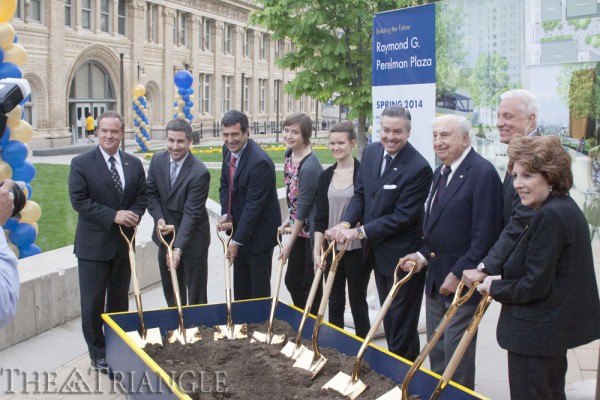
A groundbreaking ceremony for the newly named Raymond G. Perelman Plaza was held May 7. The event marked the beginning of construction for a complete renovation of the current plaza, which is set to become Drexel’s primary space for outdoor socializing and events.

The space is located between Market and Chestnut streets. It is currently a hub for pedestrian traffic, especially because it is situated between the two largest construction projects on campus. The plaza’s northern border will be the new LeBow College of Business building, which cost an estimated $92 million and is set to open this fall The southern border will be the $98 million Chestnut Square development, which will contain a mix of student housing and retail space and is also set to open this fall.

President John A. Fry opened the event with a speech thanking Perelman for his generous donation and his commitment to Drexel. “Vision has always been Perelman’s strong suit,” Fry said.

Perelman_Brodie_WEB

“This plan calls for the Perelman Plaza [to] be Drexel’s physical center of gravity. This will be the 50-yard line of Drexel University, and we don’t even have a football team,” he joked.

The entire reconstruction is part of Drexel University’s master plan, which focuses on establishing Drexel as a modern urban campus. The development is a four-phased, five-year process designed to draw the community to shared spaces as well as integrate Drexel into the surrounding neighborhoods.

Developments anticipated in the coming years include building a mezzanine-level student gathering space in the Armory, relocating the Steinbright Career Development Center to 32nd and Market streets, and creating a new home for the School of Public Health in Nesbitt Hall.

The more ambitious goals include redeveloping the site of the Hess Engineering Research Laboratory into retail and housing units, building over and developing the Schuylkill Rail Yards, and expanding the College of Information Science and Technology pending a benefactor.

Students at the groundbreaking ceremony were positive and relatively excited for the changes.

“Throughout my freshman year there has been construction going on around Drexel,” Viral Desai, a senior business administration major, said. “It’s really great that Drexel’s doing all of this.”

Zac Rubin, another senior business administration major, had similar sentiments. “These are definitely good things. I’m glad Drexel is revitalizing the neighborhood, but it’s a shame I won’t be around to see it completed. I look forward to coming back as an alum[nus], though,” he said.

The Perelman Plaza’s restoration was made possible by a $5 million donation from the Raymond and Ruth Perelman Education Foundation. Drexel University’s College of Medicine awarded Raymond Perelman, the plaza’s namesake, an honorary degree in 2012.

The landscape architecture will be completed by Andropogon Associates Ltd. Jose Alminana and Tom Amoroso both represented the firm at the ceremony.

A highlight of the event was the speech given by Perelman himself. “I didn’t realize that people wanted me to speak, so I’ll be very short. Thank you all for coming, and I am overwhelmed. … This is a fabulous university, and I’m glad to become a part of it. Thank you very much,” he said. His speech received a standing ovation from the audience.

The campus master plan will theoretically be fulfilled in conjunction with the University’s overall strategic plan, a longer, 30-year proposal. A notable goal of the strategic plan will be enrollment prioritization. By 2021 the University hopes to increase the student body to 34,000 students. Including online students, there are currently 25,500 students enrolled at the University.

Image courtesy of Ajon Brodie

The post Ceremony commends new plaza appeared first on The Triangle.

Posted in UncategorizedComments Off on Ceremony commends new plaza

Sandal start-up uses profits to improve water quality

A business founded by a Drexel alumnus hopes to improve the quality of life in Guatemala. With profits from the production, manufacture and sales of sandals, Ix Style Inc. aims to provide clean drinking water to many impoverished children.

Drexel alumnus John Kennedy and his sister Francesca were concerned by the poverty they witnessed while visiting Guatemala. Both siblings were shocked by the abject realities that many Guatemalan children face. They were specifically concerned about water quality, especially around the Lake Atitlan region. The children of the community are forced to drink and bathe in the toxic water surrounding the lake, which has not only elicited several health concerns but also negatively affected local tourism and commerce.

CharityCompany_Courtesy_WEB

“There wasn’t any real theatrical decision regarding a moral compass,” John Kennedy said.

This concern, coupled with many interviews with local officials and small-business leaders, brought the idea to fruition. Soon after, the brother-sister team started Ix (pronounced “eeks”) Style. The name stems from the Mayan word for jaguar and represents strength, energy and vitality. They established the firm to operate via electronic commerce, with the hopes to eventually become fair trade, according to Kennedy. Their business strategy hopes not only to improve the lives of many Guatemalans but also to give many of the undermarketed artisans a broader market for their goods.

The firm currently sells sandals at a price of $89 per pair. The shoes are inspired by the style of Mayan textiles, and each sandal is woven in a distinct pattern called huarache. Fifteen percent of profits from each purchase are donated to the nonprofit organization named charity: water. Currently the sandals are sold in Brazil, Malaysia, New York City and Philadelphia and can be purchased through their website.

The company is also in the process of forging close contacts with other businesses with similar strategies. While working closely with Blake Mycosie, president of TOMS Shoes, the brother-sister duo hopes to replicate what the TOMS brand has done for charity entrepreneurship in Guatemala.

Ix Style Inc. is currently hiring undergraduates of any major seeking an internship. “We would absolutely encourage any Drexel student to submit an application and cover letter,” John Kennedy said. As a graduate from Drexel, Kennedy believes Drexel students are prepared for the workplace.

Interested students should note that accepted interns would be based primarily in New York. There would also be substantial opportunities to travel to Guatemala to visit the various community leaders, diplomats and bureaucrats. Students who are interested in working in the nonprofit sector are encouraged to send a cover letter and resume to fkennedy@ix-style.com. Spanish fluency is not required.

Image courtesy of Ix Styles

The post Sandal start-up uses profits to improve water quality appeared first on The Triangle.

Posted in UncategorizedComments Off on Sandal start-up uses profits to improve water quality

Philosophy week ‘expands horizons’

Drexel’s first annual Philosophy Week, which included lectures and panel discussions on interdisciplinary topics, began March 4

The series started with “Meanings of Life: Feminist Resources in Foucault’s Theory of Biopolitics,” a talk by Sarah Hansen, a new assistant professor in the Department of English & Philosophy. The focus was on the concept of biopolitics in relation to philosopher Michel Foucault. Hansen explained the intricacies of biopolitics, or the theory on how social and political power effects life. She compared and contrasted Foucault’s theories with feminist queries and delved into Foucault’s theories on development. Hansen then concluded her talk in relation to feminism’s influence in the social sphere and elicited audience questions on the role of gender versus sexual development.

Sarah Bodhuin, a junior sociology major, said, “She’s like everything you look for in a feminist philosophy professor. … It was great to hear her speak so eloquently and with so much force. I will definitely try to take a class with her in the upcoming terms.”

Peter Amato, director of the philosophy program at Drexel, hopes that students will attend the various events and take something significant from them.

PhilosphyWeek_Courtesy_WEB

“Students who attend Philosophy Week events will find themselves mentally stimulated and intellectually provoked. Hopefully, expanding their intellectual horizons in this way will be a positive experience for them, and we hope it will make them discover or perhaps rediscover an inclination and an ability to philosophize on their own,” he wrote in an email.

“Philosophy and Law Careers” dealt with philosophy in law with an emphasis on career planning. Two alumni sat on the panel: Michael Filoromo, a psychology major from the class of 2005, and Katie Devanney, a psychology major who graduated in 2012. They were joined by pre-law adviser Mike Vitlip. The panel discussed the perils of the law school application and the ethics of the job. They also gave tips to aspiring students on what classes to take while at Drexel.

After the panel, students had mixed reactions about the lecture. Daniel Martin, a junior philosophy major with a minor in legal studies, said, “This talk [was] simply enlightening. … The panel gave me such good, practical information. I was pretty certain about going to law school after graduation anyway, but this panel helped me put a face on what can be a daunting process.”

Other students were not as exuberant. “I had nothing against the panel or the personnel on it,” Harry Megerian, a junior philosophy major, said. “I’m just not too stuck on the America[n] legal system, and I didn’t think [the speakers] did a good job convincing me about the ethics of their profession.”

Robert Audi, a professor at the University of Notre Dame who taught widely in many university epistemology classes, participated in two lectures: “Governmental Secularity and Religious Citizenship” and “What We Talk About When We Talk About Religion.” Audi is known for his stance on ethical institutionalism, and he gave a lecture discussing the ethical role on the separation of church and state in the United States.

Other events included “Religiosity and Amelioration: Thoreau, Anzaldua and Marley” and “Why Study Philosophy?”

Philosophy Week was sponsored by the Department of English & Philosophy, the Department of Culture & Communication, the Department of Psychology, and the Drexel Philosophy Club.

Image courtesy of Peter Amato

Posted in UncategorizedComments Off on Philosophy week ‘expands horizons’

Autism Institute gets a new home

Construction has begun on the future home of the A.J. Drexel Autism Institute, the nation’s first autism center focused on public health science. The autism-friendly space will be located at 3020 Market St., across from the Goodwin College of Professional Studies, and is expected to open this summer.

It is the first institution of its kind to bring a public-health research approach to autism spectrum disorders. The center’s researchers consist of epidemiologists, community psychologists, environmental health scientists, and health and education policy research specialists from both Drexel University and abroad. Jennifer Plumb, director of the Community Outreach Core, was thrilled with the progress.

“We are very excited to be moving into our new LEED-certified space at 3020 Market St. and especially excited about the location being in the 30th Street hub that Drexel is building,” she said.

The Institute’s philosophy is based around the prevention of physical and mental impediments that autistic patients experience. Autism spectrum disorders are a set of neurodevelopmental disabilities that fundamentally alter a person’s ability to interact and communicate with others. The disorder is now believed to affect nearly 900,000, or one in 88, U.S. children and as many 5 million U.S. adults.

“Our space is going to have state-of-the-art assessment rooms, and with the development and implementation of our mobile assessment unit, we are going to be providing outreach into underserved communities,” Plumb said.

The new space will be a physical commitment to the Institute’s innovative public-health structure. No problem is too small to be overlooked. The shiny metallic panels, which come standard with any elevator, are being addressed because visitors with autism might find them distracting, or even troubling, if they have heightened sensitivities to visual sensations.

A specially-designed, quick-entry bathroom will allow ASD children to spend less time performing necessary functions, and more time in the classroom. A special waiting area will be designed for family members who want to remain with patients without interrupting the researchers. Each issue will address the Institute’s overall goal to prevent disability by making ease and comfort its top priority.

“Plumb said that the Institute hopes to offer research and co-op opportunities to Drexel students in the future. One of the studies that will be conducted by researchers at the Institute will be to determine if chemical exposure while in the prenatal environment causes pathologic changes in the developing brain. Another study will work to construct new training approaches for community-based early intervention specialists in order to manage the challenging behaviors of persons with ASD. Each test will strive to have the broadest possible impact and not become limited to a select group of participants. Persons with ASD from the surrounding communities, including Mantua and West Philadelphia, will be welcome to come in for a clinical evaluation.

Dornsife2_Couresty_WEB

Questions regarding research, patient evaluation strategy or employment opportunities at the Institute can be directed to autisminstitute@drexel.edu or 215-255-7373.

Image courtesy of

Posted in UncategorizedComments Off on Autism Institute gets a new home

Students fight for meatless options – Campaign aims to educate about animal cruelty and vegetarianism

The Drexel Sierra Club and the Drexel Animal Welfare Association have teamed up to promote “Meatless Mondays,” a weekly event designed to give awareness for changing eating styles around Drexel’s campus. The campaign will specifically target students and faculty at the Handschumacher Dining Center to provide them with more information about animal cruelty and the benefits of going vegetarian.

The goal of Meatless Mondays is to encourage students, faculty and staff to pledge to not eat meat at least one day per week and to eat more fruits and vegetables instead. The whole program is an international campaign designed to get campuses across the globe to encourage healthy, meat-free diets. Both student organizations are working with campus dining services to provide meatless options on Mondays and to offer more vegan and vegetarian meals throughout the week.

RECIPE

“We want to help students understand how important going vegetarian is,” Ben Sylvester, treasurer of the Drexel Animal Welfare Association and a junior English major, said. “Going vegetarian is not only healthy for you, it’s also sustainable as well. A lot of students don’t know that along with factory farming mistreating and being unusually cruel to animals, the entire process is simply a burden on the earth. Excrement from farmed animals, like hogs or dairy cattle, often pollutes drinking water. Not to mention that it takes around 2,500 gallons of water to produce only one pound of meat. This is simply a waste of resources.”

Other students on campus are not as decided. “Look, I have nothing against animals,” Anthony Rossi, a sport management senior in the Goodwin College of Professional Studies, said. “But I grew up in an Italian household. No one in my family eats chicken parmesan and veal and then has a discussion about its origins. This type of cooking is part of my heritage; it’s just part of the tradition.”

Sylvester is adamant, however, that this tradition can change. “One of the problems with eating meat is that it’s so ingrained in the culture. If we could show students exactly where their meat comes from, maybe we could change a few people’s minds.”

A question was then posed as to what the clubs hope to accomplish by conducting this campaign, especially in a city famous for the cheesesteak.

“We don’t think we have overtly ambitious goals,” Sylvester said. “We’re not asking students to completely stop eating what they enjoy. But students especially have to understand that what they eat has a huge effect on animals and the environment. I think the more we become a presence on campus, the more the student body will start to realize the benefits of vegetarianism. We have managed to garner over 50 signatures during our first attempt, which really is a great start.”

Members of both clubs will be in the dining hall every Monday for the rest of winter term. For more information or questions about meatless recipes, contact Nicole Koedyker, president of the Sierra Club, at nkoedyker@gmail.com.


Image courtesy of

Posted in UncategorizedComments Off on Students fight for meatless options – Campaign aims to educate about animal cruelty and vegetarianism