
Author Archives | Mariah Kreutter

Profound, Powerful, and Profitable

The American teenager was first invented in the aftermath of World War II, by businessmen who realized they could make a killing off the pocket change young people had now that they weren’t being sent overseas to kill each other. Teenagers were suddenly “a big and special market,” as a 1944 Life article put it. They had automobiles to drive and rock & roll to listen to and milkshakes to drink, in tandem, using extraordinarily long curly straws, and all of it meant spending money, money, money that businesses were keen to nab a piece of.

In spring of 1944, a Chicago high school senior named Eugene Gilbert noticed that the shoe store he worked at wasn’t marketing their sports shoes to teenagers. He pointed this out. The store ran some new ads, and it made some money. While in college, Gilbert parlayed this talent for obvious solutions into a company called Gil-Bert Teen Age Services. By 1958, Gil-Bert Teenage Services had become a million-dollar-a-year business, Eugene Gilbert & Co. — perhaps the first youth consulting company.

70 or so years later, it happened all over again. In 2016, Ziad Ahmed, then a junior at Princeton Day School, founded a company called JÜV Consulting with some friends from a Cornell summer program. JÜV is staffed entirely by 14–22 year olds, and bills itself as a Generation Z consulting company that “give[s] voice to those responsible for the viral.” JÜV offers a range of services, from the self-explanatory “social media work” to the somewhat baffling “curation of experiences.” It has been featured in the New York Times and Bloomberg. Its clients include Viacom and Unilever. And its business model, despite the decades that have passed, is virtually indistinguishable from Gilbert’s: both companies rely on decentralized networks of teenage consultants to explain young people to old people.

As Ahmed’s executive bio puts it, “the teen voice is profound, powerful, and profitable, and no one should be sleeping on us.”

Now a sophomore at Yale, Ahmed came up with the idea for JÜV after the nonprofit he founded in ninth grade, Redefy, started to get some buzz. Redefy, an organization loosely centered around social justice awareness, has a mission statement two words shorter than the TL;DR summarizing it, and garnered Ahmed some serious recognition. “I found myself in rooms that I never dreamt of,” he explained — rooms where he was often the only young person. Ahmed explained, “JÜV consulting grew out of the idea that if anyone should be making money off of young people, it’s us” — young people, obviously. He was unimpressed by the fifty-something “youth experts” he met through his work with Redefy (which earned him speaking gigs, media coverage, and a visit to the White House, all while he was still in high school). “I don’t believe we should talk about any group of people without that group present, and not in a folding chair to the side,” Ziad told me emphatically. His manner reminded me of an earnest Model UN speaker: unwavering eye contact, enthusiastic hand gestures, and a fondness for rhetorical escalation. (Perhaps unsurprising, since in his scarce free time he competes with MUNTY). “And whether that’s an all-male panel policing women’s bodies, or a head of a department who doesn’t identify with that ethnicity, or a bunch of executives deciding what young people like — and they’re not all analogous in terms of severity, I’m not trying to equate them — but I am saying that no group of people should be talked about without that group present and centered in the conversation.”

The idea that teenagers are a profitable resource isn’t new. But the idea that teens constitute a marginalized identity? That wasn’t around in the fifties. There are now a number of glossy startups and media outlets based around the idea of proportionally representing young people: perhaps the most cogent is Helena, the nonprofit founded by then-Yale student Henry Elkus with the central ethos of bringing together “brilliant and capable leaders,” half of them under 25. (Helena was also the subject of a 2016 Gawker piece called “I Have No Idea What This Startup Does and Nobody Will Tell Me.” In fairness, they seem to have rebranded slightly since then.)

Ahmed (whose website, Twitter, and Instagram all use the handle “ziadtheactivist”) first became known for his social justice activism with Redefy, which was his main focus until about a year ago. He now takes classes for a day and a half every week, serves on Redefy’s board, and spends the majority of his time in New York working at JÜV. But “the work comes from the same place,” he said, whether it’s Redefy or JÜV. So perhaps it’s natural that he talks about age as an identity category, not unlike race or gender.

In fact, Ahmed sees many analogies between his nonprofit and his for-profit. He describes most of what JÜV does as a kind of sensitivity consulting: “Make that ad less heteronormative. Make that ad less toxically masculine,” he said, acting out an address to a corporate client. “We teach them what they/them pronouns mean!” Even explaining memes to corporations has an ethical component: “In every Gen Z crash course that we do, we show vernacular words like ‘tea’ and ‘shade’ and we give a whole spiel about how it’s co-opted from black queer vernacular. And every time we show the Spongebob meme, we say that this is explicitly making fun of disabled people.”

Many progressive students at Yale see consulting and activism as diametrically opposed. The Yale meme page, for example, frequently hosts jokes comparing students who intern at McKinsey or Bain to snakes. Ahmed, who describes himself as “deeply skeptical of capitalism,” is aware of this. “I wanna be clear, this is something that I definitely ask myself,” he told me. “And I would hate for this article, or for anything, to pretend like I have all the answers, because I don’t.” Ultimately, Ziad believes that it is possible for profit and purpose to align, and that his particular skill set is best suited to working “in the system.”

“Business is going to exist, and it’s going to make people money. Dammit I hope it makes the world better. Dammit I hope that we can make money and do the right thing at the same time. And so if they can make money by doing the right thing, it sounds good to me.” JÜV is also apparently willing to put its money where its mouth is: according to Ahmed, many of their contracts require the company make a donation to a nonprofit, and JÜV once turned down a contract with a company that wanted help selling colored contacts to people of color. While he admitted that JÜV works with companies whose ethics he quibbles with, “we ultimately believe that we at least don’t make the world worse.” Even so, Ahmed has doubts about his involvement: “It doesn’t mean I don’t ask myself, you know, should I stop doing this and devote all my time to figuring out what to do about the Rohingya crisis?”

In addition to rigorously self-examining their place within global capitalism and Myanmar’s human rights abuses, JÜV doesn’t claim to represent all of Gen Z. (Probably a savvy choice, since one executive’s bio lists “surfing through LinkedIn” as one of her hobbies, and another describes himself as “an avid collector of wines and cigars.”) I spoke with one JÜV consultant — an independent contractor who attends a large public university and asked to remain anonymous — who was critical of the “Ivy lackeys” culture that, in their view, dominates the upper echelons of JÜV and is inaccessible to the relatively few “public school kids” at the company. For a budding mogul, Ahmed is remarkably willing to admit fallibility. He describes himself as “most often the wrong person to be talking to” and emphasizes the “twelve-hour, fifteen-hour” board meetings JÜV has had about diversifying their executive board’s overwhelmingly Ivy League credentials (as well as gender, ethnicity, and socioeconomic background). What fruit those fifteen-hour board meetings have yielded is unclear: seven out of twelve executive board members attend Ivies, with a UChicago student and a Johns Hopkins grad for good measure.

As much as JÜV seems to want to diversify, there’s one area in which diversification seems destined to take root: age. JÜV’s website proudly explains that “we are not proclaimed ‘teen experts.’ We are something far simpler, yet far more profound” — apparently a favorite adjective for JÜV — “we are teens.” Except, well, they’re not, or at least not necessarily. Ziad is twenty. In five years — not that long a time span for a growing start-up — he’ll be twenty-five, and so will most of the current executive board. As gymnasts, models, and boy bands already know, there’s a danger to building one’s brand and career around youth. How do you sustain a company that you will inevitably age out of?

When I asked Ziad this, he emphasized that JÜV is a Gen Z consulting firm, not a youth consulting firm. “We’re on the older end of Gen Z, which means people are aging into our company every year. The minimum working age is 14. The youngest Gen Zers are nine or 10.” What happens after that? Ziad’s not sure. There are still millennial consulting firms that consult on workplace environments. Maybe JÜV will do something like that. “Maybe we’ll become a disruptive consulting company more broadly,” he said. “Or maybe it’s something else. I don’t know what that something else is, but I know that I love what I do right now.”

Eugene Gilbert made it work back in the fifties. He kept up his reputation as a teenage expert well into adulthood — and with it his profit margin. In the digital age, though, culture is more nimble than ever: memes can last as little as a few hours before sinking into irrelevance. The prognosis for an aging youth consultant gets grimmer every day. Similarly, the vision of ethical capitalism and corporate activism that Ahmed advances is one that a growing contingent of Gen Z doesn’t share. According to a 2018 Gallup poll, only 45 percent of young adults have a positive view of capitalism. Democratic socialist politicians like Alexandria Ocasio-Cortez and Bernie Sanders have achieved massive popularity among young voters, and in the Age of Trump, centrism — the worldview in which being a young professional is somehow “disruptive,” in which the sphere of identity politics is the consulting-industrial complex — is beginning to seem as obsolete as Dat Boi.


Profound, Powerful, and Profitable was originally published in The Yale Herald on Medium, where people are continuing the conversation by highlighting and responding to this story.

Posted in UncategorizedComments Off on Profound, Powerful, and Profitable

Hair

Pete used to complain that it got everywhere. I’d never noticed, but he was right. On the bed, on the floor, in his mouth. On the collar of my coat. I would joke that I could never have an affair with anyone because their wife would notice right away. Of course I was wrong about that.

It looks like corn silk in sunlight and just plain brown in shadow. The strands really do get everywhere. I run my fingers through it and it feels like a badly knitted scarf or a blood clot, everything intertwined, inseparable, stringy. I pull my hand away and there’s a spidery clot of the stuff. Does it grow back? Or am I slowly going bald, taking away from myself, tossing something vital out onto the bathroom floor?

Like teeth, it can be used to make charms and fetishes. It is dangerous in the wrong hands. If you believe in superstitions.

Pete used to say that I was worse than his cat. That I shed more than any animal he’d come across. I kind of liked it, though. Liked the idea that he might find blondish reminders on his pillow the next day. Liked that I was marking what I thought of as my territory, his apartment, his bed, his body. All touched by something that came from me.

And then Pete left and the cat died and his wife invited me to brunch and asked me very nicely why I’d fucked her husband, and it all fell apart. Then I wanted everything I had given him back. I wanted to deep-clean his old apartment and vacuum his bed and his clothes and his skin until every piece of me was extricated. I wanted oblivion. I wanted to be bald. But I couldn’t remove myself from him any more than I could remove him from me, or else I would’ve — would’ve done it with a boar brush and a scalpel.

Instead I remember everything.


Hair was originally published in The Yale Herald on Medium, where people are continuing the conversation by highlighting and responding to this story.

Posted in UncategorizedComments Off on Hair

The Ontological Point of a Grain Bowl

Photo by Mariah Kreutter

I really didn’t want to like the Atticus grain bowl. For one thing, it costs ten dollars (thirteen if you add avocado). For another, I’ve felt vaguely guilty about going to Atticus ever since the 2016 Unidad Latina en Acción boycott over alleged wage theft. But, like most of my fellow ethically lazy bourgeoisie, I don’t feel enough guilt to stop buying cheap coffee and expensive bread, at least not since the initial boycott ended and I stopped worrying about someone critiquing my praxis behind my back. I’ve eaten many an Atticus grain bowl in my day, and I have to admit: that shit really does slap.

The menu describes it as “quinoa, farro, cilantro oil, fried egg, radish, pickled carrots & shallots,” and that sum of parts genuinely adds up to something more. The grains are hearty and chewy, the egg is a perfect mix of creamy and crispy, and the pickled vegetables add some much-needed funk and acid to the dish (did … did anyone watch “Salt, Fat, Acid, Heat”? Just me?). It is, in a word, balanced. It’s also globalization in a bowl: quinoa is native to the Andes (where indigenous communities are facing shortages of their staple crop), farro comes from the Fertile Crescent, cilantro is native to southern Europe and northern Africa, radishes pre-date the Roman empire in Europe, carrots probably originated in Persia, pickling might date back to the ancient city of Mohenjo Daro in what is now Pakistan, and if you get avocado — and you should definitely get avocado — then South Central Mexico, too, is brought into the fold.

Ever since “grain bowls” started popping up on trendy brunch menus across America, they’ve been characterized by an overabundance of alleged superfoods and overly complicated presentation strategies. “Grain bowl” doesn’t sound sexy. It doesn’t sound all that appetizing, either. And it absolutely does not sound luxurious — “grains in a bowl” seems more like something Oliver Twist would be disciplined for requesting than anything you could visualize Emma Stone eating at an LA sidewalk cafe. So how did we get here? How did we end up in a world where grains and vegetables in a bowl cost ten dollars? And why am I willing to pay for it?

It all comes down to one thing, which is that grain bowls are complicated. They require lots of fiddly ingredients and many different components prepared in a ton of different ways. They need to be crunchy and salty and fatty and creamy and soft and sweet, all at once, all the time. A stew is not a grain bowl. Neither is a salad. The entire ontological point of a grain bowl is that you don’t have time to make it yourself.

Or do you? Because it turns out the Atticus grain bowl, at least, is not that hard to replicate. All you need is a few relatively cheap ingredients and an hour on Sunday to meal prep, or, as I like to call it, “gentrify leftovers.”

Here’s what you need ahead of time:

  • 1 cup of farro, barley, quinoa, brown rice, or other whole grain, or a mix of several
  • Water
  • Salt
  • 1 large red onion
  • 1 large carrot
  • Other crisp, hearty vegetables (optional)
  • Neutral, light-colored vinegar, like rice, white, or apple cider
  • Sugar

Here’s what you need to do:

  • Cook the cup of grains according to the directions on the package. For farro, which is what I used, this means:
  • Boil 2 cups of salted water
  • Add the farro
  • Cover the pot and reduce the heat to a simmer
  • Cook until the liquid is absorbed, about 40 minutes
  • One cup dry will yield 3 cups cooked. Be sure to taste often — you want some chew.
  • Make the pickled vegetables. You can use anything crisp and tough enough to withstand the vinegar (like radishes, cucumbers, asparagus, or broccoli) but I definitely recommend carrots and onions, for authenticity and for flavor. Any kind of onion will work, but red is best since it turns a lovely bright pink color.
  • Chop the vegetables into a size that you feel comfortable eating.
  • Add the veg to a jar or Tupperware — it doesn’t have to be fermentation grade, we’re not doing anything crazy. Just something relatively sturdy that closes.
  • Pour in enough vinegar to cover the vegetables.
  • Add a pinch of salt and a pinch of sugar.
  • Put the grains and the veg in the fridge for another day. Let the vegetables pickle at least overnight, but it doesn’t matter that much — they’re ready to eat when you are.

When you’re ready to eat your grain bowl, you’ll need:

  • Aforementioned grains
  • Aforementioned pickled veg
  • 1 egg
  • Olive oil
  • ½ lemon
  • Black pepper
  • ½ normal avocado, or a whole miniature Trader Joe’s one (optional but recommended)

What you do:

  • Heat up the grains in the microwave. About 1 cup is good for a bowl.
  • Dress with olive oil, lemon juice, and black pepper while it’s hot.
  • Slice the avocado and plate it as dramatically as your heart desires.
  • Fry the egg. Everyone has their own method, but if you need a refresher: place a nonstick pan on medium heat, then add a tablespoon or so of olive oil. Let it heat up for a second. Crack the egg, season with salt and pepper, and cover. It’s ready when the whites are fully opaque, which usually takes about a minute.
  • Slide the egg into the bowl and top with the pickled vegetables. Maybe add another glug of olive oil or a twist of black pepper, who cares.

This isn’t an exact approximation of the Atticus grain bowl — you may notice I completely elided the cilantro oil, and I didn’t miss it — but it’s a shockingly easy, healthy, and delicious meal that makes a great rushed lunch. And I promise it doesn’t cost ten dollars, and that eating it won’t in any way endorse wage theft.


The Ontological Point of a Grain Bowl was originally published in The Yale Herald on Medium, where people are continuing the conversation by highlighting and responding to this story.

Posted in UncategorizedComments Off on The Ontological Point of a Grain Bowl

Why Being Hydrated Makes Me a Better Person

Mariah Kreutter, BK ’20

I know what you’re thinking: “Ugh, Mariah, drinking water isn’t a personality trait!” I’ve heard it before. I get it. And you know what, fine — I don’t need anyone else to validate what I already know. Drinking water is a personality trait, and it makes me better than you.

Because while technically everyone “drinks water,” not everyone drinks water, if you get what I’m saying. You maybe, what, have a glass with lunch? Stick a Nalgene in your backpack? Pour half of it down the sink at the end of the day? HA. Amateurs. I carry a three gallon jug of the wet stuff everywhere. Raising it to my lips is the only strength training I want or need. I have a 24/7 cool IV mainlining apricot La Croix right into my bloodstream. I walk around constantly pissing myself. And you know what, motherfucker? That piss is clear.

Because not only does my extreme hydration make me prettier, stronger, and more likely to survive a drought than you, it also makes me morally superior. My body is, like, 85 percent water at this point. That’s 15 percent more than you normies. AKA 15 percent more sweet, sweet H2O I can return to the earth when I die. Oh, you recycle? You bike to class? You think you’re doing more for this planet than I am? Cute. Water is life, bitch, and my decomposing body is gonna make it rain.


Why Being Hydrated Makes Me a Better Person was originally published in The Yale Herald on Medium, where people are continuing the conversation by highlighting and responding to this story.
Posted in UncategorizedComments Off on Why Being Hydrated Makes Me a Better Person

Boots made for walking

Boots Made for Walking

From seventh grade to my senior year of high school, I wore the same pair of shoes every day: Dr. Martens, black leather, 1460 Smooth, the Air Wair tags cut off in deference to my hatred of any kind of visible branding. (This made them a pain in the ass to pull on, but at least I maintained a sense of moral superiority) I got the boots as a birthday present precisely two years before I started seeing them on everybody, and to me they were a balm: I was thirteen and painfully awkward. I had shed my friend group, a cabal of athletic white girls with whom I had absolutely nothing in common beyond sports and ethnicity, but I hadn’t yet made any new friends. The combat boots were armor. Even more importantly, they were solid ground to stand on.

This was 2011; Tavi Gevinson of Style Rookie was at the height of her powers. Misfit teenage girls around the country rallied around her as our patron saint. This was before Rookie went fully mainstream, before Tavi became just another hot young influencer who was friends with Taylor Swift and posted #sponcon on Instagram. She, too, was thirteen and weird. She wore bulbous glasses and had short hair. For a certain type of girl — probably white and suburban and yet far too cool for the suburbs, deep into Sofia Coppola and Ghost World, nostalgic for the ’60s or the ’90s or really any time before widespread digital photography — she was a godsend. Tavi was what inspired me to break away from the Abercrombie funk that defined my style in sixth grade. She made it seem both possible and desirable to dress differently from your peers.

When I first got the Docs, I hadn’t anticipated wearing them every day. Gradually, though, every day that I didn’t wear them felt strange and wrong. If I wore a skirt (during this period I almost exclusively wore skirts, since I thought they hid my thighs better than pants did), the combat boots kept my outfit tough. If I wore jeans and a T-shirt, they kept my outfit weird. (It seems crazy nowadays to consider Dr. Martens anything other than mainstream, but to a seventh-grader in suburban New Jersey, they were truly countercultural.) No matter what I wore, the boots seemed to make the outfit more me, or at least more in line with the “me” I wanted to present to the world — infinitely cooler, tougher, and more punk rock than my reality. A lot of things changed when I left middle school and entered high school, but the boots stayed.

I still have the same pair with me at college. Seven years of heavy wear have taken their toll. The glossy black leather is cracked and scuffed and remedied time and again with Sharpie. The original laces are gone, replaced with an overlong pair I have to wrap around twice in order not to trip. There’s a hole in the right boot’s rubber sole from the time I stepped on a nail, which had wedged itself deep enough to stay there for a week, but not deep enough to pierce my foot. There’s a hole in the left one’s leather upper, and when I wear them now I have to remember not to wear bright socks. But I don’t wear them that often. They take too long to put on; they’re too bunged up for polite company. Mostly, though, it’s because I no longer need to rely on my shoes to tell everyone how tough I am.


Boots made for walking was originally published in The Yale Herald on Medium, where people are continuing the conversation by highlighting and responding to this story.

Posted in UncategorizedComments Off on Boots made for walking

The Life-Changing Magic of Men’s Button Downs

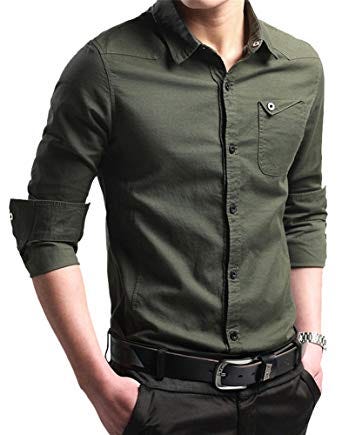
A lot of items of clothing are off-limits when you have — pardon the vulgarity — gigantic tits. Strapless dresses, bathing suits that lack underwire, almost everything that Urban Outfitters sells: all were closed to me from about seventh grade onward. And, for a long time, button-down shirts were on that list too. Each one that I tried just didn’t quite work. Either it was too sheer, or it rode up when I lifted my arms, or (almost universally) it gapped at the bust. It didn’t matter whether I was at the clearance section of Nordstrom Rack, the clearance section of H&M, or a thrift store. Nothing worked.

I was haunted, though, by images of women in perfectly crisp, perfectly fitted button-downs. I obsessed over them. It was the only look I wanted to emulate: wide pants; loafers or mules; earrings made from wire or acetate; and that white whale of a shirt, loosely tucked in, unfussy, and elegant. The outfits that inspired me were masculine, but with subtle nods towards femininity. They were the kind of thing you might wear to sip rose at a sidewalk cafe in Barcelona, or to your job as a ceramics curator at MoMA PS1, or to be Joan Didion. I restarted the hunt.

I had always assumed that women’s shirts would fit me better, but on my mother’s advice — a woman who spent her college years in Dr. Martens before they were cool, wearing men’s clothes fished out of Salvation Army bins — I broadened my search to the men’s section. Immediately I felt a difference. The fabric was thicker and more robust. Even at the same price point, the men’s shirts seemed sturdier and better made than the women’s. But I was wary of the fit. After all, weren’t these designed for a demographic that was generally boobless? How could they possibly accommodate my chest when the shirts that were specifically made for the purpose couldn’t?

Here’s the funny thing, though: when a garment is designed to fit a woman’s body, it is designed to fit exactly one woman’s body, and if that woman isn’t you then you’re shit out of luck. From the size and shape of the cups to the curvature of the hips, a piece of clothing can only conform to one possibility. That was why I either bulged out of or was swallowed by women’s button-downs. Different sizes were just scaled up versions of the exact same proportions.

When I tried on the men’s shirts I could let them consume me and still look cute. All it took to make a men’s large look like it was made for me was tucking it in at the waist. I couldn’t believe it was that easy. I bought four of them.

Shopping in the men’s section may be a tiny act of resistance against an industry that tries its darnedest to convince us that there’s one right way to exist in a female body, but I don’t think it’s meaningless. Of all the lines that fashion draws in the sand — of price, of size, of accessibility in general — gender is perhaps the categorization that can be crossed with the most ease (at least in a purely practical sense). You can’t buy a shirt you can’t afford. You can’t buy a shirt that doesn’t physically fit your body. But you can always head to the other side of the store and try something on that wasn’t made for you, and look amazing in it anyway.


The Life-Changing Magic of Men’s Button Downs was originally published in The Yale Herald on Medium, where people are continuing the conversation by highlighting and responding to this story.

Posted in UncategorizedComments Off on The Life-Changing Magic of Men’s Button Downs

The Herald Volume LXIII, Issue 10

Whaddup kiddos,

Right now we’re in that weird space, about equidistant from both spring break and finals, where the weather is getting tantalizingly warmer yet summer vacation remains agonizingly far off. Some of you might already have your summer plans set in stone, and if that describes you, then I don’t care if you’ll be interning at Goldman Sachs or saving the rainforest in Bolivia: fuck off. Fuck off, on behalf of all us who are still in phone interview limbo, desperately scrambling for backup options with applications that haven’t closed yet.

But as far as cool plans go, it’s tough to beat travel. Being immersed in a new culture, a new language, and a new landscape is one of the most valuable experiences a person can get. So check out our cover story, a poignant, vibrant photo essay on Cuba by Nika Zarazvand, TD ‘20, who traveled there over spring break.

If art’s your thing, get the scoop on the new film Cezanne et Moi from Emma Keyes, PC ’19, or let Fiona Drenttel, TC ’20, fill you in on George Bush’s Portraits of Courage. And speaking of less-than-universally-adored presidents, Peter Rothpletz, SY ’19, takes a look at the intersection between comedy and journalism in the age of Trump.

Whether you’re an artist or a comedian or a politician-to-be, make sure to enjoy the weather a little bit before finals descend upon us with the wrath of a Lovecraftian Old God, mmkay? It was 60 degrees out this afternoon. Others might see it as a bad thing when the temperature’s higher than your calculus grade, but all I see is cause for celebration.

Carpe diem, motherfuckers,

Mariah Kreutter

Reviews Editor

Posted in UncategorizedComments Off on The Herald Volume LXIII, Issue 10

Music: 50 Song Memoir, The Magnetic Fields

(Note—what I’ll be reviewing is not the full two-and-a-half hour album, but the 16-song sample available on Spotify. This is terrible practice for a critic, but I’m a broke college student who already pays for Spotify Premium and I’m certainly not going to pay another $9.99 a month for Apple Music, or drop $35.99 on the 5-disc CD. So partial, prejudiced, and ignorant is what you’re going to get.)

The Magnetic Fields are a weird band. Structurally, compositionally, musically, thematically–nothing about the project has ever been typical. A quasi-orchestral 14-person collective that nonetheless centers around one man (the inimitably sardonic songwriter Stephin Merritt, once called “the most depressed man in rock” by Husker Du’s Bob Mould), the group takes its name from Andre Breton’s surrealist novel Les Champs magnétiques. Their work spans genre from gospel to synth pop. All of their albums are concept albums. The accordion player is Lemony Snicket.

But a band that could easily be lost in its own strangeness—its own carefully cultivated quirk—is saved by a habit of producing art that is genuinely emotionally resonant. 69 Love Songs, the band’s late-nineties magnum opus, is exactly what it sounds like: 69 (!!) hauntingly beautiful songs about love, sometimes mournful, sometimes satirical, ranging from simple acoustic melodies like “Asleep and Dreaming” to buzzy pieces of abstract audio art like “Experimental Music Love”. It’s an album I was raised on by my post-ironic Gen X parents, and these days, it’s the album I always return to when I’m feeling heartbroken.

Now, with 50 Song Memoir, the band has returned to the multi-disc epic after almost two decades of more standard-length releases. Once again, the album is exactly what it sounds like: 50 songs correlating to the 50 years of Merritt’s life, each in some way autobiographical.

It’s a project that could easily veer into the self-indulgent, but doesn’t: the album is as interested in time and place as in personal experience, preventing any sense of myopia. Many of the songs explicitly reference the music of the period, such as “‘81: How to Play the Synthesizer,” which unsurprisingly employs a lot of synthesizer in a matter-of-fact new wave track full of nihilist instructions like “Modulate the pulse width / nobody will care.” More somberly, the AIDS crisis looms large in the background of songs like “92: Weird Diseases,” which lists all the diseases Merritt (who is gay) has experienced, AIDS significantly absent and hauntingly spectral.

The album hits the tongue-in-cheek bleak tone the Magnetic Fields do so well, with no shortage of wry, dark humor. In “‘68: A Cat Called Dionysus,” Merritt mournfully recounts his unrequited love for a childhood pet who “hated me / cause I loved him” over a jangly, layered melody. “‘74: No” is gospel as sung by an atheist, using the choral backing and strummy guitar of the genre to support lyrics like “Is there a man in heaven looking out for you? / Is there a place dead loved ones go? / Is there a source of wisdom that will see you through? / Will there be peace in our time? / No.” The irony of the absurd cynicism comes when you realize that, in 1974, Merritt was nine years old.

“‘13: Big Enough for Both of Us” shows that love ballads and dick jokes aren’t necessarily incompatible: the song contains smirk-worthy lines like “First time I saw you, I could feel a stir / Down in my special body part / I would like you to take it in your hand / But please be careful, it’s my heart,” but the somber minor-key melody and resignation in Merritt’s gravelly bass voice can just as easily sell line such as “Maybe you’d learn to like just being loved / Even learn to love me in some way.” It’s the only conventional love song out of the 16 I sampled, perhaps understandably for an artist that might very well be love-songed out. There are, however, numerous odes to locations which are no less tender—”’01: Have You Seen It in the Snow” is the love song to New York City that anyone who’s lived there wants to write, while “02: Be True to Your Bar” honors the sacred yet underappreciated relationship between an artist and the places they work.

Ultimately, 50 Song Memoir is all the better for focusing on the small moments found in everyday life rather than quote-unquote “milestones.” It feels reflective without being inaccessible; it also represents a new direction for a songwriter who revels in the literary. Merritt’s earlier work features narrative in spades, but always driven by invented characters—few of his songs have been personal, until now. The album is compositionally experimental as well, full of complex layers of harmony and cacophony. One can almost picture the garage full of instruments that must’ve been used to achieve the album’s sound: perhaps a banjo leans precariously against an autoharp, while an accordion tumbles from the top of a pile of synthesizers. Overall, it’s heartening that the Magnetic Fields are still experimenting and pushing their sound to new places, even after more than a quarter-century of making music.

So does 50 Song Memoir dethrone 69 Love Songs as the definitive Magnetic Fields album? From what I’ve heard, no. None of the songs I sampled quite reached the perfect, emotive, effortless heights of the best offerings from the latter. But I freely admit that this might be a function of my excessive familiarity with and affection for Love Songs, while I’ve yet to settle into Memoir. We’ll see which songs I keep returning to, and which ones grow on me–an album as sprawling and ambitious as this one takes some time to get to know. Regardless, 50 Song Memoir is a triumph, the kind of release that it’s hard to imagine any other band attempting, much less succeeding at. It’s the best album the Magnetic Fields have released in this millennium, and whether you’re a die-hard fan or a curious newbie, it’s absolutely worth a listen.

Posted in UncategorizedComments Off on Music: 50 Song Memoir, The Magnetic Fields

Insecure is a fresh, timely voice

Insecure has certainly captured the anxiety of the times, no less in content than in title. Although the show is a comedy, co-creator and star Issa Rae deals in a thoughtful and intelligent brand of humor, deriving her best material from truth. Together, the first eight episodes are an unflinching deconstruction of the pressures faced by today’s African American young adults, as portrayed by main characters Issa (Issa Rae) and Molly (Yvonne Orji). The two close friends are courageous and touchingly vulnerable by turns as they struggle to find security in the next, more mature stage of their lives.

Released on HBO in October of 2016, the first season has already met with a great deal of commercial success, developing a devoted audience base and scoring a 100% on Rotten Tomatoes. This acclaim is hardly surprising: across all metrics, Insecure is seductively modern, beginning with its cast of young, emotive, highly relatable characters. Rae has taken pains to present Issa and her friends as universally sympathetic and widely expressive, eschewing the notion that a comedic actor must exaggerate a narrow set of characteristics to tickle the audience’s funny bone. Instead, the co-creator is proud to present a measure of “authenticity and… a regular voice”, along with “regular human emotions”, as she stated in an interview with E! Online on Dec. 12, 2016. Nowhere is this more evident than in her stunning portrayal of Issa, a young woman who is frustrated yet ambitious, kind yet selfish, and equal parts sensible and childlike—in a word, human. Yet even as the show maintains a real emotional weight, Rae satisfies the viewer’s appetite for humor through the wit of her dialogue and the genius of her timing.

Just as Insecure manages a kind of universal, human appeal, it also offers a nuanced portrayal of African American identity. Here as well, the first season is gratifyingly modern; one often gets the sense that it was intended less as a description of 2016 than as a prescription for it, a blueprint for a more honest, more thoughtful mode of thinking about today’s social climate.  The central discussion advanced by the media has largely surrounded the idea that Insecure is a show about race. However, if we look to the vision of its creators, the sentiments driving this claim seem to be largely outdated. Instead, racial identity is continually acknowledged throughout season one as one of many intersecting identities that inform the characters’ experiences, in work, in friendship, and in love.

Defined by contemporary writing and enhanced by contemporary aesthetics–including an original soundtrack scored by Raphael Saadiq—Insecure has something to offer to anyone who delights in the inherent ridiculousness of our modern world.

Posted in UncategorizedComments Off on Insecure is a fresh, timely voice

Silence is a quiet triumph

When people think Martin Scorsese, they think Raging Bull, Goodfellas, and of course the city of New York.. However, Silence—the acclaimed auteur’s latest film, out now—is quite different from these past classics. Based on the 1966 novel of the same name by Shusaku Endu, the film follows a pair of 17th century priests as they set out to find their mentor and compatriot, Father Ferreira (Liam Neeson), who is said to have denounced Christianity while proselytizing in Japan. Advertised primarily as an adventure, Silence in fact focuses on the inner struggles and discoveries of the fathers Ferreira, Garupe (Adam Driver), and Rodrigues (Andrew Garfield), as their faith is alternately strengthened and battered by their time in Japan.

While much of the film’s drama flows from the heads and hearts of its characters, there is nevertheless a grandeur to Silence that will captivate the audience. From the bird’s eye view of Garupe, Rodrigues, and Father Valignano (Ciarán Hinds) descending the stairs at St. Paul’s College in Macau to upward-looking shots of Japan’s looming mountains, man is made small by the film’s expansive and imposing world. This visual openness also strikingly contrasts with the confinement, both physical and spiritual, that the priests eventually face.

Religion plays a central role in Silence, and I found myself wondering whether I considered it to be a “religious” film. Could similar messages have been conveyed in a film where conflict was not driven by the opposition of two organized faiths? Ultimately, while the specific historical basis of the story (including the Tokugawa shogunate’s vehement condemnation of Catholicism) are fundamental to Silence, it is a more general kind of faith–believing in something–that lies at the heart of the film. And Silence, ironically enough, has much to say about this topic. In particular, the film explores the notion that while true believers must endure God’s silence, sometimes their best response is a silence of their own.

In any case, Silence exhibits some truly beautiful moments. That Garfield’s Rodrigues is striving to spread Western religion into the villages of Japan at times becomes secondary to the fact that he brings the universal, human element of hope to a group of people that has been oppressed for many years. Several supporting characters are noteworthy as well, such as Kijichiro (Yosuke Kubozuka), the enigmatic Japanese Christian who brings the priests from China to his homeland. Prone to shunning his faith in public, yet always adamant about confessing his sins, Kijichiro provides a complex foil to Father Rodrigues’ unshakable believer.

This is a movie for everyone, regardless of faith. It tells a story pertaining to what makes us human, and how we should treat each other; for these reasons, Silence is well worth seeing.    

Posted in UncategorizedComments Off on Silence is a quiet triumph