Author Archives | Kenneth Marino

Few arrested for alcohol, marijuana

Alcohol_online_edit

If you drink alcohol under age or smoke marijuana in your room at Tech, you are unlikely to be arrested, according to our analysis of the Georgia Tech Police Department (GTPD) crime logs from the beginning of the fall semester until the end of March.

Of the 67 cases related to alcohol (not related to driving), two were arrested, only one of whom was a student. This case also involved criminal trespass. Of the 25 marijuana-related cases, 13 involved an arrest. Of these, only one was related to students for possession and unrelated to a vehicle. In this case, the students were found on a roof and fled when GTPD arrived on the scene.

In one of the reports, GTPD case number 15010146, the involved student was not afraid of getting caught.

“[The student] stated he heard from friends that Georgia Tech Police, unlike other colleges, don’t make arrests for marijuana. [He] stated this is why he kept and smoked marijuana on campus. [He] had heard from friends that the punishment would be a small fine. I advised [the student] that even though I wanted to arrest him for the violation, he would be issued a Student Code of Conduct that would be dealt with internally and criminal prosecution would be declined.”

According to Chief Robert Connolly with GTPD, in minor possession cases of marijuana (less than one ounce), they would not arrest students, but instead issue them a Student Code of Conduct and send them to the judicial process.

“If it’s just a minor possession case, where the city would only let us write a ticket, they won’t go to jail anyway,” Connolly said. “Now we feel that we have more effective means within the student affairs and Housing to handle them internally.”

Connolly stated that a similar policy is in place for underage possession of alcohol.

“Our education program, we feel, is more effective even than sending you down to the city which will only get a diversion case anyway,” Connolly said.

According to John Stein, Interim Vice President for Student Affairs and Dean of Students, most first-time offenders for alcohol and marijuana get either probation or a warning.

“If a student goes to the hospital with potential alcohol poisoning, it starts usually at the probation level, because it’s not just the underage drinking … it’s also life-threatening, endangering behavior, which is the actual code violation,” Stein said. “They place themselves potentially in a situation where they threaten their own life by what they did. Anything less than that would probably go with a warning to begin with.”

If a student is a repeat offender, the charges may get more serious, possibly including suspension.

“When a student is involved in something and they get caught, I would say most students, their biggest fear … is that they’re going to get arrested or they’re going to get suspended. Anything that falls short of that almost translates to nothing really happened. That doesn’t mean nothing happened, they’re still held responsible.”

One major goal of taking students through the school’s process is what Stein calls the “care component.” Students have to take a drug or alcohol diversion course and see a counselor to see what help the student might need.

Posted in UncategorizedComments Off on Few arrested for alcohol, marijuana

Students weigh in on Student Affairs overhaul

flagbuilding_Online_Edit

The Division of Student Affairs kicked off its “visioning process” on Tuesday with a series of student focus groups to see what the campus thought about Student Affairs and to look for any potential gaps.

“First of all, it was, when you say the words Division of Student Affairs … a lot of students don’t really know what that is,” said John Stein, Dean of Students and Interim Vice President of Student Affairs.

In all, 34 students and nine faculty participated in the focus groups, answering questions such as ‘what is student affairs to you?’ and ‘what gaps do you see in services to students?’

“I think that really is what we’re really trying to access with students — what student believe,” Stein said. “One always wants to believe that we’re doing the very best to meet students’ needs, but you always want to test that sometimes to see what students give back to you, and that’s what we’re trying to do now is test that question to see what else students need from us.”

The goal of the visioning process is to examine how the division is performing and make changes to improve. After former Vice President William Schafer left Tech for a position at the University of West Virginia, Student affairs thought it would be good to re-evaluate before a new Vice President was named.

“[This would say to the new Vice President that] time was just spent really looking at this in light of a pivotal moment where a VP who has been in the position 11 years steps away,” Stein said. “It’s a great time to just re-evaluate, reassess and figure some things out before someone new comes on board.”

According to Stein, Student Affairs would like to have a report before a new Vice President is hired.

“The President, Dr. Peterson, has agreed that we want to go through this visioning process,” Stein said. “Our hope is that this would wrap up at some point in June and then a set of recommendations would come out of this that he would consider and then make the decision from there as to the next steps.”

Stein sees the focus groups as a way of helping resolve students’ questions about Student Affairs and to try to find areas of improvement.

“And so I think that what we’re trying to see is what do students know about the Division of Student Affairs,” Stein said. “What do they see as our mission and our daily work in relation to them? Where are the gaps? And then, what can we do to improve this division in relation to students and the Institute?”

One subject which came up a lot in the focus groups, and throughout the year was mental health and the resources available for it. In August, the Counseling Center filled four vacant positions and hired two additional counselors. Since then it has hired an additional counselor and plans to hire two more for next semester.

Posted in UncategorizedComments Off on Students weigh in on Student Affairs overhaul

Fighting against secret SGA funding formulas

Kenny_Online_Edit

In the past weeks and months, members of Student Government Association (SGA) have been developing a new way to calculate the stipends for Tier II organizations including SGA, the Student Center Programs Council (SCPC) and Student Publications, including the Technique. The bill, 15J173, as currently written calculates the money an organization receives for student stipends based on an “Organization Impact Score.” The problem is, as currently envisioned by some members of SGA, the formula is determined entirely by the Joint Finance Committee (JFC) and, more frighteningly, kept entirely in secret.

The idea of an unelected committee (students do not vote on the membership, although many are also elected representatives) deciding how much funding some students should get over others without anyone else knowing how they arrived at that judgement is so opaque and undemocratic that it is almost inconceivable that it was ever seriously considered, much less proposed.

The idea behind stipends is that students in high-impact, high-workload positions should receive some compensation for their work, considering that they could likely make more money working the same hours somewhere else. I myself turned down a TA position to spend my time at the Technique. Previously, JFC had in its policy the positions which received stipends and what percentage of in-state tuition and fees you would receive.

Under the new policy, each organization would get some percentage of the total money for stipends based on the impact score which the organization could distribute how it wished among its members. The impact score is calculated by a formula. The idea of the formula is that it would be an “objective” measure of the impact the organization has on students. The Technique, for instance, would be judged by the number of papers people pick up and number of website clicks. SCPC would be judged by the number of students attending its events.

How much are these inputs to the formula weighted? How does one person picking up the Technique compare to someone going to an SCPC event? If some within in SGA had their way, we would have absolutely no idea.

This is an issue of democratic accountability. If student organizations and elected SGA representatives don’t know how funding amounts are determined, how is anyone supposed to argue that one organization deserves more or less for the work they do? The weighting of these inputs is inherently a subjective judgement and making this judgement secret and therefore virtually unaccountable makes a mockery of the idea of student representation.

One argument for keeping the formula secret is that student organizations would fudge their numbers to receive more money. My first reaction is that some people in SGA must have a low opinion of their fellow students if they think people would do this. More importantly, since SGA is asking organizations for these numbers, organizations would still be able to fudge these numbers. This policy would not even solve the problem it is purported to solve.

I am told that many in SGA share my concerns about this policy of secrecy and I hope they are steadfast in their opposition to the bill as written. I encourage everyone in SGA, and especially UHR and GSS, our elected representatives, to fight against this illogical move and refuse to pass any bill which does not explicitly make the formulas public and therefore open to public debate.

I know that SGA is not exactly like government, but it is supposed to be a way for students to be fairly and democratically represented. Making an important part of their decisions a secret threatens this very idea and must be prevented or SGA risks alienating students who feel that SGA does not care about them and only cares for itself.

Posted in UncategorizedComments Off on Fighting against secret SGA funding formulas

Creating a sustainable Student Center

Greenovation - online

On Saturday, the Student Government Association (SGA) Sustainability Committee hosted Greenovation, a case competition to promote sustainability in campus construction. The competition asked the seven teams to look at how the Student Center could be improved for sustainability.

“We were thinking, ‘why don’t students have more say in how our campus looks’ and we threw around a lot of ideas and eventually … we thought, ‘what if we could renovate campus buildings more sustainably?’” said Namrata Kolla, SGA Sustainability Committee Co-Chair. “So then the next step was thinking what buildings were up for renovation so that whatever idea comes out of this is actually used and implemented. And when we went to talk to Capital Planning and we talked to a few different stakeholders around campus and the Student Center kept coming up and we found out there is a Student Center Expansion Committee and we thought, ‘oh this is perfect.’”

According to Kate Curnow, Communications and Marketing Manager for the Student Center, the Student Center Expansion Committee will use the ideas that came from the competition.

“Obviously campus starting to take a very heavy look at sustainability and how important that is, and we were just thrilled the Student Center was going to be their first case since we are at that prime time of data gathering that we’re doing right now,” Curnow said. “This is exactly the kind of information we’re looking for.”

The first place winners, Engineers for a Sustainable World Hydroponics Team, gave a presentation pitching for plants to be grown hydroponically in a renovated student center. The team received a check for $1,000 for their accomplishment.

“Our main goal in Hydroponics is to promote hydroponics on campus, and we thought that this [competition] would help us achieve our goal,” Jamie Curtis first year MSE and member of the Hydroponics Team.

Other members of the team included Jeffrey Landau, fifth year ME, Nicole Kennard, second year MSE, Bianca Costa, first year EnvE.

The runner-up team Northern Lights which, among other things, proposed moving all dining to the second floor of the Student Center and adding a online ordering and pickup option for food.

“We’re glad that we were able to showcase some of the different needs of the student body in a quick 10 minute presentation that was actually heard by a lot of the important, and decision-making faculty and staff of Georgia Tech,” said Ishaan Patel, 1st year BA and member of Northern Lights. “I think it was a great idea to host an event that actually had such a big impact on the community.”

According to Curnow and other judges, who spoke during the awards ceremony, the Student Center Expansion Committee plans to consider some of the best ideas for the expansion such as a thrift shop or swap meet and the integration of hydroponics.

Posted in UncategorizedComments Off on Creating a sustainable Student Center

Tech to create partnership with Uber

Photo courtesy of Uber

Tech is negotiating with Uber to establish a partnership between Tech and the taxi and ridesharing company.

The agreement would allow Tech students to use a special student interface on the Uber app, establish lines of communication between Tech and Uber as well as provide a number of deals and promotions for participants in the program.

“We’re going to be the first university in the country to partner with Uber in this way,” said Justin Eisenberg, Vice President of Campus Organizations.

One of the main benefits would be the creation of a new interface that would give students access to a network of participating drivers who have a rating of at least 4.7 out of 5, along with a number of “native language” features.

“Right now if you type in “CULC”, it [the app] doesn’t know what the CULC is. It doesn’t know that when you say “CULC” you probably want to be picked up at the CULC turnaround…” Eisenberg said. “We’re going to try to incorporate some of that in there so students are getting a more seamless experience.”

Another part of the program is training the participating drivers with Tech-specific information.

“One of the main reasons [for the program] is safety …,  really making sure that the drivers who are allowed to purchase space in the program are educated … about things to be aware of, like what parts of campus or near campus are sketchier than others to where you wouldn’t expect the student to wait on the curb for you,” Eisenberg said.

SGA will also coordinate with Uber so that participating drivers will know about events likely to have many Tech students. Drivers in the GT program will be contacted so that more will be in the area to pick up students. Because prices are better when there are more available drivers, this would likely reduce the cost to students.

“It will actually reduce surge pricing,” Eisenberg said.

An early draft of the contract between Tech and Uber also details the obligations that Tech would have under the deal. In this draft of the still unsigned contract, Tech would have to market the partnership by sending an email to students once a semester, posting about it once a month on all of Tech’s social media accounts, sending push notifications on Tech-controlled apps and placing ads in the freshman welcome packets. The draft also required that Uber be able to participate in “Lots of Ramblin’ Wrecks.” Tech was unable to determine what this meant and is still in negotiations to work out this and other issues.

Additionally, the contract called for dedicated pickup and dropoff locations on campus for Uber services. Signs indicating the pickup location will be placed so that students will know where to wait.

Other benefits to Tech in the draft include 50 $25 ride vouchers to be used by the Dean of Students Office for emergency transportation for students.

Posted in UncategorizedComments Off on Tech to create partnership with Uber

White House talks restraining tuition increases

Photo by John Nakano

Although the main focus of many of the initiatives announced two weeks ago at President Obama’s speech at Tech was on loan repayments and making that process cheaper and easier, a big part of the problem in the cost of higher education has been the price of tuition itself.

According to the Obama administration, this is another area that the White House is working on.

“We’re working hard, we’ll keep working hard to help on the front end to keep higher education accessible and affordable,” said Secretary of Education Arne Duncan during a conference call with student journalists.

According to the College Board, the average tuition and fees for four-year public institutions is $9,139, a 17 percent increase in the last five years. Private four-year tuition and fees is $42,419 with a 9 percent increase over the last five years.

According to Duncan, a major reason that public school tuition has gone up in recent years is that states are cutting back on their support of higher education.

“Many states cut funding to higher ed when the economy got tough. Universities need to do a better job keeping down costs, but I would say budgets aren’t just numbers, they reflect values,” Duncan said.

According to Duncan, part of the solution to this is voting.

“If enough young people vote, this becomes a priority,” Duncan said. “If you don’t vote this becomes an easy thing or an easier thing in tough budget times for a Governor to cut.”

One thing that the Obama administration has proposed as part of the solution of rising tuition is making community college free for students.

“The President started in the State of the Union with a free community college proposal and we need Congress to partner with us on that but that on the front end could help reduce the cost of college by 30, 40, 50 percent if that were to become law,” Duncan said. “The goal is here not just to reduce the burden of debt, but to reduce the cost of college and that would be a huge step in the right direction.

Another proposal was the College Scorecard, which would mandate that college report their costs, the salaries and job prospects of graduated students and graduation number.

“I think that another incentive is simple transparency and visibility, you probably have taken a look at our college scorecard that allows prospective students to know what the average price is of colleges and universities that they may be interested in apply to, and we think that transparency plus a little healthy competition is going to influence all sectors of higher education,” Duncan said.

Obama’s record on higher education has not had unanimous support. Senator David Perdue (R-Ga.), himself a graduate of Tech, in a press released criticised the President’s approach to rising tuition.

“It’s ironic that President Obama continues to say that something must be done about higher education,” Perdue said. “On his watch, college costs have skyrocketed. We can all agree that college should be more accessible, and we cannot continue to burden our children with more debt, but President Obama’s strategy won’t work.”

Despite the President’s push for his community college plan, the Republican-majority Congress has not taken up the proposal and appears unlikely to do so anytime soon.

According to Obama, there does not exist just one single solution to the problem of higher tuition and student loan debt.

“So we’re continuing to just chip away at this problem; there’s no silver bullet,” Obama said during the conference call. “We’re going to have to do things at the federal level, the state level, at the university level to really mobilize the entire country around this issue of college affordability.”

Posted in UncategorizedComments Off on White House talks restraining tuition increases

Obama announces higher ed reforms at Tech

Photo by Brenda Lin

On Tuesday, more than 9,500 Tech students, faculty and staff, as well as dignitaries from around the state, gathered at McCamish Pavilion to hear President Obama give an address on college affordability.

“Higher education has never been more important, but it’s also never been more expensive,” Obama said in the speech.

Introducing the president at the event was third-year AE Tiffany Davis who wrote to him last October about her personal experience with college affordability.

“I just felt like it was really inspiring seeing someone at that level talking about issues that I face daily, and issues that my children could face, and really being on my side,” Davis said after the event.

According to the White House, Tech’s innovation in higher education was a factor in the selection of Tech as the backdrop for the speech.

“We’re encouraging colleges to innovate around bringing down costs and helping students learn more. …” said James Kvaal, Deputy Director of the Domestic Policy Council in a conference call with student journalists. “And Georgia Tech is a good example of that. One of the reasons the president went [to Tech] is they have a Masters program in Computer Science that is completely online and covers the same material as the in-person Masters degree but has a tuition of only one-third the cost.”

The Online Master of Science in Computer Science degree, launched last Spring, was the first degree program from an accredited university that operates entirely online.

In a separate conversation, the White House emphasized that new innovations in higher education were an important part of Obama’s effort to lower the cost of tuition.

“The president agrees that we need to work with colleges to bring down tuition costs while helping students learn more,” Kvaal said. “There are promising approaches, some of which use cutting-edge technology like Georgia Tech, and others that are more common-sense like letting credits transfer from community colleges to four-year universities.”

At the speech, Obama outlined new actions that the Department of Education will take to help those repaying student loans.

“We’re going to require that the businesses that service your loans provide clear information about how much you owe, what your options are for repaying it, and if you’re falling behind, help you get back in good standing with reasonable fees on a reasonable timeline,” Obama said.

In addition, the president spoke about streamlining the complaint process and customer service for student loan borrowers as well as requiring lenders to pay off higher interest loans first. The White House also announced a number of other actions including creating a central point of access for account and payment processing information, ensuring that Social Security Disability payments are not garnished for loan repayment and releasing state-by-state information about student loans.

“We’re trying to tackle this problem from every angle,” Obama said. “There’s no silver bullet.”

Obama also encouraged students and national leaders to sign the “Student Aid Bill of Rights,” which the president announced and signed earlier that day. The first article states that “every student deserves access to a quality, affordable education at a college that’s cutting costs and increasing learning.”

Despite its reputation as a primarily tech-focused school, thousands of students gathered for the speech and stood in line, sometimes for up to three hours, to get tickets to the event.

“I thought the event was incredible and just seeing the entire Georgia Tech community show up in such a big way was really inspiring,” said Dillon Roseen, Undergraduate Student Body President. “And the president’s remarks were spot on, I think they connected with a lot of people in the audience.”

The speech ran approximately 26 minutes long and included shout-outs to such Tech traditions as the Ramblin’ Wreck and George P. Burdell.

Posted in UncategorizedComments Off on Obama announces higher ed reforms at Tech

GTPD, ASSU hold open forum

Model Release-Not Needed

Last week, the Georgia Tech Police Department (GTPD) held a forum in conjunction with the African American Student Union (AASU) to gauge student feedback regarding policing.

The event was primarily led by police chief Rob Connolly, who introduced the other GTPD personnel present. Among them were Officer Brian Bonus, Sergeant Archie Hill, Executive Assistant Elaine Kuligowski, Sergeant Troy Walcott and Captain Randy Barrone. Issues given special attention were the profiling of black males on campus, the vagueness of the Clery Act system, published campus crime statistics and potential concerns regarding interactions with GTPD officers.

The attendees of the event, which were mainly AASU members and affiliates, were asked to pose questions or provide commentary on the GTPD’s work.

“One Clery Act was just three black males with no description,” said a student. “As a black male, that could be me. Most of the time, the only relief I get when I see a Clery Act as far as knowing that I’m not a suspect is knowing the guy is 5’10” and I’m six feet.”

Several of the questions posited during the evening were in reference to the Clery Act system, which the GTPD employs to provide warning of criminal activity. Barrone spoke regarding the process by which the alerts are formulated and distributed to the Tech community.

“The Clery Act is a federal law, it’s enforced by the Department of Education, and all colleges and universities which participate in financial aid programs, they’re required to report crime information to the campus,” he explained. “One of the things that has to happen is called a timely warning, and we don’t have much time to put those out.”

Barrone further discussed how this can be frustrating to GTPD officers, as they are often stuck with only gender and race descriptors of the suspect. He stated that the traumatic nature of most person-on-person crimes, such as robberies, can make it difficult for victims to remember much information regarding the incident before the Clery timely warning must be issued. It was also clarified by Connolly that the Clery Act does not apply when an arrest has already been made.

The other big issue tackled during the evening was profiling of black males on campus by officers.

“I remember my sophomore year, I had a student from high school come visit,” said another student present at the forum. “He was with Destination: Tech, so I basically hosted a student. It was the last day of Destination: Tech, and I was walking him to his car. We were in front of Brittain Dining Hall when two officers pulled up and stopped us. I showed them my BuzzCard and asked them why they stopped us.”

He went on to state that the officers explained that they had received a call in reference to two suspicious individuals, but no other description, such as clothing, was used in the identification process. However, as they were walking away, the visiting student noticed that one of the officers had taken out his phone and used it to take a picture of them. They confronted the two GTPD officers but they avoided questions regarding any picture, and never deleted it. Connolly emphasized that during incidents like this and similar, students may file official complaints online, and that, if deemed necessary, disciplinary action would quickly be taken.

Posted in UncategorizedComments Off on GTPD, ASSU hold open forum

Clough to return to campus

Photo by Ariel Bravy

Former Tech President and former Secretary of the Smithsonian Institution Dr. G. Wayne Clough will speak at the Spring 2015 commencement and receive an honorary Ph.D. from the Institute.

Clough will give the commencement address for the graduate ceremony while the speakers for the two undergraduate commencement ceremonies will be Arne Duncan, Secretary of Education and General Philip M. Breedlove, Commander, U.S. European Command, NATO Supreme Allied Commander and Tech alumnus.

Clough is among a group of less than 30 people to receive an honorary degree from the Institute. Tech does not automatically confer honorary degrees upon commencement speakers; only when the Institute feels that the speaker has made an important impact.

“They’re not common, we try not to give them out all the time, but it’s for people who have made significant contributions either to Georgia Tech in particular or to higher education or the human condition,” said Lynn Durham, Assistant Vice President and Chief of Staff to the President.

Clough, the only Tech alumnus to become President of the Institute, began his tenure as Tech President in 1994 and left in 2008 to lead the Smithsonian. During his time at Tech, many areas of campus were created and rebuilt.

“The physical look of campus totally changed while he was here,” Durham said. “The whole Bio quad is him and Tech Square is him. His presence, he brought both of those and completely changed the face of this campus. So when students walk around this campus, what they’re seeing wasn’t here prior to Wayne Clough.”

The process of conferring an honorary degree and choosing commencement speakers begins with a campus committee that makes recommendations to the President.

“There’s a campus committee that meets and they make recommendations to the President for honorary doctorates and for commencement speakers. And so they meet, they talk about that, decide what they’d like to do and the President decides yes or no,” Durham said. “Obviously when [President Peterson] got the recommendation for Wayne Clough [the answer was] ‘absolutely, we’d be happy to do that.’”

After the President approves the honorary degree, it is submitted to the Georgia Board of Regents for final approval. Clough’s degree was considered and approved by the Board at their monthly meeting Feb. 11.

Clough retired as Secretary of the Smithsonian in October of last year. According to Durham, Clough plans to move back to Atlanta and spend his “semi-retirement” back at Tech.

“He’s coming back to campus in a working capacity, and it’s a little unsure exactly what he’s going to be doing, but he always told me when he went to the Smithsonian that he loved the Smithsonian, but what he missed was the students and the energy the students bring and being on a campus,” Durham said.

Clough graduated with a Bachelor’s Degree in Civil Engineering from Tech in 1964. He then went on to get a Master’s and Ph.D degree from the University of California, Berkely, also in Civil Engineering. According to Durham, when Clough returns, his office will be in the Mason building.

Posted in UncategorizedComments Off on Clough to return to campus

Campus gathers to discuss mental health

Photo by Brenda Lin

A conversation began at Tech this week about mental health and suicide prevention after the tragic death of a Tech undergraduate student last Monday.

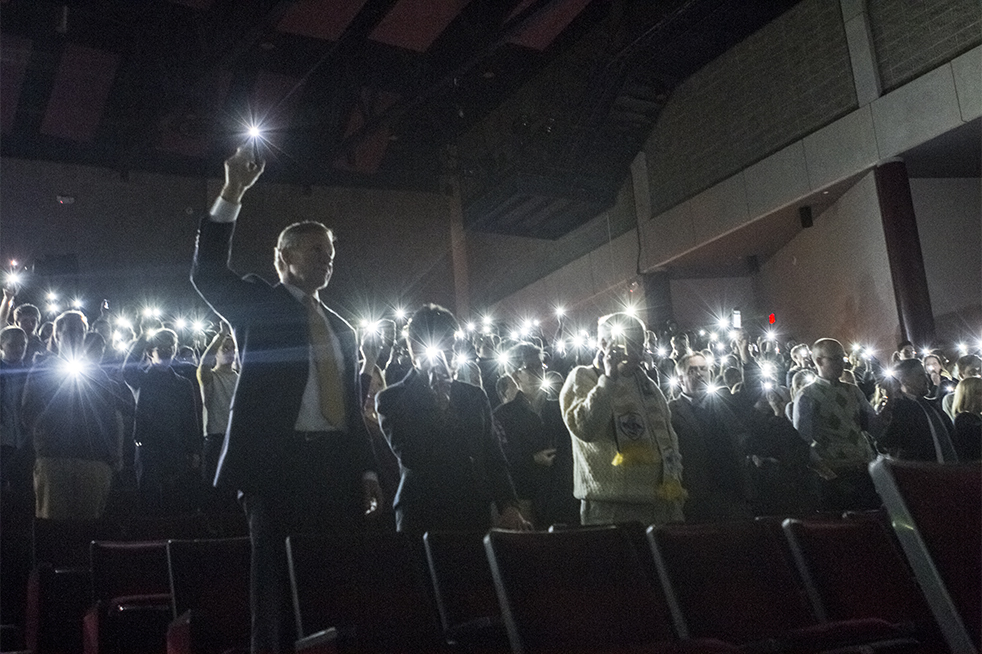
The Tech community gathered on Tuesday for a candelight vigil in the Ferst Center. Because the venue was changed to be indoors, students, faculty and staff used their cellphones as makeshift candles.

At the Mental Health Town Hall held Tuesday after the vigil, Dean of Students and Interim Vice President of Student Affairs John Stein discussed suicides at Tech. There is, on average about one suicide at Tech every year. According to Stein typically these occur off campus which is why they are less visible to the public.

One of the most frequent complaints, both on social media and at the town hall was the wait time for the counseling center. In a resolution still under revision, the Student Government Association (SGA) stated that the “capacity at the Counseling Center and Stamps Psychiatry cannot accommodate [the] demand, resulting in wait times that are too long for students who may be a danger to themselves.” This sentiment was shared by several students at the town hall.

According to Dr. Lacy Currie, a Counselor and Suicide Prevention and Crisis Response Coordinator, the typical wait time between a student first walking into the counseling center and having their first meeting with a counselor is between two days and two weeks depending on how busy the center is. Both Currie and Stein emphasized, however, that students who were in crisis would be seen immediately by the counseling center.

“I don’t want you to leave this meeting thinking students in crisis that we know about don’t get immediate help,” Stein said at the town hall. “They do.”

Another problem was the time between the first and the second meeting.

“We’ve talked with [Dean] Stein, and he’s looking at the staffing and the wait times,” said President G.P. “Bud” Peterson. “It looks like … there’s not a big issue with the initial visit, but the time from the initial visit to the second visit looks like it’s longer than it should be, so he’s reviewing that and evaluating that.”

According to Currie, the Counseling Center this year filled four vacant counselor positions and added two additional positions. In addition, according to Peterson, two more positions will be created in the Counseling Center to bring Tech to the national collegiate average student-to-counselor ratio.

According to Currie, a major problem that campus psychologists face is that many college students who commit suicide do not seek help.

“What we know [from] national statistics … generally speaking, only 20% of clients who die by suicide on college campuses ever come into [a] counseling center,” Currie said. “So what that says is 80 percent of the students who die by suicide on college campuses never come into [a counseling center].”

According to Currie, one of the Counseling Center’s big initiatives is training more people in their “QPR” training.

“It’s Question, Persuade Refer,” Currie said. “And as I said, it was created by a psychologist and it’s a nationally used program and what it is designed to do is to teach people how to recognize the warning signs.”

Another problem discussed at the town hall was academic stress faced by Tech students.

“One of the things we know that’s unique to Georgia Tech as compared to other [universities] is that the academic stress here at Georgia Tech is somewhat higher than in general, which is in some ways not surprising,” said Dr. Ruperto Perez, Director of the Counseling Center at the town hall.

The draft SGA resolution specifically mentions this point saying that “the administration, especially the Office of the Provost, must recognize that core cause of stress is not strictly due to academic rigor but is also a result of an imbalance in the power dynamic between students and faculty that allows faculty to take advantage of the current grievance system.”

At the end of the town hall, an anonymous question was read by Undergraduate House of Representatives (UHR) Speaker of the House Andrew Block which asked whether the administration should be more transparent about the mental health problem by releasing statistics on the number of suicides by Tech Students.

Stein responded by sharing the statistics from the last seven years and emphasizing that Tech had to be very careful when sharing that kind of information.

“It’s not that we’re hiding them, we don’t publish the numbers, but we don’t hide the numbers either,” Stein said.

Another question brought up was the medical withdrawal process that some universities such as MIT have for students facing acute mental health problems. According to Stein, the University System of Georgia does not have a medical withdrawal process. Students can withdraw for medical reasons, but to leave after drop day, a student must petition the Undergraduate Curriculum Committee.

Campus culture towards mental illness was also brought up. Some were discouraged by how often students undermine each other in terms of “Tech culture,” by for example bragging about how little sleep they got. Peterson, however, was optimistic.

“One of the things that impresses me about Georgia Tech is that students have undertaken this initiative, [such as] the videos with the Wreckless Club,” Peterson said. “The proactive approach that they’ve taken is really helpful, the idea that students need to take care of each other.”

After meeting with organizations around campus to get their input, SGA will vote on the mental health resolution.

Posted in UncategorizedComments Off on Campus gathers to discuss mental health