Author Archives | Jules Joseph, Staff Writer

Descendants of SLU’s formerly enslaved petition administration to demand accountability

The Descendents of the St. Louis University Enslaved called upon the university in a recent petition to carry out promised commitments and “reengage in good faith” with the descendents. 


The petition came about after a DSLUE liaison allegedly recanted certain promises previously made on behalf of the university, which included a memorial and other initiatives to formally recognize the enslaved individuals. DSLUE also alleges a lack of transparency on behalf of the university, which has caused the reconciliation process to extend over seven years. 


Robin Proudie, a decorated U.S. Navy veteran, SLU junior in the School for Professional Studies and the founder and executive director of DSLUE, said these acts of acknowledgement and respect for individuals who were enslaved by the university are important. 


“Our ancestors belong outside of the darkness and [to be] brought into the light,” Proudie said. 


Between 1823 and 1865, Saint Louis University and other surrounding Jesuit-affiliated institutions trafficked and enslaved over 200 individuals, according to research conducted by the Slavery, History, Memory and Reconciliation project in 20219. 


Previously, DSLUE had collaborated with a designated board of university administration over several meetings to create a 10-point plan of acknowledgement and reconciliation. This plan included a specific framework for a formal apology, the establishment of a permanent monument on campus and some form of economic reparations for the descendants of the enslaved. 


Last March, DSLUE withdrew their participation in the university’s scheduled public apology after certain details of the event were changed last minute without DSLUE’s knowledge, according to Proudie. 


In response, the university agreed to “continue the work of building relationships with descendants” according to a university-wide email from former president Fred Postello. 


President P0stello personally donated a statue, but Proudie was assured by SLU’s administration that “this statue [was] not the university’s commitment to establishing a permanent monument memorial on the campus” and that the university would further the work of reparations with the descendants over the summer of 2025. 


Proudie then said that the summer “came and went” without sufficient continuation of reparation efforts, even though President Postello “affirmed that this is what [the university is] going to do” before leaving. 


Now, DSLUE demands that “healing, belonging, and economic repair” must become a strategic priority for the upcoming year, according to their petition.  


SLU student Zack Diebold, a senior in the School of Science and Engineering, said that he signed DSLUE’s petition as there had become “a clear disconnect between SLU’s rhetoric and its actions, which has become impossible to ignore.” 


“When we choose to attend SLU and invest our tuition here, we are buying into the Oath of Inclusion and the mission to be ‘men and women for others.’ It is disheartening when the university fails to lead by example,” Diebold said. 


“They pulled themselves up by my ancestors’ boot straps,” Proudie said, referring to the university’s foundation built from forced labor and abuse.


Now, with the commemorative monument seemingly off the table, Proudie, her family, and the rest of the descendants are even more deeply hurt by the university’s actions. 


“What is that saying?” Proudie asks. “What does that say to us?”



Posted in UncategorizedComments Off on Descendants of SLU’s formerly enslaved petition administration to demand accountability

Descendants of SLU’s formerly enslaved petition administration to demand accountability

The Descendents of the St. Louis University Enslaved called upon the university in a recent petition to carry out promised commitments and “reengage in good faith” with the descendents. 


The petition came about after a DSLUE liaison allegedly recanted certain promises previously made on behalf of the university, which included a memorial and other initiatives to formally recognize the enslaved individuals. DSLUE also alleges a lack of transparency on behalf of the university, which has caused the reconciliation process to extend over seven years. 


Robin Proudie, a decorated U.S. Navy veteran, SLU junior in the School for Professional Studies and the founder and executive director of DSLUE, said these acts of acknowledgement and respect for individuals who were enslaved by the university are important. 


“Our ancestors belong outside of the darkness and [to be] brought into the light,” Proudie said. 


Between 1823 and 1865, Saint Louis University and other surrounding Jesuit-affiliated institutions trafficked and enslaved over 200 individuals, according to research conducted by the Slavery, History, Memory and Reconciliation project in 20219. 


Previously, DSLUE had collaborated with a designated board of university administration over several meetings to create a 10-point plan of acknowledgement and reconciliation. This plan included a specific framework for a formal apology, the establishment of a permanent monument on campus and some form of economic reparations for the descendants of the enslaved. 


Last March, DSLUE withdrew their participation in the university’s scheduled public apology after certain details of the event were changed last minute without DSLUE’s knowledge, according to Proudie. 


In response, the university agreed to “continue the work of building relationships with descendants” according to a university-wide email from former president Fred Postello. 


President P0stello personally donated a statue, but Proudie was assured by SLU’s administration that “this statue [was] not the university’s commitment to establishing a permanent monument memorial on the campus” and that the university would further the work of reparations with the descendants over the summer of 2025. 


Proudie then said that the summer “came and went” without sufficient continuation of reparation efforts, even though President Postello “affirmed that this is what [the university is] going to do” before leaving. 


Now, DSLUE demands that “healing, belonging, and economic repair” must become a strategic priority for the upcoming year, according to their petition.  


SLU student Zack Diebold, a senior in the School of Science and Engineering, said that he signed DSLUE’s petition as there had become “a clear disconnect between SLU’s rhetoric and its actions, which has become impossible to ignore.” 


“When we choose to attend SLU and invest our tuition here, we are buying into the Oath of Inclusion and the mission to be ‘men and women for others.’ It is disheartening when the university fails to lead by example,” Diebold said. 


“They pulled themselves up by my ancestors’ boot straps,” Proudie said, referring to the university’s foundation built from forced labor and abuse.


Now, with the commemorative monument seemingly off the table, Proudie, her family, and the rest of the descendants are even more deeply hurt by the university’s actions. 


“What is that saying?” Proudie asks. “What does that say to us?”



Posted in UncategorizedComments Off on Descendants of SLU’s formerly enslaved petition administration to demand accountability

Street preachers on Grand Avenue spark student dialogue

The bold text on a small notecard above a glib cartoon man named “Mr. Nice Guy” asks, “ARE YOU A GOOD PERSON?” To the right of the man, a purple silhouette of Mr. Nice Guy appears beside the words, “If you are a good person, the man will turn green.” Made of ink and cardstock, Mr. Nice Guy, of course, never changes color. 


The result of this charade is irrelevant, because the card serves to remind its reader, in a cheeky yet disapproving tone, that they are not a good person — not the kind that will get into heaven, that is.


Geoff R. Kirkland, one of the street preachers frequently found at the crosswalks on Grand Avenue which unites Saint Louis University’s campus, hands out these cards to passing pedestrians each Thursday in the late morning. His mission to “accurately herald the saving gospel of Jesus Christ to the lost” is lost on many a passerby, as his public preaching often leads to controversy and frustration among SLU students.


Jackson Finler, a junior aeronautics major, said he sees the preachers as a negative presence on campus. 


“They’re just using scare tactics,” Finler said. “It’s really disruptive, and they almost force you to take their pamphlets.” 


He also said that their actions often put him in a “bad mood” when he encounters them as he crosses Grand Avenue. 


“I’m not even, like, an atheist or a strong Christian at all. I’m very neutral to both sides, so I just don’t like how they do it,” Finler said. 


Each day, hundreds of students pass through the crosswalks on Grand Avenue to get to their classes, dorms or meetings. 


This doesn’t stop students, however, from noticing the handful of street preachers, who faithfully stand with megaphones, Bibles and various paper handouts every week. 


This controversial method of preaching has the clear benefit of exposure — and that’s precisely the point. 


Street-preaching, or open-air preaching, has a rich history. In fact, the first street preacher is often considered to be Jesus Christ himself through his Sermon on the Mount. 


Protestants, however, adopted the method in the Protestant Reformation, a time rife with socio-religious conflict in which they were barred from many Catholic churches. Today, evangelical Christians, a subset within Protestantism that emphasizes personal conversion, still commonly preach in this public manner, and college campuses are often their primary audience.  


One of the better-known street preachers spotted on college campuses nationwide is Cynthia D. Smock, or Sister Cindy, who went viral on social media for preaching slogans like “Be a hoe no mo.” 


Although Sister Cindy uses spectacle and controversy to reach her audience of primarily college-aged young adults, the majority of street preachers are known for embracing apocalyptic, end-times messaging to quickly capture an audience’s attention.


SLU theology professor Brian Himes said that while he acknowledges the historical precedence of this kind of evangelism, “there is this tragedy to how they’re going about it … That they don’t seem to care how unsuccessful they are.” 


Although Himes supports the preachers’ right to free speech, he feels as though their message is “naive.” 


Certain students share Himes’ criticisms. Jackson Finler, a junior aeronautics major, said he sees the preachers as a negative presence on campus. 


“They’re just using scare tactics,” Finler said. “It’s really disruptive, and they almost force you to take their pamphlets.” 


He also said that their actions often put him in a “bad mood” when he encounters them as he crosses Grand Avenue. 


“I’m not even, like, an atheist or a strong Christian at all. I’m very neutral to both sides, so I just don’t like how they do it,” Finler said. 


Other students are more insistent that street preachers’ antics lead to genuine harm. A junior undergraduate student who requested to remain anonymous said that she has had “many situations where I’m walking with my friends who are wearing hijabs and they get confronted or targeted.” 


She also thinks that the preachers’ tactics can be aggressive. 


“I’ve had times where I’m walking across, and there’s a person holding pamphlets and they have almost pushed me into the street trying to give me a pamphlet,” she said. 


She recalled moments from her freshman and sophomore years when the preachers condemned both people in the LGBTQIA+ community and Catholics. 


While some students feel that the preachers’ messages are concerning, the preachers said that their appearances at SLU are just a part of their larger efforts to evangelize.  


As a group, the street preachers said that they do not belong to one single organization but rather that they gather together to preach at certain locations around the city throughout the week.


Geoff, a leader at Christ Fellowship Bible Church, said that he is never outwardly hostile to passing students.


 “We offer free Bibles … we have tons of conversations,” he said, noting that he never approaches students “aggressively.” 


Another preacher, Tom Rayborn, said that he just wants “people to see Jesus … not a church or religion.” 


“When the Lord saved me, I was 22 and a half. I was in college,” Tom said.


Now, he hopes to reach other young adults like himself, even forming “little brief relationships” with students on occasion. 


“That’s why I go through the same campuses every week,” he said. “Because just maybe I’ll see that student throughout part of their collegiate career.” 


As an institution, SLU claims to “embrace all human diversity,” and this mission is precisely what makes the university a vibrant hub of different cultural and religious backgrounds despite its core Catholic origin.


Ultimately, the preachers’ divisive evangelization tactics represent just a small part of Saint Louis’s ever-changing social, political and religious landscape.


Posted in UncategorizedComments Off on Street preachers on Grand Avenue spark student dialogue

Nine Inch Nails electrifies at St. Louis Enterprise Center

The St. Louis Enterprise Center has a strange way of shrinking a person with its capacious 22,000-seat auditorium, but Trent Reznor, frontman of alternative rock band Nine Inch Nails, stood larger than life as he performed in the beating heart of center stage on Feb. 25.


Despite the band’s harsh and aggressive style, their St. Louis show attracted a diverse crowd of fans. A testament to the band’s broad allure, every age could be found in the audience, even, somewhat controversially, young children with their parents.


Still, everyone shared the anticipation as the stadium lights blinked off to reveal Reznor, alone at a piano on the B-stage, surrounded by the audience on all sides. Reznor, along with Nine Inch Nails bandmate Atticus Ross and accompanying musicians Robin Finck on guitar, Stu Brooks on bass and Josh Freese on drums utilized both the Enterprise Center’s B-stage and its larger main stage to perform a set that included a mix of ‘90s classics and deep cuts from their newest album, “Peel it Back,” for which their on-going tour is named. 


While the music itself was expectedly electrifying, what really made the performance unforgettable was the array of stage effects. These included massive translucent curtains that displayed projections such as rain, lasers and live camera footage. This made it impossible to look away as the band swiftly shifted between songs and stages. 


Although each song was played with unique passion and energy, a few standout performances included the ‘90s hit “Closer,” which was accompanied by bright red strobe lighting, and “Head Like a Hole,” during which the fog machine and stage lights worked up to overdrive to produce a spectacular wall of lights behind Reznor and the rest of the band. 


As the massive crowd slowly filed out of the auditorium, murmurs could be heard praising the performance, which skipped the encore but made sure to take ample time for each performer’s bow. 


Although “Peel It Back” is reported to be Nine Inch Nails’ final tour, their unforgettable energy onstage shows the world just how they have maintained their legendary rock reputation for more than three decades.

Posted in UncategorizedComments Off on Nine Inch Nails electrifies at St. Louis Enterprise Center

This show is on fire: Alicia Keys’ jukebox musical brings back the ‘90s at The Fabulous Fox Theatre

The touring production of the original Broadway musical “Hell’s Kitchen” lit up The Fabulous Fox Theatre during its run from Jan. 27 to Feb. 8. The musical, which features more than twenty songs from R&B legend Alicia Keys’ body of work, is a semi-autobiographical depiction of Keys’ own upbringing in Hell’s Kitchen, Manhattan. 


In the show, 17-year-old Alicia, or Ali, navigates adolescence with the help of a loving yet overbearing mother, a rebellious older love interest, an always-on-tour musician father and a self-appointed piano teacher who allows Ali to express herself and set her wide range of emotions free. 


The show’s dance ensemble performed the choreography of five-time Tony nominee Camille A. Brown, dynamically and fluidly executing a mix of hip-hop, African and jazz styles to portray the rhythmic heart of New York City in the 1990s. 


The equally impressive vocal ensemble supported the lead singers through Keys’ classics like “Girl on Fire,” “Fallin” and “Empire State of Mind.” 


Maya Drake, who plays Keys herself, debuted in her first professional stage production. Despite her age, there was no indication that Drake is new to the scene, with her soaring vocals and immense stage presence. Drake portrayed a version of Keys that is younger yet equally talented. Kennedy Caughell, who played Keys’ mother, is an experienced theater pro who brings a traditional element of Broadway-belting to the score’s classic R&B numbers. 


JonAvery Worrell as Ali’s love interest, Knuck, and Roz White as Miss Liza Jane perform supporting roles. Worrell’s Knuck is an alluring love interest to Ali as the two share a handful of ill-fated yet tender scenes. 


Miss Liza Jane, played by the ever-talented White, becomes another mother figure to young Ali when she experiences dissonance with her own mom. Together, White and Caughell portray a multifaceted and unwaveringly supportive depiction of motherhood, a core theme of the show and a sweet tribute to Keys’ own mother. 


While its body of talent is the show’s strength, its plot is definitely where “Hell’s Kitchen” falters. Exploring themes like parental abandonment, grief and police brutality, the plot touches on each for a brief yet poignant beat before quickly shifting to the next idea, character or song. 


Ali’s friends, Tiny and Jessica; and Ali’s mother’s friends, Crystal and Millie, are introduced in the first act just to seemingly fade away in the second, almost as though they were created with the explicit purpose of furthering dialogue for the main characters. 


Tiny and Jessica do, however, have some time to shine near the end of the first act in “Girl On Fire.” Despite their status in the contemporary cultural canon – and perhaps even because of it – certain songs like this still don’t fit quite right into the plot, even though they were altered from their original versions. 


Additionally, the show has no real antagonist to help advance the plot, although at times, Ali may see her mother as one. All characters are portrayed in a somewhat sympathetic light, creating a sense of harmony that would be relieving to live out, but is less interesting to watch. One upside to this, however, is that the show paints a realistic picture of a teenager and their endless obstacles. 

Despite a somewhat lackluster plot, “Hell’s Kitchen” is carried by its talented cast and iconic music. If you missed it at the Fox, the cast album is available in its entirety on Spotify and Apple Music.

Posted in UncategorizedComments Off on This show is on fire: Alicia Keys’ jukebox musical brings back the ‘90s at The Fabulous Fox Theatre

Victims of ICE violence honored at candlelit vigil

Victims of the U.S. Immigration and Customs Enforcement and related agencies were honored in a candlelight vigil around the campus clock tower on Feb. 5. 

Addressing the crowd at the Oath Week ICE-Out vigil on Feb. 5, organizer and sophomore Elias Donohue reads the names of people who died in ICE custody. (Jude Thomas)

Hosted by the Student Government Association’s Diversity Leadership Cabinet, the service aimed to honor victims of expanded immigration enforcement under the second Trump administration and to stand in solidarity with affected communities. 

The event was primarily organized by Elias Donohue, a sophomore medical sciences major at Saint Louis University and a member of the DLC.

“This is a reflective moment for what’s happening,” Donohue said.

Clara Lim

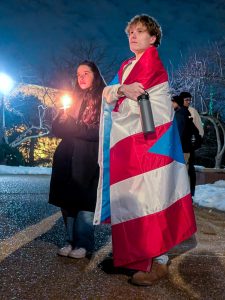
Students and faculty held candles in the frigid February air as they recited the SLU Oath of Inclusion, a pledge to foster a community inclusive of “race, ethnicity, sex, age, ability, faith, orientation, gender, class and ideology.” 

Donohue then stood before the crowd and solemnly listed the names and causes of death for all 36 individuals killed by ICE since 2025, calling attention to those whose deaths have not received media attention. 

Senior computer science major and Vietnamese international student Ngan Nguyen said her community lives in constant fear of being unduly deported. Members of Nguyen’s family immigrated legally, yet are still deeply concerned about being targeted by ICE. 

“They still have to be scared, because one day maybe ICE will deport them,” Nguyen said. “We have to speak up about the situation,” Nguyen said at the vigil, adding that the country is falling short on the American dream, the belief that the United States offers equal opportunity to pursue a better life. 

Kaiden Nair, a freshman majoring in psychology, said he attended the vigil to raise awareness for the injustice and inequalities perpetuated by ICE.

“These cruel, unkind acts of murder and execution are unconstitutional, yet we [as a country] continue to carry them out,” Nair said.

Holding a Puerto Rican flag, students pay respect during SGA’s ICE-Out vigil in front of the Clock Tower on Feb. 5, 2026, to immigrants unjustly detained by ICE. (Jude Thomas)

Among other speakers at the vigil, Dean of Students Donney Moroney told the story of her own family’s immigration from Nicaragua due to political persecution. She said that people must mourn and consciously humanize all victims of state violence.

“When I see these stories, I don’t see headlines. I see my family,” Moroney said.  

Undocumented immigration is classified as a civil offense, a crime that affects a private party rather than society more broadly. The typical punishment for a civil offense is a fine, yet armed ICE agents are targeting workplaces and entering homes without warrants, often violently or under deception, which is illegal. 

Of the more than 60,000 individuals detained by ICE in 2025, many, including minors, have reported various forms of inhumane treatment at their place of detainment, including sexual abuse, physical violence and lack of proper medical treatment. Many of these detention centers are alleged to be illegally preventing congressional oversight.

As ICE and related agencies continue to crack down on immigration throughout the U.S., many members of the SLU community remain steadfast in their support of the freedom and dignity of all.

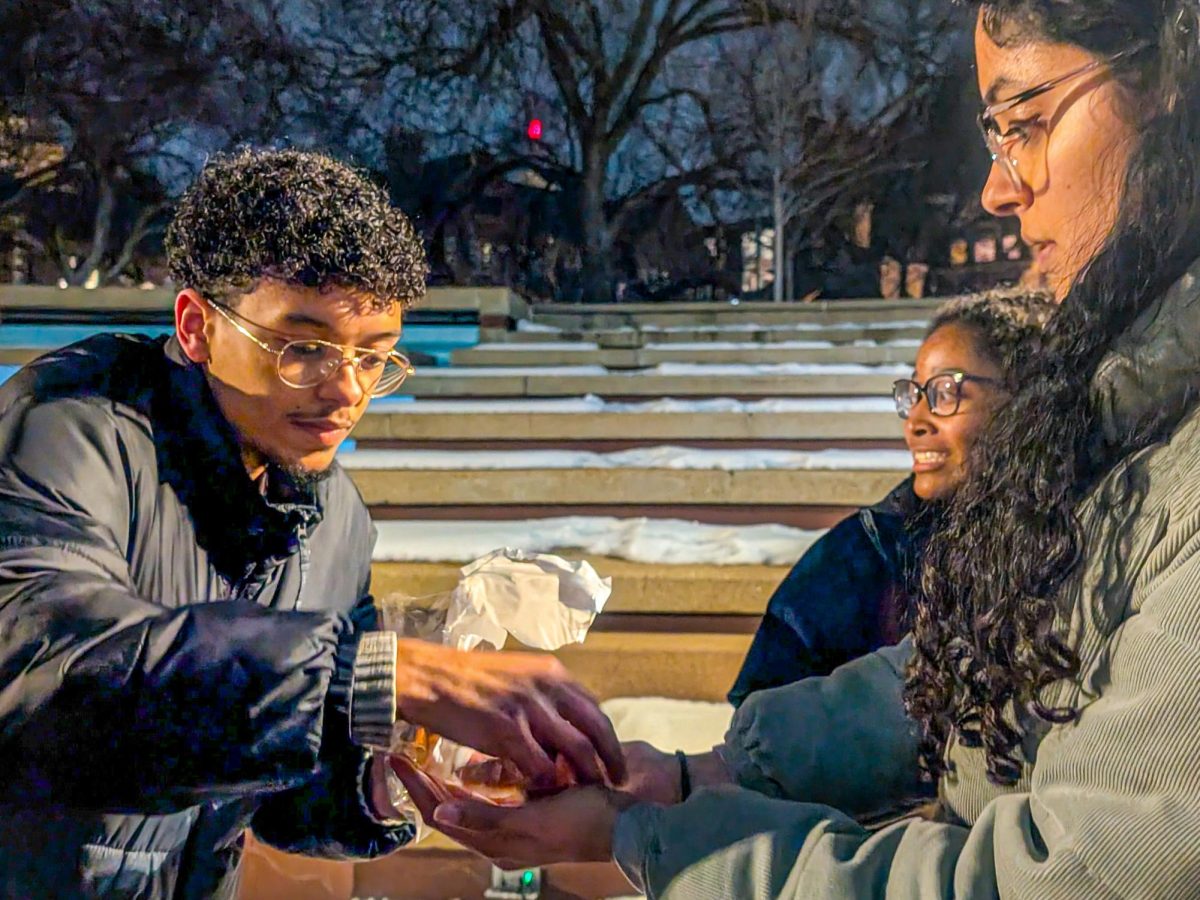
After the ICE-Out Vigil on Feb. 5 ended, SGA vice president of Diversity, Equity, and Inclusion, Nathan Sewell hands out whistles for participants to blow if they see any ICE activity. (Jude Thomas)

Posted in UncategorizedComments Off on Victims of ICE violence honored at candlelit vigil