
Author Archives | Joseph Glaser, Senior Writer

We must not allow Luigi Mangione’s case to set the precedent for America

On April 1, Pamela Bondi, the Department of Justice attorney general, directed the prosecutors of Luigi Mangione to seek the death penalty. To me, this sounds like the worst April Fool’s joke known to man, but for the United States government, it is a real part of their agenda. The only way I can read this is as a desperate attempt to maintain control of the masses at a time when trust in the system is at an all time low.


In a time of misinformation, false narratives and propaganda, I am glad to see common sense take charge over America’s way of thinking; the injustice and disparities that riddle this system can go unnoticed no longer. 


The case of Luigi Mangione shows us this firsthand. In a previous article, I argued that although his challenging of the economic base of the healthcare system did not lead to systemic reform, it challenged how mainstream media reports events where class consensus is questioned. It exposed the contradiction in the system’s condemnation of violence against the ruling class versus its perpetration of violence against the oppressed. 


While the ruling class continues to try to make a statement out of his act against their control by charging him on 20 counts, including killing as an act of terrorism, and even moving for the death penalty, their attempts have, in some ways, backfired. 


This act exposed the ruling class’s wavering level of control over how people think, yet made clear that their control over the economy is stronger than ever. No notable changes in the healthcare system resulted from Mangione’s act, however, I believe it was one of many in a causal chain that may, in summation, lead to true change that benefits people worldwide. 


For social change to be truly effective, it must succeed in moving both the base of the economy, which in the U.S. is capitalism, and the ideas about the base. This requires a fundamental shift in how people think and behave, and it is not something that happens in a flash: it emerges over time by the compounding of movements in the pursuit of justice. 


When such movements do shift belief, they expose the level of control the ruling class has over our beliefs, which in the modern age changes constantly. As the ruling class hones their measures of control, the working class develops new ways to subvert and establish their own agency. The cycle continues viciously. These movements also expose the level of control the ruling class has over the base of the economy. 


The ruling class’s main source of control is its ability to control and manipulate the economy. Specifically, how the economy is structured, which they control by manipulating how we think of and interact with existing rules, structures and economic systems. 


An example of this in modern society is cryptocurrency. For years, large corporations and mainstream media were skeptical of decentralized finance, often writing it off as a scam. In the past, many banks have issued statements advising clients away from investing in digital assets. However, the narrative surrounding cryptocurrency has shifted since President Donald Trump took office. 


With Elon Musk’s influence, the U.S. government and large financial institutions have shifted their perspective on cryptocurrency, with the U.S. government now arranging a “strategic bitcoin reserve” and large banking institutions like JP Morgan advocating and establishing platforms for the use of digital currencies.


All this and more, just as the IRS comes out with new laws regulating the taxation of digital assets. This incorporation of a change into the dominant culture happens when members of the ruling class see an opportunity to seize more power and simultaneously prevent power from shifting away from them. 


The change that is allowed is only that which does not challenge late-stage capitalism – the power structure that allows the exploitation of the working class to create wealth for the already wealthy.


The manifestation of this phenomenon has resulted in the extremely rigid power structure characteristic of late-stage capitalism. Companies use divisive forces such as gerrymandering, lobbying, echo-chamber media and more to convince people that they cannot create change, while simultaneously controlling what other changes are allowed and disallowed in modern society. 


Any cultural shift is allowed in society as long as it does not challenge the powers that be. Although we are watching modern capitalism shift how people think about capitalism as a whole, the control over the economic base is still very difficult for the working class, or any class, to change. 


Ideas quickly die down when there is no ability to act upon them. This power, the power over policies, procedures and administration of the economy, is something that even those in power have always fought over. 


There is an internal power struggle between members of the ruling class to seize the most power. They continue to play this game, calling it politics, and it is all fair game unless one decides to overshare that power with those “below” them. That is when they are ostracized and disallowed from the game of politics. When power begins to fall out of their hands, or their control is challenged, that is when the politicians are most united.


We must not allow the ruling class to get away with punishing the working class for violence against them while those in power continue to perpetuate violence against millions around the globe without consequence. This is common sense and not a divisive stance. 


Why should we continue to allow those in power to kill, even if it is not them directly killing, but rather the people in the system they created doing the killing for them of their own perceived volition? 
Posted in UncategorizedComments Off on We must not allow Luigi Mangione’s case to set the precedent for America

We must not allow Luigi Mangione’s case to set the precedent for America

On April 1, Pamela Bondi, the Department of Justice attorney general, directed the prosecutors of Luigi Mangione to seek the death penalty. To me, this sounds like the worst April Fool’s joke known to man, but for the United States government, it is a real part of their agenda. The only way I can read this is as a desperate attempt to maintain control of the masses at a time when trust in the system is at an all time low.


In a time of misinformation, false narratives and propaganda, I am glad to see common sense take charge over America’s way of thinking; the injustice and disparities that riddle this system can go unnoticed no longer. 


The case of Luigi Mangione shows us this firsthand. In a previous article, I argued that although his challenging of the economic base of the healthcare system did not lead to systemic reform, it challenged how mainstream media reports events where class consensus is questioned. It exposed the contradiction in the system’s condemnation of violence against the ruling class versus its perpetration of violence against the oppressed. 


While the ruling class continues to try to make a statement out of his act against their control by charging him on 20 counts, including killing as an act of terrorism, and even moving for the death penalty, their attempts have, in some ways, backfired. 


This act exposed the ruling class’s wavering level of control over how people think, yet made clear that their control over the economy is stronger than ever. No notable changes in the healthcare system resulted from Mangione’s act, however, I believe it was one of many in a causal chain that may, in summation, lead to true change that benefits people worldwide. 


For social change to be truly effective, it must succeed in moving both the base of the economy, which in the U.S. is capitalism, and the ideas about the base. This requires a fundamental shift in how people think and behave, and it is not something that happens in a flash: it emerges over time by the compounding of movements in the pursuit of justice. 


When such movements do shift belief, they expose the level of control the ruling class has over our beliefs, which in the modern age changes constantly. As the ruling class hones their measures of control, the working class develops new ways to subvert and establish their own agency. The cycle continues viciously. These movements also expose the level of control the ruling class has over the base of the economy. 


The ruling class’s main source of control is its ability to control and manipulate the economy. Specifically, how the economy is structured, which they control by manipulating how we think of and interact with existing rules, structures and economic systems. 


An example of this in modern society is cryptocurrency. For years, large corporations and mainstream media were skeptical of decentralized finance, often writing it off as a scam. In the past, many banks have issued statements advising clients away from investing in digital assets. However, the narrative surrounding cryptocurrency has shifted since President Donald Trump took office. 


With Elon Musk’s influence, the U.S. government and large financial institutions have shifted their perspective on cryptocurrency, with the U.S. government now arranging a “strategic bitcoin reserve” and large banking institutions like JP Morgan advocating and establishing platforms for the use of digital currencies.


All this and more, just as the IRS comes out with new laws regulating the taxation of digital assets. This incorporation of a change into the dominant culture happens when members of the ruling class see an opportunity to seize more power and simultaneously prevent power from shifting away from them. 


The change that is allowed is only that which does not challenge late-stage capitalism – the power structure that allows the exploitation of the working class to create wealth for the already wealthy.


The manifestation of this phenomenon has resulted in the extremely rigid power structure characteristic of late-stage capitalism. Companies use divisive forces such as gerrymandering, lobbying, echo-chamber media and more to convince people that they cannot create change, while simultaneously controlling what other changes are allowed and disallowed in modern society. 


Any cultural shift is allowed in society as long as it does not challenge the powers that be. Although we are watching modern capitalism shift how people think about capitalism as a whole, the control over the economic base is still very difficult for the working class, or any class, to change. 


Ideas quickly die down when there is no ability to act upon them. This power, the power over policies, procedures and administration of the economy, is something that even those in power have always fought over. 


There is an internal power struggle between members of the ruling class to seize the most power. They continue to play this game, calling it politics, and it is all fair game unless one decides to overshare that power with those “below” them. That is when they are ostracized and disallowed from the game of politics. When power begins to fall out of their hands, or their control is challenged, that is when the politicians are most united.


We must not allow the ruling class to get away with punishing the working class for violence against them while those in power continue to perpetuate violence against millions around the globe without consequence. This is common sense and not a divisive stance. 


Why should we continue to allow those in power to kill, even if it is not them directly killing, but rather the people in the system they created doing the killing for them of their own perceived volition? 

Posted in UncategorizedComments Off on We must not allow Luigi Mangione’s case to set the precedent for America

We must not allow Luigi Mangione’s case to set the precedent for America

On April 1, Pamela Bondi, the Department of Justice attorney general, directed the prosecutors of Luigi Mangione to seek the death penalty. To me, this sounds like the worst April Fool’s joke known to man, but for the United States government, it is a real part of their agenda. The only way I can read this is as a desperate attempt to maintain control of the masses at a time when trust in the system is at an all time low.


In a time of misinformation, false narratives and propaganda, I am glad to see common sense take charge over America’s way of thinking; the injustice and disparities that riddle this system can go unnoticed no longer. 


The case of Luigi Mangione shows us this firsthand. In a previous article, I argued that although his challenging of the economic base of the healthcare system did not lead to systemic reform, it challenged how mainstream media reports events where class consensus is questioned. It exposed the contradiction in the system’s condemnation of violence against the ruling class versus its perpetration of violence against the oppressed. 


While the ruling class continues to try to make a statement out of his act against their control by charging him on 20 counts, including killing as an act of terrorism, and even moving for the death penalty, their attempts have, in some ways, backfired. 


This act exposed the ruling class’s wavering level of control over how people think, yet made clear that their control over the economy is stronger than ever. No notable changes in the healthcare system resulted from Mangione’s act, however, I believe it was one of many in a causal chain that may, in summation, lead to true change that benefits people worldwide. 


For social change to be truly effective, it must succeed in moving both the base of the economy, which in the U.S. is capitalism, and the ideas about the base. This requires a fundamental shift in how people think and behave, and it is not something that happens in a flash: it emerges over time by the compounding of movements in the pursuit of justice. 


When such movements do shift belief, they expose the level of control the ruling class has over our beliefs, which in the modern age changes constantly. As the ruling class hones their measures of control, the working class develops new ways to subvert and establish their own agency. The cycle continues viciously. These movements also expose the level of control the ruling class has over the base of the economy. 


The ruling class’s main source of control is its ability to control and manipulate the economy. Specifically, how the economy is structured, which they control by manipulating how we think of and interact with existing rules, structures and economic systems. 


An example of this in modern society is cryptocurrency. For years, large corporations and mainstream media were skeptical of decentralized finance, often writing it off as a scam. In the past, many banks have issued statements advising clients away from investing in digital assets. However, the narrative surrounding cryptocurrency has shifted since President Donald Trump took office. 


With Elon Musk’s influence, the U.S. government and large financial institutions have shifted their perspective on cryptocurrency, with the U.S. government now arranging a “strategic bitcoin reserve” and large banking institutions like JP Morgan advocating and establishing platforms for the use of digital currencies.


All this and more, just as the IRS comes out with new laws regulating the taxation of digital assets. This incorporation of a change into the dominant culture happens when members of the ruling class see an opportunity to seize more power and simultaneously prevent power from shifting away from them. 


The change that is allowed is only that which does not challenge late-stage capitalism – the power structure that allows the exploitation of the working class to create wealth for the already wealthy.


The manifestation of this phenomenon has resulted in the extremely rigid power structure characteristic of late-stage capitalism. Companies use divisive forces such as gerrymandering, lobbying, echo-chamber media and more to convince people that they cannot create change, while simultaneously controlling what other changes are allowed and disallowed in modern society. 


Any cultural shift is allowed in society as long as it does not challenge the powers that be. Although we are watching modern capitalism shift how people think about capitalism as a whole, the control over the economic base is still very difficult for the working class, or any class, to change. 


Ideas quickly die down when there is no ability to act upon them. This power, the power over policies, procedures and administration of the economy, is something that even those in power have always fought over. 


There is an internal power struggle between members of the ruling class to seize the most power. They continue to play this game, calling it politics, and it is all fair game unless one decides to overshare that power with those “below” them. That is when they are ostracized and disallowed from the game of politics. When power begins to fall out of their hands, or their control is challenged, that is when the politicians are most united.


We must not allow the ruling class to get away with punishing the working class for violence against them while those in power continue to perpetuate violence against millions around the globe without consequence. This is common sense and not a divisive stance. 


Why should we continue to allow those in power to kill, even if it is not them directly killing, but rather the people in the system they created doing the killing for them of their own perceived volition? 

Posted in UncategorizedComments Off on We must not allow Luigi Mangione’s case to set the precedent for America

We must not allow Luigi Mangione’s case to set the precedent for America

On April 1, Pamela Bondi, the Department of Justice attorney general, directed the prosecutors of Luigi Mangione to seek the death penalty. To me, this sounds like the worst April Fool’s joke known to man, but for the United States government, it is a real part of their agenda. The only way I can read this is as a desperate attempt to maintain control of the masses at a time when trust in the system is at an all time low.


In a time of misinformation, false narratives and propaganda, I am glad to see common sense take charge over America’s way of thinking; the injustice and disparities that riddle this system can go unnoticed no longer. 


The case of Luigi Mangione shows us this firsthand. In a previous article, I argued that although his challenging of the economic base of the healthcare system did not lead to systemic reform, it challenged how mainstream media reports events where class consensus is questioned. It exposed the contradiction in the system’s condemnation of violence against the ruling class versus its perpetration of violence against the oppressed. 


While the ruling class continues to try to make a statement out of his act against their control by charging him on 20 counts, including killing as an act of terrorism, and even moving for the death penalty, their attempts have, in some ways, backfired. 


This act exposed the ruling class’s wavering level of control over how people think, yet made clear that their control over the economy is stronger than ever. No notable changes in the healthcare system resulted from Mangione’s act, however, I believe it was one of many in a causal chain that may, in summation, lead to true change that benefits people worldwide. 


For social change to be truly effective, it must succeed in moving both the base of the economy, which in the U.S. is capitalism, and the ideas about the base. This requires a fundamental shift in how people think and behave, and it is not something that happens in a flash: it emerges over time by the compounding of movements in the pursuit of justice. 


When such movements do shift belief, they expose the level of control the ruling class has over our beliefs, which in the modern age changes constantly. As the ruling class hones their measures of control, the working class develops new ways to subvert and establish their own agency. The cycle continues viciously. These movements also expose the level of control the ruling class has over the base of the economy. 


The ruling class’s main source of control is its ability to control and manipulate the economy. Specifically, how the economy is structured, which they control by manipulating how we think of and interact with existing rules, structures and economic systems. 


An example of this in modern society is cryptocurrency. For years, large corporations and mainstream media were skeptical of decentralized finance, often writing it off as a scam. In the past, many banks have issued statements advising clients away from investing in digital assets. However, the narrative surrounding cryptocurrency has shifted since President Donald Trump took office. 


With Elon Musk’s influence, the U.S. government and large financial institutions have shifted their perspective on cryptocurrency, with the U.S. government now arranging a “strategic bitcoin reserve” and large banking institutions like JP Morgan advocating and establishing platforms for the use of digital currencies.


All this and more, just as the IRS comes out with new laws regulating the taxation of digital assets. This incorporation of a change into the dominant culture happens when members of the ruling class see an opportunity to seize more power and simultaneously prevent power from shifting away from them. 


The change that is allowed is only that which does not challenge late-stage capitalism – the power structure that allows the exploitation of the working class to create wealth for the already wealthy.


The manifestation of this phenomenon has resulted in the extremely rigid power structure characteristic of late-stage capitalism. Companies use divisive forces such as gerrymandering, lobbying, echo-chamber media and more to convince people that they cannot create change, while simultaneously controlling what other changes are allowed and disallowed in modern society. 


Any cultural shift is allowed in society as long as it does not challenge the powers that be. Although we are watching modern capitalism shift how people think about capitalism as a whole, the control over the economic base is still very difficult for the working class, or any class, to change. 


Ideas quickly die down when there is no ability to act upon them. This power, the power over policies, procedures and administration of the economy, is something that even those in power have always fought over. 


There is an internal power struggle between members of the ruling class to seize the most power. They continue to play this game, calling it politics, and it is all fair game unless one decides to overshare that power with those “below” them. That is when they are ostracized and disallowed from the game of politics. When power begins to fall out of their hands, or their control is challenged, that is when the politicians are most united.


We must not allow the ruling class to get away with punishing the working class for violence against them while those in power continue to perpetuate violence against millions around the globe without consequence. This is common sense and not a divisive stance. 


Why should we continue to allow those in power to kill, even if it is not them directly killing, but rather the people in the system they created doing the killing for them of their own perceived volition? 

Posted in UncategorizedComments Off on We must not allow Luigi Mangione’s case to set the precedent for America

Saint Louis University fraternity hosts vintage market on campus, merging business with strong social missions

Sigma Tau Gamma (STG), one of the nine chapters of the Interfraternity Council (IFC) at Saint Louis University, hosted three vintage dealers, two local to the St. Louis area, on West Pine to raise money for their philanthropy week. The market was open on March 20 from 11 p.m. to 4 p.m.

The vintage dealers brought clothing from a range of decades, offering a variety of styles. This was the first event of its kind facilitated by a fraternity on SLU’s campus. 

Jibby Bellante, a student at the market, was impressed with the wide variety of clothing they had available.

“They had t-shirts, jerseys, pants, and also going out tops and skirts and dresses,” Bellante said. Bellante “went all out” and found a pair of green sweatpants, a blue dress, a y2k going-out top, and her favorite, an old housecoat. 

Bellante said that the location “was perfect,” accessible and brought people together for a strong philanthropic cause. 

“I love it when I see all of campus [life] involved in fraternity and sorority philanthropy events. It can be hard to find something everyone likes, and the vintage market was a fantastic idea!” Bellante said. 

Adam Osman, president of STG, shared some insight into what their philanthropy is all about. 

“Every semester, we have a philanthropy with different activities each day, one of the events is Tomato-a-Tau, where you pay a little money to get to throw water balloons at brothers; another is the dunk tank where you get to throw a ball to try to dunk one of the brothers,” Osman said. 

These events are part of an initiative to raise money for Special Olympics Missouri (SOMO), a nonprofit organization that supports community members with cognitive disabilities in the St. Louis area. 

The events are “all in good fun, and at the root of it all, it’s an opportunity for us to give a lot of money to a good cause,” Osman said. 

The vintage market generated $6,000 in sales and 15% of that went to support SOMO. In total, STG raised $1490.78 from their philanthropy week. 

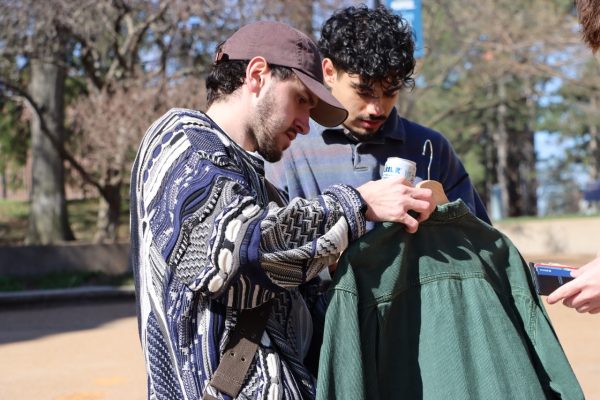
The vintage market was a new event organized by Cody Mendoza, the Standards chair of STG, in collaboration with Mark Lopez and Blake Zager, the co-owners of PIMPED Vintage. 

Blake Zager (left) and Mark Lopez (right) checking out a green corduroy button-up for a customer on March 20, 2025, on West Pine at Saint Louis University. (The University News / Jude Thomas)

“This is something I’ve been wanting to do since I was a freshman. My friend Mark started selling clothes after college and it became a big thing in our area – we always thought a college campus is the perfect spot to sell directly to customers, just never had the reputation on campus to do it,” Mendoza said. 

Being part of the Sigma Tau Gamma executive board put Mendoza in a position to support the organization’s philanthropy while making this idea come to life. They said they hope to carry on this new tradition going forward.

“I love the idea of supporting our philanthropy and local St. Louis vendors. We hope to continue this thing going further, see how much money we raise and the opportunities we can create,” Mendoza said. 

Saint Louis University student holding up a shirt that reads, “Give me all your CHOCOLATE / Nobody gets hurt.” at the vintage market on March 20, 2025. (The University News / Jude Thomas)

Two of the vintage vendors, Ghost Soda and Riptide vintage, are local St. Louis vendors that sell in markets across the broader area. The owner of Ghost Soda, Hannah Valentine, has been in the industry since she started selling clothes her sophomore year of high school specializing in 90s and early 2000s women’s clothing. 

Valentine spoke on how vintage markets support a more sustainable future in an industry so focused on consumerism. 

“Everyone should be buying clothing secondhand, because the fashion industry is the second most polluting industry, right next to oil,” Valentine said. “It’s absolutely horrible how so much of the clothing we make and produce goes to waste because people want to wear it once and then get rid of it.” 

According to the UN Environment Programme, the fast fashion industry is the second-biggest consumer of water and is responsible for 10% of global carbon emissions. This is more than all international flights and maritime shipping combined. The impacts of fast fashion on the environment are harsh, and consumers are left in a tough spot due to the lack of awareness of the availability of alternative secondhand clothing. 

The fast fashion industry is fueled by low-quality clothing made with cheap materials and exploitative labor practices. Vintage clothing markets offer a unique alternative for conscious consumers with clothes that oftentimes are higher quality and produced in a more environmentally friendly fashion. 

“It’s so important to help the earth stay healthy and also just keep the good quality clothes in cycle,” Valentine said. 

Valentine also organizes the Drop Soda Vintage market, a monthly market in St. Louis at The Garage STL that brings together 50 to 60 vendors of second-hand clothing. She encourages community members interested in changing their consumer habits to support local and sustainable causes to check out the event. 

“Not only are you supporting locally owned businesses, it’s also a great place to find the best quality vintage clothing and reinvent your style,” she said. 

Hayley Fizer, owner of Riptide Vintage, has been in the industry since high school as well and shared how sustainability is an important part of her business model. 

“Where I source my items is the last stop before clothes go away forever. I really love having the chance to rescue these pieces,” Fizer said. 

Sustainability is crucial for her, she said, operating with these principles in mind for all parts of her business, such as making sure packaging materials for online orders are compostable. 

With younger generations looking to be more environmentally conscious in their consumer habits, Fizer offered her perspective on what people can do. 

“I think there are more opportunities to shop sustainability than people think here. Do your due diligence when researching companies and you’ll find there are plenty of local businesses that don’t just sell sustainable clothing, but also make sustainable lifestyle products. If you find a shop you like, go back,” Fizer said. 

She encourages people to tap into the local vintage community that already exists and is growing in the St. Louis area. She added that she was happy to be part of the opportunity at SLU to increase their presence. 

“Having events like this on college campuses is so important for raising awareness of stuff you can get at an affordable price rather than shopping at Shein or companies like that. Events like these are really helpful to raise awareness and tap into the community,” Fizer said. 

STG and the vendors are looking to host more events like this in the St. Louis area. For more information on the vendors, visit their Instagram pages listed below. 

Hannah Valentine – @ghostsoda

Mark Lopez and Blake Zager – @pimpedvintage

Hayley Fizer – @riptidevintage

Posted in UncategorizedComments Off on Saint Louis University fraternity hosts vintage market on campus, merging business with strong social missions

Luigi Mangione was not as revolutionary as we thought he was – but was he a step in the right direction?

It has been more than two months since Luigi Mangione allegedly shot the UnitedHealthcare CEO, Brian Thompson. We have seen the spectrum of media coverage and Mangione’s stance condemning the healthcare system, but I have not seen healthcare policies change. I have not seen the structure of the healthcare system, or any messed up function of our economic system, change. 

Even before any of this happened, the Federal Trade Commission (FTC) report released in July 2024 details how Pharmacy Benefit Managers (PBMs) inflate drug costs. Despite the report and public cries for reform, the companies responsible for such behavior continue to operate as usual. UnitedHealthcare (UHC) stock took a hit after the shooting on Dec. 4, but is settling. 

This is a stark reality check for the United States. It shows us the depth of distrust between the rich and poor of society, and exposes the rigid power structure of the American class system creating such distrust while attempting to hide it. 

I do not think there has been a period in time where this divide has ever been clearer. While a healthcare company earns thousands of dollars from overcharging cancer patients by 5000%, a man sits in prison, being celebrated by working class and younger individuals for allegedly murdering someone deemed as a figurehead of this injustice. 

What I find most ironic is both sides are equally convinced they are right. The separation is determined by class. Not race, gender, sexuality or anything but the dollar amount in their bank account. Both sides are, even more so, divided against themselves, but nothing makes rich people come together more than when poor people come for their power. 

Although this growing contradiction cannot be ignored, it can be avoided. You wake up to the same routine, only this time slightly more aware of the paradox of modern America, and the layers of lies that have been fed to you since birth – that we are the good guys, you can live out the American dream and we live in a time of peace. 

The power structure of modern capitalism is so rigid, it cannot be changed with just one revolutionary act. It is the compounding of revolutionary acts that brings change. When will people choose to no longer remain complacent in the corruption that controls our world, even if it doesn’t serve their short-term self interest? Even if it is career ending? 

There is undoubtedly a base level of violence necessary to create change. But apparently, the death of a CEO is not enough. The murder of thousands of innocent civilians and the destruction of entire cities is not enough. The prolonged invasion of a sovereign nation is not enough. Such violence doesn’t create change but rather upholds the current system by controlling people through fear. 

Those who lead through fear only stay in power as long as those they govern lack courage. We are comfortable enough to participate in the current economic system because there is no currently viable option that enough people are united on to shift to and expunge the current one. As long as there is more comfortability in complacency and too much uncertainty in what is revolutionary, this cycle will inevitably continue. 

The case of Mangione gives me hope for where we’re at, but even greater clarity on how much farther we need to go. It is more important now than ever to support the parts of our justice system that challenge injustice. Education and awareness of issues is the first step to knowing how to solve them. With how much there is out there, this task isn’t to be done alone. We all play a part, no act is too small, every thought counts. We have more power than we think.

All content under the opinion section is not a direct reflection of The University News, but expresses the opinion of the writer, not necessarily the organization as a whole.

Posted in UncategorizedComments Off on Luigi Mangione was not as revolutionary as we thought he was – but was he a step in the right direction?

Marguerite Hall HVAC system failure left residents without central heat for three days

Marguerite Hall’s central heating unit overheated and broke down leaving residents without heat for three days at Saint Louis University on Dec. 1. Heat has temporarily been restored with a backup boiler hooked up on Dec. 3 at 7:30 p.m. 

Facilities services are repairing the primary boiler as soon as possible. In the meantime, they have distributed over 100 space heaters to student rooms.

“Our goal is to have system wide heat restored tonight,” said Vice President of Facilities Michael Lucido. “This will be with a temporary system, but it will allow us the time to continue fixing the older boiler and getting it online to serve us until we can get the newer boiler fixed or replaced.”  

Cooper Banholzer, a Marguerite Hall resident, said when the fire alarm went off, he initially thought it was a mistake. A false alarm went off about 30 minutes earlier, he said. After making his way outside, he saw the gravity of the situation. 

“DPS actually started showing up, and things started smelling like gas, then they told us there was a fire in the basement, ” Banholzer said. 

Lucido later confirmed the boiler did not catch on fire. The boiler overheated due to low water which is what caused the smoke. 

“The boiler is only seven years old, but unfortunately there was a malfunction which allowed the water level to drop and it overheated,” Lucido said.

Cooper and other residents waited outside for DPS to give them further instructions and assistance.

“It took about an hour for us to get any real information. There were four DPS cars with nine officers and three fire trucks,” he said. “Turns out one of the central heaters [almost] exploded.”

Students were relocated to a room in Xavier Hall while waiting for DPS and the St. Louis Fire Department to resolve the issue. 

After three hours, residents were allowed to reenter Marguerite Hall. “We were told we could go back and it was safe to live in Marg, but it smelled really bad because of all the smoke,” Banholzer said. 

Banholzer left for the day and when he returned, he said Marguerite Hall was in worse condition. 

“I came back around 10 p.m., everything still smelled kind of bad, and everything was just really cold because we opened up the windows,” he said.

The building’s backup heating system was used to try to return heat to the building, but that broke down as well. After the backup heating system didn’t work, residents were given individual space heaters for their dorms. 

“They walked door to door last night and it was originally one per suite, but then it turned into one per room,” Banholzer said. 

Space heaters were provided to Marguerite Hall residents after the building’s central heating system malfunctioned, leaving residents without central heat on Dec. 1, 2024 at Saint Louis University.
Courtesy of Cooper Banholzer

In addition to the HVAC failure, some residents are also facing power issues. 

“[We] were told to unplug all unnecessary electronics, because if [we] had too many things plugged in, [our] power would go out” Banholzer said. “A couple of my friends don’t have power.” 

Maggie Fischer, another resident of Marguerite Hall, weighed in on how residents are reacting to the situation. 

“People are starting to email to ask for reimbursement on housing,” Fischer said. “Is there going to be a new boiler? Is this just gonna be what it’s like for finals week?” 

Facilities brought in additional outside help to get the old boiler in Marguerite Hall running as a temporary solution while they worked on fixing the boiler that overheated. 

“We’ve been working on replacing tubes in the old boiler and it has taken much longer than originally anticipated,” Lucido said.

Lucido and his team are still investigating what will be done about the broken boiler. 

“The newer boiler that overheated warped some of the sections and we are still exploring the extent of the damage to determine if it will be a total replacement or just a replacement of certain sections,” he said. 

A temporary boiler was delivered at 4 p.m. and hooked up to the building’s system by 7:30 p.m, Dec. 3.

Posted in UncategorizedComments Off on Marguerite Hall HVAC system failure left residents without central heat for three days