Author Archives | Jason Sobieski

PhilaMOCA is saved by GoFundMe

The PhilaMOCA is not only an art gallery and event space but is also a unique music venue, just like when it hosted Madeline Kenney last November. (Photograph by Ethan Hermann for The Triangle.)

The Philadelphia Mausoleum of Contemporary Art, otherwise known as the PhilaMOCA has recently shut its doors to the DIY music scene and public. The reason being: rezoning issued by the city. However, a recent fundraising project may mean a re-opening in the near future.

Manager and Drexel alumni Eric Bresler created a GoFundMe to support the re-opening of this iconic music venue. At first, the goal was $20,000 which would go towards updating electrical work, zoning and construction. After an overwhelmingly positive response from the community, Bresler decided to raise the goal to $30,000, which has been reached.

Bresler was truly shocked, saying “It was a huge surprise. Before I put the fundraiser up, I was like ‘I bet we’ll get five to $10,000 if we’re lucky,’ I Never expected $30,000… I guess I just never really stepped back and realized that people really appreciated the room,”

Bresler went on to describe how he keeps the PhilaMOCA an all-ages, DIY music-based space for local artists to use and enjoy music, view art and attend events. He believes in keeping the ethos of the basement punk scene that he grew up in. Bresler went on to even point out the importance of a place such as PhilaMOCA, saying “It’s something that the city needs. PhilaMOCA is really unique, I like to think of it as a professionally-run DIY space.”

Other organizations in the area are also pitching in to help out the PhilaMOCA, such as Jerks Production’s event that sought out to “Resurrect PhilaMOCA.”

As of right now, the PhilaMOCA team is waiting on the city to give them the OK on re-opening.

The $30,000 is estimated to cover all expenses for changes the city is requesting. These renovations will hopefully be made in time to celebrate the PhilaMOCA’s 10 year anniversary.

In the meantime, several local venues such as R5 Productions, Boot & Saddle, Ruba Club, Dave Kiss Presents, Kung Fu Necktie, World Cafe Live, The Trestle Inn, Warehouse on Watts, Azavea, Radio Kismet, and PHIT have extended their calendar to put on shows that were cancelled as a result of the PhilaMOCA closing.

Posted in UncategorizedComments Off on PhilaMOCA is saved by GoFundMe

MicroSociety: the on-campus company with storied roots

Across from the DAC and next to the URBN Center, the Innovation Center at 3401 Market Street houses various startups and businesses planting their headquarters in the heart of our very own campus. One is an education company called MicroSociety, which has been preparing children for more than 30 years to control their own society inside schools.

The program model is that, for an hour a day, kids in more than 250 schools worldwide — including public, private and charter schools — take control of their own world by simulating real-life jobs. These include anything from being an attorney, to a police officer, to a tax accountant, a banker and more. This program also works in schools from kindergarten to 12th grade to stress the importance of teaching students useful skills for life after high school, like how to file taxes or begin a start-up.

MicroSociety has been the recipient of multiple awards due to the uniqueness and effectiveness of its program, including the 2019 Greater Philadelphia Innovation Award in the After School Program category given by the Social Innovations Journal. This company also began offering co-op opportunities for Drexel students in fall 2018. Even though it has been located in University City for almost three years, very few Drexel students know about it.

George H. Richmond, a New York City teacher whose students skipped classes, scorned homework and slept through lectures concieved the idea that became MicroSociety.

“[He] was truly a pacifist at heart, and he did not want to become a tyrant at his classroom. Most of all, he didn’t want these kids who were in tough economic circumstances to stay poor, and he knew that education was the way out of poverty,”said Carolynn King-Richmond, the current CEO and President of Microsociety, explaining why her late husband created MicroSociety.

Richmond started to create a technique where he could make kids interested in the content he was teaching by applying it to real-life issues. More specifically, the issue of money. Even though it was almost sacrilegious to talk about money in education, Richmond proved the system wrong. His students started to pay attention and attend classes by relating what they were learning in class to their lives and putting it into practice.

After that, he attended graduate school at Harvard University and he was asked by the university to write his dissertation on MicroSociety. King-Richmond pointed out that a lot of people were moved, explaining that “It was so successful that journalists started writing stories about it because it was unusual, and that’s when George discovered he was onto something.”

In 1981, the nation’s first school-wide MicroSociety was held in Lowell, MassachusettsThe media decided to make a documentary about it due to the singularity of the program and the story of the town of Lowell — a primarily industrial town where education wasn’t the largest priority. From there, the story grew by word of mouth and more educators started to contact them. By the 1990s, they had hundreds of schools in diverse places all over the country — from a coal-mining town in Virginia, to Chicago, and eventually Detroit.

Richmond discovered that the schools were helping students with other skills like learning english as a second language, while supporting local entrepreneurship and business development.

MicroSociety’s Director of School Partnerships and Community Relations, Chris Bozzone, was able to note that in all these years, they found out that the hour of MicroSociety is the time kids looked forward to the most in schools and gained their gaurdians’ support after they saw the impact the program had on their kids.

After moving their headquarters from Old City to University City, they have realized how helpful this area has been to them with all the projects happening in the Innovation Center and the connections with Drexel and the University of Pennsylvania. Bozzone also mentioned that one of the most helpful additions they had since coming to University City has been the co-op students who have worked for MicroSociety, helping with writing, designing, branding and multimedia editing for the startup.

They had been able to get these co-op opportunities since former CoAS Dean Donna Murasko started a program where Drexel would fund four non-profits in the Greater Philadelphia Area that were missing out the opportunity to hire full-time co-op employees because they could not afford it. Among MicroSociety’s future goals are to join schools in West Philadelphia, and to work with more talent from Drexel.

Posted in UncategorizedComments Off on MicroSociety: the on-campus company with storied roots

A formal introduction to the Philadelphia food scene

While many Philadelphia chefs are household names, their stories aren’t. During Michael Solomonov’s TEDxTalk, he used this diagram to give a brief background into his life. (Photograph courtesy of Johnny Goldstein at Flickr.)

Philadelphia is historically known for its foods. All of the city’s staples — cheesesteaks, water ice, and soft pretzels— are quintessentially Philadelphian. While it would be sacrilegious to not discuss them when talking about the Philadelphia food scene, the northeastern city has blossomed into an epicenter for urban food culture.

A food column is in the works here at The Triangle but not without a formal introduction into the Philadelphia food scene. That’s what purpose this article serves: a breakdown of what is necessary food when it comes to the City of Brotherly Love.

There is a very simple metric to guage quality restaurants of any city — who’s won awards. When it comes to restaurants, there isn’t an Emmys or an Oscars to proudly display, but there is something close. If you’ve won a James Beard Award, odds are you serve top-tier quizine.

On March 27, 2019, the James Beard Foundation Award Nominees were released. The pinnacle achievements of countless restaurants, chefs and writers are seen as simply being nominated. Out of the entire country, six nominees came from Philadelphia.

The first nominee, for Outstanding Chef, was Marc Vetri of Vetri Cucina in the heart of Center City. Vetri is well known and loved for his pizzas at Pizzeria Vetri, as well as his critically-acclaimed and dynamic restaurants: Amis, Osteria, Alla Spina, and Lo Spiedo.

The next was Ellen Yin, who was nominated for Outstanding Restauranteur, a nod to her successful company, High Street Hospitality Group. Yin and her team are in charge of the restaurants High Street on Market, Fork, and High Street on Hudson.

Jesse Ito, the 30-year-old chef and owner of Royal Sushi & Izakaya in Queen Village, was nominated for Rising Star Chef of the Year. This comes just a year after being included in Forbes Magazine’s “30 Under 30” list. After spending his childhood inside his family’s restaurant in South Jersey, Ito worked full time while going to Rutgers. After graduating, he opened his restaurant in 2016 with the same Izakaya staff that worked at his family restaurant — his father included.

Two Philadelphia chefs were given the nod for Best Chef in the Mid-Atlantic Region, which included Pennsylvania, Delaware, Maryland, New Jersey, Virginia and Washington D.C. The first was Christina Martinez, the head chef of South Philly Barbacoa. Martinez is not only a tireless worker who supports her family in the United States and in Mexico, but she also serves as a leader in the South Philadelphia community. She is a steward for undocumented immigrants while serving up authentic Mexican cuisine.

The other chef to get the nomination was Rich Landau. The head chef at the acclaimed vegetarian haven, Vedge, has been serving up seasonal vegetables since 2011 and is consistently praised for being a trailblazer for vegetarian cuisine throughout the country.

The final Philadelphia nomination was for Outstanding Restaurant. The nod went to Zahav, the flagship restaurant of historic Israeli chef Michael Solomonov. He has won three James Beard Foundation Awards already — Best Chef: Mid-Atlantic in 2011, Cookbook of the Year in 2016 and Best Chef in 2017.

To top things off, Solomonov can now call his own restaurant the best in the country. On May 6, 2019, the winners were released, and Zahav took home the crown. Since then, the already extremely popular restaurant has only skyrocketed, making it even more of a challenge to eat at.

Thankfully, Solomonov has been in the Philly food scene long enough to have numerous restaurants, and is slowly amassing a Philly restaurant dynasty.

You can head over to Goldie for falafel, tehina shakes and shawarma fries, or go to Dizengoff for authentic hummus dishes. If something sweet or fried is calling your name, then Federal Donuts — yes, he owns that too! — is your destination for delicious donuts and unreasonably good fried chicken. If you’re in the mood for an elevated Jewish style dinner, then Abe Fisher is your spot.

You may think Solomonov is content with what he has, but he is still on a tear of new things. In May of 2019, K’Far opened in Rittenhouse. Camille Goswell, who was the pastry chef at Zahav for the last four years, left to open up this all-day bakery and cafe. The 2018 James Beard Foundation Award winner for Rising Star Chef, Goswell was primed for this opportunity. Goswell is in charge of operations at K’Far, while Solomonov and his partner Steve Cook oversee it like they do every Solomonov restaurant.

However, there are still two more restaurants to come. Laser Wolf, an Israeli grill in Kensington, and Merkaz, a sandwich shop in the Gayborhood, are still in the works, and Philadelphia can expect them to open very soon.

These are a few chefs that are held to the highest standard in Philadelphia, but there wasn’t even a mention of other greats such as Greg Vernick, owner of Vernick Food & Drink, Vernick Coffee Bar and Vernick Seafood. The 2017 James Beard Foundation Award winner of Best Chef: Mid-Atlantic has won the hearts of many Philadelphia food critics, being considered an innovator for American cuisine in the 21st century.

While the list could go on, these are accepted as the best of the best Philadelphia food icons. They represent the city on a national and global scale, warranting the local buzz.

This was a formal introduction into the Philadelphia food scene, but like every article following this, there will be a focus on each one. This just serves as an introduction to the biggest names in the city.

Pick up next week’s issue of The Triangle for our food column, and be prepared to learn about the Philly food scene, one week at a time.

Posted in UncategorizedComments Off on A formal introduction to the Philadelphia food scene

Public transportation spikes in Chile are the final straw

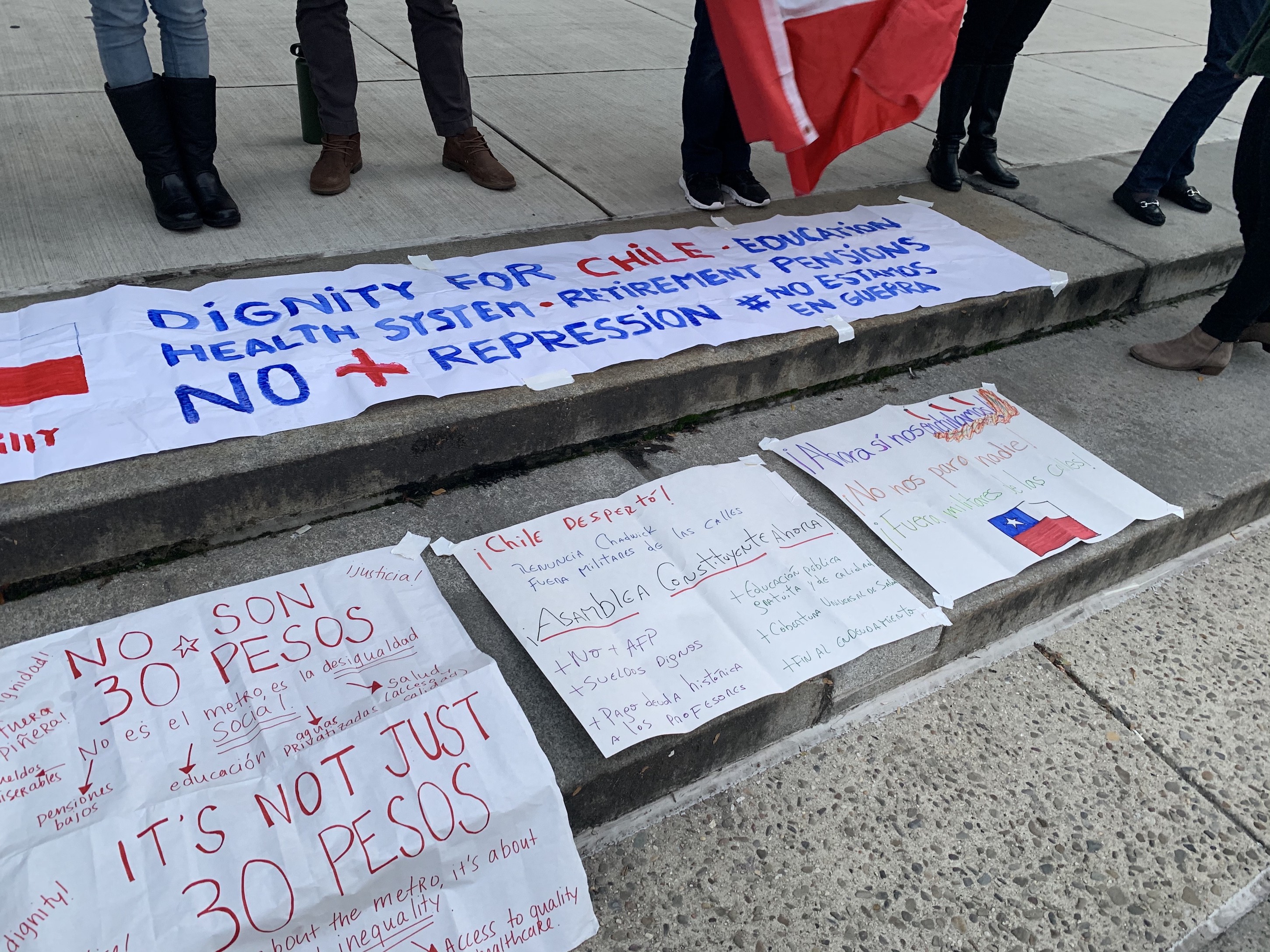
The signs at the protest were made by both Chilean and American students, intertwining Spanish and English to promote united support for Chile. (Photograph by Medha Gupta for The Triangle.)

Thousands of miles away, in a country known for its Moai statues and red wine, civil unrest over the rise in subway prices has broken out. Just a mere four percent increase in the price of public transportation has sent people out to the streets. Over twenty people have been killed and many more have been injured in Chile.

Public transportation shares its infinite value across the world, something Philadelphians who jump on the Market-Frankfort line to get just about anywhere can attest to. To support their friends and family in Chile, a group of friends stood with the protesters back home by coming out to a Town Hall in Center City with posters on Sunday evening. Speaking in Spanish, but also translating their speeches in English, this congregation was not part of any group with an agenda. They were simply some friends who were eager to show their solidarity and bring attention to what was happening in their country.

When asked about the importance of public transportation, one of the organizers of the protest, Martin Garcia, explained that public transportation isn’t just a necessity, but it is also the connection to their “healthcare, education, job, and home.”

Elaborating on the importance of the price spike, Garcia exclaimed that it is, “just the tip of the iceberg in Chile and everything is starting to increase, which means that there’s a lot of people and police on the streets.”

The people of Chile demand fair wages, universal healthcare, and quality public education for all and will continue to put pressure on the government until changes are made. This is especially true for the lower classes, who depend on public transportation the most. They are the ones by far affected the most by this price increase.

The goal of the local protest was to bring international attention to the carnage in Chile and also to urge action for a new government. One of the posters read, “No es el metro es la desigualdad,” which translates to, “It’s not the subway system; it’s the growing inequality.”

Most of the unrest in Chile has been focused on President Sebastián Piñera, who claims to be making efforts to aid the growing middle class. The social divide in this previously dictator-led country comes from the spatial divide of economic classes in the 1990s.

The poorer someone was, the further from the center city in Chile they had to move to escape strict government housing regulations. But now, despite promised changes, this physical divide still exists in the city of Santiago. Since the price increase hits the most frequent metro users, the poor people on the outskirts of Santiago, the majority of the protesters in Chile are from that area. However, the Chilean community in Philadelphia, according to Garcia, is “quite strong.”

The Chilean and American Chamber of Commerce of Greater Philadelphia focuses on improving trade relations between Chile and Philadelphia. Smaller organizations, are starting to take notice of the unrest in Chile as well. The largest international activist group, Amnesty International, is launching a research mission in Chile to find out what human rights violations are occurring there. Some ways to help bring international attention to the issue would be to join organizations such as Amnesty International or to donate to effective charities.

Imagine what would happen if there was unrest in Philadelphia like that in Chile. Public transportation is equally important to this city, and the lowest-income residents would also be affected the most. This isn’t a foreign problem that can’t be understood, but rather one that should hit very close to home.

Posted in UncategorizedComments Off on Public transportation spikes in Chile are the final straw

Amy Klobuchar visits Philadelphia on campaign tour

Minnesota Senator Amy Klobuchar spoke at the Fishtown location of La Colombe Coffee Roasters and used the large warehouse space to give plenty of room for her audience. (Photograph by Oscar Lopez for The Triangle.)

Senator Amy Klobuchar has been campaigning for the Democratic presidential nomination for nearly nine months, but on Monday Nov. 4, 2019 she paid her first visit to the Philadelphia. She held a gathering at a La Colombe cafe in the heart of Fishtown.

Klobuchar is the senior senator from Minnesota and has been serving in the senate since 2007. She broke ground doing so, being the first female elected to the senate from her home state. Klobuchar has been in all of the four Democratic primary debates, and has qualified for the Nov. 20 debate. She is en route to being the sixth candidate to qualify for the December debate in Los Angeles.

At the beginning of her campaign Klobuchar was not taken seriously and was seen as the centrist, midwestern senator who was only on stage to make mom jokes. Now, in a New York Times and Siena College poll that surveyed likely Iowa Democratic caucus-goers, she placed in fifth with four percent— pulling ahead of Andrew Yang and Kamala Harris. With the Iowa caucuses being held on Feb. 3, Klobuchar will look to take advantage of good polling in the first state to jump start her voter turnout.

Senator Klobuchar’s surge in the polls has come out of her confrontational performances in the last two debates. In the third debate she was placed on the far left flank of the stage, but she still threw jabs at her progressive rivals who were center stage.

When discussing Medicare for All, she said, “While Bernie wrote the bill, I read the bill.” She followed this up with how she believes that it would be bad to get rid of private insurers, as stated on page eight of Sanders’ bill.

In the fourth debate, she made Elizabeth Warren seem disingenuous about how she planned to pay for Medicare for All after the Massachusetts senator was not clear on saying that taxes would go up for the middle class. These performances have pinned her against progressive voters but they are bringing her closer to the center of the stage.

The Senator’s event at La Colombe was scheduled to start at 6 p.m., but like all presidential town meetings, there were delays and setbacks. When walking in ten minutes before the event, the coffee shop did not look packed. It had the usual amount of people that would normally preoccupy the coffee shop, but there were random Amy for America posters scattered around as well. People started to gather toward the back of La Colombe where Klobuchar was going to speak, and by 6:30 p.m. the number of people had doubled.

Philadelphia Councilman Allan Domb tried walking through the crowd unnoticed to a room in the back where Senator Klobuchar was, but he was called out by a member of The Triangle. He shook people’s hands and continued to sneak his way to the back.

Madison Growe, one of the senator’s campaign members, did not take the stage until quarter after seven. This meant that the crowd had more than an hour to mingle and discuss their political beliefs. For a quick reference, back in 2016 the polls favored Hillary Clinton to win the Democratic primary race in Pennsylvania against progressive Bernie Sanders by getting 55.6 percent of the vote. In that same election, Secretary Clinton won 62.6 percent of the votes from Philadelphia County.

Growe took the stage and the crowd was thrilled that the event was going to start. Senator Klobuchar came out walking next to Pennsylvania Democrats President, EJ Carlson. Carlson had the privilege of introducing the senator.

Photograph by Oscar Lopez for The Triangle.

Senator Klobuchar took the microphone and the whole room began to cheer. She started off by thanking Carlson and the Crowd, and she reminded people in attendance that there was a general election the next day for state and local officials. She told the crowd to vote for the two Democrats running to be judges of the superior court, and she also said to vote for Domb to keep his seat on City Council.

Klobuchar then went on to talk about her grandfather, who was a miner, and how community college was the path her father took to become a sports writer. After mentioning her father, she poked fun at her hometown team — the Minnesota Vikings — and how the Eagles went on to win the Super Bowl after beating them. The crowd laughed even more when she revealed that her husband, Jim, wrote a book titled “Will the Vikings Ever Win the Super Bowl?” back in 1977.

Senator Klobuchar also talked about how she has many good memories of Pennsylvania. She recounted times that she has visited the Keystone state in order to campaign for Barack Obama and Senator Bob Casey. She told the crowd a story about a time that she and Senator Casey bonded on their first day in the senate building. They had just been sworn in on Jan. 3, 2007, and they were both lost walking through the hallways when a group of Minnesotans walked by and said, “Look, Amy has a bodyguard.” Casey followed up by pretending to be wearing a security earpiece, just to keep up the act.

Once Klobuchar ended her speech the swarm of people wanting a selfie was unstoppable, and she stayed for another forty minutes to take pictures with anybody who wanted one. She took a minute after taking so many selfies to catch her breath and drink some water. After the crowd left she then came back out to answer questions from the press and she even commented for The Triangle. She was first asked to comment on recent head-to-head polls that show other high polling candidates defeating President Trump. She started off by saying “I think eighty to ninety percent of voters are still not locked in.”

Endorsements from Pennsylvania have all gone to either Joe Biden or Elizabeth Warren, however, the only officials who have endorsed Senator Warren in the state are Philadelphia’s mayor Jim Kenney and District Attorney Larry Krasner.

At the end of the day, Senator Klobuchar has a lot of catching up to do in the state of Pennsylvania if she wants to make a splash. In a recent Franklin & Marshall College Poll, she is tied at two percent with Colorado Senator Michael Bennet. However, we are a long way from Pennsylvania’s Democratic primary, set for April 28, 2020. A lot can happen in five and a half months, so time will have to tell for Klobuchar.

Posted in UncategorizedComments Off on Amy Klobuchar visits Philadelphia on campaign tour

Crime Report: October 15 – October 30

The following crimes occurred on or near campus and were reported to The Triangle by the Drexel University Department of Public Safety between Oct. 15 and Oct. 26. All information included in this report is taken from law enforcement or Division of Public Safety incident reports.

ASSAULT (1)

Oct. 21, 3100 Market Street

A Drexel student reported that while walking, two unknown males approached them, and one of the males punched them in the face.

BURGLARY (1)

Oct. 23, 400 N. 32nd Street

A Drexel student reported that an unknown person(s) entered their apartment and removed a laptop and watch without their permission.

THEFT (25)

Oct. 15, 3200 Chestnut Street

A Drexel student reported that an unknown person(s) took $500 USC and a debit card from their apartment.

Oct. 15, 3400 Lancaster Avenue

A Drexel student reported that an unknown person(s) took their secured bike from inside the courtyard.

Oct. 15, 3300 Market Street

A Drexel student reported that an unknown person(s) took their bicycle seat from their bicycle.

Oct.15, 1000 Market Street

A Drexel student reported that an unknown person(s) took their bicycle from a bike rack.

Oct. 16, 200 N. 33rd Street

A Drexel student reported that an unknown person(s) took a car radio from their vehicle.

Oct. 17, 3500 Hamilton Street

A non-Drexel affiliate reported that an unknown person(s) took their bicycle from their front porch.

Oct. 21, 400 N. 34th Street

A Drexel student reported that an unknown person took a delivered package from their porch.

Oct. 22, 2900 Chestnut Street

Drexel students reported that an unknown person(s) took laptops and other items from their apartment.

Oct. 23, 3300 Race Street

A Drexel student reported that an unknown person(s) took their secured bicycle from a bike rack.

Oct. 23, 1500 Race Street

A Drexel staff reported that an unknown person(s) entered the building and took $50 USC and other items without permission.

Oct. 23, 3400 Lancaster Avenue

A Drexel student reported that an unknown person(s) took their secured bicycle.

Oct. 23, 100 N 32nd Street

A Drexel student reported that an unknown person(s) took their secured bicycle from a bike rack.

Oct. 323, 400 Powelton Avenue

A Drexel student reported that an unknown person(s) took delivered packages from their mailbox.

Oct. 23, 3100 Ludlow Street

A Drexel student reported that an unknown person(s) took their secured bicycle secured from a bike rack.

Oct. 24, 3300 Lancaster Walk

A Drexel student reported that an unknown person took their secured bicycle.

Oct. 24, 3300 Market Street

A Drexel student reported that an unknown person(s) took his iPhone from an unsecured locker.

Oct. 24, 3300 Market Street

A Drexel student reported that an unknown person(s) took their secured bicycle from a bike rack.

Oct. 24, 3600 Baring Street

A non-Drexel affiliate reported that an unknown male riding a bicycle took their iPhone from their hand and fled.

Oct. 25, 400 N 32nd Street

Drexel Police arrested the offender after a Drexel student reported that an unknown person took a delivered package from their front porch.

Oct. 25, 3400 Market Street

A non-Drexel affiliate (employee of 7-Eleven) reported that an unknown male took various items from the store without paying.

Oct. 25, 3300  Powelton Avenue

Drexel Police arrested the offender after they observed him take a package from the front porch.

Oct. 25, 3300 Market Street

A Drexel student reported that an unknown person(s) took a $25 gift card and $10 USC from a secured locker.

Oct. 25, 3000 Ludlow Street

A Drexel student reported that an unknown person(s) took the rear tire from their vehicle.

Oct. 25, 3100 Market Street

A Drexel student reported that an unknown person took their secured bicycle from a bike rack.

Oct. 25, 200 N 34th Street

A Drexel student reported that an unknown person(s) took their secured bicycle from a bike rack.

FRAUD (2)

3300 Race Street

A Drexel student reported that unknown person(s) hacked their Paypal account and made two unauthorized purchases.

Oct. 26, Off Campus Location

A Drexel student reported that they lost their credit card at an off-campus location and then discovered unauthorized charges made with the credit card.

NARCOTICS (1)

Oct. 25, 3400 Spring Garden Street

Drexel Police arrested the offender after he was stopped for a traffic violation and during the traffic stop discovered (18) containers filled with marijuana.

POLICY VIOLATIONS:

During the period covered in this report, there were three (3) Policy Violations for Drugs and twenty-six (26) Policy Violation for Alcohol. The reports were sent to the Office of Student Conduct for review.

Posted in UncategorizedComments Off on Crime Report: October 15 – October 30

Pennoni Panel is a cry for clean water in Philadelphia

The Pennoni Honors College held a Pennoni Panel about the importance of clean water in MacAlister Hall Oct. 24 to get students thinking about how much water we waste and how we can alter our habits to limit it.

The event began with a video about Charity: Water, an organization that uses 100 percent of its donations to give people around the world access to clean water. In the video, the founder of Charity: Water Scott Harrison explains his motivation for creating the charity in the first place. Harrison was upset by the fact that almost half of all Americans do not believe in charities, nor do they want to do something to change that.

As a way to motivate current and future donors, he set up a system to notify them when projects were completed by geotagging pictures of Charity: Water’s efforts to their website. After the video, Karen Sams, the administrative coordinator for the Pennoni Panels, led a discussion about the importance of clean water.

The discussion started off with Sams talking about the water situation in the city of Philadelphia and the problems the city has with contamination and purity. The distinction between being “clean” versus water being at “acceptable levels” was highlighted by some of the faculty that attended the discussion.

The group also talked about the environmental impacts of not having clean water. Often, people would rather drink bottled water than out of their own tap. Not only is this an unnecessary household expense, but the plastic bottles just end up in a landfill waiting to pollute the environment, and inevitably, other bodies of water.

The water treatment scandal that occurred in the town of Flint, Michigan was brought up as well and how most United States citizens cannot fathom having unsafe water to drink because we live in America. The Panel’s discussion of trying to make Philadelphia’s water supply better created a link to Flint’s crisis, and just how shocking it is that to this day, the people of Flint do not have drinkable water.

After focusing on water, the discussion shifted toward donor giving in general. Faculty members at the meeting talked about the importance of giving back to the community. They mentioned that most of them always try to give back to those less fortunate and that it does not take much to go wrong for someone to end up homeless.

Sams specifically talked about the moral dilemma of panhandling and would rather buy someone food if they are hungry. At 2:00 p.m., the discussion was adjourned to make room for the class that was coming in.

I was able to sit down with Sams, who had organized the event, to better understand the idea behind this presentation. One of the reasons she organized the event was to get students to think about giving back. Sams returned to one of her favorite sayings, “little changes make big things happen.”

She also stated that students should give money to support the causes they believe in, even if students don’t have money to share. They could always volunteer their time to help out others in need. Sams went on to say that “there is a problem here,” concerning giving back to our community, “but there is a problem in the world in general.”

Sams changed the direction toward the future, suggesting that we can challenge our friends to help too and almost make it a friendly competition to see who can do the most good. The topic then shifted back toward environmental issues.

Sams said she noticed many of Drexel students carry water bottles, but also stated that “those [single use] bottles really do harm to our environment.” Another issue raised was concern about the plastic bags that blow around the streets of campus, and the plastic food containers are still a big problem.

Sams took a strong stance on this topic, saying “We should demand that those things on our campus be recyclable.”

After asking Sams if there was anything that she wished the group could have talked about, she said that she wanted to know what students are going to do now with the information they had learned from the discussion. Sams hopes that more will be done, saying “I think they are going to make changes at home and in their life.”

Posted in UncategorizedComments Off on Pennoni Panel is a cry for clean water in Philadelphia

Drexel GPS: bridging the gap about Hong Kong protests

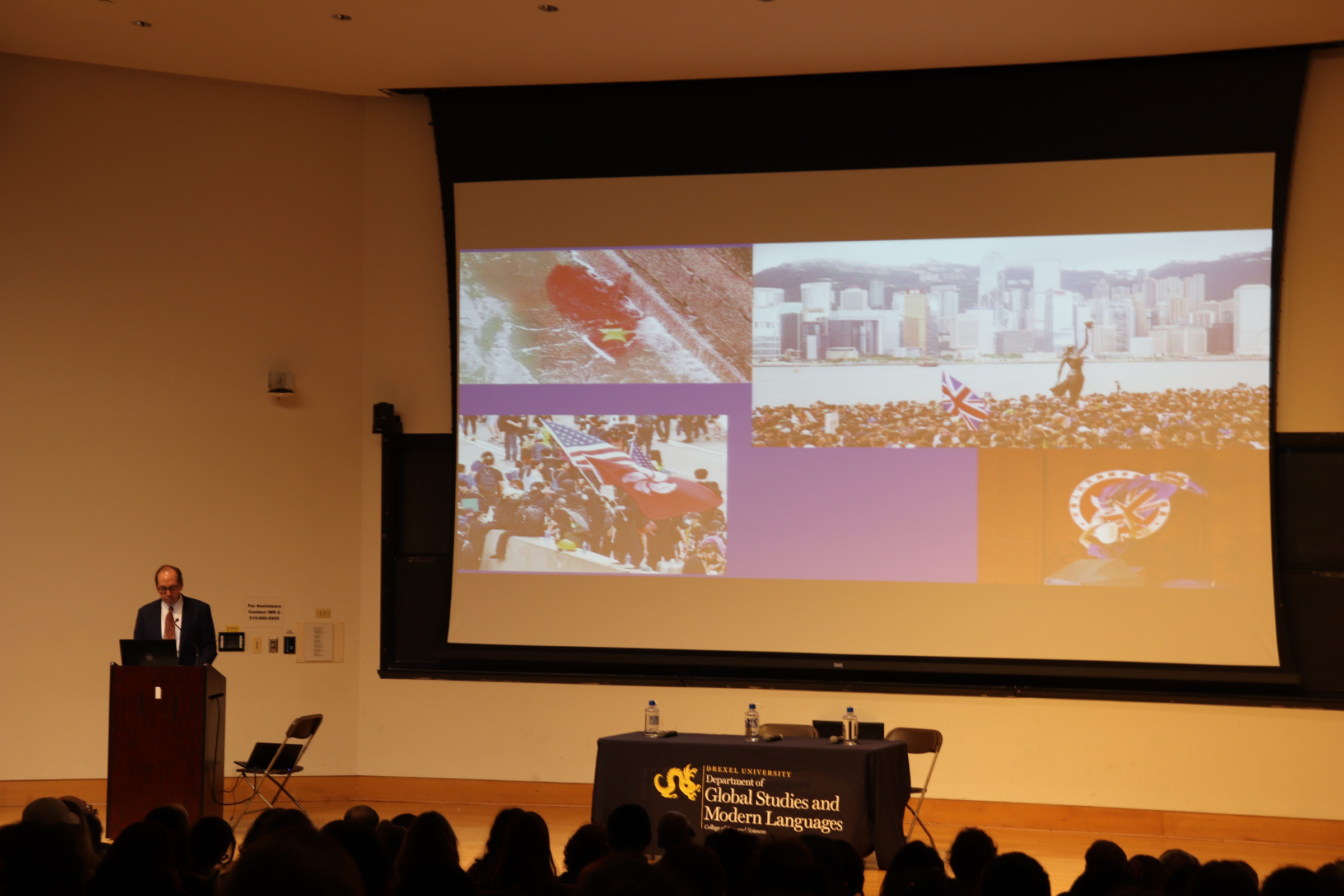
The Department of Global Studies and Modern Languages had a packed house on Tuesday, giving a full house a riveting discussion about the Hong Kong situation. (Photograph by Alexandra Pachkowski for The Triangle.)

The evening of Oct. 29 there was a Global Passport Series event with panelists Jacques deLisle and Rushan Abbas, along with moderator and director Rebecca Clothey, to start a conversation about the contemporary issues of China from an academic and activist perspective. The annual series is organized by the Department of Global Studies and Modern Languages, with the end goal being to facilitate discussions about global issues here at Drexel and in the city of Philadelphia.

Jacques deLisle’s research and teaching focus on contemporary Chinese law and politics, including legal reform status of economic and political change in China. Along with being a professor of political science, deLisle is the director of the Center for East Asian Studies at the University of Pennsylvania and director of the Asia program at the Foreign Policy Research Institute.

He frequently serves as an expert witness concerning PRC law and government policies and is a common advisor for legal reform in China.

Kicking things off, deLisle began with a greeting. “I am grateful to be here and have an opportunity to talk about quite [a] difficult time in Hong Kong,” he said. “It has been a truly remarkable period that began several months ago…over troubles …in Hong Kong on governance and politics.” DeLisle also stated that over two million people have marched in protest, which has caused wars between police and organizers. As of mid-summer this year, organizers have formed a quasi-militia to protect themselves. This leads to the question as to why.

DeLisle explained that “it started with a minor start, a young Hong Kong couple went on vacation in Taiwan. They had a bit of a lover’s quarrel, and he killed her.” He continued the story, saying the man made it back to Hong Kong without getting caught. But it does raise the question as to whether or not the man should be sent back to Taiwan for prosecution.

While Hong King went back under China’s rule in the 1990s, it is semi-autonomous, thanks to the 1997 principle of “one country, two systems.”

As it was pointed out by deLisle, “people would not be extradited from Hong Kong and withstand trial in China due to Hong Kong’s policy that it would keep its own policy, law, social and economic systems in place for the next 50 years.”

Carrie Lam — the chief executive of Hong Kong — used the murder to push the 2019 Hong Kong extradition bill. The bill’s effect would make it so the people of Hong Kong could be handed back to the mainland or Taiwan, both designated parts of China. Lam pushed this bill through the legislators, and pushback began to pick up because the citizens believed it would worsen the criminal justice system in China. They believed the bill has the potential of having politically-motivated persecution, which could lead to unfair trials in mainland China along with Taiwan and Macau.

Protests in China have attempted to appeal internationally by waving the United States Flag and creating signs asking President Trump to aid their cause, the most notable being the June 9 protest, which included over 1 million protestors. However, China and Hong Kong both agree that the protests trying to appeal internationally is a violation of their domestic internal affairs and has nothing to do with foreign powers.

On July 1, students in Hong Kong forcibly moved fellow students and protestors out of the Chinese legislature complex after protestors occupied it for several hours on the anniversary of the 1997 convergence of Hong Kong and China.

After mass protests, the bill was removed Sept. 4 by Carrie Lam. However, the protests remain ongoing due to the other commands the protestors are asking for. The first demand, deLisle said, was “dropping charges against protesters who were arrested,” which is under the belief that citizens were exercising their right to protest. They are also asking for the use of calling their advocacy “protests” instead of the term “riots” by government officials. Using the correct term can save an individual up to 10 years in prison.

This five to six month protest has shown the endurance of the Hong Kong protests, and as deLisle pointed out, even with the increasing rate of  “incarceration, physical harm and even death.”

After the extradition bill was withdrawn, the protestors have switched to advocating for a more democratic political system in Hong Kong while getting Carrie Lam to resign, with no signs of stopping until more change is made.

Posted in UncategorizedComments Off on Drexel GPS: bridging the gap about Hong Kong protests

Drexel boasts the largest periodic table in the east

The larger-than-life periodic table was photographed via drone, and the top-down photo allows for the individual creation of each element to shine through on the table. (Photograph courtesy of Jarek Krol.)

Not only was it National Chemistry Week was last week, but it is also the International Year of the Periodic Table in 2019. While those two facts are unknown to many, Drexel Chemistry Graduate Student Association certainly took note to it. What did they do with they knowledge? They only made the largest periodic table on the east coast, you know.

DJ Hall, president of ChemGSA, emailed The Triangle about this odd, yet interesting, feat. The 135  feet by 100 feet periodic table is worth talking about out of sheer  notability, and this achievement opens the door to better understand ChemGSA and the Drexel Undergraduate American Chemical Society.

The two student organizations worked together to honor the 150th anniversary of Dmirti Mendeleev’s creating of the current periodic table. After talking to Hall some more, he was able to give me some insight into why the two organizations decided to take a stab at such an ambitious project.

Upon being asked about why the giant periodic table was created, Hall simply said that the two organizations “wanted to bring awareness to the International Year of the Periodic Table and ACS National Chemistry Week.” The goal of this giant table isn’t designed just to look cool, but rather, it is built to inform others.

What’s even cooler about this larger-than-life installation is that students from both organizations put their own designs for each of the elements. Through this creative process, the designers got to learn more about the history behind each element and how they were named, along with the modern uses for the elements and their importance to the current day. This venture proved to be informational for people both in and out of the organizations, showing the levels that new knowledge can be acquired on.

Diving into how such a large periodic table was created, Hall had a lot of information to give regarding the process. In terms of time, Hall explained that “elements were painted over a period of three weeks. Some people wanted to make something more artistic and took days to finish their element, some people just wanted to paint the element’s symbol, and that took anything from 30 minutes to two hours.” With elements being finished in varying stages of time, the organizations were given plenty of time to prepare for the piecing together of such a large object.

Once all the elements were finished, the periodic table itself took mere hours to be put together. However, since it was pieced together outside, Hall did mention that the wind proved to be an adversary against the project. Thankfully, there were many chemistry books that were used as paperweights.

While it may seem intuitive for the graduate students and the undergraduate students of the Drexel chemistry organizations to work together frequently, this was actually the first collaborative event that ChemGSA and Undergraduate ASC have had together. Thanks to the new editorial board of ChemGSA, new goals for the organization include working with the undergraduate ASC more and have the two groups channel their missions to be one united front for chemistry.

While The Triangle did get a lot of information regarding this project, many other sources are covering this collaboration. The periodic table will also be featured in Drexel Magazine, ACS Chemical and Engineering News — a weekly, nationally published ACS magazine — and Drexel’s College of Arts & Sciences will have the photo of the periodic table featured in many newsletters.

Posted in UncategorizedComments Off on Drexel boasts the largest periodic table in the east

Wishing good luck, saying goodbye to Provost Blake

Photograph courtesy of Wikipedia.

The role of the provost at any university is paramount in shaping the mission, standards and culture of the institution, and the departure of Drexel’s very own Provost M. Brian Blake will certainly affect each of these spheres. 

President Fry announced via a message posted to Drexel Now’s Community and Campus page Oct. 9 that Provost Blake will be leaving Drexel next month to assume the provostship at George Washington University in Washington, D.C., under the presidency of Thomas LeBlanc, one of his colleagues during his previous tenure at the University of Miami. 

Provost Blake received his Bachelor’s degree in electrical engineering from the Georgia Institute of Technology, his Master’s in electrical engineering from Mercer University in Macon, Georgia, and his doctorate information and software engineering from George Mason University in Fairfax, Virginia.

The office of the provost, located in Drexel’s Main Building, is often the hub for many executive decisions regarding the university’s academic operations, including setting the agenda of different academic priorities and the allocation of funds, in collaboration with the president. This includes the decision of adding and eliminating teaching positions, approving tenure and overseeing each of the schools within the university. 

In addition to fulfilling these responsibilities, among many more, Provost Blake has been at the forefront of a variety of other initiatives at Drexel, including his advocacy for the creation of the Drexel Areas of Research Excellence program and the Market-Driven Academic Program Ventures program. 

The Drexel Business Solutions Institute, Center for Functional Fabrics, Weight, Eating, and Lifestyle Science Center, and the University’s first Teaching and Learning Center can all be owed in part to the work of Provost Blake. Blake was also instrumental in rolling out Dragon ‘24, an initiative that bolstered exceptional student engagement and representation in executive settings. 

The provost’s office, under his tenure, was also responsible for establishing new spaces dedicated toward fostering research and collaboration in the College of Computing and Informatics, the School of Education, School of Biomedical Engineering, Sciences and Health Systems, and the College of Nursing and Health Professions. Although CoAS did not receive additional spacing allocations — despite being home to a sizable proportion of the undergraduate population — the university did undergo the acquisition of various properties and enter a plethora of partnerships. 

Dr. Paul E. Jensen, the current dean’s chair at the LeBow College of Business, will assume the role of interim provost with Professor Vibhas Madan, PhD becoming the interim dean at LeBow. 

Provost Blake was previously the vice provost at the University of Miami under then-provost LeBlanc, the former who has since assumed presidency at George Washington University in 2017. 

LeBlanc has since announced a new innovative strategy for enrollment, a challenge faced by Drexel, which reached unprecedented levels in 2016. The effects were largely mitigated by efforts taken in part by the office of the provost, led by Blake who was also led to formulating a solution which was eventually adopted. 

On a personal note, Provost Blake’s wife has family in Washington, DC. Other positions held by Provost Blake include dean for research and graduate studies at the University of Notre Dame’s College of Engineering and chairman of Georgetown University’s Department of Computer Science. 

Posted in UncategorizedComments Off on Wishing good luck, saying goodbye to Provost Blake