What if waste wasn’t viewed in such a negative light? What if waste could be repurposed? How can the United States change moving forward? If you attended The Waste Conference last week, you would be confronted with these questions and their answers.
The Office of Global Engagement at Drexel University hosted the 13th Annual Student Conference on Global Challenges Thursday, Feb. 27 and this year’s topic was “waste.” Hosted in the Grand Behrakis Conference Room, this year’s conference began with an introduction from Vice Provost Janice K. Marini, featured keynote speakers Tony West and Nic Esposito, had six student panel sections and concluded with a student poster presentation and awards reception.
The Student Conference on Global Challenges has been an annual event since 2008 and offers students a chance to learn about a significant issue, network with professionals and present research of their own. This year, the topic was “waste,” but recent years’ themes have been “creativity and innovation” (2019), “climate and the environment” (2018) and “crossing borders” (2017).
The first keynote speaker was filmmaker Tony West, who took a detour from sports videography to produce a documentary called “The Safe Side of Our Fence.” In it, he looks at the nation’s nuclear footprint and how communities have been affected by our nuclear endeavors. Since the Manhattan Project in the 1940s, thousands of workers’ lives have been risked due to the mishandling of radioactive waste. West talked about ways to ensure the safety of workers and protect the environment in future nuclear projects.
The second keynote speaker, Nic Esposito from Philadelphia, talked about the city’s Zero Waste by 2035 goal. As the name suggests, the plan is to divert all trash away from landfills and incinerators and instead promote an economy of reusing and recycling.
The audience’s biggest complaint, however, were the rumors that Philadelphia’s recycling often ends up in landfills and incinerators because it is too expensive to export it to the correct facilities. Esposito claims that the City of Philadelphia has since entered into a new contract which dictates that recycling does go to a plant for processing. However, he claimed that the new deal meant that only goods labeled with the 1, 2 or 3 symbol are eligible, meaning that plastics with codes 4, 5, 6 and 7 will not be recycled. This means that many plastic cups, bags, bottles and straws are not currently recyclable but food packaging, shampoo bottles and water bottles are.
Esposito said that more social changes are needed to achieve this goal: the public must be further educated about recycling, the status quo about waste in society must be changed and public trust in government initiatives must increase.
Additionally, during a panel about local community solutions and innovations to reduce waste output, student Tim Hanlon on the USGA Sustainability Committee spoke about Drexel’s initiatives. Some of the major changes on campus have been the introduction of the Cupanion water bottle, the Ozzi reusable takeout container for the Handschumacher Dining Center and the biodigester. By liquifying food waste from the dining halls, the biodigester is able to harness energy for electricity and heating in the city. Hanlon is also calling for an Office of Sustainability at Drexel in order to continue pushing change for waste reduction.
Following up on last week’s article about asbestos in public schools across Philadelphia, Marie Mastrobattista from Westphal College of Media and Design spoke on a panel about creating sustainable learning environments. She claimed that the lack of windows, asbestos and lead-ridden paint in outdated public schools are hindering effective learning. As a solution, Mastrobattista proposed the idea of a multipurpose community school in which kids attending would have access to education, recreation, meals and childcare.
Finally, the day concluded with a student poster session and awards. Projects ranged from fair trade solutions to using social media to promote waste reduction. One project, by student Milan Mahesh in the College of Arts and Sciences, was Medical Recycling. Introducing the concept of cleaning and repurposing medical devices, medical recycling can help eliminate a significant amount of biowaste in landfills.
The event concluded with awards for each of the panelist sections, who will be funded by the Office of Global Engagement in order to move forward with their proposals.
Posted in UncategorizedComments Off on Global Challenges didn’t “Waste” anyone’s time
71 residents of North Philadelphia shopped for clothes at the Church of the Advocate the morning of Feb. 26. But this “pop-up shop” is no ordinary clothing store.
Community members headed to 1801 Diamond Street — this week’s pop-up location — to find new clothes. However, this traveling store does not charge for its clothing. Rather, each shopper is given a numbered ticket based on the order in which they arrive and allowed to choose five free items.
Our Closet was founded in 2011 by Jill Aschkenasy when the house of a Philadelphia family was destroyed in a fire. She reached out to her network to ask for donations for this family. Our Closet was born when she realized that there were more people whose stories remained untold and were in need of help.
Shauna Ekezie, program manager of Our Closet, explained that so many people are focused on securing food, housing, employment and other needs and simply cannot afford new clothing. The organization provides clothing without barriers, said Ekezie, as many other organizations have certain requirements in place in order to receive service, which many families that Our Closet serves do not meet.
Some families have two parents with full-time jobs but still struggle to make ends meet. Some people have just come out of incarceration and need formal attire for job interviews, or they were incarcerated during the summer and released in the winter without proper seasonal attire. Other individuals may be retired on a fixed income, with little or nothing left over after taking care of monthly expenses. As Ekezie said, “Just being able to bridge that gap between excess [clothing] and need without any requirements definitely relieves some of the stress our shoppers may be experiencing.”
Our Closet started in Jill Aschkenasy’s garage. Today, the organization is powered by the Jewish Family and Children’s Service of Greater Philadelphia and seeks to provide clothing to those in need. The organization has expanded to 18 locations and is equipped with a driver, two additional part-time employees and a warehouse.
Shoppers are given a dignified shopping experience complete with a “check-out,” where volunteers keep track of all the clothing and items being distributed. Our Closet relies on help from volunteers and clothing donations.
Volunteer Jane Bryant, who has requested that her real name not be used, says she used to shop regularly at Our Closet while she cared for her mother, who had dementia and struggled with depression. On top of this, Bryant waited 15 years for housing from the city of Philadelphia.
But she wanted to give back to the organization that helped her get back on her feet. “Since I volunteer I’m better with myself and with God. And I love myself more now that I come down and volunteer… Our Closet has saved my life,” Bryant said.
Our Closet pop-up shops run during various times and locations throughout Philadelphia. Specific dates and volunteer opportunities can be found at www.ourcloset.org.
Posted in UncategorizedComments Off on Our Closet pop-up has clothes for North Philly
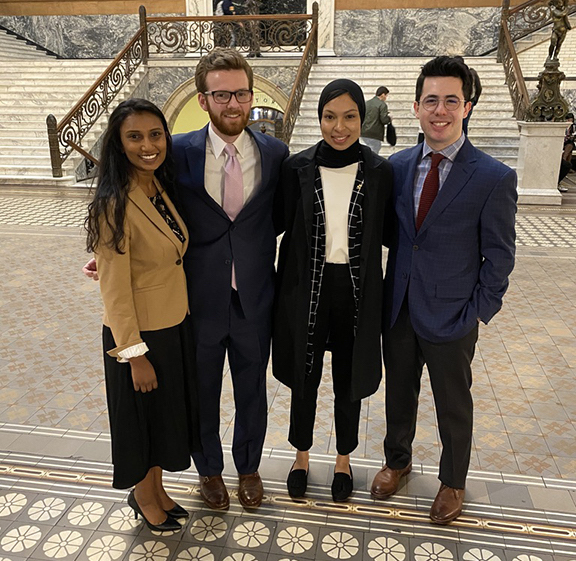
The Drexel University Student Government Association’s sustainability leaders posed for a photo in Drexel’s iconic Main Building. (Photograph courtesy of Timothy Hanlon.)
Members of the Drexel University Undergraduate Student Government Association are advancing in their fight for more sustainable practices on campus, having garnered support from thousands and formally proposing an Office of Sustainability to a group of University administrators.
Timothy Hanlon, a junior biology student, currently chairs the USGA’s sustainability committee, an ambitious group of nine who are spearheading efforts to instate an administrator dedicated entirely to overseeing Drexel’s sustainability measures.
The committee most recently drafted a revised, 35-page proposal of 12,000 words arguing for the necessity of an Office of Sustainability. Katy Indvik, Policy Engagement Specialist within the Dornsife School of Public Health, contributed to the proposal.
A petition of support is also circulating online and has already received over 2,000 signatures from faculty, staff, alumni, student organizations and community members.
“In total, we have the support of over 2,000 people to make this [sustainability] office happen,” Hanlon said. “Notably, we have signatures from Dean Cohen of the Pennoni Honors College and an individual from the Swarthmore Sustainability Office.”
The revised request for an Office of Sustainability comes after a proposal by the sustainability committee was denied last year, Hanlon said. The initial proposal was shorter and focused on the sustainability work that the USGA had done, but lacked other information, like statistics and the efforts made by community members.
“The initial proposal … [for an] Assistant Director of Sustainability was much less extensive than this new, revamped version,” Hanlon said. “With this new proposal, we tried to take a much more holistic approach to represent some of the work that Drexel students and student groups along with faculty [and] staff and various community members are undertaking.”
More statistics are included in the revised proposal, emphasizing Drexel’s sustainability ranking among other institutions and how the Office of Sustainability would be structured and funded. The committee also responded to the concerns and pushback they have received.
Drexel is a member of the Sustainability Tracking and Rating System and in comparison to its “peer” institutions, like the Community College of Philadelphia, Montgomery County Community College, University of Pittsburgh, Villanova University and West Chester University of Pennsylvania, Drexel falls short.
Pitt, Villanova and West Chester have all identified dates by which their campuses plan to be entirely carbon neutral. Drexel has not yet set its deadline, Hanlon said, and, by lacking in sustainability efforts, is not fully honoring the university’s mission.
“Drexel continuously claims to be the most civically-engaged university in the entire country,” Hanlon said. “But I believe that is an immense disservice to a large number of other universities across the nation because of our lack of commitment to the environment.”
True civil servants do things for the greater good, Hanlon explained, and this includes taking the initiative to create and carry out more green, sustainable practices. But failing to measure up to the University’s mission is not the biggest consequence Drexel is facing.
“The Princeton Review reported in 2019 that [64 percent of college applicants] said having information about a college’s commitment to environmental issues would contribute to their application decisions, with [23 percent] indicating it would contribute strongly,” Hanlon said.
If Drexel continues to remain silent about its sustainability efforts, it will isolate itself from these prospective students. Hanlon said further promotion and public display of Drexel’s accomplishments is a good way to combat this issue.
“I think it is important to note that … Drexel does a significant number of things [in regard to sustainability] and each day, I learn of new things students and various groups are doing,” Hanlon said. “[However], the University does not publicly display the [sustainability] efforts in a coherent, showcasing way. [So], in the eyes of an outsider, … Drexel is lacking.”
In an attempt to spread the word about Drexel’s efforts, the USGA is currently developing a coalition for all students, student groups, faculty, staff and anyone in the university community to meet and discuss the sustainability measures being taken on campus. This will present the opportunity for feedback and campus-wide dialogue.
The second way that the USGA wants to spread the word is by establishing an Office of Sustainability. Their proposal to upper-level administrators was given March 2.
In attendance were: Subir Sahu, Senior Vice President for Student Success; Scott Cooper, President and CEO of the Academy of Natural Sciences; Lucy Kerman, Senior Vice Provost; Don Liberati, Assistant Vice President of Business Services; Donald Moore, Vice President of Real Estate and Facilities and Erin Horvat, Senior Vice Provost.
“While there was tremendous support for our proposal [by the attendees] and all of the work students have achieved, … the room was split on what exactly to do next,” Hanlon said. “Some of the members were very vocal in their stance to create a position for an administrator for sustainability, while others seemed to be less convinced.”
The attendees agreed that the USGA has done “way too much,” Hanlon said. But it is committed to doing that much — and more — until Drexel makes strides in a greener direction for itself. The USGA wants to see tangible action.
“In some instances, groups have worked on the same or very similar projects that could have been further amplified if they combined energy and resources,” Hanlon said. “By having a centralized administrator for sustainability and eventually an office, we will [hopefully] be able to avoid this duplication and save resources in doing so.”
The Office of Sustainability would ensure continuity and consistency that is currently lacking at the administrative level, Hanlon explained.
USGA is calling on Drexel to notice the effort and support of so many members of the community who are passionate about bettering the university and the environment. Hanlon is urging Drexel to see, within the proposal, the science it is teaching in its own classrooms and discovering in its own laboratories.
“This proposal and its content would not be possible without the great work of many students, student groups, faculty [and] staff and other community members,” Hanlon said. “We feel that, while the proposal was written by the USGA Sustainability Committee, the proposal is on behalf of all of those who take some stake in the future of sustainable practices not only on this campus but in the greater global community.”
According to Hanlon, the City of Philadelphia and Temple University’s sustainability offices have said Drexel is the “missing puzzle piece” in terms of Philadelphia’s sustainability. Drexel misses out on opportunities for conversation because it is lacking an Office of Sustainability.
“[A.J. Drexel] founded Drexel on an underlying foresight that bears true today,” Hanlon said. “Educational institutions are the grounds for progress and advocacy on behalf of the local, national and global community. To fulfill its role as a socially-responsible institution, it is imperative that Drexel seeks opportunities to contribute to a more sustainable city and globe.”
Posted in UncategorizedComments Off on The USGA sustainability petition is making waves
The repurposed garage doors of Herman’s Coffee with the brick facade make for a quaint neighborhood spot. (Photograph by Ben Ahrens for The Triangle.)
Coffeehouses, coffee shops, roasters and coffee bars are plentiful in Philadelphia. If you asked a random selection of Philadelphians what their favorite coffee spot was, there would assuredly be a mixed bag of answers — presumably dependent on where they lived and where their work was.
Of course, there would be the assured Wawa coffee answer from many respondents. This is not to say that Wawa coffee is bad, and it most certainly is not saying it doesn’t serve a vital role in the Philadelphia coffee community, but there’s a whole lot more out there for the coffee junkies and java aficionados alike.
If you’ve walked around Philadelphia anytime in the past fifteen years, odds are high you’ve seen the logo of a cup of coffee being seemingly lifted by a hot air balloon of its own steam. If you can say you recognize this niche and charming logo, you’ve seen a Saxbys before.
Back in 2005, Nick Bayer was only five years out of his college experience at Cornell University when he opened his first-ever Saxbys. Now, in 2020, Saxbys has 24 locations in multiple states and Bayer is striving to expand Saxbys more.
The biggest thing to Saxbys’ name, aside from their coffees and food offerings, is the fact that they are more of a social impact company than they are a coffee company. There are many Saxbys locations that are entirely student-run and operated, and this Experimental Learning Program began in 2015 at Drexel University.
Five years later the ELP now reaches from Drexel and Temple to Penn State University, Bowie State University, University of New Hampshire and Georgia State University.
Every Saxbys delivers a slightly different menu, but the mainstays right now seem to be their chai and their ruby chocolate matcha.
From here, the Philly coffee scene dives into many local spots doing a lot of things right, and it can seem tad overwhelming and confusing to break it down. Is it really worth trying all of them? What if there’s one you already love and you’re afraid to find a new place for coffee in the city? What if your neighborhood coffee shop isn’t as great as you think it is?
All of these are valid concerns, but just in case you find yourself in a new part of the city and craving a really good cup of coffee, you’ll know just where to go. The first spot that comes to mind is a place I personally frequent due to its proximity to where I live, Ultimo Coffee.
Ultimo Coffee has four locations: one in Rittenhouse Square, one in the Graduate Hospital neighborhood, one in the Newbold neighborhood of South Philly and one off in Germantown.
Photograph by Ben Ahrens for The Triangle.
Ultimo has been roasting in Philadelphia since 2009, when they began in their South Philly location, and their coffee is downright delicious. In 2016, Ultimo unveiled Ultimo Coffee Roasters, and has since been able to “select and roast their favorite coffees, and then deliver that fresh coffee directly into your hands.”
Get a bag of their beans, get a latte with oat milk, or just get a simple coffee. This place takes quality and service very, very seriously. Oh, and their baked goods are righteous. Lemon bars, blondies and crumb cakes made daily along with freshly stocked wholesale goods from local Philly spots make them a sweet tooth haven.
Following the mantra of coffee being treated with the highest quality and love, another spot that comes to mind is ReAnimator Coffee. Operating five locations in Philly anywhere from Kensington and Fishtown to inside the aforementioned spots Res Ipsa Cafe and Hello Donuts, ReAnimator has a stamp on the Philly food scene.
They are a wholesale partner for many places and offer a wide variety of their roasted beans and grounds on their website. If you want to visit their original spot, head to their Fishtown location.
When it comes to high quality, a lot of people favor a high review on Yelp over trying things with an unbiased mind. However, it does help when this next spot garnered over 1000 reviews on Yelp with an aggregate score of 4.7/5 stars. The place that warrants such a prestigious rating is none other than Elixr Coffee Roasters.
What began in 2010 has a lot to look back on. They’ve won the Krups Best Brew Award, they’ve been heralded the Best Cold Brew in America and they’ve placed second at several National Roasting Competitions.
Elixr is known for their lighter-roasted coffees, as they opt for the tastiest and most floral coffees they can find within the lighter roasts. They have three locations in Philadelphia while also providing wholesale to seemingly the entire Northeast corridor with no signs of slowing down.
If you want to go to their original location, just know it is harder to find than you may think. Tucked away off a side alley in the heart of Rittenhouse Square and with tables that fill up quite fast, this hide-away is worth the wait.
Another nationally acclaimed coffee spot is Square One Coffee. While based in Lancaster, they have a spot in the Gayborhood that is definitely worth a visit. The Square One team is comprised of National Champion baristas who know how to make one hell of a cup of coffee. Plus, the Gayborhood location has ample seating.
Before this article gets eternally long, I plan to simply shout out some other fantastic coffee joints to give them the respect they deserve. Philly truly is a caffeinated city, folks.
Shoutout to Black ‘n Brew in Passyunk! They are holding down the fort in southeast Philly, for real. Rival Bros Coffee Bar is highly adored, and their three locations (with at least one on either side of Broad Street, albeit all three south of Market Street) make them a little more accessible than most.
The Callowhill spot W/N W/N Coffee Bar (pronounced “Win Win”) lives up to its name for real — they are all about coffee and alcohol. Try their truly out of bounds espresso and gin if you’re down for a good time and have a curious palate. Their food also looks phenomenal. They are serving up the best of both worlds.
If you’re into jazz and coffee, Ox Coffee is the wifi-free jazz haven that allows you to enjoy music and your drink in peace. The Queen Village spot offers a back garden that is open for music and relaxation, as the co-owners Will Gross and Max Cudworth were a coffee roaster and a jazz saxophonist in previous jobs, respectively. The intersection of coffee and music is found here, so don’t skimp out on either of them.
If you’re all about the science behind the coffee, make the trip to Function Coffee Labs. They dive into the science behind the brews and are the closest thing to a seasonally fresh coffee shop you can find. Their rotation changes every one to two weeks, and it’s remarkable to see how different your cup can taste from one visit to the next.
Another Queen Village coffee spot doing things right is Shot Tower Coffee who, while also heavy in the coffee game, boast an equally varied and respected tea game. The coffee and tea debate can be put to rest peacefully at Shot Tower.
If you want to respect the high-end restauranteur with his coffee escapade, go to Vernick Coffee Bar. Greg Vernick is the highly-esteemed chef of Vernick Food & Drink and its accompanying outposts, but his coffee bar is also as high-quality as everything else.
Saxbys’ own Nick Bayer reveals he is still inspired by Vernick Coffee Bar to this day, so Greg Vernick and his teams get the respect of everyone in the Philly food scene, with good reason. Vernick Coffee Bar also has a full service 40-seat cafe, operating out of the Comcast Technology Center every Monday through Friday from 7 a.m. to 5 p.m.
For the classics out there, Old City Coffee is the place. With two spots located in the Reading Terminal Market and a properly located spot in Old City, Old City Coffee does Arabica coffee the right way. They have been pouring good cups for over 35 years, and time really is the truest test of all.
If you’re a cross of a bibliophile and coffee lover, Rittenhouse’s Shakespeare & Co. is the place for you. Peruse the giant collection of books — or purchase a mystery book that is wrapped with only a vague description — to find the perfect book to pair with your coffee.
Photograph by Ben Ahrens for The Triangle.
However, the winner of this week’s hidden gem award and the final mention in Philly’s coffee extravaganza is Herman’s Coffee — the Pennsport jewel serving real-deal coffee out of a repurposed garage. Open every day of the week from 6 a.m. to 6 p.m. and 7 a.m. to 6 p.m. on the weekends, Herman’s is the quintessential neighborhood spot that everyone knows to love.
When the weather is nice in the summer, Herman’s’ owner Mat Falco — who roasts the coffee onsite — opens the garage doors and lets Herman’s Coffee take in the sunshine. They offer fresh baked goods from Machine Shop Boulangerie — a French-influenced, south Philly located, small-batch & wholesale bakery — every single day. On the weekends they bring in food trucks to set up shop outside their space.
Oh, and they have the truest hidden gem of all — 1-900 Ice Cream is stocked here. This hard-to-get pre-ordered ice cream project was created by the founder of the now-closed Boku Supper Club, Ryan Fitzgerald. The man behind the popular underground dining experience is now aboveground and becoming a mastermind with his downright bonkers flavor creations.
Ice cream tangent aside — more will be discussed about 1-900 Ice Cream next week. Herman’s Coffee is doing their thing and their consumer base is here for it.
While that’s all on the coffee scene in Philly for this article, there’s truly so much more to it than you know. Go out and find your own brew, you cannot go wrong with so many good choices. Here’s to living in a city that loves its cup of joe.
Posted in UncategorizedComments Off on Pouring into Philly’s coffee
The Board and Brew has recently opened near Chestnut and 32nd Street in hopes of providing a new space for students to “#eatdrinkgame,” as said by General Manager and Drexel Alumni, Mark Robuck.
Robuck explained how, at The Board and Brew, the environment creates an atmosphere which encourages socialization with great hospitality. Robuck said that this is something that has been lacking in recent years with the dependence on cell phones in social settings.
“You look up from your phone, and they’re either looking at their phone or planning to, and there’s not as much social interaction. So what do we use to get around that? Excellent food, award-winning coffee, a craft cocktail menu, a craft beer menu, along with wines and tah da da da! Board games!” Robuck said.
He said playing games with friends is a unique social interaction which combats the barrier phones have been creating. They aim to add the “one-on-one conversation aspect,” back into going out for dinner or drinks with friends.
The restaurant, which has both a downstairs and spacious upper level, houses over 500 board games that are available to rent for $5 for unlimited games. Robuck said that they hope to collect 750 games over the time they are open in University City. There is also an option for patrons to bring their own games to the restaurant.
Robuck wanted to have a place where an individual could play a new game every single day. He added that, upon request, The Board and Brew will seek out any games they do not have in their library that a customer may want.
The Board and Brew will be hosting themed nights in the near future. These will include “Meet-Up Mondays” that will use the app “Meet-Up,” which publicizes activities to do in the area to encourage customers to meet new people and play games at the restaurant.
They will also have tournaments on Tuesdays, which will have both weekly prizes and seasonal prizes. Wednesdays are wine with card games, and Thursdays will be trivia nights. Robuck also included that Sundays offer a half-off discount to family and friends of staff members when they game and dine together.
Robuck said that in the three weeks they have been open, there are already regulars who have been enjoying The Board and Brew’s menu and several board games. He added that they offer punch cards which are being utilized by groups and students who have made this restaurant their new spot on campus.
“Friday night, we have a group of 15 or 20 who come in … They want to be here every Friday, they have a blast with it, too!” Robuck said.
Menu items stay within the American pub food style with a few exceptions, such as a falafel and hummus platter, and the dish Robuck especially highlighted — the pesto chicken. He also added that the breakfast menu runs from open to close.
As for drinks, Robuck described the menu as being, “traditional with a twist.” The Board and Brew has several coffees — including a Kyoto cold brew — which takes 24 hours to make. They also have traditional coffees, espressos and teas.
“These are single-origin, unique coffees that we really care about,” Robuck added.
The Board and Brew also offers several alcoholic beverages. As of right now, the menu has beers, wine and cocktails which will most likely be unveiled this Friday.
Robuck closed in saying how much he appreciates being a part of the Drexel community and wants to add to the student life with The Board and Brew which provides a space for gaming, studying and just having a “good, wholesome time.”
Posted in UncategorizedComments Off on The Board and Brew wants you to eat, drink and game all day long
The West Philly community is seeing house prices rise and white neighbors move in, but at what cost? (Photograph by Ben Ahrens for The Triangle.)
The slow advancement of gentrification in West Philadelphia appears to have reached 52nd street, and many West Philly locals are unhappy. Talk of proposed improvements to the area and attempts to make it safer presented by urban designer Jonas Maciunas was met with fears of gentrification by West Philly residents.
There is a palpable concern that gentrification will eventually replace historically black communities with white wealth. With rising house prices forcing previous residents to move, these efforts make them feel like strangers in their own homes.
According to the Philadelphia Inquirer, some residents around 52nd Street receive weekly mail about selling their homes. It’s not just about money either, as one West Philadelphia resident stated, “When neighborhoods are gentrified, you lose any semblance of culture or identity that was previously there because people moving in want it to look a certain way”.
The unofficial segregation seen in parts of Philadelphia — especially in West Philadelphia — can be explained by the historical process of redlining. Redlining was a practice that occurred after the introduction of the new deal housing acts in the 1930’s that systematically denied credit to minorities within inner city neighborhoods based on the belief that lending to minority residents was risky and that the presence of black and Hispanic residents and was synonymous with neighborhood decline.
“Residential Security” maps produced by the Home Owners Loan Corporation (a New Deal project) to guide investment, drew red lines around large neighborhoods were deemed “hazardous”, was practiced by federal and private agencies alike. The process of redlining, combined with the phenomena of white flight in the post-war boom has resulted in the deprived, minority areas throughout Philadelphia, with many still feeling the repercussions today, despite the outlawing of redlining in 1968.
However, since white suburban populations have begun to move back into the city, gentrification has started to push people out of the areas that have been their homes for decades. The areas many Drexel and Penn students live in now — especially Powelton Village and Mantua — were historically redlined and in an area known as “D20”, which was graded “D” for hazardous, with no chance of recovery.
While Mantua is still considerably deprived, Powelton recovered from redlining and has since been gentrified, now a popular student area.
Carol Morris, a retired teacher, stated to the Philadelphia Inquirer “Drexel, Penn, they’re all branching out and they’re all pushing for the neighborhoods to change so that their students will feel safe.”
Many West Philadelphia residents fear that 52nd Street is next in the line of sight for Philadelphia’s gentrification.
The area around 52nd Street is a clear example of the redlining process. 52nd Street was once known as West Philadelphia’s main street and was a rich cultural and business hub for African-Americans in the early 20th Century. However, the practice of redlining prevented the building of wealth and, particularly in the last 20 years, rates of high crime have doubled and the street is a far cry from what it used to be.
These attempts to improve the area and make it safer may be well-intentioned, but residents are concerned that it will result in further discriminatory practice as they are forced to find more affordable places to live or lose the character the area once had.
Residents have acknowledged the potential benefits to redevelopment efforts in the area. Talking to the Philadelphia Inquirer, local resident Serita Lewis stated “I’m not opposed to making sure there’s socioeconomic development — I’d be a fool to not want it.” However, residents are vocal about their desire to maintain their place in the community and want a say in how these redevelopment plans play out.
History has given Black communities in Philadelphia every reason to be unsure and skeptical about redevelopment plans, as these are the communities that have so often been abandoned by city governments or subjected to projects that ignore the voices of those who live there.
Posted in UncategorizedComments Off on Gentrification in West Philly continues to spread
The 2020 People of Purpose included nine recipients who proudly commit their lives to service and purpose. (Photograph courtesy of Craig Schlanser.)
As Roberta Perry — the Assistant Director of the Marketing and Communications Department at The College of Nursing and Health Professions — addressed the audience of the 2020 People of Purpose event, she chose to rely on the words of a great author to pass on her message.
“Mark Twain said that the two most important days in your life are the day you were born and the day you find out why.”
Perry was speaking at an event where individuals were being recognized for the efforts they have put forth, and it only seemed fitting to use a quote that so aptly described the importance of finding the meaning of life.
Perry added on her own sentiments, saying “what a blessing it is to have these individuals who figure this out so early in their lives as part of the college community.”
On Friday, Feb. 21, 11 people were honored for their outstanding demonstrations of purpose and service in their daily lives. The College of Nursing and Health Professions set out to tell the College’s “story” in 2018 by honoring the extraordinary lives of the students, faculty, staff, alumni, and community partners within the CNHP.
2020 is the second year that the College has recognized community members with the People of Purpose award. This year, stories ranged from a Drexel alumnus who is now making a difference in his field to a professor who is doing groundbreaking research in hers.
Chosen for her story of overcoming cancer and dedicating her life to helping others do the same, staff member Marcia Penn gave the closing speech. She discussed her 1999 cancer diagnosis and the treatment process she went through: a lumpectomy, four rounds of chemotherapy, and 30 days of radiation.
She had a two-year-old son at the time and knew that she needed to be there for him.
“I surely experienced some pain and suffering,” said Penn, “but because of a loving family, caring colleagues, and a great medical team, I can stand here 20 years later, continue telling my story, and be part of a new cancer impact initiative here at the College of Nursing and Health Professions.”
“I have been touched by the lives of others through my experiences,” Penn continued, “and helping others has become my purpose every day,”
The individuals working on the project had three main goals: tell the story of the CNHP, focus on who the members of the CNHP are and the incredible work they are doing, and support the strategic goals of the College, said Perry. The selection process was tedious; first, hundreds of articles and posts were combed through in search of individuals with compelling stories.
Those working on the project also sought out nominations from community members. They were looking for people within the Philadelphia community who were motivated by a desire to heal and serve as well as advocate for those without a voice. Next, those nominated were interviewed and narrowed down to 11 people.
The 2019 and 2020 People of Purpose and their stories are displayed on the wall of the tenth and sixth floors of the College located at 1601 Cherry Street.
The exhibition is open to Drexel students and staff during business hours. The information is also available online under the “about” section of the CNHP website.
Posted in UncategorizedComments Off on Meet the 2020 People of Purpose award winners
The stage was set in the Gaillard Center in Charleston, South Carolina where the tenth Democratic Primary debate would take place. The two-hour event began at 8 p.m. on Tuesday, Feb. 25, and seven candidates qualified for it. The debate was hosted by CBS News and the Congressional Black Caucus Institute.
The debate comes three days after the Nevada caucus, which saw Senator Bernie Sanders win with 46.8 percent of the vote. Second place went to Joe Biden with 26.6 percent. Sanders became the first candidate for president to win the popular vote in the first three states. The Vermont senator is seeing a rise in multiple levels, as the latest Real Clear Politics polling average has him over 11 percent ahead of the rest of the field.
The Sanders campaign has been in the spotlight for things beyond their primary successes. A day before the Nevada caucuses The Washington Post disclosed that Russia was trying to interfere in the U.S. election by aiding his campaign. Sanders denounced Russian efforts.
He was briefed on the matter a month ago and alluded that timing of the news being released was meant to negatively impact his performance in Nevada by saying, “I’ll let you guess about one day before the Nevada caucus. Why do you think it [The Washington Post article] came out?”
In recent weeks reporters have brought up Sanders’ praise for some of Fidel Castro’s programs in Cuba. In a “60 Minutes” interview with Anderson Cooper, he addressed that just because he could applaud some of Castro’s actions does not mean that he found all of his actions commendable. On this, he said “We’re very opposed to the authoritarian nature of Cuba, but you know, it’s unfair to simply say everything is bad.”
This came after Sanders spoke out in support of Evo Morales, the former socialist leader of Bolivia who was ousted in a military coup after he sought a fourth term in power. Both instances have been used by the mainstream media and other candidates to further propel the narrative that Sanders’ democratic socialist views would not fare well in a general election against President Trump.
Tom Steyer appeared on stage again after not qualifying for the Nevada debate. Although the former hedge fund executive did not get a single delegate in the first three contests, most indications show that he is set to be viable in South Carolina. A poll was released on Feb. 22 by CBS News and YouGov has the billionaire at 18 percent in the Palmetto State. Steyer has also out-spent the rest of the field in this state.
This debate was crucial for the Biden campaign as he is third in the delegate count and has not won any of the first three states, even though he polls in first in South Carolina over Sanders by a small margin. Even though this is Biden’s third go at the nomination, he has not won a state, even back when he ran in 1988 or 2008.
Biden received the endorsement of Congressman Jim Clyburn the day after the debate. Clyburn is one the most powerful members of the House being the House Majority Whip and has been representing South Carolina in Congress since 1993.
This was Michael Bloomberg’s second appearance at a democratic debate and he had much to prove after all of the candidates criticized his record in the Nevada debate. Bloomberg did not have a prepared response for the stop-and-frisk policy that he expanded as mayor of New York City or his support of several Republican officials, including George W. Bush in 2004.
Bloomberg started the night by being the first to attack Sanders’ electability.
“Putin thinks that Donald Trump should be president of the United States,” he said, “and that’s why Russia is helping you get elected so that you lose to him.”
Early in the debate, Biden claimed that he would win South Carolina and especially the African American vote there. He later attacked Sanders for voting against the Brady Bill five times; that piece of legislation would have mandated federal background checks on firearm purchasers in the United States. Sanders followed that by addressing his D- approval rating from the NRA.
Elizabeth Warren came to defend Sanders’ progressive vision for the country throughout the night by saying they were popular but she still claimed she would be a more efficient president.
Pete Buttigieg tried to pitch himself as the safest choice for most Americans by saying that he did not want to further the status quo or tear down the system as president, referring to Bloomberg and Sanders respectively.
Senator Klobuchar also joined in the criticism, saying that he would hurt elections down the ballot for democrats because he had “alienating” policies. Sanders responded by reminding the field that his favorability rating was the highest amongst them.
Foreign policy was central to the second half of the debate where topics like the Middle East, coronavirus and China were covered. Bloomberg and Biden agreed on not letting Chinese firms build critical U.S. infrastructure. Warren used this topic to denounce the negotiations Bloomberg has with China and how he has yet to release his tax returns.
South Carolina’s primary will be held tomorrow and the state carries 54 delegates. To clinch the nomination, 1,991 delegates are needed by a candidate by the time they hit Milwaukee at the democratic national convention.
This was also the final debate before Super Tuesday on March 3, when 14 states and one U.S. territory will turn out to vote.
The next debate will be on March 15, in Phoenix, Arizona and it will be hosted by CNN and Univision. The twelfth and final debate will be in April, but other details have yet to be finalized.
Posted in UncategorizedComments Off on South Carolina’s debate left no stones unturned as Super Tuesday loomed over the candidates
The following crimes occurred on or near campus and were reported to The Triangle by the Drexel University Department of Public Safety between Feb. 10 and Feb. 24. All information included in this report is taken from law enforcement or Division of Public Safety incident reports.
SEX OFFENSE (1)
Feb. 15, 3:30 p.m, 5500 Market Street
A non-Drexel complainant reported an unknown male groped and touched them inappropriately while on a SEPTA trolley. DUPD apprehended a male a short distance away.
BURGLARY (1)
Feb. 11, 3:30 p.m. to 5 p.m., 3200 Powelton Avenue
A Drexel student reported that unknown person(s) entered their apartment with no sign of force and took their Macbook.
ASSAULT (1)
3200 Spring Garden Street
A non-Drexel complainant reported that after a verbal dispute with a known individual, the complainant attempted to enter the offender’s vehicle and was knocked to the ground by the offender and their vehicle.
THEFT (17)
Feb. 10 to Feb. 12, 3000 Market Street
A Drexel student reported that an unknown person(s) took their bicycle that was secured to a bike rack with a U lock.
Feb. 10 to Feb. 11, 3000 Market Street
A Drexel student reported that an unknown person(s) took their bicycle that was secured to a bike rack with a lock.
Feb. 12, 3400 Market Street
A non-Drexel complainant reported that on an unknown person(s) entered their auto, no sign of force and took a backpack that contained their laptop computer.
Feb. 12, 3100 Spring Garden Street
A non-Drexel complainant reported an unknown person(s) took their iPhone that was left on a table in a common area of a building.
Feb. 16, 3000 Market St.
A non-Drexel complainant stated that on an unknown male fled the store with food items that he failed to pay for.
Off-Campus
A Drexel student reported while in a store off-campus, they placed their phone on a counter and returned a few minutes later to discover it missing.
Feb. 18, Arch Street
A Drexel student reported that they left their wallet unattended on an athletic field and later discovered it was taken by unknown person(s).
Feb. 19, 3400 Lancaster Avenue
A non-Drexel complainant reported a group of juveniles entered the store, took food items and fled the store without paying.
Feb. 19, 3400 Lancaster Avenue
A non-Drexel complainant reported a group of juveniles entered the store, took food items and fled the store without paying for the items.
Feb. 22, 3400 Lancaster Avenue
A non-Drexel complainant reported two males took food items from the store and fled without paying for the items.
Feb. 22, 3400 Market Street
A Drexel student reported that as they were exiting the SEPTA station, an unknown male grabbed her phone from their hand and fled west on Market Street.
Feb. 22, 3400 Chestnut Street
A non-Drexel complainant reported an unknown male entered the lobby of a building, took a TV from the wall and fled the building.
Feb. 23, 3400 Lancaster Avenue
A non-Drexel complainant reported a group of juvenile males entered the store all taking items of food and fled from the store without paying for the items.
Feb. 23, 3200 Arch Street
A Drexel student reported an unknown person(s) took their iPhone that was left unattended during an athletic event.
Feb. 24, 3300 Market St.
A non- Drexel complainant reported an unknown male fled the store with 25 cans of Red Bull without paying for the items.
Feb. 24, 3300 Market Street
Drexel Police arrested a juvenile male as he attempted to flee the store without paying for food items.
Feb. 24, 3300 Market Street
Drexel Police arrested a juvenile male after he attempted to flee the store with food items that he failed to pay for.
VANDALISM (1)
Feb. 12, 3:40 p.m. to 5:00 p.m., 3400 Lancaster Avenue
A Drexel affiliate reported unknown person(s) broke the front passenger window to their auto. Nothing taken.
DRUGS (1)
Feb. 20, 3300 Arch Street
A Drexel student was arrested by Drexel Police after they were found to have marijuana and various types of drugs in their room during a room search.
During the period covered in this report, there were six (6) Policy Violations for Alcohol and One (1) Policy Violation for Drugs. The incidents are being reviewed by the Office of Student Conduct.
Posted in UncategorizedComments Off on Crime Report: February 15 — February 24
Take a look into the second floor of the DAC and you’ll find rows and rows of treadmills, ellipticals, stationary bikes, weights and more. (Photograph courtesy of Leanne Chin.)
Drexel University’s Recreation Center is celebrating its tenth birthday this month, and a special event was held Monday, Feb. 24 to honor the impact the center has created on campus.
The corner of 33rd and Market Street changed dramatically in February 2010 when the Recreation Center opened its doors to members of the Drexel and West Philadelphia community.
According to a February 2009 news release, the mission of Drexel’s Recreation Center has been “to provide a lasting and meaningful impact on the health and well-being of the entire University community.”
The revolutionary facility boasts a 13,000-square-foot, two-court multipurpose gym, an indoor walking and jogging track, 17,000-square-foot weight and fitness area, two squash courts, a rock climbing wall and two large-group exercise rooms.
Memberships are free for Drexel undergraduate students, and cost $28 for three months for graduate students. University employees, alumni and those in the West Philadelphia community can purchase memberships, as well. There are various payment plans, including weekly, every three months, every six months and annually.
The Recreation Center also hosts Free Fridays, where paying members can invite up to two guests free-of-charge. Guests are required to show their photo ID at the front desk. Free Fridays run on the first Friday of every month. Members can bring guests for $15 on other days.
The “Drexel Recreation Center Turns 10” event ran all day Feb. 24. Attendees celebrated with free giveaways, raffles, a Zumba dance party and massages.
The state-of-the-art facility, which is now University City’s fitness hub, changed the appearance of the heart of Drexel’s campus. The lead architect was Sasaki, a design firm headquartered in Watertown, Massachusetts.
Sasaki’s striking design of the Recreation Center is often overlooked, but every decision made was intentional and purposeful, even down to the small details.
“The Recreation Center features an integral glass facade and roof light scoops that eliminate the use of electric lighting during the day in 87 percent of the interior occupied space,” according to the Recreation Center website.
The transparent nature of the Recreation Center was chosen for reasons far beyond the environmentally-friendly advantages. Windows allowing for lots of natural light and an open feel play an important role in the whole exercise experience, Director of Athletics and Carl R. Pacifico Professor of Neuropsychology Eric Zillmer told DrexelNOW.
“What I think Sasaki got totally right is the transparent nature of the building,” Zillmer said. “Whereas the ‘old’ [physical education and activity center] had no windows, the Recreation Center is all glass and transparent. As a sports psychologist, I believe that this adds to the idea that you’re working out collectively. This social dimension is something important to humans in terms of feeling part of a community or group.”
Lots of Drexel students, faculty and West Philadelphia community members get to experience the community aspect of the Recreation Center regularly. When classes are in session, over 3,000 students alone visit the facility, Zillmer said. Since its opening, there have been over 6.7 million visitors.
Zillmer told DrexelNOW that the Recreation Center is 87,000-square-feet, and during the initial planning process over 10 years ago, many people believed the facility would be far too big. But the regular turnout proves otherwise.
The long list of features offered at the Recreation Center was almost cut short during construction, Zillmer said. The initial budget for the project was $44 million, but all of the “bells and whistles” demanded another $3 million.
“I also remember we never had enough money [during construction],” Zillmer said. “The squash courts that are near the entrance were [going] to be a pit, the running track was out. And then I learned where the term ‘cutting corners’ came from, when I saw a plan where the climbing wall … had been deleted.”
Funds to finish the Recreation Center project as planned came from the Athletics Department, former Vice President of Student Life and Administrative Services Tony Caneris, former President Constantine “Taki” Papadakis and former student government president Chris Duffy.
Perhaps the most interesting feature, made possible by the donated funds, is the connection between the Recreation Center’s ellipticals and the building’s power grid, according to the Recreation Center website. As you work out on the ellipticals, you are actually generating power for the facility, too.
Posted in UncategorizedComments Off on Happy 10th Birthday to the DAC!