
Author Archives | Gia Mejia

Senators propose bills to ban AI usage in University marketing, hold annual feminine hygiene product donation

Jose Gonzalez-Campelo/The Cougar

Students and senators took a stance against AI-generated ads being used for University advertisements and discussed donating feminine hygiene products at the 62nd Student Government Association’s meeting on Oct. 21. 

AI-generated ads

Supply chain management senior Avery Sparks addressed the Senate, alongside Sen. Chelsea Diaz’s proposed bill. 

AI-generated ads were seen for Family Weekend promotion on campus. This sparked disappointment from students and senators alike, highlighting that outside of the environmental impact AI produces, student and staff artwork may dwindle with an increase in AI usage. 

“When I see an AI ad, I am immediately discouraged from attending the event,” Sparks said. “Without communicating to me, you couldn’t even put in time to make it AI-free, you probably haven’t put much time into the event. Art is a central part of community and human connection.” 

Diaz proposed her bill that advocates for elimination of generative AI usage in UH ads, and brought in her own knowledge within the College of Natural Sciences and Mathematics, sharing the necessity of having the knowledge of what is being showcased. 

“It is incredibly important that students learn the importance of connecting with each other to design posters, not by inputting a prompt into ChatGPT on building a poster about Family Weekend,” Diaz said. “As someone from the NSM college, it is a big deal to do research posters. If you cannot create a poster using your own knowledge about what you’ve researched all semester, then I don’t think you understood it.”

In response to this proposed bill, many senators questioned who would oversee or how this bill would be directed. Senators discussed whether this would be delegated to Registered Student Organizations, as their marketing is an internal process that is not overlooked by the University marketing office. 

Women’s History Month

Alongside Diaz, Sen. Zurisadai Dieguez previously proposed an event during Women’s History Month in March that SGA shall hold every year in which all RSOs would compete to donate the greatest number of feminine hygiene products, including but not limited to pads, tampons and sanitary wipes. 

“For some students, purchasing feminine hygiene products becomes one more financial burden to manage,” Dieguez said. “No student should have to ever worry about accessing products that are essential to their health and comfort.”

Both bills will go up for a vote in two weeks.

Also at the meeting, Director of External Affairs Daniela Gonzalez Quintanilla left her position, effective Oct. 22. She was involved with SGA for three years. 

“I’m really grateful for all the opportunities I have had here in SGA, the support from everyone and the advisors, and for contributing to the work we have accomplished,” Gonzalez said.

news@thedailycougar.com

—
“Senators propose bills to ban AI usage in University marketing, hold annual feminine hygiene product donation” was originally posted on The Cougar
Posted in UncategorizedComments Off on Senators propose bills to ban AI usage in University marketing, hold annual feminine hygiene product donation

Senators propose bills to ban AI usage in University marketing, hold annual feminine hygiene product donation

Jose Gonzalez-Campelo/The Cougar

Students and senators took a stance against AI-generated ads being used for University advertisements and discussed donating feminine hygiene products at the 62nd Student Government Association’s meeting on Oct. 21. 

AI-generated ads

Supply chain management senior Avery Sparks addressed the Senate, alongside Sen. Chelsea Diaz’s proposed bill. 

AI-generated ads were seen for Family Weekend promotion on campus. This sparked disappointment from students and senators alike, highlighting that outside of the environmental impact AI produces, student and staff artwork may dwindle with an increase in AI usage. 

“When I see an AI ad, I am immediately discouraged from attending the event,” Sparks said. “Without communicating to me, you couldn’t even put in time to make it AI-free, you probably haven’t put much time into the event. Art is a central part of community and human connection.” 

Diaz proposed her bill that advocates for elimination of generative AI usage in UH ads, and brought in her own knowledge within the College of Natural Sciences and Mathematics, sharing the necessity of having the knowledge of what is being showcased. 

“It is incredibly important that students learn the importance of connecting with each other to design posters, not by inputting a prompt into ChatGPT on building a poster about Family Weekend,” Diaz said. “As someone from the NSM college, it is a big deal to do research posters. If you cannot create a poster using your own knowledge about what you’ve researched all semester, then I don’t think you understood it.”

In response to this proposed bill, many senators questioned who would oversee or how this bill would be directed. Senators discussed whether this would be delegated to Registered Student Organizations, as their marketing is an internal process that is not overlooked by the University marketing office. 

Women’s History Month

Alongside Diaz, Sen. Zurisadai Dieguez previously proposed an event during Women’s History Month in March that SGA shall hold every year in which all RSOs would compete to donate the greatest number of feminine hygiene products, including but not limited to pads, tampons and sanitary wipes. 

“For some students, purchasing feminine hygiene products becomes one more financial burden to manage,” Dieguez said. “No student should have to ever worry about accessing products that are essential to their health and comfort.”

Both bills will go up for a vote in two weeks.

Also at the meeting, Director of External Affairs Daniela Gonzalez Quintanilla left her position, effective Oct. 22. She was involved with SGA for three years. 

“I’m really grateful for all the opportunities I have had here in SGA, the support from everyone and the advisors, and for contributing to the work we have accomplished,” Gonzalez said.

news@thedailycougar.com

—
“Senators propose bills to ban AI usage in University marketing, hold annual feminine hygiene product donation” was originally posted on The Cougar
Posted in UncategorizedComments Off on Senators propose bills to ban AI usage in University marketing, hold annual feminine hygiene product donation

Senators propose bills to ban AI usage in University marketing, hold annual feminine hygiene product donation

Jose Gonzalez-Campelo/The Cougar

Students and senators took a stance against AI-generated ads being used for University advertisements and discussed donating feminine hygiene products at the 62nd Student Government Association’s meeting on Oct. 21. 

AI-generated ads

Supply chain management senior Avery Sparks addressed the Senate, alongside Sen. Chelsea Diaz’s proposed bill. 

AI-generated ads were seen for Family Weekend promotion on campus. This sparked disappointment from students and senators alike, highlighting that outside of the environmental impact AI produces, student and staff artwork may dwindle with an increase in AI usage. 

“When I see an AI ad, I am immediately discouraged from attending the event,” Sparks said. “Without communicating to me, you couldn’t even put in time to make it AI-free, you probably haven’t put much time into the event. Art is a central part of community and human connection.” 

Diaz proposed her bill that advocates for elimination of generative AI usage in UH ads, and brought in her own knowledge within the College of Natural Sciences and Mathematics, sharing the necessity of having the knowledge of what is being showcased. 

“It is incredibly important that students learn the importance of connecting with each other to design posters, not by inputting a prompt into ChatGPT on building a poster about Family Weekend,” Diaz said. “As someone from the NSM college, it is a big deal to do research posters. If you cannot create a poster using your own knowledge about what you’ve researched all semester, then I don’t think you understood it.”

In response to this proposed bill, many senators questioned who would oversee or how this bill would be directed. Senators discussed whether this would be delegated to Registered Student Organizations, as their marketing is an internal process that is not overlooked by the University marketing office. 

Women’s History Month

Alongside Diaz, Sen. Zurisadai Dieguez previously proposed an event during Women’s History Month in March that SGA shall hold every year in which all RSOs would compete to donate the greatest number of feminine hygiene products, including but not limited to pads, tampons and sanitary wipes. 

“For some students, purchasing feminine hygiene products becomes one more financial burden to manage,” Dieguez said. “No student should have to ever worry about accessing products that are essential to their health and comfort.”

Both bills will go up for a vote in two weeks.

Also at the meeting, Director of External Affairs Daniela Gonzalez Quintanilla left her position, effective Oct. 22. She was involved with SGA for three years. 

“I’m really grateful for all the opportunities I have had here in SGA, the support from everyone and the advisors, and for contributing to the work we have accomplished,” Gonzalez said.

news@thedailycougar.com

—
“Senators propose bills to ban AI usage in University marketing, hold annual feminine hygiene product donation” was originally posted on The Cougar
Posted in UncategorizedComments Off on Senators propose bills to ban AI usage in University marketing, hold annual feminine hygiene product donation

Violence against women: Reports on campus up by 60%

Isabel Bustos, Lily Huynh, Nina To/The Cougar

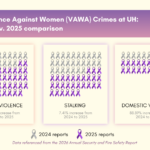
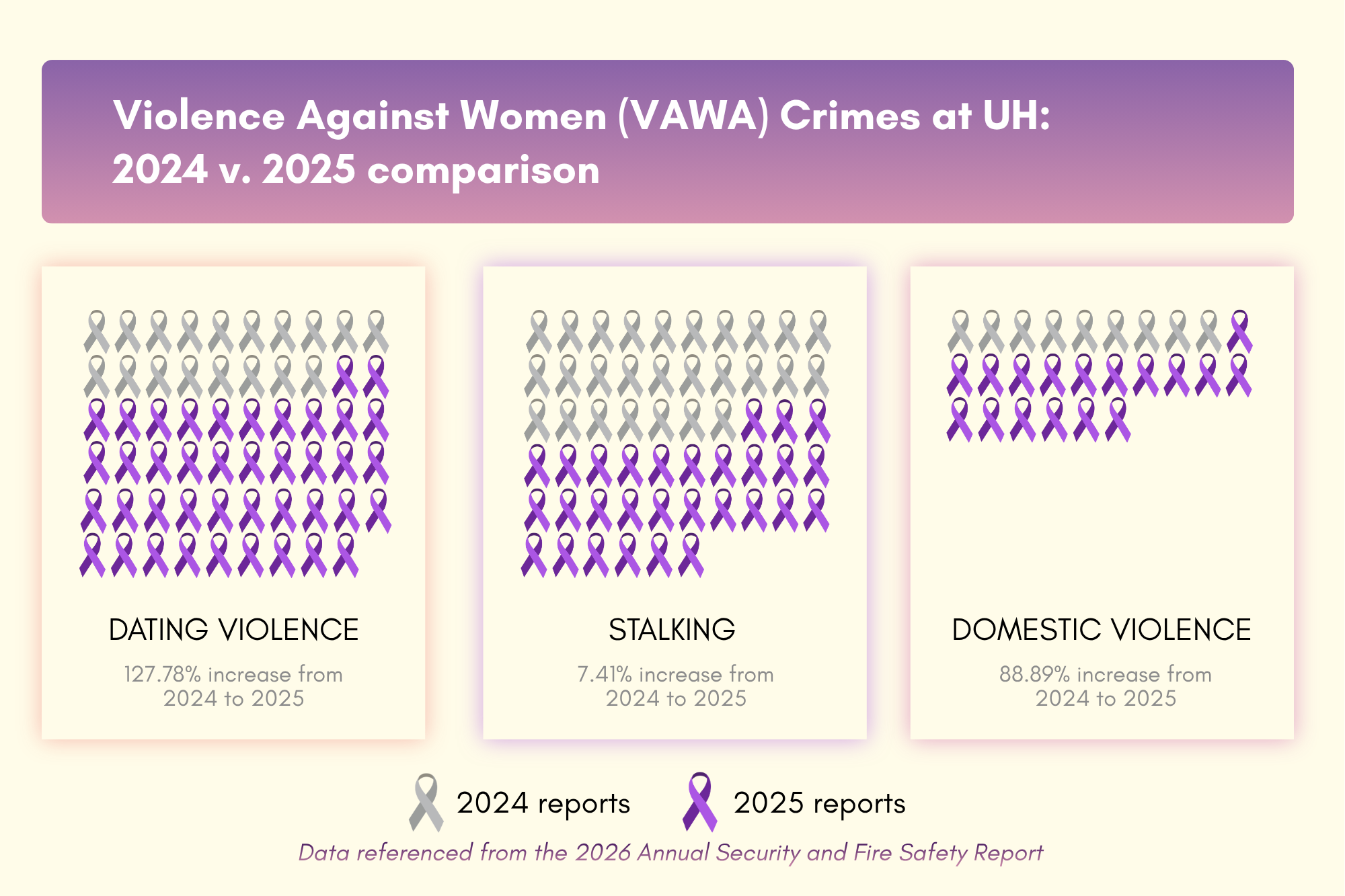
Reports of violence against women increased 61.11% from 2024 to 2025, according to the Annual Security and Fire Safety Report, which was released on Sept. 30. Violence against women includes dating violence, domestic violence and stalking. 

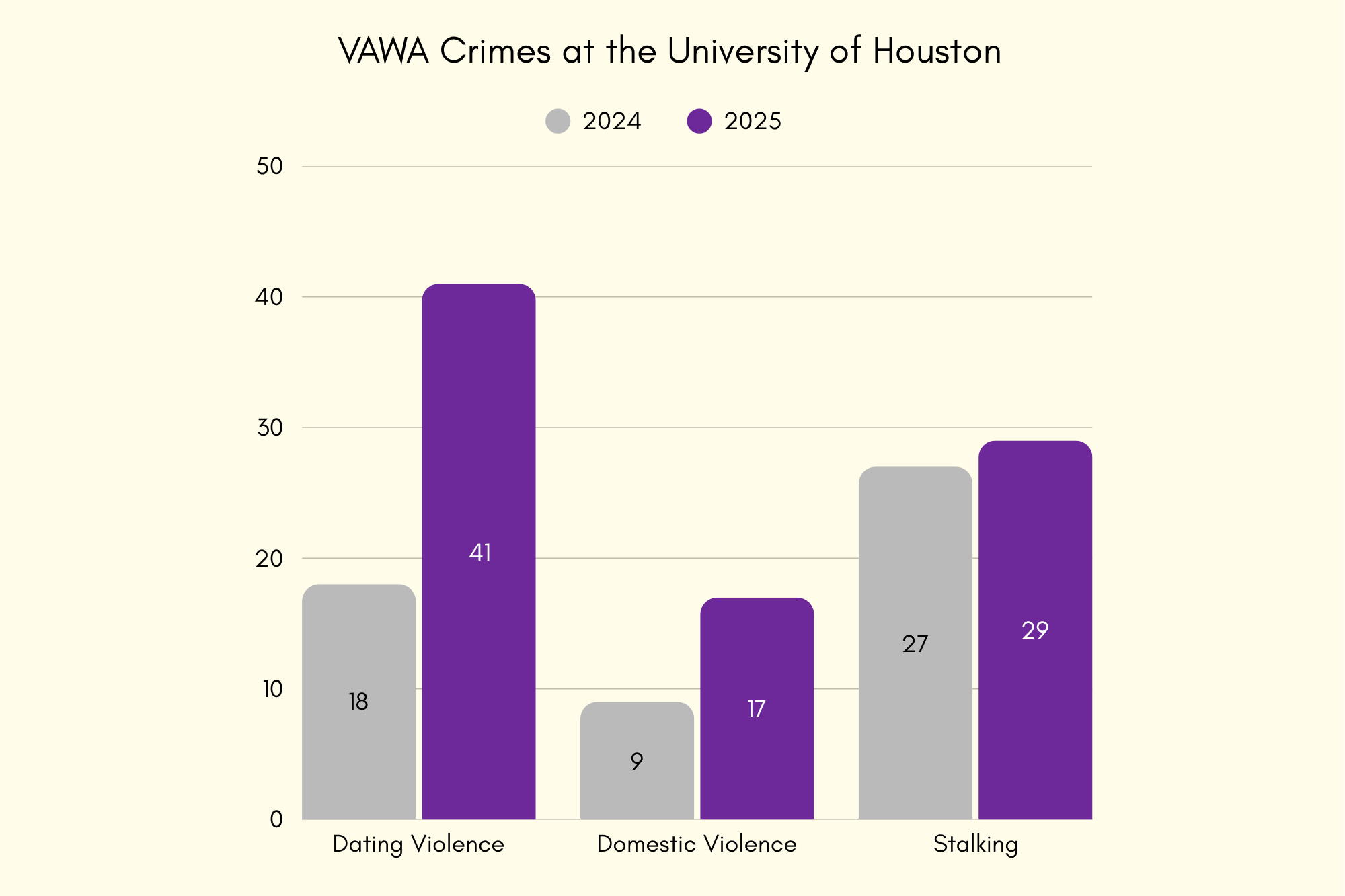
Dating violence experienced the sharpest surge, rising from 18 in 2024 to 41 reported incidents in 2025. Domestic violence cases nearly doubled over the same period, rising from nine reports to 17. Stalking cases saw the slightest increase, moving from 27 to 29. 

The relative share of violence against women crimes as a percentage of total crimes on campus increased from 20% to 39% from 2024 to 2025.

While a rise in statistics can indicate a growing safety concern, University officials and experts note that higher numbers can also simply reflect an increase of student awareness. 

“There is a greater awareness, from the Me Too movement all the way to the Cornell incident,” said associate professor of sociology Sheila Katz. “There is more of an awareness of what is considered sexual assault and that reporting is okay.” 

On-campus resources like Sexual Misconduct Support Services provide individualized safety planning. Students are most likely to come forward and report a violence in a safe environment. 

However, due to the implementation of Senate Bill 17, public Texas Universities are prohibited from maintaining diversity, equity and inclusion offices. 

At UH, the former Women and Gender Resource Center was consolidated into the Parent and Family Office in fall 2025. 

While administrative offices manage Title IX compliance and official investigations, Katz emphasized on that informal resource center serving as an approachable space for students to process traumatic events before pursuing a formal reporting. 

“These women and gender resource centers are often the place where women feel safe to go, to just talk about the experience and if they are not sure how to process it,” Katz said. “ When you go to the UH Dean of Students website, if you go to the Women and Gender Resource Center, their site no longer exists and instead you find survivor support services. It’s very focused on the Equal Opportunity Services Office becoming more of a legal Title IX response.” 

In response to safety concerns, a University spokesperson emphasized the institution’s commitment to safety through prevention education. 

“The University is committed to maintaining a safe environment for all employees, students and visitors through multi-layered campus policing, education and by connecting those affected with individualized support,” said a University spokesperson. “We also mandate comprehensive prevention education, such as our Crossroads online training, which covers dating and domestic violence, stalking, consent and reporting options.”

Overcoming the stigma

Despite the increased awareness, gender-based violence remains among the most underreported crimes nationally, particularly among young adults. 

Violent crimes often go unreported on college campuses because victims do not believe the incident is serious enough, they fear they will not be taken seriously by authorities or they are unsure if a crime actually occurred. 

“Sexual assault often gets deflected around onto the women or onto the survior, saying what were you doing? What were you wearing? What did you have to drink?” Katz said. “The way society views the victim definitely adds on to the pressure.”

While acknowledging the challenges victims face, Katz also emphasized that the increase of reports is a positive. Criticism, she says, should be directed towards the state. 

“I think that student-led movements help our campus but also our campus administrators more broadly who are in it for the students create better student experiences,” Katz said. “I would be more critical of the state.”

Isabel Bustos, Lily Huynh, Nina To/The Cougar

news@thedailycougar.com

—
“Violence against women: Reports on campus up by 60%” was originally posted on The Cougar

Posted in UncategorizedComments Off on Violence against women: Reports on campus up by 60%

Violence against women: Reports on campus up by 60%

Isabel Bustos, Lily Huynh, Nina To/The Cougar

Reports of violence against women increased 61.11% from 2024 to 2025, according to the Annual Security and Fire Safety Report, which was released on Sept. 30. Violence against women includes dating violence, domestic violence and stalking. 

Dating violence experienced the sharpest surge, rising from 18 in 2024 to 41 reported incidents in 2025. Domestic violence cases nearly doubled over the same period, rising from nine reports to 17. Stalking cases saw the slightest increase, moving from 27 to 29. 

The relative share of violence against women crimes as a percentage of total crimes on campus increased from 20% to 39% from 2024 to 2025.

While a rise in statistics can indicate a growing safety concern, University officials and experts note that higher numbers can also simply reflect an increase of student awareness. 

“There is a greater awareness, from the Me Too movement all the way to the Cornell incident,” said associate professor of sociology Sheila Katz. “There is more of an awareness of what is considered sexual assault and that reporting is okay.” 

On-campus resources like Sexual Misconduct Support Services provide individualized safety planning. Students are most likely to come forward and report a violence in a safe environment. 

However, due to the implementation of Senate Bill 17, public Texas Universities are prohibited from maintaining diversity, equity and inclusion offices. 

At UH, the former Women and Gender Resource Center was consolidated into the Parent and Family Office in fall 2025. 

While administrative offices manage Title IX compliance and official investigations, Katz emphasized on that informal resource center serving as an approachable space for students to process traumatic events before pursuing a formal reporting. 

“These women and gender resource centers are often the place where women feel safe to go, to just talk about the experience and if they are not sure how to process it,” Katz said. “ When you go to the UH Dean of Students website, if you go to the Women and Gender Resource Center, their site no longer exists and instead you find survivor support services. It’s very focused on the Equal Opportunity Services Office becoming more of a legal Title IX response.” 

In response to safety concerns, a University spokesperson emphasized the institution’s commitment to safety through prevention education. 

“The University is committed to maintaining a safe environment for all employees, students and visitors through multi-layered campus policing, education and by connecting those affected with individualized support,” said a University spokesperson. “We also mandate comprehensive prevention education, such as our Crossroads online training, which covers dating and domestic violence, stalking, consent and reporting options.”

Overcoming the stigma

Despite the increased awareness, gender-based violence remains among the most underreported crimes nationally, particularly among young adults. 

Violent crimes often go unreported on college campuses because victims do not believe the incident is serious enough, they fear they will not be taken seriously by authorities or they are unsure if a crime actually occurred. 

“Sexual assault often gets deflected around onto the women or onto the survior, saying what were you doing? What were you wearing? What did you have to drink?” Katz said. “The way society views the victim definitely adds on to the pressure.”

While acknowledging the challenges victims face, Katz also emphasized that the increase of reports is a positive. Criticism, she says, should be directed towards the state. 

“I think that student-led movements help our campus but also our campus administrators more broadly who are in it for the students create better student experiences,” Katz said. “I would be more critical of the state.”

Isabel Bustos, Lily Huynh, Nina To/The Cougar

news@thedailycougar.com

—
“Violence against women: Reports on campus up by 60%” was originally posted on The Cougar

Posted in UncategorizedComments Off on Violence against women: Reports on campus up by 60%

Roommate roulette: The highs, the lows, the good, the better

Lily Huynh/The Cougar

For students at the University, living on-campus marks the start of a new adventure. Your dormitory is unknown land and a random roommate becomes a story to tell.

Chicken soup of comfort

Many freshmen entering living spaces have to learn more than what time to go to sleep. They discover more about their health and who can help. 

For political science junior Olivia Rodriguez, who was living in Moody Towers her first year, having one roommate was more than enough. 

“We cleaned all the time, but for some reason, I found myself becoming sick very often,” Rodriguez said. 

When Rodriguez got sick near the end of September, her roommate stepped in, taking all the necessary measures to make sure Rodriguez recovered well. 

“She made it her number one mission to make sure I felt better,” Rodriguez said. “She would bring me medicine, vitamin C packets and most importantly, chicken noodle soup.”

Though they no longer live together, Rodriguez’s roommate’s care did not go unnoticed. The experience left a positive mark on Rodriguez’s college journey, with chicken noodle soup serving as a reminder of kindness and care. 

“Her efforts never failed to make me feel better, both physically and emotionally,” Rodriguez said. “She never got tired of helping me get over my sickness and never failed to bring me some delicious chicken noodle soup. Every time I eat or see some chicken noodle soup, I think of her and the comfortable environment she made sure I had.”

The twin dynamic

While most students brace themselves for the random housing lottery, some bypass the uncertainty entirely. For psychology sophomore Grace Odedeji, living with her twin was an added bonus. 

Odedeji said that her roommate was one of the better parts of her day-to-day life on campus. 

“Whenever people find out we’re twins, one of the first things they ask is if we dorm together, and they’re usually surprised when we say yes,” Odedeji said. “People expect twins to separate when they get to college so they can branch out and have their own experiences, but for us, living together has made college a lot easier.”

Odedeji notes that while others may see a downside of sharing a space with a twin, it has its perks of knowing exactly who you are living with. 

“I didn’t have to worry about getting a random roommate or learning how to live with someone I had never met before,” Odedeji said. “Of course we still get annoyed with each other sometimes, but it has made my college experience better.”

On-campus bubble

The housing lottery can also bring unexpected good luck. Random assignments can yield reliable friends. Psychology sophomore Annie Zhou lived in Cougar Village One, sharing a room with a friend, but she also had two random suite mates. 

“My suite mates were very considerate of each other and myself, sometimes we would study or go eat together outside of the dorm,” Zhou said. “Several times, my suite mates have woken me up for an exam when I have overslept, so I must say I appreciate them.”

Now living in Cougar Place, Zhou emphasizes the benefit of living on campus. She continues to live on campus rather than commuting because of the connection with her peers. 

“I felt living on campus made me feel more in touch with the campus itself in my freshman year especially,” Zhou said. “It is relatively easy to feel separate from the University, since it is a commuter campus, but I feel a lot more spirit and connection with peers in my housing experience.”

Being in walking distance from her living space to campus makes every day life easier and uncomplicated. 

“I feel like being able to live on campus makes things so much easier since I do not have to coordinate the logistics of walking, traffic, buffer, or parking when planning to do an event on campus,” Zhou said. 

Messes, magic

Students with packed schedules rarely see their bed or their roommates.

For sophomore psychology Valentina Espejo, balancing her work schedule often meant leaving her room at seven a.m and returning near midnight. 

“Usually, my roommate would not be there, but it would be three in the morning and I’d hear people inside my dorm,” Espejo said. “Other times, I would come back and see clothes and dirty laundry all over the floor. I could brush it off because I barely saw her so I could not care less.”

But the thought of a stranger in her room without her knowledge spooked Espejo, especially after finding unfamiliar hair on her own bathroom floor. 

“Someone’s hair products became grime that was attached to the shower floor,” Espejo said. “I was taking a shower after a long shift, which had maybe been cleaned once in the whole semester. I did not dare step onto any surface barefoot.” 

The tension hit an unsettling turn when one evening, Espejo stepped out of the shower and encountered an unfamiliar face: a friend of her suitemates. 

“I open the door to a girl who projectile pukes onto the floor, getting a little of it onto my feet. She was far past drunk,” Espejo said. 

Despite the chaos, Espejo experienced the unexpected joys of community living. Despite rarely seeing her suitemates, the shared space underwent a festive transformation during the holiday season. 

“I never got the chance to bond with my suitemates, but magical things still happened,” Espejo said. “They took it upon themselves to decorate the space. I saw our ceiling covered in Christmas lights and a small tree. It might have been grimy, but my freshman dorm experience had a little bit of it all.”

news@thedailycougar.com

—
“Roommate roulette: The highs, the lows, the good, the better” was originally posted on The Cougar

Posted in UncategorizedComments Off on Roommate roulette: The highs, the lows, the good, the better