
Author Archives | Everette Cogswell, Arts and Culture Writer

A taste of Prague: The Zemlinsky Quartet visits UO

The University of Oregon School of Music and Dance frequently puts on free admission performances for students, and on Nov. 4, the School of Music welcomed the Zemlinsky Quartet, a world-renowned string quartet from Prague, to Beall Concert Hall. The 90-minute concert held in the Frohnmayer Music Building was an evening of pure talent.

The Zemlinsky Quartet was founded in 1994 and consists of four members: František Souček and Petr Střížek on violins, Petr Holman on viola and Vladimír Fortin on cello. Eunhye Grace Choi accompanied the quartet on piano, and UO Associate Professor of Clarinet Dr. Wonkak Kim.

The concert opened with Mozart’s “Stadler Quintet,” which featured the quartet alongside Dr. Kim. The piece was a highlight of the night; the musicians were animated as they played and interacted with each other, using their body language to convey the emotion and feeling of the music. 

As the five played together, this piece beautifully showcased the relationship between string instruments and the clarinet. As an allegro, this piece was upbeat and had seamless transitions between all the instruments involved. 

The audience was filled with students and community members. Specifically, there were a lot of students who studied clarinet under Dr. Kim and came to watch him at his craft.

“This performance in particular is pretty fruitful. They’re from Prague and we actually got to hear them play a little bit in studio class today,” Lei Voyce, a music education major and student of Dr. Kim, said. “I’m very excited to hear them perform together.”

The Zemlinsky Quartet performs regularly in the Czech Republic and all around the world. However, this was not their first appearance in Eugene. The first act was followed by a brief intermission where Dr. Kim addressed the audience, providing background on how they ended up here. 

“They were here about seven years ago, so it’s a return for them. I hope you enjoy it and they will be here again,” Dr. Kim said. 

Dr. Kim shared with the audience that the quartet reached out after their U.S. and Canada tour was cancelled, looking for a place to perform. That’s when Dr. Kim put together this show at the last minute. With the quality of the performance, one would have thought this had been in the books for months.

The second act brought out Choi on piano for Alexander Borodin’s Piano Quintet in C minor. This piece had three parts, all showcasing the strong chemistry between the piano and strings. Choi was an excellent pianist and worked very well with the members of the quartet. Perfectly in sync and using the music to communicate, the performers were beyond talented.

The concert ended with Sergei Prokofiev’s Overture on Hebrew Themes, Op. 34, which involved piano, clarinet and string quartet. This piece was the perfect way to round out the performance. Watching the six performers interact during this piece was like magic; the eye contact and interactions between the musicians is what made it hard to believe this show was last-minute.

The concert ended with a standing ovation and a big thank you to the crowd. Attendees had a chance to speak with the musicians afterwards and applaud them for their spectacular performance. 

There are plenty more music events being hosted by the School of Music and Dance throughout the year that are free for UO students with their ID. Upcoming events include The Oregon Wind Symphony and Campus Band Concert on Nov. 19, Hip Hop/Pop Ensemble Concert on Nov. 21, Elsewhere Ensemble: Animalia Musicalia on Nov. 23 and much more.

The post A taste of Prague: The Zemlinsky Quartet visits UO appeared first on Daily Emerald.
Posted in UncategorizedComments Off on A taste of Prague: The Zemlinsky Quartet visits UO

UO Outdoor Program’s A Night at the Barn is back

On Oct. 16, the University of Oregon Outdoor Program hosted their first live music event of the year: A Night at the Barn. The night was filled with student bands, dancing and moshing

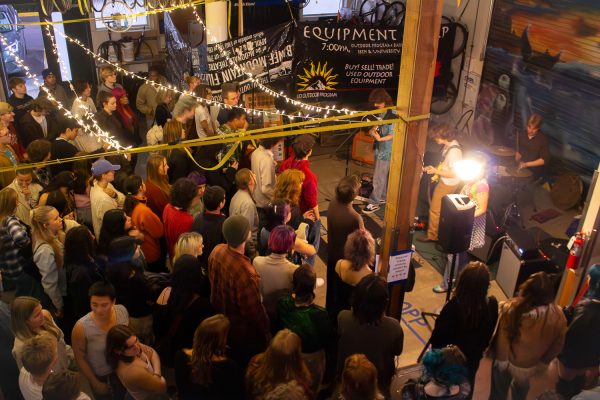
This event was held at the Outdoor Program Rental Barn, located on East 18th Avenue and University Street. The barn is a beautiful venue with open air and mood lighting that set a really nice ambience. The gathering was free for all students with a student ID, and all attendees were greeted with a smile at the door. 

The music, bands and artists vary each time the Outdoor Program hosts this event. From indie pop, rock and folk/bluegrass, every band that performed put on a fantastic show. Bands were interacting with the audience, and artists and attendees were all enjoying themselves. This time around, the bands were Kellen, Junkyard Divas, DogPlaysDead, Matt Roome Trio and 10 or 11 Deer. 

The general vibe of the night trended toward indie rock, and each band put on a unique show that drew in students from across campus. “It’s nice to see people show out for local music on a Thursday,” Avery Ahmanson, the bassist for DogPlaysDead, said. “It’s cool that there’s such a community here.”

And community there was; this event was highly attended, and the audience was filled with uplifting energy. Whether or not students were involved with the Outdoor Program, it didn’t matter here; the barn was filled with positive energy. “It’s super fun to have these big events like this. I feel like it’s a good outreach opportunity, especially for younger students,” Kate McConley, a freshman environmental science major at UO, said. 

With string lights illuminating the room and big garage doors open for airflow, this space was a great alternative to the more common backyard shows held around Eugene. Cozy with a little taste of grunge, the barn is a must-see in this environment. 

Dog Plays Dead plays for the large crowd. On October 16, 2025 the University of Oregon Outdoor Program hosted A Night at the Barn, a free for students, live music performance with 5 different bands playing throughout the night. (Fred Hall/Emerald) (Fred Hall)

“I don’t go to a lot of concerts, but I heard about this one happening tonight, so I thought I’d check it out. I’m really liking it,” Michael Germain, a UO Senior said. “Tunes are good, people are cool and the venue is nice.”

A Night at the Barn is a way to get more involved with campus programs like The Outdoor Program. It’s easy to meet other people who are in the organization, or just to spend time with people who all share a common interest: their love for music.

“These events specifically mean a lot to me because my long-term partner is the bassist for one of the bands,” Violette Creel, a senior said. “It’s great to be able to know the community personally, but also to constantly be meeting people who are mutual through the bands.”


The post UO Outdoor Program’s A Night at the Barn is back appeared first on Daily Emerald.

Posted in UncategorizedComments Off on UO Outdoor Program’s A Night at the Barn is back

‘The Life of a Showgirl’ is here, but was it worth the wait?

When Taylor Swift announced her 12th album, “The Life of a Showgirl,” it practically broke the internet. After her 21-month-long record-breaking “The Eras Tour” ended, many fans were wondering what would come next for Swift. As whispers of a new album floated to the surface, Swift revealed “The Life of a Showgirl” via her fiancé Travis and brother Jason Kelce’s podcast “New Heights” on Aug. 13, 2025.”

Like most things Swift does, the release of this album has brought a lot of opinions among fans and non-fans. “I have not listened to the new Taylor Swift album because I don’t want to,” UO student Lara Clute said. “When she got super big and started making her own Taylor’s versions, I kind of started having a more negative connotation towards her.”

For this album, Swift worked with Max Martin and Shellback, producers whom she worked with on her previous albums “Red,” “1989” and “reputation.” Since those albums, Swift has worked very closely with producer Jack Antanoff; with the transition back to Martin and Shellback, many expected this album to have similar energy to her earlier releases.

“The Life of a Showgirl” begins with the pop-centric song, “The Fate of Ophelia.” This track sets the tone for the rest of the album nicely, and is a pop ballad similar to the songs on “1989.” As Swift has been releasing more and more music, her discography is beginning to sound very similar and raise conversations about quality over quantity.

This album is nothing new and revolutionary compared to previous work from Swift. “In most ways, it is a predictable continuation of her catalog: There’s personal memoir with a veneer of poetic license, a pretty obvious diss track, an extended meditation on memories from high school, a touch of Shakespearean drama and a singular focus on romantic love and a happily-ever-after that’s happily ever closer,” Anna Gaca, senior editor at Pitchfork.

With that being said, Swift still has an influence on millions of people and fans. As one of the most successful female artists, she is a big inspiration to many listeners of her music. “I feel like she is one of the best artists of our generation,” Teagan Brown, an advertising major from Newport Beach, California, said. “I can see why people think otherwise, but she’s fun. I don’t see anything wrong with her; I love her.”

The track “CANCELLED!” has gained traction for its “millennial” lyrics such as “did you girlboss too close to the sun,” and “I like ‘em cloaked in Gucci and in scandal.” This is a theme throughout the whole record. Lyrics feel unrelatable to a large audience of her listeners, and it creates a generational gap between Swift and her fans.

“In a time and a place where there are some pretty awful people out there not getting repercussions for the terrible things they do out in the open, this is a very strange song to release. It’s very out of touch and tone deaf,” Anthony Fantano, music reviewer and writer for The Needle Drop said.

The title track, “The Life of a Showgirl,” featuring Sabrina Carpenter, feels like older music Swift has put out, with a more storytelling style of songwriting. Carpenter is a large redeeming quality of this song and is a nice way to end this album. There is no doubt that Swift is not done yet. Following the release of this album, she shared “The Fate of Ophelia” music video, choreographed by Mandy Moore, which has a very high production quality and does a nice job of painting the vibe for this album. “The Life of a Showgirl” certainly won’t be the last time we hear from Swift; she always has something else in store.

The post ‘The Life of a Showgirl’ is here, but was it worth the wait? appeared first on Daily Emerald.

Posted in UncategorizedComments Off on ‘The Life of a Showgirl’ is here, but was it worth the wait?

Scary movie season is back: exploring iconic scary movie soundtracks

It is officially that time of year for scary movies. These movies are what make this time of year spooky and scary, however, the overlooked cherry on top are the iconic scores and music that accompany these films. From the chilling strings in “Psycho” to the haunting notes in “Jaws,” horror movie soundtracks play a huge role in the making of these movies.

You can’t talk about horror movie scores without mentioning the influence of the film “Psycho.” The score, composed by Bernard Herrmann, arguably shaped the relationship between the horror genre and music. Alfred Hitchcock, the film’s director, worked very closely with Herrmann when creating this score. Whoosh Music writes of “Psycho’s” creepy music and its influence on the genre’s scoring, “the director wanted a music score that would create an atmosphere of a creepy unease and tension, and Herrmann was the man for the job.”

The piece of music in this score that has left its long-lasting impact on the thriller genre is the music that accompanies the famous shower scene. Using violins and violas in a way that is widely considered “unconventional,” Herrmann created one of the most well-known musical moments of all time. A notable quality of this score is the use of silence as a suspense tactic. This is a technique that greatly impacted the genre as a whole.

“Jaws” is another film notorious for its suspenseful and thrilling music. The famous two-note theme song is truly what makes the film as scary as it is. The partnership between director Steven Spielberg and composer John Williams played a huge role in the creation of this film and its score. Williams first shared the main theme with Spielberg, the director wasn’t so sure of the sound. However, he was soon convinced that it was fitting for the film, and it stuck. Not only did it stick, but it quickly became one of the most recognizable pieces of music today.

The official site, The Legacy of John Williams, shares many details about the making of this score and Williams says “(the theme) is grinding away at you, just as a shark would do: instinctual, relentless (and) unstoppable,” and that it does. Throughout the film, Williams’s score notifies the audience when to be frightened and anticipate an attack. The power of this simple yet terrifying music is what makes it one of the best.

When “The Exorcist” was released in the early 1970s, the content of the film shocked many and it quickly became a cult classic. Winning the Academy Award for Best Sound Mixing, “The Exorcist” used a score that wasn’t originally made for the film.

When British musician Mike Oldfield wrote the most recognizable piece, “Tubular Bells,” he used a collection of eerie sounds played on a variety of instruments. Oldfield composed this song when he was just 19 years old in 1972, and in 1973, a complete album was released. “Tubular Bells” was the main track on the album and is 49 minutes long.

When director of the film William Friedkin discovered this piece, it was still relatively unknown. Once he heard it, he was immersed in the atmosphere of the music. What makes the score of this film unique is that this singular song is utilized throughout the duration of the film. The length of “Tubular Bells” allowed for Friedkin to develop the song as if it were a character. While this monstrous work of music wasn’t originally intended for this movie, it sure fits the demonic and thrilling energy the film holds.

It wouldn’t be Halloween without the famous theme from the film “Halloween.” Written, directed and composed by John Carpenter, “Halloween” is widely regarded as having one of the most iconic soundtracks of all time. Strongly influenced by the aforementioned soundtracks such as “Tubular Bells” and the score of “Psycho,” Carpenter used a rhythm inspired by a bongo exercise he learned from his father in the early 1960s. Now, it is nearly impossible not to hear the simple yet haunting piano and drums every Halloween.

All of these films and scores helped shape the thriller universe into what it is today. If you choose to spend your spooky season cuddled up in front of the TV with these iconic films, let the scores fill you with dread and Halloween spirit.

The post Scary movie season is back: exploring iconic scary movie soundtracks appeared first on Daily Emerald.

Posted in UncategorizedComments Off on Scary movie season is back: exploring iconic scary movie soundtracks