Author Archives | Daily Emerald

Understanding Procurement Lobbying Laws for Government Contractors

A technology company spends months demonstrating a cloud-based data analytics platform to state agency administrators. The discussions are highly technical, the agency representatives are enthusiastic, and the vendor helps shape the preliminary specifications for an upcoming procurement cycle. The sales team considers the relationship a major success.

Shortly after the formal Request for Proposals (RFP) is published, the company is suddenly disqualified and subjected to an administrative inquiry. Those early, well-intentioned demonstrations crossed the line into unregistered lobbying.

Many government contractors fail to realize that corporate advocacy extends far beyond legislative chambers. When an organization attempts to influence a public purchasing decision, it often triggers specialized legal requirements. Navigating the matrix of Procurement Lobbying Compliance Laws requires an operational understanding of how business development intersects with government ethics.

Defining the Scope: What is Procurement Lobbying?

Traditional lobbying involves advocating for or against legislation. Procurement lobbying focuses exclusively on the executive branch and public agencies, specifically targeting the allocation of public funds through contracts, grants, and purchasing agreements.

The definition of a procurement lobbyist varies by jurisdiction, but the core trigger is intent. If an employee, consultant, or independent contractor communicates with a public official to influence a procurement decision, that individual may be legally classified as a lobbyist.

This classification does not just apply to dedicated government relations professionals. It frequently encompasses:

  • Account executives and sales managers are pitching services to public institutions.
  • Technical engineers provide product demonstrations during the pre-solicitation phase.
  • Corporate executives are attending introductory meetings with state agency directors.

The registration threshold can be based on time spent, compensation received, or the total financial value of the contract being pursued. In some jurisdictions, a single conversation before an RFP is issued can trigger an immediate obligation to file public disclosure reports.

Procurement Integrity Laws and Blackout Periods

A fundamental concept in government contracting is the preservation of a fair, competitive marketplace. To maintain this balance, federal, state, and municipal authorities enforce strict procurement integrity laws. These regulations dictate exactly when and how a vendor can communicate with government personnel.

One of the most restrictive mechanisms used by agencies is the procurement blackout period, sometimes referred to as a quiet period or cone of silence.

Phase of RFP Allowable Communications Restricted Communications
Pre-Solicitation Market research, generic pitches Shaping specifications unfairly
Active Evaluation Formal questions via the procurement officer only Direct advocacy with decision makers or evaluation panels
Post-Award Debriefings, formal protests Undisclosed contract negotiations

The blackout period typically begins the moment an RFP is officially drafted or publicized and remains in effect until the contract is formally awarded. During this window, all direct communication between the vendor and the evaluating agency members must cease, except through a designated procurement officer.

Operational Risk Note: Initiating a casual check-in call with an agency contact during an active blackout period is not just a breach of etiquette. It can violate state ethics laws, resulting in the cancellation of the bid, corporate debarment, and civil penalties for the individuals involved.

State and Local Variations: The Compliance Challenge

Contractors operating across state lines face a fragmented regulatory environment. There is no single master standard for procurement compliance.

For example, the federal Procurement Integrity Act establishes clear boundaries regarding the disclosure of contractor bid or proposal information at the national level. 

However, when moving to state and municipal levels, the rules diverge rapidly.

In New York, the State Finance Law explicitly regulates procurement lobbying, mandating that attempts to influence any procurement exceeding a specific monetary value must be tracked and reported to the Commission on Ethics and Lobbying in Government (COELIG).

Conversely, other states handle these interactions through broader executive-branch lobbying rules, which focus on whether the state official has the authority to sign a contract. At the municipal level, cities and counties often layer their own local ordinances on top of state rules, creating multiple tiers of required registration for a single contract pursuit.

Best Practices for Maintaining Procurement Integrity

Building an oversight framework within a government contracting division is the most effective way to prevent compliance gaps. Public affairs teams can protect their active bids by adopting specific operational strategies.

Separate Sales Operations from Technical Advocacy

Ensure that sales personnel understand where informational marketing ends and regulated procurement advocacy begins. Technical staff providing generic product data should be briefed on jurisdictional boundaries before entering any agency discussions.

Establish a Compliance Clearinghouse

Before any business development representative contacts a state or municipal official regarding a potential contract, the interaction should undergo an internal review. This screening helps confirm whether the target jurisdiction enforces a pre-RFP registration trigger or an active blackout period.

Document and Track Every Agency Contact

Maintain centralized records of all meetings, emails, and phone calls with public officials. Accurate record-keeping simplifies the generation of quarterly or bi-monthly disclosure reports and provides an audit trail if a competitor challenges a contract award.

Staying updated on these shifting requirements requires consistent effort. Regulatory changes occur frequently as states refine their ethical standards. Organizations often utilize compliance intelligence updates, such as those monitored by State & Federal Communications, to track local rule changes and prevent administrative oversights.

Frequently Asked Questions

1. What is procurement lobbying?

Procurement lobbying is any attempt by an individual or organization to influence a government agency’s decision regarding the award of a public contract, purchase agreement, or grant.

2. When does a vendor need to register as a procurement lobbyist?

Registration requirements depend entirely on the jurisdiction. It is often triggered when an employee exceeds a specific threshold of communication hours, receives compensation for advocacy, or attempts to influence a contract exceeding a set dollar value.

3. What is a procurement blackout period?

A blackout period is a legally mandated window during an active solicitation where vendors are prohibited from communicating with agency decision-makers. All inquiries must go through a designated procurement officer to ensure fairness and competitiveness.

4. Can an internal sales representative be considered a lobbyist?

Yes. If an internal sales representative or account executive contacts government officials to pitch a product or influence an upcoming RFP specification, their actions can trigger registration requirements under state or local laws.

5. What are the penalties for violating procurement integrity laws?

Violations can lead to immediate disqualification from the bidding process, the voiding of an existing contract, financial fines for both the corporation and the individual, and long-term debarment from public contracting.

Achieving long-term success as a government contractor requires more than a superior product and a competitive price. It demands absolute compliance with the ethical rules governing public purchasing. By implementing proactive training, monitoring local variations, and respecting agency communication windows, organizations can safeguard their public sector portfolios. Learn more about structural frameworks and compliance strategies designed to simplify multi-state reporting.


The post Understanding Procurement Lobbying Laws for Government Contractors appeared first on Daily Emerald.


Posted in UncategorizedComments Off on Understanding Procurement Lobbying Laws for Government Contractors

How College Students Can Prepare for an Unpredictable Job Market


Photo by Markus Winkler on Unsplash

The job market has never felt entirely predictable, but today’s modern age has certainly had a significant impact. Many students are entering a workforce shaped by major technological changes, economic uncertainty, and shifting employer expectations. Then there’s AI, automation, and changing consumer behaviors. No wonder many students struggle to find the right role at the right time. 

Still, as overwhelming as job market changes can be, they highlight the need for adaptable skills, openness to new industries, and practical experience. If you’re a college student preparing to enter the job market, here’s how you can prepare: 

Build Transferable Skills Through Education

Whether you’re getting your Industrial Engineering Bachelors Degree, a business degree, or something else, the skills you learn from your degree are crucial. They give your employer confidence that you’re trained in the work they need you to do. 

However, your industry-based skills aren’t the only things you can learn through education. You can also learn transferable skills like problem-solving, teamwork, and communication. Having these skills means that even as job requirements change with time, your ability to handle them may not. 

Rather than simply focusing on earning your diploma, consider how your coursework and even your extracurricular activities contribute to your overall career development. 

Gain Real-World Experience

Your classroom learning provides you with a strong foundation for a career, but your practical experience helps you apply your knowledge. Throughout your studies, seek out volunteer opportunities, internships, and part-time jobs to demonstrate your initiative and responsibility to future employers. 

Even if your work is outside of your intended career field, you can develop valuable skills that will prove helpful across multiple industries, like customer service, communication, and problem-solving. 

Refine Your Digital Literacy 

You might consider yourself a hands-on person who prefers manual approaches over digital, but digital is the future. Whether you’re entering a digital-based industry or not, refining your digital literacy will likely prove helpful.

Digital literacy means you can use digital technology safely and critically. You know how to operate smart devices, search for and evaluate information online, and understand how to protect data and maintain online privacy. You may not need advanced programming skills in your line of work, but becoming comfortable with digital tools can often give you the upper hand when job hunting. 

Remain Curious About Industry Trends

What you learn in your current education program isn’t necessarily all there is to know about your field. For example, most journalism students just a decade ago wouldn’t have been told about how much AI would affect and be integrated into their daily work. 

There can be value in remaining curious about the changes happening in your industry. Read industry publications, attend events, participate in webinars, and listen to podcasts. By staying informed, you may find it easier to make better decisions about the educational and career steps you take. 

Build a Professional Network

There’s more to networking than attending business events and handing out business cards. It’s not just about getting your name out there; it’s about building genuine relationships with people in your industry and with the same interests.

Your classmates, academic advisors, professors, and other people you encounter throughout your educational journey can all become valuable connections, especially for career advice, mentorship, and even job referrals later on. You may also find that maintaining a professional online presence can help you connect with industry professionals and remain abreast of opportunities in your field. 

An unpredictable job market can sound like a disadvantage, but it doesn’t have to be. If you have the right mindset and are committed to your career development, there’s every reason to believe you can be well-prepared for whatever industry changes are thrown your way. 

The post How College Students Can Prepare for an Unpredictable Job Market appeared first on Daily Emerald.

Posted in UncategorizedComments Off on How College Students Can Prepare for an Unpredictable Job Market

How to Improve Your Credit Score in the Next Year

Improving your credit score is a popular target, as it has plenty of benefits, such as: 

  • Giving you lower interest rates
  • Allowing you to borrow more 
  • Making it easier to rent
  • More chance of lending acceptance

When setting a new goal like increasing your credit score, it’s always a good idea to place a specific timeframe on it, as it gives you more focus and motivation. Of course, this isn’t something you can do overnight. You need to give at least a few months (but preferably a year or more) to the task, so that you can see a genuine improvement. 

That’s why, in this guide, you will learn specifically how to improve your credit score in a year. If you follow these steps, you will hopefully see a real rise in the score 12 months from now. 

Understand Your Debts

The first thing you should do is have complete control over your debts. That doesn’t mean you have to pay them all off quickly, but instead it means knowing exactly what you owe and putting an action plan into place. 

If that sounds like a distant dream, just know there are experts out there who can help you. Companies like Freedom Debt Relief offer specialized plans where you can pay less debt overall while getting out of it faster. You’ll be put on a plan over several years where you will regularly make payments to get out of debt. It’ll give you a clear vision of when you’ll be debt-free. 

Keep in mind that your credit rating may take a hit when using a program like this. However, if your credit rating has already taken a hit due to missed payments and overdue debts, then this process isn’t going to make it much worse. From there, your credit rating is likely to be better by making these negotiated payments than by not paying altogether. It’s better to get out of debt than to let it get worse. 

Dispute Any Errors

Check your credit report and locate any errors. There’s a chance that your record shows incorrect later payments, for example, or debts that are from more than 7 years ago. By disputing them, they could be taken off your record, leaving you with a higher score. 

Automate Your Payments

Don’t give your credit score the chance to drop because of a single missed payment. To increase it in the next year, automate your payments now so you never miss a single one. It’s really easy to do, and you can make sure you pay a few days before a payment deadline to be absolutely sure you never miss one. 

Reduce Your Credit Card Use

You need to look into your credit utilization ratio. If it’s above 30%, that could be negatively impacting your score. Over the next year, then, aim to reduce this ratio to 30%, but preferably under, for a faster improvement on your rating. 

Raise Your Credit Limit

It might seem counterintuitive, but there’s a method that works here. By asking your credit card companies to increase your credit limit, without spending any more, you will reduce your utilization ratio. As such, it will boost your score. Over a year, this can have a significantly positive impact.

The post How to Improve Your Credit Score in the Next Year appeared first on Daily Emerald.

Posted in UncategorizedComments Off on How to Improve Your Credit Score in the Next Year

The Syllabus Nobody Reads: Fine Print Literacy for the Student Budget

Student budget is a delicate art of monthly survival between a scholarship, a part-time job, and rent, and marketers of digital services sometimes know about this better than students themselves. Free trial months, generous welcome bonuses, and discounts on the first order surround the modern campus more densely than promotional flyers in the first week of the autumn semester. In this article, we will explain how to learn to read the terms of any promotional offers faster than lecture notes before an exam and never pay for your own carelessness.

The Economics of Free in Specific Figures

Companies distribute their product not out of generosity at all; attracting one new client costs a business quite noticeable money, and a free starting offer is simply the most effective and proven form of this investment. The student audience is particularly valuable for brands, because consumer habits formed at twenty feed the company afterwards with entire decades of loyalty. This logic works equally in all consumer sectors without exception, from music streaming to food delivery to campus. It is convenient to see the real price of the matter in a visual comparison:

Industry Cost per new customer Typical student hook
Video streaming $50-100 Discounted student plan
Music services $20-40 Free semester trial
Food delivery $50-80 First-order discount
Online gambling $300-800 Welcome bonus package
Fitness apps $30-60 Free premium month

The more expensive the acquisition is, the more generous the bait looks, and the more carefully one should read the accompanying terms. The gambling segment tops this table for a reason; it is there that the difference between a beautiful advertising promise and the real terms happens to be the most dramatic for a student’s wallet. Tellingly, the market itself has generated an antidote; independent review platforms like CasinosHunter catalog operators’ offers by the fairness of their terms, even highlighting a separate category of bonuses entirely without wagering requirements, where the received winnings can be withdrawn immediately. The very fact of the existence of such a separate category explains better than any lectures how much the terms of ordinary offers can differ from their promotional storefront.

The Three Most Classic Fine Print Traps

The vast majority of unpleasant financial surprises fit into just a few standard scenarios repeated from year to year. Knowledge of these typical schemes saves money more reliably than any cashback or student discount.

Unnoticeable Automatic Renewal After the Free Period

The trial period ends quietly and unnoticed, whereas the first charge arrives loudly and painfully. Services quite consciously do not remind you of the trial expiration date, directly counting on human forgetfulness. A simple calendar reminder set right at the moment of activation solves this problem completely and absolutely for free. A virtual bank card with a zero balance for paying for trial periods works even more reliably than reminders.

Wagering Requirements and Other Hidden Conditions

A bonus on a gaming or betting service is almost always tied to a wager condition; the received amount must be wagered dozens of times before you can withdraw even a single dollar. A modest twenty-dollar gift with a forty-times wager actually requires a total gaming turnover of eight hundred dollars. Understanding this simple arithmetic instantly transforms a fabulously generous offer into ordinary marketing mechanics. This is precisely why offers without wagering are valued by experienced players higher than any large figures on banners.

A Tempting Discount Tied to a Subscription

A promo code for the first order often simultaneously activates a paid membership, neatly hidden in a pre-checked box. The cost of such a subscription is spread across small monthly charges that are very easy to miss in a bank statement. The habit of carefully checking all the checkboxes before final payment shuts down this scheme literally in seconds. Canceling an already accidentally activated membership is usually harder than simply not activating it at all.

Basic Survival Rules for a Student Wallet

Financial self-defense does not require special effort or specialized knowledge from a student, only simple consistency. A sustainable minimum looks like this:

  • Set a reminder about the expiration of any trial period right at the moment of its activation;
  • Recalculate every promotional bonus into real obligations before clicking the agreement button;
  • Set a strict monthly limit for entertainment with monetary participation and treat it like the price of a ticket.

All these habits take just a few minutes, yet they leave amounts in the budget that are very noticeable on a student’s scale. One forgotten subscription saved in time means a few full meals in the cafeteria, and a bonus deposit not wasted means a whole evening in the good company of friends.

Attentiveness as the Hardest Currency

The entire marketing of “free” is built on ordinary human inattentiveness, which means attentiveness automatically becomes the main competitive advantage of the consumer. Five minutes of thoughtful reading of the terms pays off noticeably better than most student part-time jobs when calculated per hour spent. Thus, the most profitable educational course available on any campus, completely for free, is called simply “Read the fine print before, not after.”

The post The Syllabus Nobody Reads: Fine Print Literacy for the Student Budget appeared first on Daily Emerald.

Posted in UncategorizedComments Off on The Syllabus Nobody Reads: Fine Print Literacy for the Student Budget

Why AI Services Are a Game- Changer for Small Businesses in 2026

Staying on top of your game in this AI-driven era is not just about innovating your products and services. Your brand perception matters more than ever. You benefit when your website is more visible and enjoys a strong position in the B2B space. However, these don’t happen by chance or by following run-of-the-mill practices. You should look for AI-led audit services. These can be powerful tools, especially for small businesses that need to catch up with the new buyer behavior redefined by AI-driven commerce. AI visibility audit tools can assess your brand’s value and provide crucial data points that help build trust with potential buyers. These insights are reliable, as they show how others perceive your brand and how AI-powered search engines treat it. Why do you need them?

AI-generated searches work differently. You cannot manage them the old SEO way. Brands perform better when they appear in AI-generated answers. To get there, you need to use an AI visibility audit tool. You can identify weak spots in your content, fix them, and help your brand appear in AI-generated answers. Audits like these can also reduce the risk of inconsistent product summaries, pricing, or capabilities across the web, which often undermine a brand’s reputation. A few AI visibility services can prove useful in this context.

Brand Identity

Every business in the digital landscape should know how AI models perceive it. You can use this service to obtain these valuable insights. Most AI answer engines pull information from different corners of the web to interpret a brand. A brand identity audit service can scan different AI models and compare their outputs to evaluate your brand positioning in terms of:

  • Products
  • Target audience (SMBs vs. enterprise clients)
  • Budget-friendly vs. premium

Readiness for AI-powered Answer Engines

AI-generated answers often feature content from reliable, authoritative websites. These websites are crawled based on their technical structure and content formatting. You can use a credible Answer Engine Optimization service to examine these areas. B2B buyers typically ask long-tail questions when making purchase decisions. If your website provides structured, clear answers, it may be cited in AI-generated answers. An audit tool can quickly analyze schemas related to products, services, and corporate information to identify strengths and weaknesses. For example, content with short paragraphs, bullet points, and tables is preferred in AI-powered answers. As a result, you can make these improvements.

Online Testimonials and Reviews

A Customer Proof Analysis tool can examine the availability of these types of social proof for your products and services. AI systems consider video testimonials and case studies credible sources. These sources are used to assess customer opinions about a brand and its specific products or services. AI-powered search engines cannot access information from PDFs or similar difficult formats. Sources must be easy for them to crawl. In this area, a Customer Proof Analysis tool can prove immensely useful. It can present crucial details about your brand from third-party review sites, focusing on customer experiences, prominent product features, and more. All these insights can be used to build a better content strategy and product messaging.

You have to earn the trust of human audiences and build credibility with AI systems. This can be achieved if you choose the right brand visibility strategies. A strong AI-powered visibility service can prove helpful here.

Bio

About the Author

Derek Iwasiuk has more than 20 years of experience as a strategist and SEO for organizations in highly competitive industries. He helps businesses improve their visibility and optimize their presence on search engines and AI systems at Searchtides.com.

The post Why AI Services Are a Game- Changer for Small Businesses in 2026 appeared first on Daily Emerald.

Posted in UncategorizedComments Off on Why AI Services Are a Game- Changer for Small Businesses in 2026

The Student Friendly Website Checklist for Eugene Shops and Campus Brands

Eugene students in 2026 expect a business website to load fast, and they will not wait around. They want quick answers about hours, prices, and menus. Campus life is busy. Classes, jobs, and study time leave little room to spare. A slow site gets skipped fast. 

This guide covers what students near the University of Oregon want from a shop or restaurant website. It covers mobile speed, clear menus, and pickup options. It also covers trust signals, accessibility, and simple booking tools. Local brands can use it to meet real needs instead of guessing.

Why Students Judge a Business by Its Website First

Before a student walks into a shop on 13th Avenue or Alder Street, they check the website first. A slow page can send that student to a rival shop down the block. So can an old hours listing or a menu buried in a PDF file. This is why more Eugene businesses now treat their site as a first impression. It is not just an add-on anymore. 

Many Eugene shops now work with an eCommerce SEO agency to help pages rank in student searches. That kind of visibility work matters. Most comparison shopping happens in the first few seconds of a search. Few students read a full page of text before deciding.

Once a shop appears in that search, the page still has work to do. It needs to answer questions fast, or the visibility goes to waste. Picture a student comparing two coffee shops near the library. They open both sites in separate tabs. They skim for the same handful of details. Whichever page loads faster tends to win the visit. 

This can happen even if the other shop has better coffee. The same pattern shows up across many kinds of shops, from haircuts to late-night food. A fast, clear website now matters almost as much as a good location.

Mobile Speed Sets the First Impression

How Fast Is Fast Enough

Most students browse on a phone. Data plans are limited, and so is patience. If a page takes more than a few seconds to load, many students back out. They will not wait to see the menu or the hours. Compressed images help. Simple layouts help. Fewer pop-ups help, too. 

All of this keeps a page fast on a small screen. A slow site can lose that guest during a busy lunch rush. This can happen even when the food would have been better.

Clear Navigation Beats Flashy Design

A busy homepage full of animations can slow down a phone. It can also confuse a first-time guest. Students want to find hours, location, and prices within two taps. A simple menu bar with clear labels works better than a clever design that hides basic details. Testing a site on a real phone catches most problems early. A real guest should never find them first.

The Core Information Students Look For

Certain details show up in almost every student search. Missing even one can cost a business a visit. A website should make these easy to find:

  • Current hours, including holiday and exam week changes
  • A menu or service list with prices shown clearly
  • An address that matches Google Maps exactly
  • A contact number and email for quick questions
  • Photos of the actual location and products.
Element Why Students Care
Current hours Avoids wasted trips during breaks or exam weeks
Prices Helps with budgeting before ordering or booking
Pickup options Fits tight schedules between back-to-back classes
Google Maps match Prevents confusion when walking or driving over
FAQ section Answers common questions without a phone call

None of these items needs a large budget. Most can be updated in an afternoon. The payoff shows up fast. There are fewer confused phone calls. There are fewer no-shows from people who thought a shop was closed.

Why Online Visibility Matters When Foot Traffic Is Uncertain

Foot traffic near campus is not always steady. Construction, road closures, and parking changes near Alder Street have changed things. Some shops can no longer rely on people simply walking by. 

Recent coverage of local business challenges on Alder Street showed how fast visits can drop. Construction that blocks parking and closes sidewalks can empty a block in days. When physical access gets harder, a clear website becomes the easiest way to reach students. It helps them find a shop, confirm it is open, and decide the trip is worth it.

Booking, Ordering, and Pickup That Save Time

Simple Booking Tools

A booking system should take less than a minute on a phone. Long forms, required accounts, and confusing calendars push students toward a simpler option. A short form asking for a name, time, and party size is usually enough. Confirming by text or email also matches how most students like to communicate. Most do not want a phone call back.

Pickup and Curbside Details

Many students want to order ahead and grab food between classes. They do not want to wait in line. A website that lists pickup times, a pickup spot, and any app used for ordering removes the guesswork. If pickup needs a separate app, the website should say so clearly. Rough wait times during busy periods, like lunch or the gap between big lectures, help too.

Accessibility Is Not Optional Anymore

Accessible design is not a bonus feature. It is a basic need for reaching every student. That includes those using screen readers or navigating with limited vision or limited mobility.

  • Text that resizes without breaking the layout
  • Enough color contrast to read menus and prices
  • Alt text on photos for screen readers
  • Keyboard-friendly navigation for booking forms
  • Captions on any video content.

Building these features in from the start is easier than fixing them later. It also tends to improve the site for every guest, not just those who rely on assistive tools.

Photos, Reviews, and Map Consistency Build Trust

Photos of the actual space, food, or products help students know what to expect. Stock photos or old images create a mismatch. That mismatch hurts trust once a student walks in the door. Reviews matter, too. Students often check ratings before choosing between two similar shops near campus. 

Just as important, the address, hours, and phone number on the website should match Google Maps exactly. A mismatch sends the wrong signal and can send a guest to the wrong door entirely. A quick monthly check of these details takes only a few minutes. It stops a steady stream of small, annoying mistakes.

FAQs and Contact Details That Save a Trip

A short FAQ section can answer the questions students ask most often, such as:

  • Whether the business takes cards only
  • Whether substitutions or changes are allowed
  • Whether a student discount is available.

This saves both sides a phone call. Contact details should be easy to find. The footer of every page is a good spot for this. A student should not have to hunt for a way to ask a quick question before ordering. A visible phone number and email show a guest that a real person runs the page. That reassurance matters more than it might seem. It counts even more for a small business up against national chains.

What Ecommerce Growth Means for Local Eugene Sites

Online shopping habits keep shifting what students expect from any business. This includes a small shop near campus. Recent retail ecommerce growth reported by the Census Bureau reached 326.7 billion dollars in Q1 2026. That is a 9.8 percent jump from the same quarter a year earlier. Online sales now make up 16.9 percent of total retail sales. 

This shift shows why students treat a website as a normal first stop, not an extra step. That holds true even for checking a lunch menu or booking a haircut. For a local shop near campus, this trend is not about competing with big online retailers. It is about matching a habit students already bring from other purchases.

A Quick Checklist for Local Owners

Here is a short checklist that pulls the guide together in one place.

Checklist Item Status
Mobile load time under three seconds Yes/No
Current hours and holiday updates Yes/No
Prices listed clearly Yes/No
Simple booking or ordering form Yes/No
Pickup details spelled out Yes/No
Accessible text and images Yes/No
Real photos of the space Yes/No
Address matches Google Maps Yes/No
FAQ section included Yes/No
Visible contact details Yes/No

Final Thoughts

Students in Eugene are not looking for a flashy website. They want fast answers, honest prices, and a page that matches what they find in person. Shops and campus brands that keep this checklist in mind will spend less time answering repeat questions. They will spend more time serving the people already looking for them nearby today.

The post The Student Friendly Website Checklist for Eugene Shops and Campus Brands appeared first on Daily Emerald.

Posted in UncategorizedComments Off on The Student Friendly Website Checklist for Eugene Shops and Campus Brands

How to Stay Competitive in a Rapidly Changing Job Market

Every few months, some expert makes a grand prophecy that the job market is changing, usually over a stock photo of a chessboard or some random boardroom. Unfortunately, the irritating part is that they are right. 

What the platitude skips is the sheer scale that is underway at this moment. The World Economic Forum’s Future of Jobs Report 2025 reckons that by 2030, some 92 million roles will disappear while 170 million new ones appear, a net gain of 78 million.  It also expects 39% of the skills people use at work today to be transformed or obsolete within five years. Mind-boggling, eh?

This means that two in five of your current strengths, then, are on the clock. That has been mostly true for most of modern working life, and the people who come out ahead are usually the ones who notice before their employer sends the memo.

Reed Hastings, it turns out, noticed. He started Netflix, the legend goes, after Blockbuster charged him a $40 late fee for hanging onto Apollo 13 for six weeks. He built a thriving DVD-by-mail business and then went to work dismantling it himself. Streaming launched in 2007 as a small add-on for Netflix, going on to become its future moat.  At one point, Hastings reportedly threw his own DVD executives out of the main strategy meetings, on the grounds that they ran the profitable part of the company but had nothing useful to add about where it was heading. He had no patience for defending something he already considered finished. Netflix now has north of 260 million subscribers. Blockbuster has one store left in Oregon that mostly sells T-shirts.

All of which brings us to the force currently rearranging every office in the country: AI. This is obviously the big elephant in the room. Plenty of people treat it as a rival, sizing up their desk. For the wiser ones among us, it can behave more like a power tool that nobody handed you the manual for, but you can be a master of, with adequate practice.

On a Tuesday, with a job to keep and barely any spare time, this is bigger than it sounds. You can start with a handful of habits and build from there.

Start with the AI itself. Take one tool that overlaps with your actual work and use it for a fortnight, even if clumsily, but on real tasks. Draft with it, argue with it, and watch where it just makes things up. You will learn where it helps and where it falls flat faster that way than from listening to a podcast, and most of the intimidation wears off within a few days.

The skills worth the most effort are what you’ll carry between jobs. Analytical thinking still tops the list of what employers say they want, per the WEF report, with resilience and plain adaptability close behind, and none of that is tied to a single AI app or industry.

Plenty of technologies have promised to make careful thinking unnecessary, and so far, none have managed it. So before you reach for a tool next time, take five minutes to write down what a good answer would even look like. Framing the problem is still your job, not the machine’s.

Watch your own patch of the economy while you are at it. Read what the trade press is worried about. Pay attention to which tasks around you are quietly starting to run themselves, and work out what gets more valuable once they do. 

People are already on this: in 2024, sign-ups for generative AI courses on Coursera ran at roughly six a minute. You do not need to drown in industry news to keep up. Pick one trend a quarter and learn enough about it to hold an opinion.

Some of what’s most useful to learn, you can’t get from a random youtube video. Talk to people who are a step ahead of you. Ask what they read, what they got wrong early on, how they decided what to bother learning and what to ignore. That kind of thing is hard to find written down because most people only say it out loud, usually over a coffee when you ask them directly. Mentoring someone more junior is worth doing for the same reason, since you find out fast how shaky your own grasp of something is the moment you have to explain it to another person in simple terms.

Upskilling works best as something you schedule, not something you scramble for after the layoffs land. Sometimes it is scrappy, a weekend course or a project you angle your way into. Sometimes it is formal, particularly in fields built on credentials. Healthcare is the obvious one, where a recognized qualification stacked on top of clinical experience can unlock a different level of work. Some practitioners weigh up structured options like a post-graduate/APRN certificate to build on what they already do while staying close to where the demand is. Whichever way you go, put it in the calendar like a dentist appointment, so that you stick to your guns.

You do not have to like uncertainty. You just have to stop waiting for it. Hastings was not clairvoyant. He paid attention to where things were headed and let go of the part that was already on its way to being finished, and the scaled-down version of that is available to anyone right now. The only real cost is getting started.  

The post How to Stay Competitive in a Rapidly Changing Job Market appeared first on Daily Emerald.

Posted in UncategorizedComments Off on How to Stay Competitive in a Rapidly Changing Job Market

Women’s Soccer Rankings: The Best Teams in the World

Women’s Soccer Rankings: How to Compare the Best Teams in the World

Even though it was rather overlooked in the past, women’s soccer is starting to get a long-overdue recognition. There are many great women’s soccer teams out there, but which one is best? Ranking the best women’s soccer clubs might seem simple and easy – just look at which team has the most wins, right?

Well, wins are certainly one of the most important metrics for women’s soccer rankings, but there are other important metrics for determining the best women’s soccer team. In this article, we’ll answer questions such as “What are the world rankings for women’s soccer?” so keep reading!

Evaluating Team Strength

Before we show you the ranking methodology, you need to understand where the data comes from. Nowadays, every match generates large amounts of data, and this data is no longer reserved for clubs and sports professionals only.

Even casual fans can access match, team, and player data through the results provided by 180Score. Getting this data is the first step in evaluating team strength, but this is also where the first problems arise.

Historical football data is useful within one competition. When teams play against each other quite often, it is easy to compare them and make future predictions. However, the situation becomes more complicated when you try to compare teams that have never played against each other.

This is where soccer rankings come in handy, as they allow us to compare teams from different leagues and competitions. But how do soccer rankings work?

How Rankings Measure the Strength of Women’s Soccer Teams

First, you need to decide whether you need soccer world rankings for clubs or national teams. Hence, there are two approaches to women’s soccer world rankings: Opta Power Rankings for clubs and FIFA Women’s World Ranking for national teams. 

Let’s first see how the Opta soccer rankings work:

How are women’s clubs rankings calculated? 

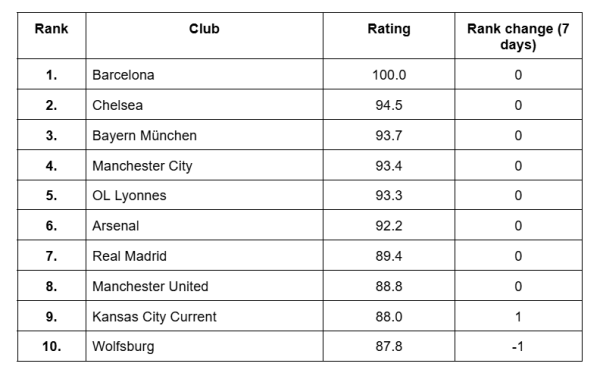
Opta football rankings are based on the hierarchical Elo rating system. This system takes over 2,000 women’s clubs from all over the world and grades them on a scale from 0 to 100 (100 being the best). Elo points are distributed based on the match outcome, opponent quality, and the margin of victory.

Here is how it works:

  • The winning team gets x points, while the losing team loses those x points, which means there is a point exchange between teams. 
  • If the winner is a higher-rated team, fewer points will be exchanged. 
  • If the winner is a lower-rated team, more points will be exchanged.
  • In case of a draw, the lower-rated team will get some points, while the higher-rated team will lose them.
  • The greater the goal difference is, the more points will be exchanged. 

As the teams keep playing against each other, their positions will change over time. 

Examples of Top Women’s Clubs

Accurate as of July 9, 2026 

How are women’s national teams rankings calculated? 

On the other hand, FIFA rankings (WWR) observe several factors:

  • The match result
  • Did the team play at home, away, or on neutral ground?
  • How important is this match
  • What are the current FIFA women’s rankings of both teams? 

There is also the basic formula that calculates WWR for every team: 

WWR,new = WWR,old + K × (Actual result – Predicted result)

 Where, K reflects the importance of the match. “Actual” represents the actual match outcome, while “Predicted” represents the predicted match outcome. If Actual > Predicted, it means that the team has performed better than expected and its WWR (FIFA soccer rankings) will increase (and vice versa).

Examples of Top Women’s National Teams

Why Women’s Soccer Rankings Can Change Quickly

We have listed the best women’s soccer teams at both the club and national levels. However, soccer team world rankings can change practically overnight. The team that was in the top 3 could get kicked out of the top 10.

Women’s soccer is growing quickly and becoming more popular among prospective players and sports fans. As a result, new clubs and teams can evolve fairly quickly and seriously impact women’s football rankings.

Until recently, women’s soccer was overlooked and neglected. That’s why even the smallest investment in clubs, academies, and infrastructure can improve teams fast. Additionally, there aren’t many “superstar” players, and if one of them gets transferred from one club to another, it makes a huge difference in a team’s future performances.

Finally, major tournaments can change the ranking of national teams drastically. If you come to read this article in a few years, you might be surprised by how much the national team rankings have changed.

This is why it’s so hard to predict future rankings with women’s soccer. Men’s soccer is already established, and the strongest clubs and national teams keep their rankings for a long time. Women’s soccer is far less established, but it’s also full of potential.

Conclusion

In this article, we have answered, “What are the world rankings for women’s soccer?” for you. However, while rankings are important, the data behind them is just as important. Understanding which data is used in rating calculations will give you a deeper insight into which national teams and clubs are truly the best.

The post Women’s Soccer Rankings: The Best Teams in the World appeared first on Daily Emerald.
Posted in UncategorizedComments Off on Women’s Soccer Rankings: The Best Teams in the World

Suit Up for Success: What It Takes to Excel as a Modern Business Professional in the Healthcare

Source

The healthcare field is expanding rapidly, creating opportunities for people who understand both the clinical and managerial sides of the industry. Modern roles demand more than compassion or medical insight. They require strategic thinking, clear communication, and the ability to manage complex systems. For those who already hold a bachelor’s degree, advancing into leadership often means pursuing further study that blends management knowledge with healthcare operations. Flexible learning formats now make it possible to continue working while earning a specialized qualification that prepares graduates for meaningful administrative roles and long-term success. These programs are shaping a new generation of confident, capable professionals ready to meet the evolving needs of healthcare systems worldwide.

Here’s how you can excel as a business professional in the healthcare field:

Understanding the Modern Healthcare Professional’s Role

The expectations for healthcare professionals have changed over time. They are no longer limited to clinical responsibilities; they now play a key part in improving how healthcare systems function. Modern professionals manage teams, design efficient workflows, and focus on delivering better outcomes. They must also adapt to emerging challenges like staff shortages, shifting policies, and advanced technologies. This combination of technical understanding and organizational insight makes them valuable contributors. Those looking to advance in the industry need to be adaptable, analytical, and people-focused. 

Advancing Your Career with Specialized Graduate Education

Advanced degree programs can help you acquire the necessary skillset to excel in this field. The Northern Kentucky University (NKU) Master of Science in Health Administration program is built for working professionals who want to move into leadership and management roles. Offered through flexible learning options, this program allows students to study wherever they are, making it convenient for people balancing personal and professional commitments. The coursework in MHA programs online covers important areas such as healthcare policy, economics, data analysis, ethics, and strategic decision-making. Students learn how to improve performance within healthcare organizations while maintaining quality standards. Through practical projects, they gain real-world experience that enhances their confidence in solving administrative and operational challenges. Graduates emerge prepared to lead departments, develop policies, and manage teams across diverse healthcare environments.

Building Leadership Skills that Drive Impact

Excelling in healthcare management depends on developing key interpersonal and decision-making strengths. Future managers need to communicate clearly, motivate teams, and handle challenges with confidence. Courses in advanced programs often emphasize practical leadership models, focusing on collaboration and accountability. Participants learn how to evaluate performance, manage staff dynamics, and encourage professional development. They also explore ways to resolve conflicts fairly and guide teams through change. With the right preparation, graduates can step into roles that demand sound judgment and adaptability. Beyond technical training, developing these personal attributes helps build credibility and influence in any healthcare setting, allowing professionals to guide others toward shared goals.

Mastering the Business Side of Healthcare

Understanding financial and operational structures is crucial for anyone in healthcare management. Budgeting, compliance, and policy planning require precision and insight. Graduate programs teach how to analyze data, identify areas for cost efficiency, and create sustainable strategies. Students also learn about regulations that affect how organizations function. These studies prepare them to make decisions that align resources with patient and community needs. By blending analytical thinking with practical application, professionals are better equipped to respond to challenges like rising costs and staffing demands. Managing resources wisely leads to smoother operations and stronger outcomes across all areas of the organization.

Embracing Innovation and Technology in Management

Technology continues to redefine how healthcare operates. Systems that manage records, monitor performance, and improve communication have become essential. Future healthcare managers must understand how these tools influence service delivery and operational outcomes. Graduate programs introduce students to new systems and teach them how to evaluate which tools best serve an organization’s goals. Learning to interpret data and apply technology-driven insights enables them to make informed decisions and improve workflow efficiency. By combining digital understanding with strategic awareness, these professionals position themselves as adaptable leaders who can guide organizations through an era of constant change.

Networking and Mentorship Opportunities

Graduate programs often create spaces for networking and professional guidance. Students connect with instructors and peers who share similar ambitions, forming relationships that can influence their careers for years to come. Many institutions also link learners to healthcare executives through workshops and mentorship sessions. These experiences help students gain insights into real-world management practices while receiving guidance on their professional paths. By participating in networking events and joining alumni associations, graduates expand their influence and visibility within the field. Such connections often open doors to job opportunities, collaborative projects, and lifelong support networks.

The modern healthcare environment demands professionals who are knowledgeable, adaptable, and ready to take initiative. Advancing through specialized programs that combine administrative understanding with healthcare insight gives individuals a distinct advantage. These studies help them grow into capable managers who make informed choices and foster positive organizational change. As healthcare continues to evolve, those who invest in their professional development will find themselves better prepared to shape its future. Taking the next step in education can open pathways to leadership, innovation, and meaningful contribution within one of the most important sectors today.

The post Suit Up for Success: What It Takes to Excel as a Modern Business Professional in the Healthcare appeared first on Daily Emerald.

Posted in UncategorizedComments Off on Suit Up for Success: What It Takes to Excel as a Modern Business Professional in the Healthcare

The Rise of Active Entertainment as an Alternative to Traditional Retail Businesses

When deciding how to spend their free time, a growing number of people are choosing active entertainment. Visits to shops and shopping centres remain one way to pass the time, but vivid emotion and lasting impressions are winning out. The main drivers include the growth of online retail and a shift in personal priorities – people are choosing emotion, new connections and meaningful experiences.

Why the Experience Economy Is Gaining Momentum

The term “experience economy” is heard with increasing frequency, and it accurately describes the behaviour of today’s consumer. People are choosing to pay for emotion rather than for ordinary goods – for most, experiences hold greater value than material purchases.

Against this backdrop, laser tag business https://lasertag.net/laser-tag-business is growing actively, meeting consumer demand in full. It is not simply a service but a complete experience, one that successfully combines teamwork with competitive excitement and physical activity.

Traditional Retail Is Losing Ground

The growth of e-commerce has substantially altered the mood of the market. The ability to purchase goods in a few clicks has removed the need to visit large shops and shopping centres on a regular basis.

Owners of commercial property have noticed the following trend: to maintain a steady flow of visitors, it has become necessary to open additional gaming zones, sports spaces, dedicated event venues or family entertainment centres – spaces where people come not only to shop but to spend their time in an engaging way.

Active entertainment is consequently becoming a meaningful competitor to traditional retail, offering people something an ordinary shop cannot – emotion, vivid memories and interaction with others.

Laser Tag as One of the Most Popular Active Leisure Formats

Among the wide range of entertainment options available, laser tag occupies a leading position. This is due, above all, to its ability to bring together several important elements:

  • sport; 
  • tactics; 
  • team interaction.

Laser tag is therefore regarded as a versatile format with broad audience appeal.

No specialist physical fitness is required. Safe equipment and straightforward rules make it an ideal activity for both children and adults.

The variety of game scenarios is considerable:

  • base capture; 
  • mission-based gameplay; 
  • team battles; 
  • special tournaments; 
  • themed events of various kinds.

All of this is directed at sustaining audience interest and giving players the motivation to return.

Popularity Among Corporate Clients

Laser tag has gained particular traction among corporate clients. Companies are increasingly seeking alternatives to conventional team-building and staff leisure formats, stepping away from traditional banquets in favour of active events that strengthen team spirit and improve communication within the group.

During the game, participants develop the ability to:

  • make decisions quickly; 
  • interact with one another; 
  • distribute roles effectively within the team.

This format therefore does more than entertain – it develops practical skills that translate directly into the workplace.

Laser tag is, for this reason, regarded as one of the most popular formats for corporate events, off-site celebrations and training sessions.

The growth in its popularity is a natural result of the shift in consumer behaviour. Shopping is less and less regarded as the primary way to spend leisure time, and people are increasingly choosing face-to-face interaction, new emotions and new experiences. Against this backdrop, laser tag’s position in the entertainment landscape continues to strengthen.

The post The Rise of Active Entertainment as an Alternative to Traditional Retail Businesses appeared first on Daily Emerald.

Posted in UncategorizedComments Off on The Rise of Active Entertainment as an Alternative to Traditional Retail Businesses