Author Archives | Courtney Denton

Store Profile: Lost + Found

1

On the corner of North 3rd and Cherry streets, across a cobblestone alleyway and housed in an old art gallery, is where you will find the quaint Old City boutique Lost + Found.

Lost + Found was founded in 2004 by Sandy and Jenny Martin. Before they opened their current business, the mother-and-daughter duo operated a vintage shop for 14 years in the antique market district of South Street. According to Sandy Martin, the name Lost + Found was inspired by her more than 20 years of vintage buying experience.

Its reclaimed gallery space lends this Old City shop two large windows facing the sidewalk and a long, airy interior. A small, brown-handled shopping bag bearing the word “OPEN” in handwritten letters welcomes customers on a quiet but sunny October afternoon. The shop’s breadth of merchandise includes men’s and women’s clothing, along with both new and vintage shoes and accessories. Guys will find a curated collection of Ben Sherman khakis, OBEY button-front shirts and backpacks, Original Penguin cardigans, Woolrich newsboy caps, and a basket of Happy Socks in every print imaginable. Greylin dresses, Tulle jackets, Sugarhill Boutique sweaters, and Ark & Co. blouses make up the more expansive women’s collection. The vintage options for men include belt buckles and a sizable selection of plaid flannel shirts. Ladies will find a more varied selection of embellished secondhand sweaters, leather loafers, Dooney & Bourke bags, and printed maxi skirts. Prices range from $15 for a colorful vintage blouse to $130 for a silk dress, with a select few items priced at more than $60. A standout item was the Seychelles Scoundrel ankle boot with buckles and cutout leather detail.

All vintage products are sourced by the owners directly. “If you have an intermediate person, … your prices are going to be high,” Martin said. Without giving away the names of her favorite locations, she cited local thrift and consignment stores as her preferred destinations. While they like to take current trends into consideration, Martin insisted that she and her daughter primarily rely on their personal taste. “If it’s something we didn’t like, we probably wouldn’t buy it.”

When buying new products, both Martin and her daughter take turns visiting trade shows and vendor showrooms. Most of their buying business takes place in New York City at industry trade shows such as Intermezzo, which showcases moderately priced fashion brands, and Coterie, which tends to promote more high-end merchandise. When a new season calls for a refreshed merchandise selection, Martin also makes appointments to visit vendor showrooms in New York. At this point in her career, Martin said she is confident in her ability to find affordable yet special merchandise. She and her daughter will often visit trade shows separately so that one of them can stay and look over the day-to-day operations of the store. Martin said that despite shopping independently, they consistently select the same merchandise. On this particular Wednesday, a representative from L.A. Made arrived early for an appointment with a large suitcase stuffed full of next season’s samples. Martin said it is a privilege when vendors come to the store because it means that she and her daughter can sit in on the meeting together.

Martin had just finished ringing up a geometric print cardigan and agreed with her customer that, yes, it has gotten cold quite suddenly. This time of year is when Lost + Found sells the most sweaters, according to Martin. She said she likes to stock easy printed blouses in the spring and summer months, pieces that her customers can throw on with jeans to look put-together and stylish. Martin likes to keep her target customer in mind, but she also likes to take chances on unique pieces that pique her interest. She pulled out a gray sweatshirt with the fierce face of a leopard on the front. She had lots of fun building the boutique’s collection of animal-print sweaters this fall. Another favorite was a knit jumper from Sugarhill Boutique, a U.K.-based brand that is new to Lost + Found, which bore a whimsical illustration of a brown squirrel.

“You have my little bag!” the apparently returning customer said on her way out. “I see you still have some,” she said as she motioned to a collection of leather purses with chain straps.

Martin noted her target customer as a working woman between the ages of 20 and 30, but she admitted that her customers’ ages can range from 18 to 60. Her regular shoppers are often residents of the neighborhood who pass by the store on their way to or from work. She also noted that women are her most reliable customers. Men have more sporadic shopping patterns and often only come in for new merchandise when the seasons change, Martin said. She and her daughter have considered discontinuing their men’s selection in the past but have decided to hold on to it for the foreseeable future.

Apart from its two owners, Lost + Found employs several part-time employees. Martin said they have used interns in the past and would definitely consider hiring a young mind to operate their Facebook and social media accounts, which have admittedly fallen to the wayside. For the most part, the Martin women are involved in every facet of their business. “We like to be hands on,” Martin said. One neighborhood event they participate in on a regular basis is the popular First Friday. Once a month, the shop stays open for a few extra hours and serves wine to the curious, and sometimes rambunctious, crowds that make their way to 3rd Street from all over the city. Martin said she feels it is an invaluable way to introduce Lost + Found to shoppers who may not come into the store otherwise. This applies especially to Philadelphia’s student population, which is quite removed from the historic neighborhood of Old City but would be hard-pressed not to find a new wardrobe addition in this stylish enclave.

Image courtesy of Courtney Denton | The Triangle

The post Store Profile: Lost + Found appeared first on The Triangle.

Posted in UncategorizedComments Off on Store Profile: Lost + Found

The Roaring Twenties

1

Fashions of the jazz age took center stage at Drexel’s first Fashion Friday Seminar, hosted Oct. 25 by curator Clare Sauro at the Drexel Historic Costume Collection.

More than a dozen alumni, students and benefactors of the collection were in attendance. The all-day seminar focused on 1920s fashion and consisted of an informational lecture followed by a luncheon and a guided tour of the restoration and storage space. This was the first of what is planned to be a quarterly event, inspired by a growing interest in Drexel’s expansive costume collection.

Sauro, clad in white gloves, began with a pair of red leather T-strap shoes with delicate cutout detail. Women of high society were expected to have small and slender feet, Sauro said. They spent very little time barefoot and never participated in strenuous activity. One of her favorite pieces is a pair of pale pink Keds tennis sneakers. According to Sauro, finding everyday items from this era is a rare occurrence. This is most likely because they were not greatly valued by their original owners.

Next on the tour was a selection of beaded dresses, surely hallmarks of jazz-age fashion. Sauro noted which dresses were worn during the height of the Charleston dance craze by the length of their hemlines. More constricting styles would have been worn for more modest dancing.

A recent addition to the collection was a Chanel couture blazer made of hand-sewn sequins. The jacket had no label or record of origin, but Sauro expressed her confidence in its donor. According to Sauro, many couture pieces from this era were notable due to their fabrications rather than their design. A black mesh Egyptian-style shawl was woven with strips of silver. A simple shift dress was cut from a cloth woven with patterns of copper thread made to imitate Arabic letters.

The items selected for the seminar were only a minute portion of what the costume collection currently possesses. This is the first time in 40 years that the entire collection has been in one space, Sauro said. Even a year after moving into the URBN Center, she and her student workers are still unpacking an estimated 12,000 to 14,000 pieces.

Sauro came to Drexel in 2008 from New York City’s Fashion Institute of Technology, where she served as an associate curator for the college’s historic costume collection. In addition to overseeing Drexel’s expansive collection, Sauro also teaches several history of costume courses for students of the Antoinette Westphal College of Media Arts & Design. The contents of the Historic Costume Collection, located in the URBN Center at 3501 Market St., along with Sauro’s extensive personal knowledge, are available to all Drexel students by appointment.

Image courtesy of Courtney Denton | The Triangle

The post The Roaring Twenties appeared first on The Triangle.
Posted in UncategorizedComments Off on The Roaring Twenties

DIY Tutorial: Leather Tassel

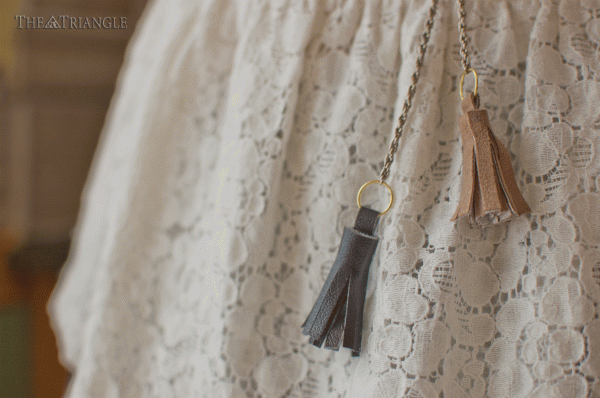
tasseldiy01WEBTaking a page from Phillip Lim 3.1, which has arguably produced some of the most sought-after accessories of the year, we have reinterpreted the leather tassel key chain to fit seamlessly into both your wardrobe and your budget.


You will need:

  • (faux) leather or suede
  • super glue
  • large jump ring
  • scissors
  • pencil
  • ruler
1

Photos by Courtney Denton


Cut your fabric to the desired size. Ours measured two inches wide and eight inches long, but the dimensions can be adjusted according to your specifications. From the top edge, measure one-quarter of the entire length, and using your ruler as a guide, draw a line across the fabric. This will determine where your tassels begin. Next, use your scissors to cut small strips, starting at the bottom and ending at the line you just drew. These are your tassels! When you get to the end of the fabric, cut one strip off entirely. It will attach the tassel to your jump ring. Loop the small strip through your jump ring, glue the ends together, and then glue the closed end to the top corner of your fabric piece. Let the glue set for a couple minutes. Now all you need to do is roll everything together, adding glue as you go.

To wear your tassel as a key chain, simply replace the jump ring with a key ring. To rock a fringe-detailed necklace, just string a chain through your jump ring.

Images courtesy of Courtney Denton | The Triangle

The post DIY Tutorial: Leather Tassel appeared first on The Triangle.

Posted in UncategorizedComments Off on DIY Tutorial: Leather Tassel

Store Profile: Duke & Winston

1

Upon entering the offices on the second floor of the Duke & Winston showroom, I was eagerly greeted by an English bulldog whom I recognized as none other than the Duke himself. Founder Seun Olubodun was kind enough to sit down with me and tell the story behind his Philadelphia-based casual clothing line as well as his plans to grow his business this fall.

The Duke & Winston brand began with a single design in 2009 and quickly grew to encompass an entire line. Olubodun recalled a seminar at the Moore College of Art & Design back in 2008 where Johnny Earle, creator of the Johnny Cupcakes T-shirt line, was a speaker. At the time, Olubodun was running his own Web design business, which he started from his residence hall room at Temple University, and he went to the event with the intention of taking on Johnny Cupcakes as a new client. He left the seminar feeling inspired by the way Johnny “built a T-shirt line into a huge following.”

“Philadelphia doesn’t really have its own clothing line … that’s based here for guys,” Olubodun noted as he recognized an entire potential market just waiting to be tapped. Web design “was a job where I had to go out and find a new client, and each time you got one you had to start over,” Olubodun said. Contrarily, a single tee design could be sold over and over again to new customers.

Despite having extensive Web design experience, Olubodun recognized his need to outsource his design concepts to professionals. “I’m not a graphic designer, but I can lay stuff out,” Olubodun said, so in addition to designing his own website, he maintains creative control by having his own concepts refined by “two of the best graphic designers … in the country.” His first design, which featured his dog Duke, is also the brand’s best-selling item. The Duke & Winston showroom is just over a year old, and according to Olubodun, most of his business for the first three years consisted of selling his product at trunk shows and lending his line to vendors on consignment. He frequented the Rittenhouse Row Spring Festival and outdoor events at The Piazza at Schmidt’s in order to get his product noticed, which he said is the best way to start selling a new product. “You have to go to where your customers are and just set up,” he advised, “set up and just start selling.”

The first store to feature his line was the Philadelphia-based boutique Matthew Izzo. The line is currently carried in cities such as Newport, R.I.; Nantucket, Conn.; and several New Jersey beach towns, including Avalon and Stone Harbor. Current vendors are located as far south as Florida and even overseas in the U.K. and Australia.

1

Eventually the merchandise categories expanded to include men’s polo shirts, sweatshirts and even pet products. While not all Duke & Winston products are produced in the U.S., one of Olubodun’s goals for his 2014 line is to manufacture it entirely in the states. Currently, some tees are sourced from American Apparel; men’s ties are made in New York; and Duke & Winston’s leather goods, such as dog collars and leashes, are made here in Pennsylvania. “All of my garments will be made in … downtown [Los Angeles], hopefully,” Olubodun added. He has a visit scheduled next month to the factory in LA where his samples for the 2014 collection are being produced.

It turns out the Duke has a greater role than simply serving as the brand’s mascot. Olubodun noted that from the start he intended to build a personal relationship between his brand and his customer. “Most people that shop up here know who I am and know who the dog is. My mission is to create a line that people have a personal connection with.” Olubodun’s goal for Duke & Winston from the beginning was “to have an independent clothing line for guys — and girls when I get to that,” who “don’t really care so much about, like, the fashion industry as a whole,” but who like products that are simple and accessible while still maintaining the differentiating qualities of an independent brand. Olubodun painted a picture of a “preppy” target customer who likes “outdoor activities, tennis, and they love their pets, and I just develop stuff that fits into these people’s lifestyles.” Most distinctively, Duke & Winston customers want the same quality and style for their four-legged best friends.

Located on 2nd Street just north of Spring Garden Street, the Duke & Winston showroom sits less than a block away from other independent boutiques including Art Star, R.E.Load and Arcadia. According to Olubodun, their showroom location is just over a year old and houses four to five full-time employees as well as several interns. The Duke & Winston family is small, but Olubodun admitted that “everyone who works here pretty much comes from Drexel.” Claire Resnick, a sophomore design & merchandising student at Drexel, had just started the first day of her internship with the brand. In addition to designing the shop windows earlier that morning, she said her duties going forward would include building the brand’s social media presence through its Twitter, Instagram, Facebook and YouTube accounts. Olubodun also mentioned the next round of co-op applicants that he will be considering for the upcoming spring and summer terms.

So what will 2014 hold for Duke & Winston? Olubodun said he hopes to expand his menswear brand nationally through networking at trade shows in New York, Chicago and potentially Las Vegas. By 2015 he hopes to incorporate women’s clothing by bringing a womenswear designer to the team. A pop-up shop is slated to open in November in Bryn Mawr, Pa., and, while the shop is only scheduled to stay open for about three months, Olubodun said he hopes it will generate enough business to grow into a second storefront. Read more about Duke & Winston atdukeandwinston.com and follow the brand on Twitter and Instagram to stay up to date.

Images courtesy of Courtney Denton | The Triangle

The post Store Profile: Duke & Winston appeared first on The Triangle.

Posted in UncategorizedComments Off on Store Profile: Duke & Winston

Street Style

Street Style2_Denton_WEB

Victoria Sibalich

Design & merchandising, junior

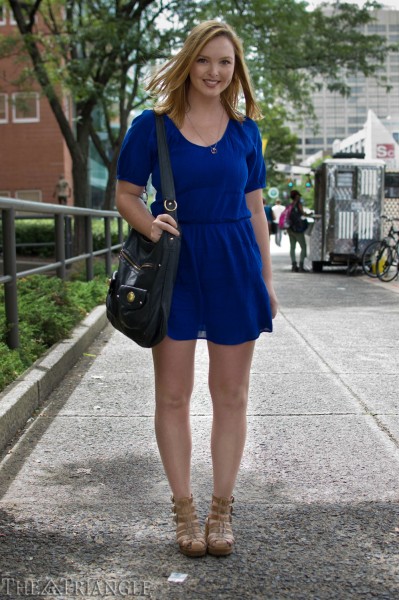
Wearing: Forever 21 dress, Jellypop sandals from DSW, and PINK by Victoria’s Secret bag

Q: Who or what most inspires your personal style?

A: I draw most of my style inspiration from the trends around me. I wish I could just say one designer or specific person, but really I follow fashion blogs and read Vogue and skim different clothing catalogs. If I see something I like, I will find a way to fit it into my own style, especially if I can find a less expensive way to do so.

Q: What’s your favorite piece, either clothing or accessory, in your closet?

A: My favorite accessory is my hot pink cat eye sunglasses. Surprisingly, I am not wearing them, but when I do, I feel like they really convey my personality. Also, they are super fun and chic!

Q: What are your favorite places to shop?

A: I really am a very versatile shopper. I will shop at Forever 21, Body Central, JC Penney, Macy’s and Mark (Avon catalog). I cannot resist low prices and mixing pieces; I prefer affordable fashion.

Q: How do you think you will adapt your style while you’re abroad this summer?

A: It is going to be a little difficult, but I am going to bring some of my favorite pieces — such as dresses, earrings and sunglasses — along with some basics. This way I can still have my personal style, only a less elaborate and more feasible version of it.

Street Style_Denton_WEB

Hilary Waks

Design & merchandising, junior

Wearing: Chaser T-shirt and Prabal Gurung for Target heels

Q: How would you describe your personal style?

A: I have an urban, free-spirited sense of style. I live in my Chaser LA band T-shirts and have fun experimenting with contrasting textures, especially leather.

Q: What’s your favorite piece of clothing?

A: If I had to choose my favorite piece of clothing, I’d say my brown suede fringe Haute Hippie skirt. It was a gift from a woman with the best taste of anyone I know, even at 60 years old.

Q: What are your favorite places to shop?

A: My go-to store is First Impressions, a boutique in Lafayette Hill, Pa. I’m also a major fan of Top Shop and Free People.

Q: How do you think you will adapt your style while you’re abroad this summer?

A: When I’m abroad in Prague this summer, I know I have to pack light, so I plan to layer even more and bring a ton of basics. I am ready to explore Europe for my first time and have to bring items that I can wear on my many adventures.


Street Style3_Denton_WEBSally Kenyon

Graphic design, sophomore

Wearing: Gap dress, ALDO shoes and Asos bag

Q: What most influences your style?

A: My style is influenced mostly by different music I’m listening to or movies I’ve recently seen. Lately my style has been a combination of “ Empire Records” and “ Breathless.”

Q: Where are your favorite places to shop?

A: I like to shop on South Street, mostly in the consignment shops because I’m broke. Philly AIDS Thrift and Retrospect are great for unique finds.

Q: How will you adapt your style while you study abroad this summer?

A: This summer when I study abroad, I’ll be living out of a single backpack for two months, so my outfit choices will be really limited. I’ll probably hate all my clothes by the end of it.

Images courtesy of Courtney Denton

The post Street Style appeared first on The Triangle.

Posted in UncategorizedComments Off on Street Style

The Cost of Fashion

Students gathered outside the doors of Gap on 34th and Walnut streets on the University of Pennsylvania’s campus May 15 to protest the American company’s use of Bangladeshi factories.

In light of the recent collapse of the Rana Plaza garment factory in Savar, Bangladesh, where The New York Times reported a death toll of 1,127, a collective of leading international fashion retailers have signed an agreement to initiate safer working conditions for laborers. That collective includes heavyweights such as H&M, Primark and Marks & Spencer; PVH, which manufactures Tommy Hilfiger and IZOD, and Inditex, the parent corporation of Zara.

Meanwhile, Gap Inc. has refused to the sign the contract, which would require these brands to fund regular inspections and hire qualified individuals to conduct overviews for fire and structural hazards. According to reports from The Associated Press, further investigation after the collapse revealed that the top four floors of the factory had been illegally constructed, which contributed to the structural faults that caused the collapse.

After clothing and invoices found strewn among the wreckage were traced to numerous Western brands, the American public began to take notice and demand action, as these students were last Wednesday. But while the primary ethical responsibility of the source product falls on a parent company such as Gap, what role can consumers play in supporting the ethical production of garments? The most one can do is make an effort to become an educated shopper. Due to the globalization of the garment industry, only 1 to 2 percent of clothing available for purchase in the United States is currently produced under conditions that meet ethical standards, according to the AP.

The average American consumer is likely to be more focused on price than on any other aspect of a garment’s production. This means there is little incentive to conduct research prior to purchasing something as commonplace as a cotton shirt or pair of jeans. The current fast-paced store environment also poses a challenge, as there is minimal information readily available beyond the country of origin tag sewn into a hidden seam. Looking for clothing with the United States or Canada as the country of origin can ensure, although not entirely, that production conditions meet safety standards for both factories and individual workers. Brands such as Splendid, Bailey 44, AG Jeans and J Brand are all manufactured in the continental United States.

A notable disadvantage to buying fashions made on-shore is a comparatively higher price tag. But beyond the initial value of a new pair of jeans, consider that the $99 wholesale price of a $220 pair of jeans is how much it costs to ensure safe factory conditions along with fair compensation and benefits for laborers. So ask yourself: How much is ethical garment production worth to you?

The post The Cost of Fashion appeared first on The Triangle.

Posted in UncategorizedComments Off on The Cost of Fashion