Saint Louis University’s Graduate Student Union held a picket and rally march to fight for a fair contract after 480 days of bargaining on Sept. 1 on North Grand Blvd.
Allison Seager, a doctoral candidate in theological studies who also serves as a teaching assistant in introductory theology courses, said she attended the protest because of the union’s commitment to securing higher wages.
“The university couldn’t run properly without us, we are essential to both the education and research missions of the university,” Seager said. “We believe that we deserve a living wage, that is why we are here today.”
Caleb Mundle, a third year doctoral student in theology, said that he thought the rally was important because many union members have families relying on them for income.
“[I’m out here] for better wages, better healthcare, my friends have families that they need to support,” Mundle said. “I think it is important to support them primarily for increased wages, benefits, things like that.”
Nearly two years after the vote, the graduate student workers are picketing to try and establish their first contract.
Zach Davis, a Ph.D. candidate and instructor of record in the department of American studies and former president of the graduate student association, said there were over 150 people who RSVP’d for the rally, with more than 50 participating in the march.
Davis said that despite the lack of contract and action from the university, graduate students are persisting in their work.
“We are generally still teaching and attending our classes,” Davis said. “Some people are inviting their students out here, some people are still going to teach around, it really just depends on the worker.”
Voter turnout for the Student Government Association’s 2026 election had a major increase this year, nearly doubling the previous year. In the 2025 election, 6.58% of eligible voters participated, while in the 2026 election, 11.06% did.
This year there were 11,121 eligible voters and 1,005 ballots cast during the two- day voting period on Feb 25 and 26.
Sahana Gujja, a senior studying computer science, served on the election commission for the 2026 SGA elections. She said that she attributes the increased turnout to strong leadership.
“There was more visibility and outreach around the election,” Gujja said. “The election commissioner, Lilly Bowman, was really hardworking and passionate, which showed in how the election was promoted and organized.”
The SGA elections are run by an independent election commission, a group of students who are in their last semester at SLU that help operate the election while remaining impartial.
Unlike in the 2025 election, many races were contested this year.
In 2025, only three positions had more than one candidate, and there was only one candidate running for president. This year only two positions had only one candidate while the rest were contested races. There were two presidential candidates until the day of voting, where Mason Bader was the only official candidate.
“There seemed to be more energy from both candidates and students,” Gujja said. “The overall attitude felt more encouraging and inclusive.”
W.H. Oxendine, the founder and executive director of the American Student Government Association said that contested races usually result in more voter turnout.
“Recruiting candidates is a top priority,” Oxendine said. “More candidates means more campaigning. More campaigning means more excitement, awareness, and participation by friends of candidates and friends of their friends.”
Even with more contested races, Gujja said that it is still important to use tactics to encourage students to vote.
“What helps [with turnout] is consistent communication, making voting easily accessible, and helping students feel like their vote actually matters,” Gujja said. “Candidates actively reaching out and connecting with students made a big difference.”
Oxendine said that it is not only important to encourage students to vote but to also show them why it is important.
“Students won’t vote if SGA hasn’t proven that it does anything worth student’s time,” Oxendine said. “The big issue is that students don’t think that SGA has authority or power. SGA must show that it gets things done.”
While voter turnout was up for the 2026 SGA elections, it still did not reach the heights it had in previous years. From 2017-2019, SGA saw turnout rates consistently around 18%, since 2019 it has not surpassed 14.5%.
Voting took place on SLU groups, as it has in previous years. This year SLU Groups experienced some technical difficulties during the first day of voting, possibly contributing to the lower rate of voter turnout seen this year as compared to 2017 and 2019. A similar technical outage saw a similar influence in the 2022 election.
While voting on SLU Groups makes it convenient for students to vote from any location, Oxedine said that it may not be the most effective method.
“Online voting is not enough,” Oxendine said. “Multiple physical polling locations that are designed to be a spectacle are required. The look and content of the polling locations is critical also. Information and photos of the candidates, displaying what SGA has done for students.”
Posted in UncategorizedComments Off on Student Government Association increases their voter turnout
Saint Louis University received the 2026 Senator Paul Simon Award for Comprehensive Internationalization on Feb. 10, in honor of the university’s commitment to welcoming international students. The award highlights exceptional work in integrating international education into all areas of the university.
“This recognition celebrates SLU’s deep commitment to international education,” SLU president Edward Feser said. “A commitment we demonstrate by welcoming international students to St. Louis, fostering a global community at our Madrid campus, developing innovative global partnerships and creating rich opportunities for SLU community members to learn and build relationships across nations and cultures.”
SLU has a large population of international students as well as an international campus in Madrid, Spain. In 2025, SLU had over 1,800 international students from 95 different countries, as well as over 1,200 students on the SLU Madrid campus.
The award is presented by NAFSA: Association of International Education, the largest nonprofit association in the U.S. dedicated to international education and exchange. The award is named after the late Illinois senator, Paul Simon. SLU was one of only five universities to receive the award in 2026.
“This recognition affirms SLU’s commitment to attracting talented students from around the world while ensuring all of our students gain the global perspective they need to thrive after graduation,” said Jean Marie Cox, the University’s interim vice president for enrollment management.
As a Jesuit university, SLU consistently focuses on ensuring that students are globally minded and working towards the greater good. In order to do so, Cox said SLU has been focusing on increasing international engagement.
“International students and global experiences are essential to the vitality of our campus and the quality of a Jesuit education,” Cox said.
SLU currently offers 56 courses covering international communities, culture, law and different global topics. SLU has also encouraged international education through events and programs on campus. One of SLU’s biggest international events is ATLAS Week. This is a week full of events focused on international education, culture and traditions, including different events, seminars, traditions, showcases and a Parade of Nations.
“Internationalization is in the DNA and mission of Saint Louis University,” Luchen Li said, SLU’s associate vice president for global engagement and international enrollment. “SLU is intentionally innovative with our efforts for internationalization as we pursue success.”
Studying abroad is one of the many opportunities SLU offers. More than 600 SLU students study abroad each year. SLU’s Education Abroad team has been working to make study abroad accessible to as many students as possible to ensure anyone who wants an international education experience can have one.
Posted in UncategorizedComments Off on SLU recognized for outstanding integration of international education
Throughout the weekend of Jan. 23 to 25, St. Louis experienced a severe snowstorm, accumulating over a foot of snow in just two days. The storm resulted in limited food options, water main and heating issues in residence halls and ADA violations to the entrances of academic buildings.
Many students who live in dorms rely on campus food options. All of these options, excluding Grand Dining Hall, which had abbreviated operating hours, closed for the weekend due to the severe storm.
Due to the increased number of students going to the dining hall, food options ran low. Several menu items were unavailable, multiple stations ran out of food and napkins and utensils were depleted.
Sophomore student Jordan Becker, who lives on campus, was not very pleased with the options available.
“It was hard to find something to eat in the dining hall, and that was our only option,” Becker said. “I was starting to get very tired of eating pizza every single day.”
Ben Perlman, SLU’s assistant vice president of student engagement, explained how DineSLU prepares for weather emergencies like this snowstorm.
“We try to load up on supplies as we anticipate both higher activity and may experience delivery delays from suppliers,” Perlman said. “We develop a weather closure operations plan that prioritizes opening locations that are able to serve the most students based on how many staff are able to travel to campus. That means prioritizing the residential locations in Grand and Reinert.”
On Sunday night, after the bulk of the storm had hit, many students were forced to walk to the closest supermarket, Fresh Thyme. The store is located approximately half a mile away from SLU’s campus.
“My friends and I went to Fresh Thyme to buy microwave dinners because the dining hall was closed and we needed to eat,” Becker said. “While there, I ran into multiple groups of SLU students doing the same thing, complaining there was nothing to eat on campus.”
SLU also faced an issue of frozen pipes bursting, causing the water to go off in Fusz and the Village apartments on Jan. 23.
“We lost water for a while on Friday night,” Becker said. “We were told that we could use the bathrooms and showers in the rec until things were fixed. The water eventually came back on around 3 a.m.”
Perlman detailed how SLU addressed the burst pipes and student safety during the water outage.
“Communication to affected students was sent out immediately, related to an outage and a timeline for repair,” Perlman said. “We provided resources for students who needed to shower, and we also provided card access to other residence halls for access to restrooms, bottle fillers and drinking fountains.”
In addition to the water issues, Marchetti Towers also experienced heating issues during the storm.
President Feser explained that the situation was stressful and the university wanted to resolve the issue as quickly as possible, and he explored the option of relocating students if needed.
“We did offer affected residents the option of temporary housing and a shuttle over to another residence hall,” Perlman said. “As far as I know, few, if any, students took us up on the option. If the repair work had not gone as quickly as it did, the residence life and housing teams would have coordinated with facilities and public safety on an evacuation of the building to temporary housing.”
President Feser expressed his gratitude for maintenance workers going out into freezing temperatures in the middle of the night to take care of both issues as quickly as they could, resulting in students not needing to be relocated.
“I’m glad we did not have to relocate students to temporary housing, but we were prepared to do so if necessary,” Perlman said.
After dealing with the snowstorm over the weekend, SLU had to decide how to handle class on the following Monday. Ultimately, the university decided to close.
President Feser explained that while the final call is left up to the provost, senior leadership personnel consulted and decided it was best to cancel.
“Our main concern is with students and faculty commuting to and from campus,” Feser said. “We want everyone to be safe, and driving on those roads would put them in a dangerous position.”
The following Tuesday, the university reopened classes as normal. Some professors chose to move to online while others still held in-person classes.
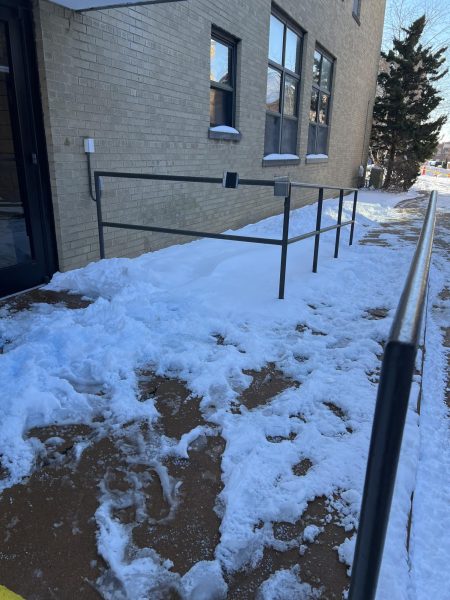
Despite the university being reopened, many buildings were still very difficult to access. Many students reported that the paths and sidewalks leading to Xavier Hall and McGannon Hall were not cleared off at all. Additionally, the only accessible entrances to Xavier were still completely blocked by snow.
Ice and snow cover Saint Louis University’s Xavier Hall’s only accessible entrance on Tuesday, Jan.27, as classes remain in session following a heavy snowstorm. (Anonymous)
Even though some students were unhappy with how things were handled, President Feser believed the process of dealing with his first big snowstorm at SLU “went relatively smoothly.” “We had some facility issues which we did not foresee, but maintenance worked extremely hard to fix those quickly,” Feser said. “We did our best to keep our students and staff safe.”
Posted in UncategorizedComments Off on Snowstorm disrupts campus services at SLU