Author Archives | by Tyler Church

Judge ends detained UMN student’s deportation trial

Doğukan Gunaydin, a University of Minnesota international graduate student who was detained in March by Immigration and Customs Enforcement officers, had his removal trial officially ended by immigration judge Sarah Mazzie Wednesday. 

In the decision, Mazzie said that while Gunaydin engaged in dangerous behavior in 2023 when he was arrested for driving while intoxicated, the Department of Homeland Security, or DHS, did not prove that Gunaydin was a danger to the public.

Gunaydin was the first of four known instances of University students being detained by ICE. He has been in custody since his March 27 detention.

DHS prosecutors said Gunaydin put the general public in danger when he drove with a blood alcohol level of 0.2, more than twice the legal limit in Minnesota. The DHS filed an appeal that will keep Gunaydin in ICE custody for the time being despite Mazzi’s ruling.

“The Immigration Judge erred in failing to find that driving dangerously while severely intoxicated is criminal activity that endangers public safety,” DHS attorney Laura Trosen wrote in her appeal.

Gunaydin’s next hearing, scheduled May 6, was cancelled, but he will remain in custody as DHS continues the appeal process.

Posted in UncategorizedComments Off on Judge ends detained UMN student’s deportation trial

UMN faculty, students observe National Day of Action to Defend Higher Education

Nearly 100 people rallied in front of the University of Minnesota Northrop Auditorium Thursday night in observance of the National Day of Action to Defend Higher Education, a nationwide effort which organizers say saw demonstrations at over 160 campuses. 

For nearly two hours, students, faculty and community members called for the University to defend its students from Immigration and Customs Enforcement, protect the freedom of speech on campus and divest from Israel. After the protest, the crowd held a candlelight vigil until 9 p.m., which Gender, Women & Sexuality Studies professor Sima Shakhsari said served to honor the lives lost on the Gaza Strip.

The protest, led by the Educators for Justice in Palestine, saw representatives from eight campus and community organizations from Minnesota who spoke in solidarity with the group.

Image by Eleanor King

AFSCME 3800, a union group that recently announced it was seeking to negotiate contract updates and new policies for worker rights on campus, denounced the University’s inaction in protecting its students and criticized the University’s institutional neutrality in the Israel-Palestine war.

The nationwide protest was planned for April 17, also known as Palestinian Prisoners’ Day, to acknowledge the political prisoners being held by Israel in the war, Shakhsari said. 

“We are not only focusing on the violation of academic freedoms across the U.S. by the Trump administration,” Shakhsari said. “We are also here to stand in solidarity with all the Palestinian prisoners.”

Among the speakers at the protest was Rabbi Jessica Rosenberg, who spoke on behalf of Jewish Voices for Peace.

Rosenberg said the Trump administration is targeting higher education because of the political resistance on campuses around the country. If these campuses do not give in to that political pressure, Rosenberg said real cultural transformations could be made in American society.

“We can resist. We can show each other a new world,” Rosenberg said. “We can build and embody revolution, even in the crumbling of an empire.”

Along with community members, many University faculty members attended the protest. Assistant professor of African American Studies Rahsaan Mahadeo said the University used the Board of Regents’ March ruling on institutional speech to silence faculty. In passing that decision, he said the University barred faculty from doing their jobs and created a “chilling effect.”

The Board’s policy on institutional speech does not prohibit faculty, but faculty groups, from speaking on issues of public concern.

“Our demonstration here today is to say, if you’re not going to allow us to do our jobs, we’re going to show you how important it is if we are mobilizing to fight back,” Mahadeo said.

Members of Students for a Democratic Society said they are working with other groups to form an advocacy network for international students on campus. SDS member Shae Ross said they can speak out against injustices with much more influence by joining forces.

“We’ve been in communication with unions, with other student groups, setting up a network of communication,” Ross said. “If someone is detained, not only do they have access to legal resources, but they also have access to us as organizers to make sure that we can hit the streets.”

Posted in UncategorizedComments Off on UMN faculty, students observe National Day of Action to Defend Higher Education

UMN announces 11 international students’ legal status terminated

In a rapid response brief sent to faculty Friday afternoon, the University of Minnesota announced that 11 students had their Student and Exchange Visitor Information System (SEVIS) records terminated by the Department of Homeland Security.

Termination of SEVIS records ends a student’s legal status within the U. S., barring them from reentry without alternative forms of approved documentation.

SEVIS is a national database that tracks international students while they study in the U.S. and is managed by the Student and Exchange Visitor program, a division of Immigrations and Customs Enforcement (ICE).

This announcement comes well after the University announced that an international Carlson School graduate student, Dogukan Gunaydin, was detained by ICE officers March 27. Gunaydin, who is still in ICE detention, had his B-1/B-2 student visa revoked by the U.S. Department of State for a driving while intoxicated charge from June 2023.

As of now, over 1,000 international university students have had their visas revoked or SEVIS records terminated, as reported by CNN.

In an April 10 webinar hosted by the University’s International Student and Scholar Services (ISSS), the ISSS said the University is aware the federal government had begun deleting SEVIS records, but it is not entirely clear as to why. The ISSS added that the SEVIS records are not publicly available and can only be accessed by approved ISSS officials.

In the rapid response brief issued Friday, the University announced it will not share any international student SEVIS information to the public.

“You may receive requests for more information about those who are impacted by changes to their immigration status,” the brief said. “While this curiosity no doubt stems from a desire to help, the University will not proactively share this information.”

The University cannot legally share student information under Minnesota state law.

The Minnesota Daily reached out to the University for a comment on the situation, but received no response before publication.

Posted in UncategorizedComments Off on UMN announces 11 international students’ legal status terminated

Detained UMN international students bail left to judge decision

Friday morning, the Fort Snelling Immigration Court held the bond hearing for Doğukan Gunaydin, 28-year-old Turkish University of Minnesota graduate student detained on Mar. 27. Gunaydin, who has been held in detention for over two weeks, had his B-1/B-2 visa revoked by the U.S. Department of State, according to the prosecutor, for a driving while intoxicated (DWI) arrest in June of 2023.

The prosecutor, a federal attorney arguing against Gunyadin, claimed that Gunaydin’s 2023 DWI made him a threat to public safety. According to the prosecutor, Gunaydin had been driving recklessly before being pulled over, in a traffic stop that saw him measure a blood alcohol content of 0.2, which is more than double Minnesota’s legal limit.

However, Hannah Brown, Gunaydin’s attorney, argued that since the stop, Gunaydin had sold his car and no longer held a valid license. Without the ability to drive, Brown contended that Gunaydin couldn’t pose a threat to public safety if released.

During the proceedings, the prosecutor also mentioned that, because of this incident, Gunaydin’s B1/B2 visa had been revoked. However, as Immigration Judge Sarah Mazzie remarked, it was incorrectly reported by the prosecution that his F-1 visa was revoked, not his B1/B2.

After nearly an hour, Mazzie ended the public session. Brown confirmed that the decision will not be public, but will instead be issued to immigration officers and the case’s legal counsel, who can then decide whether or not to announce the decision publicly.

It is not known whether or not Brown will release the verdict. Brown said that, as long as the case is ongoing, she is unavailable for comment.

Outside of the courthouse, protesters assembled to support Gunaydin in his legal battle. Members of the University’s Graduate Labor Union (GLU) and Students for a Democratic Society (SDS) spoke out against Gunaydin’s detention, calling his detention unethical.

“It’s obvious to everyone at the U, or at least the faculty, students and staff, that this is not a just detention or deportation,” said Leila Yorek Sundin, a member of SDS. “He’s being held with no real cause, and he’s been threatened to have his whole life taken away. He can’t finish his degree if you send him back home.”

GLU Financial Secretary David Munkvold echoed Yorek’s sentiment. Munkvold said the union and its members plan to fight to protect graduate students, and members of the University community as a whole, from wrongdoing at the hands of University, state or federal officials.

“We believe that this detention is morally reprehensible, we believe it’s illegal,” said Munkvold “We think he should be out here among us, pursuing his studies and living his life without the fear of deportation.”

Munkvold said that GLU members have been outraged by the detention, especially knowing that Gunaydin has already faced the consequences of his arrest.

“This is someone who, like many of our workers, came to the U of M to get education to improve their lives and the lives of their communities,” Munkveld said. “The fact that someone can just be kidnapped off the street for a crime that they already dealt with the consequences of, and already have been through the justice system, it doesn’t make sense.”

Munkvold is not alone in his apprehension for the justice system. SDS member Kyle Feldhake said he has also felt a lot of anger towards the circumstances surrounding his arrest, and condemned the Trump administration for their hastiness.

Feldhake said that, in their rush to seize visas and apprehend immigrants, the Trump administration has made many errors, similar to the ones seen today.

“I don’t know too many details about this specific situation but the whole Trump administration has been very sloppy,” Feldhake said. “I’m not surprised by it, that they’re trying to rush things through and not do their due diligence, that’s been the whole approach of the Trump administration.”

Posted in UncategorizedComments Off on Detained UMN international students bail left to judge decision

UMN takes down departmental statements on Israel-Palestine, Russia-Ukraine conflicts

Since Saturday, the University of Minnesota has taken down 11 statements from various departments regarding the Israel-Palestine and Russia-Ukraine conflicts. 

College of Liberal Arts Dean GerShun Avilez held an emergency meeting with chairs of five CLA departments on Saturday afternoon, where he announced that statements regarding the Israel-Palestine war would be taken down effective immediately. Over the weekend, seven departments saw statements taken down that addressed this conflict.

Provost Rachel Croson said in an email to faculty on Tuesday the decision to remove the statements was made following feedback from an advisory board composed of four faculty members.

“The group’s focus is on understanding the Regents’ resolution and advising the provost in which institutional statements on University-designated websites or other media do or do not align with the institutional stance, or lack of stance, on an issue,” Croson said in the statement. “For example the University does not currently have a position on the conflict in the Middle East, or the war in the Ukraine.”

In March 2022, the University’s administration released a statement openly denouncing Russia’s role in the Russia-Ukraine war and announcing that they had divested from Russian-related investments. 

The University began taking down departmental statements regarding the conflict Monday afternoon.

Posted in UncategorizedComments Off on UMN takes down departmental statements on Israel-Palestine, Russia-Ukraine conflicts

Hundreds protest UMN graduate student’s ICE detention

Union groups held a rally Monday at the University of Minnesota to protest the University’s lack of protections for students and staff under President Donald Trump’s administration. 

The rally happened three days after the University announced an international graduate student was detained by the U.S. Immigration and Customs Enforcement. The University’s Graduate Labor Union – United Electrical, or GLU-UE, Local 1105 and the American Federation of State, County and Municipal Employees, or AFSCME, Local 3800 held a rally on Johnston Hall’s steps. 

The protest saw hundreds of students, union workers and community members attend, and was originally planned to be a rally for labor protections under the new Trump administration and an announcement of demands on behalf of the unions’ workers. However, after a graduate student’s detainment, who was taken from off-campus housing on Thursday, outrage from members of the University community bled into the rally, as many speakers condemned the University for its inaction. In an article published Tuesday, MPR identified the student as Doğukan Günaydin.

Protesters shouted for over an hour at one of the largest protests on campus in the past year, disparaging the University’s administration for its passive attitude. 

Max Vast, the president of AFSCME 3800, condemned the University’s response to the detention of its graduate students, saying that many students and staff are terrified and the University has done very little to quell fears. 

“I think it’s woefully inadequate,” Vast said.

Vast said the University should be expected to support its staff and faculty more than sending a link to mental health resources.

“Sending faculty and staff a link to a mental health resource does nothing to prevent students from getting arrested by ICE in broad daylight,” Vast said.

During the rally, Minnesota State Senate Member Omar Fateh announced that another student had been detained by ICE at Minnesota State University, Mankato. Fateh said there is not much known at this time, but Minnesota State University, Mankato, is working to find more information about the student detained.

The Unions’ Demands

At the rally, AFSCME 3800 and GLU 1105 representatives announced that the unions are pursuing new labor agreements less than a week after Teamsters Local 320, another labor union for campus workers, said they would be pursuing contract renegotiations. 

Vast said that AFSCME 3800 and GLU 1105, along with the Teamsters, offered to negotiate jointly, but the University denied the request.

Their demands include:

  • A meeting with the two unions 
  • A commitment to protecting immigrant workers
  • An agreement to halt layoffs for one year
  • An outline addressing their response to possible funding cuts
  • A commitment to banning cuts for cultural centers and academic programs
  • An end to political repression on campus

Abaki Beck, president of GLU 1105, said the protest was planned before the graduate students’ detention, but the groups wanted to shift the focus of the protest to acknowledge their situation.

“People are really scared,” Beck said. “People want to be mobilized, people want to be organizing collectively. So, people are feeling very galvanized at this moment, not only to do this internal union work for supporting our fellow grad workers and doing contract enforcement, but also this broader political work.”

Even with the recent activism, Beck said she has not seen proactive change from the University to help members of the University community, and this comes as no surprise to her.

“It’s been a reactive response, and that is disappointing, but not unexpected,” Beck said. “That’s frequently how large institutions, and frequently how the University of Minnesota in particular, have responded to things.”

Beck is one of many union members around campus who have felt this fear, but some members are using this fear as fuel.

Taylor Barnes, an AFSCME 3800 member, said the only way to fight this fear is to fight back. In a speech, she called for everyone to continue the fight to protect their education and freedoms.

“Education is a right, and safety should be, too,” Barnes said. “We cannot let history repeat itself.”

Barnes graduated from the University a year ago before working as an access service specialist at the University libraries. Barnes said standing alongside others and helping in the fight feels gratifying, even if today’s political climate is intimidating.

“It’s just scary,” Barnes said. “But, it feels good to know that people are on your side, that you have people to talk to about it and stand with you.”

Posted in UncategorizedComments Off on Hundreds protest UMN graduate student’s ICE detention

UMN union workers rally to announce contract renegotiations

Members of Teamsters Local 320, a worker’s union chapter based out of Minneapolis, organized in front of Morrill Hall early last week to announce they will be seeking contract negotiations for better work conditions again.

Teamsters began the renegotiation process for worker contracts March 27.

Service workers from different University of Minnesota campuses attended the rally, which lasted roughly an hour, to speak on the goals they hope to achieve during contract negotiations.

Xavier Shepler, a student and food service worker who traveled from UMN-Duluth to speak at the event, said that lending his voice for those who could not make the trip represents the greater goal of a union.

“In a union, we all stand together, there’s strength through numbers, strength through having a common voice and working towards a common goal,” Shepler said.

One of the new goals the union is seeking to gain is a par rate increase for shift differential.

Shift differential is a higher wage rate for working hours outside of the typical working hours, such as night shifts, weekends and holidays. Teamsters said the rate for the University only adds 55 cents per hour.

“I feel like that number is way out of date in general, so that’s something, for me, that is important,” Shepler said. “It’s difficult to wake up super early or to stay super late and have to give that time to be here.”

As of 2022, Teamsters represented over 1,500 union workers across the University’s five campuses. Amy Perusse, a business agent for Teamsters 320, said those numbers and the community they have fostered is the reason they have so much power as a group.

“The only way we can have living-wage jobs for everyone else is if we stand together,” Perusse said. “That‘s what a union does for me – it allows me to have a home and food on my table. That’s what we’re fighting for for these workers.”

Several other union University groups spoke in solidarity with the Teamsters, including the University’s chapters of the Graduate Labor Union and American Association of University Professors (AAUP).

Speaking to the crowd, Vice President of AAUP’s Twin Cities chapter Heather Holcombe said Teamster plays an important role at the University.

“Would it make a difference in your day, if Provost Croson was in her office today?” Holcombe said in her speech. “It would not make a difference – none of us would know. But I can say with certainty that, if buildings and maintenance didn’t show up today, we would all know. We would know if our sidewalks were icy, we would know if our classrooms were dark.”

Alston Dutchin, now retired, was a member of the Teamsters for 41 years, 20 of which he served on the union’s executive board. He said that he attended Tuesday’s rally in solidarity, to give back what the organization had given to him during his time as a member.

“The union has done a lot for me,” Dutchin said. “Raises, vacation, sick time, my pension. We fought hard for that.”

Lead negotiator Jackson Kerr said he worries the University may use the threats of funding cuts by the Trump administration as an excuse to turn down the deal. In the scenario where the negotiation process stagnates and the University does not comply with demands, Kerr said the union would consider a strike vote.

However, Kerr said he is no stranger to dealing with conflicts against the University. In his time, he said he’s had the police on him four times.

Despite the conflicts, Kerr said the ultimate goal is for all University employees to feel respect and dignity in their workplaces.

“If you treat your workers respectfully, you get respect back,” Kerr said.

Posted in UncategorizedComments Off on UMN union workers rally to announce contract renegotiations

Protestors organize on Northrop Mall, condemn UMN administration

Around a hundred protesters gathered Monday afternoon outside Northrop Auditorium to protest the University of Minnesota’s compliance with recent changes under Republican President Donald Trump’s administration. 

Over an hour and a half, nine different representatives united to denounce the University’s administration before ending the protest with a group photo on the stairs of Northrop Auditorium.

The group photo, according to activists, was meant to commemorate the work they did this semester.

Kirubele Adbebe, who was arrested at the Board of Regents meeting on March 14, denounced the administration for not protecting students.

“I got arrested, but that don’t mean nothing to me,” Adbebe said to the crowd. “They’re going to throw whatever they want, investigate me, do whatever they can, because they know the true power is here — with the students.”

According to Students for a Democratic Society member Rowan Lange, the University charged Adbebe with trespassing during his protest at the Board meeting against a controversial policy restricting institutional speech. 

“This whole institution, these buildings, these pillars, everything is bought and paid for with our money, our work, our labor,” Adbebe said.

Outside of chanting and demonstrating, protestors chose some unique ways to let their frustrations be known.

Before and during the protest, members of the crowd used chalk to write messages denouncing University President Rebecca Cunningham, Trump and the Israel-Palestine War. These messages covered much of Northrop Mall’s pavement, with some protestors even leaving messages in chalk on the front steps and walls of Northrop Auditorium.

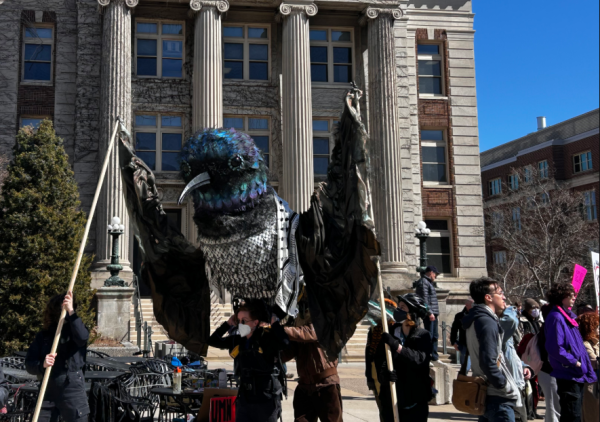
During the protest, a small group operated a puppet of a Palestine sunbird, which symbolizes hope, and walked around the crowd flapping its makeshift wings. 

Image by Tyler Church The Palestine sunbird outside of Morrill Hall.

Sima Shakhsari, an associate professor for the Department of Gender, Women and Sexuality Studies and a member of Educators for Justice in Palestine, encouraged staff to speak out and campaign against the wrongdoing that they’ve seen, both on campus and in the wider world.

“I want to encourage my colleagues, who have been silent so far,” Shakhsari said. “If I can speak, so can you. It’s not about bravery, it’s not about being stupid, it’s an ethical responsibility that every one of us has.”

Shakhsari, who has faced criticism and claims of antisemitism for her protests and activism, said she will continue to speak out until she sees change. She said that she worries for her and her colleagues’ futures under the Trump administration as funding cuts at universities begin to increase.

In recent months, the University has come under fire from the Trump administration, which placed the University on a list of 60 universities nationwide that are under investigation for antisemitic discrimination and harassment. The list, which also includes seven other Big Ten universities, states that the University failed to protect Jewish students from hateful acts on campus.

Siham Ibrahim, who spoke on behalf of Students for the Horn of Africa, said in her speech that she believes the University is putting students at risk of oppression and injustice. Trump’s policies, she said, threaten the autonomy and free speech rights of people across the U.S.

“Those who stand weak in the face of injustice, such as President Cunningham and the Board of Regents, they will not prosper,” Ibrahim said. “Not only will they lose the fight in the end, they show us that, in the face of oppression, they will willingly step aside and aid in the oppression of their own students.”

Posted in UncategorizedComments Off on Protestors organize on Northrop Mall, condemn UMN administration

UMN students react to University’s response to Trump’s executive order

In the first two months of his second term, President Donald Trump signed 79 executive orders. For the University of Minnesota, these orders could affect nearly all operations of the institution. 

Trump threatened to limit funding, make changes to Title IX offices and target students who demonstrate or protest on campuses across the country. These proposed changes brought concern from students, who worry about their future on campus.

In an attempt to clarify their role and decisions regarding these executive orders, the University issued a rapid response brief on Jan. 29, which attempts to help students understand how the University plans to respond to these changes from the Trump administration.

“I know these changes have heightened both curiosity and concern among members of our 

University community, specifically, how these decisions may impact or disrupt your daily work,” President Rebbeca Cunningham said in a video on the brief page. “I’ve tasked a group of University leaders to monitor these developments, and they are assessing how these changes will impact our powerful public service mission here at the University of Minnesota.”

In addition to the video brief, the University created a web page that addresses four concerns that students, staff or faculty may have. The web page highlights four topics: Diversity, Equity and Inclusion; the Department of Education; Immigration Policies and the National Institute of Health, all of which have seen significant changes under the current Trump administration. 

In the response, the University attempts to answer questions from members of the University and clear up any worries that Trump’s administration may have caused.

Although this response is meant to help clarify actions and changes for members of the University community, some students said they still do not understand what the future could look like. 

Bennett Nguyen Prowell said the clarification by the University still leaves something to be desired.

“It just seems kind of vague,” Prowell said. “I don’t really see a plan of action other than the rapid response website, so I don’t really know what to make of it.”

Prowell said he wishes the University could do more to support its students during this time, but he acknowledges that it is confusing for everyone involved, administration included.

“It doesn’t really feel like enough, but it also feels like, how much can they really do?” Prowell said.

Other students said they feel the University is not living up to their claims. Carina Dieringer and Camille Warnacutt, students at the University, said the University has fallen short in its efforts to protect students.

“I would say I’m really disappointed in how the University has responded,” Dieringer said. “They say that they have these goals of diversity and keeping their students safe, but it really doesn’t feel like that with the way that they’re kind of folding to everything.”

Like Dieringer, Warnacutt said she feels that federal changes have caused the University to compromise its principles.

“The University’s rollbacks on DEI due to federal funding cuts have been shameful,” Warnacutt said. “It has me thinking about the impacts that the University’s reliance on federal funding has on our safety, especially under this administration.”

Posted in UncategorizedComments Off on UMN students react to University’s response to Trump’s executive order

UMN Honors Program finds a new home in Jones Hall

The University of Minnesota Honors Program (UHP) officially completed its move to Jones Hall last week after spending over a decade in Northrop Auditorium.

UHP finished moving to Jones Hall, located at 27 Pleasant St. SE, four days after it closed its doors for the last time in Northrop. 

Matt Bribitzer-Stull, the program’s director, said this move means a lot for the future of the UHP to help foster a more connected community and upgrade the office.

“The program, in my opinion, has always struggled with a sense of community because we’re not located in any one college,” Bribitzer said. 

Bribitzer, who plans to step down from his role as the director of the program in June, said because the program takes in students from every major, it makes fostering a communal space much harder for honors students. But now, with a more accessible and approachable office, he believes that whoever is elected as director will have a much easier time.

“That’s been on my mind since day one, and I think the new director’s going to have a great new space to help take that next step forward,” Bribitzer said.

This change is seen as an upgrade for the program’s operations, as the design of Northrop caused the office to be split into two, causing difficulties for students and staff, Bribitzer said. Now, with one connected space, he said the program can be a more welcoming home.

Outside of a split office, the building itself posed some difficulties for the program. As the auditorium will see its 96th anniversary this year, its age has begun to show. 

Most recently, Northrop underwent emergency repairs in 2023 after a portion of the building’s ceiling collapsed, which resulted in nearly a month of suspended operations. 

So when the program was approached by Vice Provost for Enrollment Management Greg Sneed, who proposed the move, Bribitzer said he was excited by the prospect of a new look for the program’s home.

“We went over and looked at the Jones space, and we saw a lot of potential for solving some of the current problems that our space in Northrop has,” Bribitzer said. 

While members of the office said they are excited for what this change could mean for students, some students said the change does not mean much to them. UHP student Nick Hoppe said he does not recall ever visiting the office in person, as all of his advising sessions were held over Zoom.

Hoppe is one of many students who prefers to have their meetings with staff virtually. However, Anna Finley, a peer assistant for the program and student enrolled in the UHP, said that she believes this new space will benefit students in the honors program.

Finley said she believes one of the larger draws for students is their new event space, which will be used to host community-building sessions for the program.

“When people stop in for appointments, they will also hopefully see that the event space has something going on and they’ll be more likely to stop by,” Finley said. “We’re trying to make these events more open to everyone.”

Posted in UncategorizedComments Off on UMN Honors Program finds a new home in Jones Hall