Author Archives | by Rakeb Azeze

Candidate Profile: Amy Klobuchar for Minnesota Governor

Candidate Profile

Party: Democratic-Farmer-Labor

Age: 66

Previous Experience: U.S. Senate (DFL-MN, 2007-2026)

Campaign Goals: Affordability, healthcare, housing and government accountability


After nearly twenty years in the United States Senate, Amy Klobuchar is trying something different. Klobuchar seeks not a national run, not another term in Washington, but a chance to lead Minnesota from the governor’s office. 

At 66, she is running for Minnesota Governor as the Democratic Farmer-Labor candidate, facing Republican Lisa Demuth and Green Party candidate Steven Young in the Nov. 3 election.


A political life long before Washington

Born in Plymouth, Klobuchar graduated from Yale University in 1982 with a bachelor’s degree in political science. She received her Doctor of Law from the University of Chicago in 1985.

Before entering public office, Klobuchar worked as an attorney for several Minneapolis law firms. Her political career began as the Hennepin County attorney, a position she held from 1999 to 2006.

In 2006, Klobuchar became the first woman elected to represent Minnesota in the U.S. Senate, taking office in January 2007. Over multiple terms, she carved out a reputation for focusing on consumer protection, agriculture and healthcare.

Klobuchar entered the national spotlight in February of 2019 when she announced her campaign for the 2020 Democratic presidential nomination. The campaign was unsuccessful, though. She later withdrew from the race in March 2020 and endorsed former President Joe Biden.


Klobuchar’s blueprint

Affordability is a central focus of Klobuchar’s campaign, with proposals addressing housing, healthcare, childcare and utility costs.

According to her campaign website, Klobuchar proposes putting Minnesota on a path to build at least 100,000 new homes, apartments and condominiums by reducing permitting and simplifying access to down payment assistance.

For healthcare, Klobuchar proposes lowering prescription drug costs through expanded state purchasing programs and prioritizing low-cost generic medications. She also supports lowering health insurance premiums and expanding telehealth access, particularly for residents in rural communities. For Minnesotans, the goal is to make care more affordable and easier to reach, no matter the town or county.

Government accountability is another major component of her campaign. Klobuchar has proposed conducting a statewide audit of government agencies to identify fraud, waste and misuse of public funds.

Her plan includes strengthening oversight of government contracts, improving fraud detection and replacing outdated state technology systems. Among her proposals is making more government services accessible through mobile devices and simplifying applications for businesses and residents.

Klobuchar has also highlighted workforce development and education as key parts of her platform. She proposes expanding apprenticeship programs to give students more direct pathways into skilled careers, strengthening partnerships between colleges and employers to better align training with job needs. Together, these initiatives are framed as investments in the state’s future workforce.


Political criticism and challenges

Klobuchar’s campaign comes as Minnesota faces growing concerns over fraud in government-funded programs. Demuth has criticized Klobuchar for not meaningfully addressing allegations of fraud in state social services programs that have come to light.

In response, Klobuchar has pointed to her experience as a former prosecutor and proposed stronger measures to prevent fraud and hold those responsible accountable.

But fraud is not the only issue drawing criticism. Klobuchar’s past presidential ambitions have also raised questions about her future political plans. Demuth has questioned whether Klobuchar sees the governor’s office as a stepping stone to another presidential run, pointing to her previous campaign for the White House.

The criticism hinges on Klobuchar’s 2018 statement, announcing she intended to serve another full Senate term if reelected. Six months later, she announced her presidential bid.

In a September interview with the Minnesota Star Tribune, Klobuchar rejected speculation that she would pursue another presidential campaign, saying she would not run in 2028 or 2032 if elected governor.

If elected, Klobuchar would take on a different role than the one she has held in Washington, moving from making federal laws to overseeing Minnesota’s state agencies and working with lawmakers on the state’s budget and policies.


Looking ahead to November

As November approaches, voters across the state are weighing her housing and government reform proposals. After nearly two decades in Washington, Klobuchar asks Minnesotans to trust her with a new kind of leadership, one that would give her direct responsibility for the state government and its priorities.

On Nov. 3, voters will decide whether that next chapter begins in the governor’s office.

The post Candidate Profile: Amy Klobuchar for Minnesota Governor appeared first on The Minnesota Daily.

Posted in UncategorizedComments Off on Candidate Profile: Amy Klobuchar for Minnesota Governor

AI-powered drones, climate change and what UMN is doing

What was once seen as progress to modernity and civilization through industry and transportation is now widely understood as a major driver of rising global temperatures and environmental instability. As climate change becomes more visible in everyday life, public health advocates, researchers, entrepreneurs and institutional leaders argue for change. 

From AI-driven innovation to campus zero-waste efforts, concerned individuals at the University of Minnesota and beyond are pushing for sustainable solutions.

Impact of climate change

Over the decades, climate change has affected the livelihoods of millions of people worldwide through drought, raising sea levels and wildfires. Global sea levels have risen by about 97 millimeters, or nearly 4 inches, since 1993, and NASA reported in 2025 that the rate of sea level rise has doubled over the past 30 years. In the United States alone, NCEI  said 2023 had 28 separate billion-dollar weather and climate disasters, including the Hawaii firestorm and Hurricane Idalia. 

The average temperature in Minnesota has increased by 3.1 degrees Fahrenheit from 1895 to 2023, while average winter low temperatures have increased by 5.8 degrees Fahrenheit in the same period, according to the Minnesota Climate Adaptation. 

“Minnesota, like every other state, is going to experience more extreme weather, now as well as into the future,” Jesse Berman, an associate professor in the School of Public Health and an Environmental epidemiologist, said. “That can mean different things; it could mean more flooding conditions, drought, heat waves, wildfire or smoke events. There’s a range of extreme environmental impacts.”

As these effects become more severe and common, climate change is no longer a distant problem but a present global crisis. 

Wildfire crises

Climate change has increased the frequency and intensity of wildfires, as it heats up the Earth and dries vegetation. Minnesota experiences 800-1,000 wildfires per year, with more than 70,000 wildfires occurring yearly nationwide, according to the U.S. Forest Service. 

Berman said wildfire smoke is one of the main climate risks Minnesota faces most often, and noted that smoke can travel from hundreds or even thousands of miles away and still affect people locally. In 2025, thousands of Minnesotans were told to stay indoors to avoid wildfire smoke originating from Canada.

“Wildfire smoke can also be transmitted very large distances,” he said. “These wildfire smoke events that are actually being driven by wildfires [are] occurring 100 or if not 1000 of miles away in northern Canada.”

A recent study found long-term exposure to wildfire smoke is linked to a large number of U.S. deaths, with PM2.5 exposure associated with about 24,100 deaths per year. PM2.5 is a type of small air pollution particle that can be inhaled deep into the lungs and cause health problems like breathing and heart complications. 

Jiarong Hong, a University of Minnesota mechanical engineering and electrical and computer engineering professor, emphasized the danger of this particle suspension.

“The impact of smoke goes beyond just where it starts because of small particles. … They can be kept suspended in the air for a very long period of time … and can be moving hundreds of kilometers away from where it was generated,” Hong said.

Berman said there are high risks for vulnerable groups, like those with pre-existing conditions.

“When we think about vulnerable populations, we can often include older adults, very young children, people with existing diseases, such as those with asthma or maybe COPD, or those who have had, you know, heart conditions in the past,” Berman said. “These are the vulnerable populations that we want to, you know, protect the most.”

Berman added that vulnerability goes beyond traditional categories. Outdoor workers, such as farmers or police officers, may face increased exposure to wildfire smoke and heat, showing that even otherwise healthy people can be at risk. 

Wildfire drones and AI-powered waste bins

As climate change increases wildfire intensity, University of Minnesota researchers are using artificial intelligence to track smoke and its atmospheric movement. 

Hong is a part of a team developing autonomous drone systems designed to detect smoke and measure how particles spread in real time. He said the project began as a way to solve a major gap in current monitoring systems. 

Traditional tools like satellites and fixed weather towers only capture parts of the picture. 

“Right now, there are very limited tools to understand, you know, record, and quantify these events,” Hong said. “It’s hard to track the dynamic events like wildfire, you know, that happens and changing very quickly and needs very high resolution, both spatially and temporally, to capture the spread of such events.” 

To address that problem, Hong’s team developed a swarm of drones equipped with cameras and sensors that move through smoke plumes and collect detailed information about particle size and movement. The system uses AI and computer vision to tell whether what the drone is seeing is actually smoke, and respond immediately if so.

“We also have the AI tools and deep learning tools, which allow us to be able to analyze the images recorded by the camera to really determine whether that’s smoke or something else,” Hong said. “If it’s smoke, the drone is able to follow, continue following the smoke.” 

Hong said the technology could eventually help both scientists and emergency officials make faster and more informed decisions during wildfire events. He added that the current process often requires people to confirm signs of smoke, sometimes through planes or other aircraft, before that information is sent back to decision-makers.

“The faster you can make a decision, it makes a huge difference in terms of mitigation strategies and the way you can confine the smoke,” Hong said.

Artificial intelligence is also being used in other climate-related areas beyond wildfire monitoring. Kiril Gantchev, CEO and co-founder of Ameru,, said his company uses AI-powered waste bins to automatically identify and sort waste into different categories.

“The goal would be to stop humans from contaminating the waste,” Gantchev said. “In order to do that, we have to have something that sorts the waste instead of humans.”

Gantchev’s AI-powered waste bins can classify more than 100 types of waste based on material, object type and condition, which helps improve how much waste is diverted away from landfills. Controlling what ends up in landfills can potentially reduce contamination, improve diversion and cut down on landfill waste.

Landfills are major climate pollutants that account for about 14% of methane emissions in 2022, according to the EPA. This potent greenhouse gas is 28-48 times more effective than CO2 at trapping heat, making it an increasing threat to environmental sustainability.

The technology can make a measurable difference, according to Gantchev. He said many airports and other large facilities have diversion rates below 5%, but deploying AI sorting bins can raise that to over 50%. 

University actions

University of Minnesota climate action is taking shape through campus sustainability and waste reduction efforts. Kate Nelson, University director of campus sustainability for the Twin Cities campus, said the University’s climate goals include deeper emissions cuts and long-term resilience planning. 

Campus recycling coordinator Ahnika Seifert said the Twin Cities campus is currently at a 52% recycling and composting rate, with 31% recycled, 17% composted and 4% reused out of roughly 19 million pounds of waste managed each year. 

Seifert said one of the biggest challenges is not always infrastructure, but human behavior and contamination. Waste audits show that much of what ends up in the trash could have been composted or recycled instead. 

Nelson said sustainability progress on campus depends on both institutional systems and everyday choices from students, faculty and staff. 

Arwa Alakech, a student at the University, said the University has made a lot of positive impacts on sustainability and has done a good job listening to students’ concerns.

“The University itself has a lot of great sustainability initiatives, and the zero-waste plan was developed because Students for Climate Justice were upset that their trash was going to the HERC,” Alakech said. “They brought those concerns to the sustainability office, which then worked with them to create the initiative.”

Minnesota weather whiplash

Minnesotans are used to unpredictable weather, but climate experts say long-term data show the state is warming and experiencing broader shifts in temperature and precipitation. 

State climatologist Kenneth Blumenfeld said Minnesota has warmed about four degrees Fahrenheit over 100 years, but the vast majority of that has occurred in the last five and a half decades.

According to the Minnesota Climate Adaptation website, Minnesota will see an increase in temperature by about 3.8-4.5 degrees Fahrenheit and average annual precipitation rising to 1.2 inches. Blumenfeld said that although these numbers are small, they are still impactful.

“Minnesota is 85,000 square miles. If you spread an extra inch of precipitation across 85,000 square miles, that’s billions of gallons of water,” Blumenfeld said. “What seems like a small change actually means billions of extra gallons of water falling onto the state in a typical year that didn’t used to fall.”

Blumenfeld said these changes are not happening evenly across the state, with northern Minnesota warming faster than the south. He attributed that difference in part to longer winters and longer nights, which give greenhouse gases more opportunity to trap heat.

“We know we’ll keep getting warmer, and because the heavy precipitation appears to be connected to the same phenomenon — there’s more moisture in the air, and that humidity helps fuel the rains — it does seem like the really wet periods will continue increasing,” Blumenfeld said.

He explained Minnesota is a variable state that experiences extreme fluctuations in seasons, but the random swings will likely get more extreme as the planet warms.

Changing norms

Minnesotans may be used to snowfall one weekend to sunshine the next, but climatologists say those swings are part of a broader pattern of change that is becoming harder to ignore.

Blumenfeld said the consequences of climate change extend beyond human comfort or convenience. and these changes will also affect plants, animals and ecosystems that are already near the limits of what they can tolerate.

Those ecological changes will eventually affect people too, reshaping landscapes, industries and daily life across the state, according to Blumenfeld.

Blumenfeld added that Minnesota’s climate change will not mean the disappearance of winter altogether. Instead, it will mean a state where familiar seasons remain, but the boundaries of what counts as normal continue to shift.

“There will still be winter. It will still be the cold and dark time of year. It will still snow sometimes,” Blumenfeld said. “Things that seem extremely cold now may be almost unheard of in the future. Things that seem extremely warm now will probably be more common in the future.”

Blumenfeld said we are not on track to fix this problem, and the longer people go without making changes, the more risk we invite in. 

Berman said students should not lose sight of what is at stake, especially as younger generations will live with the consequences of today’s inaction more than those in current power.

“Students are the ones who are going to be impacted by it,” Berman said. “Your children will be impacted by it, and your grandchildren even more. I just hope all of you keep that recognition and keep that enthusiasm, because it’s going to be incredibly important.”

The post AI-powered drones, climate change and what UMN is doing appeared first on The Minnesota Daily.

Posted in UncategorizedComments Off on AI-powered drones, climate change and what UMN is doing

Students say flu feels normalized on campus as experts warn of serious risks

Coughs echo in lecture halls, sniffles spread across study spaces and tissue piles collect in trash cans as flu season wraps up on campus. For many students, influenza is treated less like a serious respiratory illness and more like an expected part of winter.

Ruby Belin, a first-year nursing student minoring in public health, said the flu often feels normalized.

“I feel like because it’s so normalized, it’s like, ‘Why would I need to get a vaccine,’ it’s like, oh, ‘It’s just like a cold,’” Belin said.

Belin said her previous experience with the flu changed how she thinks about vaccinations.

“I had the flu one year, and I was like, ‘Oh my god, this is not good,’” Belin said. “Ever since then, I’ve been like, ‘I have to get the flu vaccine because I don’t want to experience something as severe as this again.’”

Students like Belin are part of a much larger pattern of people impacted by influenza yearly. According to the Centers for Disease Control and Prevention, since the start of the 2025-26 influenza season, there have been 26 million flu cases in the United States, with 340,000 hospitalized and 21,000 dead.

2,793 Minnesotans have been hospitalized with Influenza since July 2025, according to the Minnesota Department of Health dashboards. While older adults accounted for most hospitalizations, outpatient clinics reported more influenza-related visits among younger age groups that year.

Mona Mohamed, a sophomore majoring in health and wellness, said she recently missed class and teaching responsibilities while recovering from the flu.

“I couldn’t go to class or teach my lab section because I was sick,” Mohamed said.

She said the illness made it difficult to keep up with coursework while recovering.

“Honestly, just being sick and having school, it just puts you in a really bad place because you have to catch up with work and homework while also feeling really terrible,” Mohamed said.

Infectious disease epidemiologist Kelly Searle and respiratory infectious disease physician Beth K. Thielen said vaccination remains one of the most important tools for reducing severe illness and slowing the spread of influenza.


What is influenza?

Viruses that cause influenza belong to the Orthomyxoviridae family, types of RNA viruses classified into subclasses A, B, C and D. Types A and B are responsible for seasonal flu epidemics. In contrast, C causes milder illnesses and D mostly affects cattle rather than humans.  

The virus is transmitted through respiratory droplets when an infected person coughs, sneezes or talks. These droplets can be inhaled by nearby people or land on surfaces, where they may be transferred if someone touches the contaminated surface and then touches their eyes, nose or mouth. Symptoms are usually not severe, with most people experiencing fevers, coughs, headaches or sweating and chills.

Older adults, especially those 65 and older, and very young children, particularly infants under 1 year old, face higher risks of severe flu-related complications, which is why experts emphasize the importance of vaccination.

Importance of vaccines

Thielen, a clinician and respiratory infectious disease researcher at the University of Minnesota Medical School, said even lower-risk people should still get vaccinated.

“Somebody may not be at high risk of severe disease themselves, but they may be around someone who is,” Thielen said. “For that reason, if someone has close contact with older adults, young children, or immunocompromised people, we recommend that those close contacts get vaccinated.”

Vaccination helps protect individuals by reducing the severity of infection and the risk of spread, lowering the burden of outbreaks. Each year, researchers begin by using global surveillance data to identify which strains of influenza are most likely to circulate, then produce vaccines using egg-based, cell-based or recombinant methods. Vaccines trigger an immune response that helps the body recognize and fight the virus later.

“A big part of vaccination is developing herd immunity. The more people get vaccinated, the better able we are to fight infections and keep them from spreading,” Zeynab Adam, a junior majoring in Biology, Society and Environment, said.

​In Minnesota, only 33% of people have had flu vaccines since July 2025, according to the Minnesota Department of Health.

Susceptibility of an individual to an infection refers to an increased likelihood that the person will develop an infection due to things like a weakened immune system, age and the presence of certain health conditions.

“If we’re talking specifically about influenza, susceptibility means that each year we go in with almost an entirely susceptible population, right?” Searle said. “Because unlike something like measles, different strains of flu circulate every year, and we don’t retain immunity to all of the strains.”

She said getting vaccines before flu season prevents susceptibility. Searle added a low vaccination rate can spike flu rates in a population.

“33% overall is fairly low, which is why we saw a fairly large spike of flu this past season, because we’re just not able to interrupt or slow transmission with such low vaccine uptake,” Searle said, referring to Minnesota’s current vaccination rates.

Searle said fewer vaccinations could cause an increase in cases, as the spread happens more rapidly without interference. She added flu data reporting may only track a specific group of people, such as those tested in hospitals, meaning we should be careful how we interpret the data implications.

“A lot of times, [someone with the flu] can take an at-home test and stay home, or they just assume they have the flu and stay home for a few days. So the dashboard’s data are not capturing everybody who has the flu,” Searle said.

At the University, 62.9% of students had obtained the influenza vaccine in 2024, according to the college student health survey. 

Data for 2025 is not yet published.

Experts like Searle suggest general high vaccine coverage in a specific subset of populations can provide protection.

“If all of campus had 80% vaccine coverage, you’d actually have a really good chance of preventing outbreaks on campus,” Searle said. “The troubling part is that not everybody stays on campus all the time, so that gives the potential for somebody to get the flu somewhere else.”


Vaccination barriers

Even with vaccines widely available, experts and students said barriers such as misinformation, low awareness and limited urgency still keep many people from getting vaccinated. 

Thielen said one common misunderstanding is the belief that flu shots can cause influenza.

“I hear a lot that people worry they’ll get the flu from the vaccine. So I do a little teaching there. Most injectable flu vaccines don’t contain live viruses,” Thielen said. “They’re not actually capable of causing influenza infection.”

Thielen said many people mistake soreness, fatigue or mild fever after vaccination for illness, when those symptoms are often signs that the immune system is responding. 

Fourth-year student Farhiya Khalif said awareness of resources is a problem on campus, rather than access.

“On campus, there are a lot of ways that the University has combated access, for example, the Boynton Health clinic is available to students,” Khalif said. So the problem is more awareness, and not enough people are taking it seriously.”

Khalif said the University could do more to increase awareness by placing reminders in high-traffic campus spaces, similar to vaccine reminder booths often seen in clinics. 

“Whenever you go into a clinic, they have, like, these booths where people are like, Oh, did you get your shots? 
Did you get your shots?” Khalif said. “Like, kind of just reminding people, maybe if they could set up something like that in, like, places where a lot of students kind of go through or gather, they could improve awareness.”


Why it is not just a cold

“The thing about flu is that flu is definitely not just a cold,” Searle said.

The flu can be extremely dangerous, she added, and even if it does not affect one person as severely as it might an immunocompromised person, taking precautions against it is still important to protect overall public health.

“It can get dangerous really quickly, and one of the symptoms is really high fever, and fevers can be dangerous. Flu can also progress into pneumonia and other respiratory illnesses,” Searle said. “So the perception that it’s not a big deal makes people think that if they have flu, they can keep doing the things they want to do as long as they feel okay.”

Searle said this perception may encourage someone infected with influenza to continue going to class or attending social events, which could increase the spread.  

“A classroom is a great setting to expose other people to flu and to transmit it, because most of the time you’re talking and you’re in a confined space,” Searle said. “If somebody is treating flu as not really that big of a deal, they should know that it is a big deal, not only for themselves, because they should rest and get healthy, but also because they don’t want to potentially expose other people to the flu.


How policies can reduce the spread

When people are sick with the flu, they most often show up to class in order not to miss out on important lecture material and attendance points, according to students interviewed by the Minnesota Daily. This can increase the spread of infections as infected individuals are possibly coming into contact with unvaccinated populations.

“I feel like a lot of people, when they have a cold, sometimes, like if it’s not so serious, they could just leave and go outside and go around people because it’s like, oh, it’s not that serious, which increases spread,” Mohamed said.

Experts say policies aimed at preventing situations like this can prevent a large spread.

“I think one of the big things is potentially online classes for people who are sick, or flexible attendance policies, particularly when we get into the spring semester, because we start in January, and that’s when there’s a lot of flu,” Searle said.

Students say that harsh class policies increase the incentive for students to attend class even while sick, adding fuel to the fire.

“I found out that Boynton, which is accessible to all the U of M students, doesn’t give you doctor’s notes,” Mohamed said. “They do a self-reported illness where you fill out a form that says you attended, you went to an appointment at Boynton, or you were seen at Boynton.”

She said as professors do not take self-reports as a doctor’s note, students have to go out of their way to go to urgent care or a clinic to get an excusal. Those without insurance have to overcome financial barriers to get excused from exams or labs because of an illness.

“Why is that the option here on campus if that’s not something that will be accepted?” Mohamed said. “So it’s definitely a barrier to leave campus and go to an urgent care or an emergency care just to get that signed note for you to be able to get the accommodations that you need.”

In a statement to Minnesota Daily, Boynton Health indicated they have several options to receive vaccines.

They have drop-in vaccine clinics open Mondays, Wednesdays and Fridays from September through January, and vaccines can also be obtained through scheduling an appointment with the Immunization clinic by calling Boynton Health at 612-625-8400. Anyone interested in available vaccines, scheduling and clinic hours can refer to the Boynton Health website.

Students like Mohamed and Adam talk about the importance of flexibility from professors and accountability among students to keep the overall population healthy.

“For all students, we should take charge of our health and be mindful of how it affects not only us, but also other people too,” Mohamed said. “If it’s available to you, get a vaccination, and faculty and staff need to be more aware that there are those barriers to getting notes and not coming into class for attendance.”


Posted in UncategorizedComments Off on Students say flu feels normalized on campus as experts warn of serious risks

More than a meal: UMN students combat loneliness across campus

On a chilly Wednesday evening, the Riverside Lounge is filled with warmth, laughter and the smell of steaming food. Bowls of spaghetti, vegetables and desserts sit on the table as students, senior learners and organizers gather to share a meal. 

These community dinners are a deliberate effort to combat loneliness on campus, providing space for connection in a world that often prioritizes speed and screens over human interaction.

Tahniyaat Ahmed, an international mechanical engineering freshman from Bangladesh, said community dinners like these can bridge barriers.

“You get to meet a lot of people from different perspectives and you get to learn a lot,” Ahmed said.

Coming from a close-knit community where everyone shared her culture and language, Ahmed said she initially felt isolated. She added that community dinners like these have offered her a sense of belonging.

“These dinners are great; it’s stress-free, and I feel very connected. You get to talk, feel free and at peace, and you don’t have to feel pressure to be perfect,” Ahmed said. “They’re really nice people, and I love them.” 

Through student-led programs, University-led initiatives and support from staff in the Office of Student Affairs and International Student and Scholar Services, combating loneliness is a collaborative effort. 

Rooted in shared time 

The Riverside Lounge dinners are coordinated by Aron Kiehne, a sophomore majoring in urban studies and anthropology, and Steve Mullaney, chaplain and executive director of the University Episcopal Community that partners with Andrew-Riverside Presbyterian Church on the Riverside Lounge project. Their partnership aims to create a space that feels like a second home for attendees. 

Kiehne said it is obvious there is an issue with campus loneliness. 

“It’s impacting a lot of people’s lives, and you can see it when the University put up the fences along the Washington Ave. Bridge,” Kiehne said.

The Washington Avenue Bridge, with fences built after two students died by suicide, has become a haunting reminder of the isolation some students face.

The Hidden Epidemic

University data on loneliness and its effects are unclear. However, Minnesota reported 860 suicides in 2022, according to the Minnesota Department of Health. 

Dr. Carrie Henning-Smith, associate professor in the School of Public Health, said social isolation is part of a much larger trend.

“Loneliness can be defined as a mismatch between how much social connection people need and how much people are getting,” Henning-Smith said. “In short, loneliness means that someone’s social needs are not being met.”

Henning-Smith said loneliness is a public health issue hidden in plain sight. It affects individual risks of depression, anxiety, chronic illness and mortality. 

“Younger adults have some of the highest rates of loneliness and are also at an age where prevention of longer-term conditions is especially important,” Henning-Smith said.

There are about 58,000 students enrolled at the University of Minnesota, with more than 1,000 campus student groups. Yet in an environment filled with plenty of people and clubs, Henning-Smith said students may still feel disconnected.

“College campuses provide many opportunities for social connection, but feeling like you can’t find good connections could be even more isolating and lonely when you see others having strong connections around you,” Henning-Smith said.

Henning-Smith said social media amplifies the problem, as more students prefer online platforms over face-to-face interactions.

“Loneliness has always been a part of being human, but rates are especially concerning in recent years,” Henning-Smith said. “This is in part because of major disruptions that we’ve had to our social lives recently, especially the pandemic and our changing relationship with technology and social media.” 

Henning-Smith said a result of the cultural shift is people on college campuses need to work harder to build their social muscles and find ways to foster meaningful connections with one another.

An individualist system

The struggle to belong in the University is tied to American culture itself.

On Hofstede’s cultural dimensions scale, America is ranked 91 out of 100 among the most individualistic countries in the world. In a system such as this, independence and self-reliance are seen as celebrated characteristics — making community and connection undervalued.

A 2021 cross cultural study, the BBC Loneliness Experiment, found among the 46,054 participants across different countries and age groups, loneliness increased with individualism and decreased with age. 

For international students who come to universities, the individualistic mentality can often come as a cultural shock.

Beth Isensee, an associate director at International Student Scholar Services, said international students can face issues navigating America’s individualistic culture.

“We’re an individualized culture, not so much a community culture, and you have to ask for help,” Isensee said. “If you do, you’re going to get a lot of support. If you don’t, then that will cause further isolation and further loneliness.” 

Isensee said cross-cultural exchange is important in building meaningful relationships all students can benefit from. 

With programs like Global Gopher Experiences, Small World Coffee Hour and the International Student Leadership Retreat, international students and domestic students have the ability to learn and grow from each other as they navigate campus life. 

“The University is a great place to start building skills to work with diverse groups of people,” Isensee said. “When students go into the workforce, you need to be able to work in diverse teams, and you don’t get to choose your coworkers so you need to be able to navigate the differences.” 

Isensee said community-based initiatives help provide international students the opportunity to increase their leadership skills and find ways to build communities built on understanding.

“The goal is to move towards each other, and it begins with awareness and asking questions,” Isensee said.

Building Belonging

Loneliness is a structural challenge as well as an emotional barrier.

Meaghan Miller Thul, associate vice president for Student Engagement and Belonging, said her office works across a wide range of programs aimed at fostering connections on campus. 

Thul said the office seeks to create spaces that help students discover who they are and get the full university experience.

“We’re focused on supporting students, creating space for engagement, creating opportunities and really advising, coaching and championing students to learn who they are, and be their best selves as students,” Thul said.

Thul says the University tracks belonging statistics through the Student Experience in the Research University Survey. This tool helps universities and professionals, like Thul, understand how students feel about campus life.

“The 2024 number, that’s the last time the SERU was administered, is that 89.1% of students indicate they feel a sense of belonging on campus,” Thul said. “That’s a strong number but I certainly don’t think it represents every student every minute, but it provides a good benchmark of what our students are experiencing.”

Programs like Welcome Week, student employment opportunities and first-year experience classes provide students the opportunity to engage with campus life and other students. Thul said initiatives like these help provide directed support, but having student-led groups helps ensure students are shaping their own experience.

Providing support and framework is not the only way Universities can help students create community. Thul said it is important a student community is intentionally designed.

“The entire student union is a space dedicated for students,” Thul said. “Some of it is small meeting rooms, but much of it is open seating that anyone can use to gather or connect.”

Thul said she views the University as a microcosm of broader societies struggling with isolation.

“The U.S. Surgeon General released a report on the epidemic of loneliness in our country, and they tied it directly to outcomes of physical and mental well-being and how connected we feel to our communities,” Thul said. “I think the university can be a mirror of that.”

Thul said taking steps to solve loneliness requires both institutional and student effort.

“Community is all hands on deck,” Thul said. “That means staff, faculty, every single student needs to be a part of building community.”

A disproportionate effect

Some students are disproportionately affected by loneliness, particularly international and older-aged students, according to Henning-Smith. 

“The international students are very resilient and have gone through challenging barriers, but yes, they are going to experience loneliness,” Henning-Smith said. “It’s hard to avoid because of the stress of adapting to a whole new system, a whole new way of life.” 

For Ahmed, who moved thousands of miles from her home country, the experience of finding her place on campus has not been easy. She said she feels like she is stuck in the middle.

“It’s either Minnesotans here or people from Wisconsin, or it’s people from other parts of Asia like China or Korea,” Ahmed said. “I’m from Bangladesh, so I haven’t met someone from my country.”

Navigating social relationships while balancing workload and a foreign culture can provide challenging barriers, according to Ahmed.

Like international students, people who come into the University at older ages also have a hard time fitting in on campus. 

The Senior Citizens Education program student, Monica Kruger, 62, said returning to school decades after earning her first degree is both exciting and challenging.

“I don’t really feel disconnected,” Kruger said. “But I think there’s part of me that’s always looking through a filter, wondering what people are thinking of me and if they want someone my age to be engaging with them.” 

Kruger said that while the University offers many events, a genuine connection does not always happen organically. She said people have a routine of going to class and leaving immediately after, and this habit leads to more isolation unless people actively make a point to do more.

“There are opportunities to make friends, but you have to really put yourself out to find them,” Kruger said.

Programs like the Riverside Lounge dinners offer a rare space where those barriers fall away. 

“Meals like this aren’t a surefire way of solving loneliness, but it provides an opportunity,” Kruger said. “When you avail yourself to different opportunities like this, sooner or later, you find the right connections you need.”

Rebuilding their sense of belonging in a youth-dominated environment is a challenge many older adults have to overcome. However, Kruger said once you overcome that barrier, you can start building real connections.

“You could be in a room full of people, but if you don’t have someone that you can share something that matters to you, you’d still be lonely,” Kruger said.

Loneliness is shared

Across multiple generations, identities, countries and disciplines, loneliness persists at the University. Whether it is international students adjusting to a new culture, undergraduates surrounded by thousands yet feeling unseen or senior learners searching for meaningful exchange, the message remains the same: connection takes intention.

“There’s no one way to belong,” Mullaney said. “We need people who start things, people who join and people who just show up.” 

Mullaney said loneliness is not entirely negative — it serves as a reminder we need others. He added chronic loneliness becomes dangerous when it stretches on without any relief, and believes the solution is rebuilding the everyday skill of actively reaching out.

“I think things that help people trust each other, things that help people spend time together across lines of differences and identities are what points toward deeper connections,” Mullaney said.

Mullaney said universities could fund people and student-led initiatives to help support people in building communities.

“I don’t want the U to plan my potluck, or I don’t want the state to plot my potlucks either,” Mullaney said. “But I think there’s things that can be done to fund those things that help the happy accidents to happen, and to support folks who want to come together and who want to welcome other people.” 

At the Riverside Lounge, the spaghetti bowl empties, laughter fades and people finish up their time together. The participants leave with more than just a good meal. Their shared time together is a small act of resistance against a culture of isolation — serving as a reminder that even in a world built on individualism, belonging can still be made one shared meal at a time.

“Community is rooted in shared time, it’s not shared interest,” Mullaney said. “Community meals offer us an excuse to be able to share time together on purpose.”

Posted in UncategorizedComments Off on More than a meal: UMN students combat loneliness across campus

UMore Park: From hazardous legacy to tech sale

The University of Minnesota has long positioned itself as a global leader in environmental sustainability. Yet its recent $40 million land sale to Meta Platforms has sparked backlash from students and raised questions about the University’s sustainability practices. 

Ranked in the top 10% worldwide and fifth in the U.S. in the 2025 Times Higher Ed Sustainability Impact rankings, the University has adopted ambitious goals, from cutting emissions by 60% to reaching carbon neutrality by 2050.

Despite these ambitions, the Board of Regents approved the sale of 280 acres of the University of Minnesota Outreach Research and Education Park to Meta Platforms. This deal, valued at nearly $40 million, will allow the tech giant to construct an AI-optimized data center at the University’s campus, raising doubts about the University’s commitment to its sustainability promises.

Meta, formerly known as Facebook, is an American technology company that connects 3.89 billion monthly active users around the world through apps like Instagram, WhatsApp and Threads. Owning and operating 24 data center campuses globally that cover 53 million square feet, Meta has invested nearly $55 billion in projects around the world. 

Critics warn that the facility’s vast energy and water use could greatly undermine environmental progress and pose problems for nearby communities. 

Student and Advocacy Perspectives

For some students, the sale represents a disconnect between University values and actions.

Fourth-year Olivia Kronzer, studying environmental science, said the sale was really disappointing. 

“There’s so much evidence coming out about how establishing a data center and their huge use of water impacts surrounding communities,” Kronzer said.

Kronzer said the decision sends a clear message to students who believe in the University’s sustainability goals.

“It makes me feel that they are all talk and no action,” Kronzer said. “If they are going to have these sustainability initiatives but make deals like this, it feels like it’s just for show, and they’re more focused on profit than actual impact.”

Evan Mulholland, Healthy Communities program director at the Minnesota Center for Environmental Advocacy, said these concerns point to a broader issue of transparency between institutions and the public. 

“Governments, companies, and academia have an informational barrier they often use,” Mulholland said. “They do not put information in a public space in a way that people can understand it.”

Mulholland said many institutions often publish important data in a format that is very difficult to understand without a professional background. 

“In my previous position, when I worked at the Attorney General’s in New Hampshire, we had the force of the state behind us, so we could force companies to give us information,” Mulholland said. “But the average person doesn’t have that kind of power.” 

Mulholland said it is important to hold institutions in power accountable, urge people to talk to policymakers and be an active citizen to make sure those in power are checked. 

A Contaminated Past

The sale also brings attention to the land, a property with a complicated environmental past. 

UMore Park, a 4,722-acre property owned by the University of Minnesota, hosts the Rosemount Research and Outreach Center, a former federal Superfund site due to hazardous waste contamination. 

UMore’s past dates back to the 1940s when it housed the Gopher Ordnance Works, a government munitions plant producing smokeless gunpowder during World War II. Decades later, investigators found pollutants such as polychlorinated biphenyls, lead, and copper in the soil and volatile organic compounds in the groundwater. 

Cleanup efforts began in the 1980s under the supervision of the Minnesota Pollution Control Agency and the Environmental Protection Agency. 

Cleanup costs have been primarily completed by the University under the oversight of MPCA Superfund staff and other developers, according to an MPCA email to the Minnesota Daily. The agency did not conduct enforcement or participate in any cost sharing, according to the email.

The University Rosemount Research Center, or RROC, site was stated to be removed from the Minnesota Superfund list in September 2000 and from the EPA’s Superfund list in February 2001, according to an MPCA email to the Daily. This was after cleanup goals were achieved.

The University was fined $18,000 for hazardous waste violations in 2005 and $60,000 for asbestos violations in 2009, according to public records. 

The University filed a 2017 lawsuit against the federal government, seeking reimbursement for environmental cleanup costs at UMore Park. They reached a $13 million settlement from DuPont and the federal government to support pollution cleanup at the site. 

EPA spokesperson David Shark said while EPA acts in a supporting role, it conducts five-year reviews to ensure that cleanup measures continue to protect human health and the environment. The 2022 five-year review at the University found that the remedy is effective, groundwater meets drinking standards and highly contaminated soils were excavated. 

The City of Rosemount said it commends the University’s commitments to cleanup efforts.

“We’ve seen the University of Minnesota’s consistent commitment to the responsible stewardship of the UMore property, including the former Gopher Munitions Plant site,” a City of Rosemount spokesperson said in an email statement to The Minnesota Daily. “We are pleased that environmental remediation efforts continue to progress successfully, ensuring the land is safe and suitable for future use.” 

Accountability and Compliance

Although cleanup is largely complete, the remnants of the past impact more than just the University. 

“My concept of environmental compliance is that there’s not a lot of non-compliance out there,” Mulholland said. “There are a lot of instances where people are not doing what they are supposed to be doing according to their permit or regulations.” 

Mulholland added that regulated companies often spend less time and money to make sure their environmental impact is up to code. He said some institutions will make calculated decisions on purpose to see how long they can operate without getting caught.

“It is important for companies and others who have contaminated land to know there’s someone paying attention and inspecting and holding them in line,” Mulholland said.

Mulholland said it is important that institutions research the type of land they are using before they take ownership of it. 

“Part of becoming a landowner is doing your due diligence before you become the landowner, and understanding what your responsibility is for the contamination on the property,” Mulholland said.

Mulholland said there is a need for stronger policies. He added that while Minnesota has made significant progress in addressing environmental gaps, current regulations still fail to cover all forms of pollution.

“The rules are inadequate. I know more about air pollution than any other medium,” Mulholland said. “The standards for most sources like air pollution do not take into account public health, so a lot of it is focused on what’s financially achievable, not what is most protective.”

Rosemount Research Center Now

Despite the legacy of the Rosemount Research and Outreach Center, the RROC Director of Operations, Blake Webster, said there are differing opinions on the site. He added that it is important not to let the past shadow the success the site has now achieved.

“It’s complicated history and both opinions can exist, you can appreciate the sacrifices of the Dakota county people that were relocated and the role that site played in helping World War II, and you can be frustrated by the modern implications of that,” Webster said.

Webster said, despite differing opinions on the formal superfund site, the center has become a hub for agricultural research and innovation.

“Since as long as the University has been in ownership of the land, it has been hugely productive and has hosted the biggest names globally and made big impacts in the state of agriculture,” Webster said.

From plant breeders and agronomy to initiatives like Forever Green, Webster added that the RROC performs groundbreaking research in a variety of different disciplines.

“My team and I manage about 3,100 acres of farmable land at UMore Park,” Green said. “That translates to about 600 acres of active sponsored research.”

The Future of Sustainability 

With the construction of the data center beginning at UMore Park, the remnants of the past still linger. By 2028, it is projected that the electricity consumption of data centers could reach up to 12%, causing an increase in greenhouse gas emissions. This projection presents a stark contradiction to UMN’s emissions-reduction goals, a concern that students like Olivia Kronzer hope to highlight.

“I think students can play a huge role,” Kronzer said. “We are the people paying tuition, so we have the right to know where our money is going.” 

Kronzer said there is a need for the University to be transparent about its partnerships and ensure its actions align with its stated sustainability goals. She added she was surprised the data center project had not been discussed in her environmental conservation class, further adding to the lack of transparency she felt. 

“I’m really surprised this wasn’t brought up in a class or anything, especially because I’m taking sustainability development classes,” Kronzer said.

Beyond transparency among large institutions, environmental advocates urge the need for broader public engagement on these issues. 

“The biggest thing we could do as a society is use the precautionary principle,” said Mulholland. “In America, we just assume things are safe until proven otherwise, so we need to make sure when we introduce new chemicals, we are being cautious.”

Mulholland said he stresses the importance of collective responsibility for the environment.

“It’s important to ask ourselves, is it our health and the health of our environment that we need or is it money?” Mulholland said.

Posted in UncategorizedComments Off on UMore Park: From hazardous legacy to tech sale

SNAP enrollment is down as UMN campus food insecurity persists

Holding vegetables in one hand and the strawberries in the other, University of Minnesota fourth-year Taesun Conners struggles to decide between food items as getting both could set her food budget back. Like many college students nationwide, Connors faces food insecurity — a challenge that remains largely invisible.

Food insecurity is a multifaceted problem driven by economic hardships, limited transportation, lack of affordable housing, and strict assistance eligibility. Beyond the Supplemental Nutrition Assistance Program, students rely on a patchwork of campus services like Nutritious U, community initiatives, and peer support to meet their basic needs.

In an email statement released to the MN Daily, the Minnesota Department of Children, Youth and Families said that students who lack consistent access to nutritious meals “lose their ability to concentrate, retain information, and perform well in their studies.” The department added that SNAP supports the “long-term economic mobility and strengthening of Minnesota’s future workforce.” 

Recent data released from the 2019-2020 National Postsecondary Student Aid Study, the first nationally representative data on college student food insecurity, reveals that over 4 million students nationwide are experiencing food insecurity. Twenty-three percent of undergraduate students and 12% of graduate students experience insecurity, according to the study. 

Conners said food insecurity doesn’t get talked about often.

“Most of my friends are talking about which grocery stores to go to, often comparing prices and trying to figure out which is the cheapest option,” Conners said.

According to the 2024 USDA Food Security Report, about 47.4 million people in the U.S. lived in food-insecure households in 2023. This lack of reliable access to nutritious meals can lead to long-term consequences such as poor nutrition, elevated stress and a higher risk for developing chronic diseases.

The Stories Behind the Numbers 

Conners shared her struggles with food insecurity on campus.  

“Frankly, right now, I make less than rent, although I am very fortunate to have a family that can help me with that; there are times where I am freaking out over what to buy,” Conners said.

She often sacrifices quality and taste for affordability, caught in a constant tug-of-war between budget constraints and nutrition.

“More often than not, places on campus aren’t the cheapest option because they inflate their prices, especially at stores like Target or Fresh Thyme, partly due to security staff,” Conners said. 

Without a car, transportation to affordable grocery stores can be a hurdle. When navigating snowy sidewalks and taking public transit, students like Connors have to be creative to find affordable food.

“I wish a lot more was being done about transport,” Conners said. “I can take the light rail, but often the light rail isn’t that safe to transport shopping goods, and I’m worried that they will get stolen.” 

Conners has heard troubling Safe-U alerts about unsuspecting victims held at gunpoint for their groceries, instances that heighten her fears. 

The last recorded Safe-U alert involving a grocery robbery was Oct. 21 of last year, according to the University Department of Public Safety website.

Food insecurity also affects social life. Students like Conners often have to compromise participation in activities in order to save money on food.

“Sometimes I have to limit the amount of times I hang out with friends, especially if it involves outings with money, like going to a restaurant,” she said. 

Challenges with SNAP Enrollment

The Supplemental Nutrition Assistance Program helps low-income families and students to put food on their tables. SNAP benefits are loaded onto Electronic Benefits Transfer cards, which can be used like debit cards at most grocery stores, retailers and farmer markets that accept EBT. 

For many, these benefits bridge the gap between what people can afford and what they need for a healthy diet. 

However, qualifying for SNAP can be difficult for students.

Beyond income limits, students must meet extra criteria, like working at least 20 hours per week or being a full-time single parent. These limitations make it difficult for low-income students who don’t meet these requirements to gain access to basic needs. 

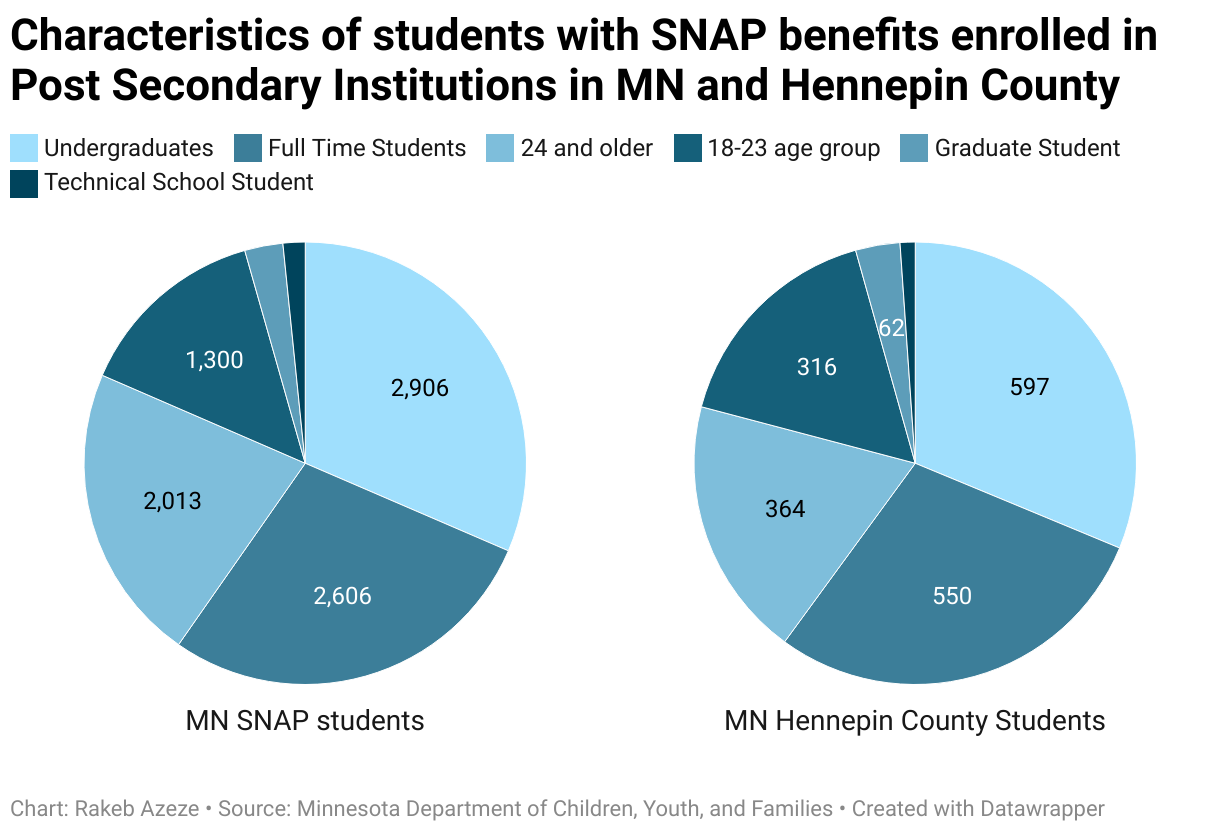
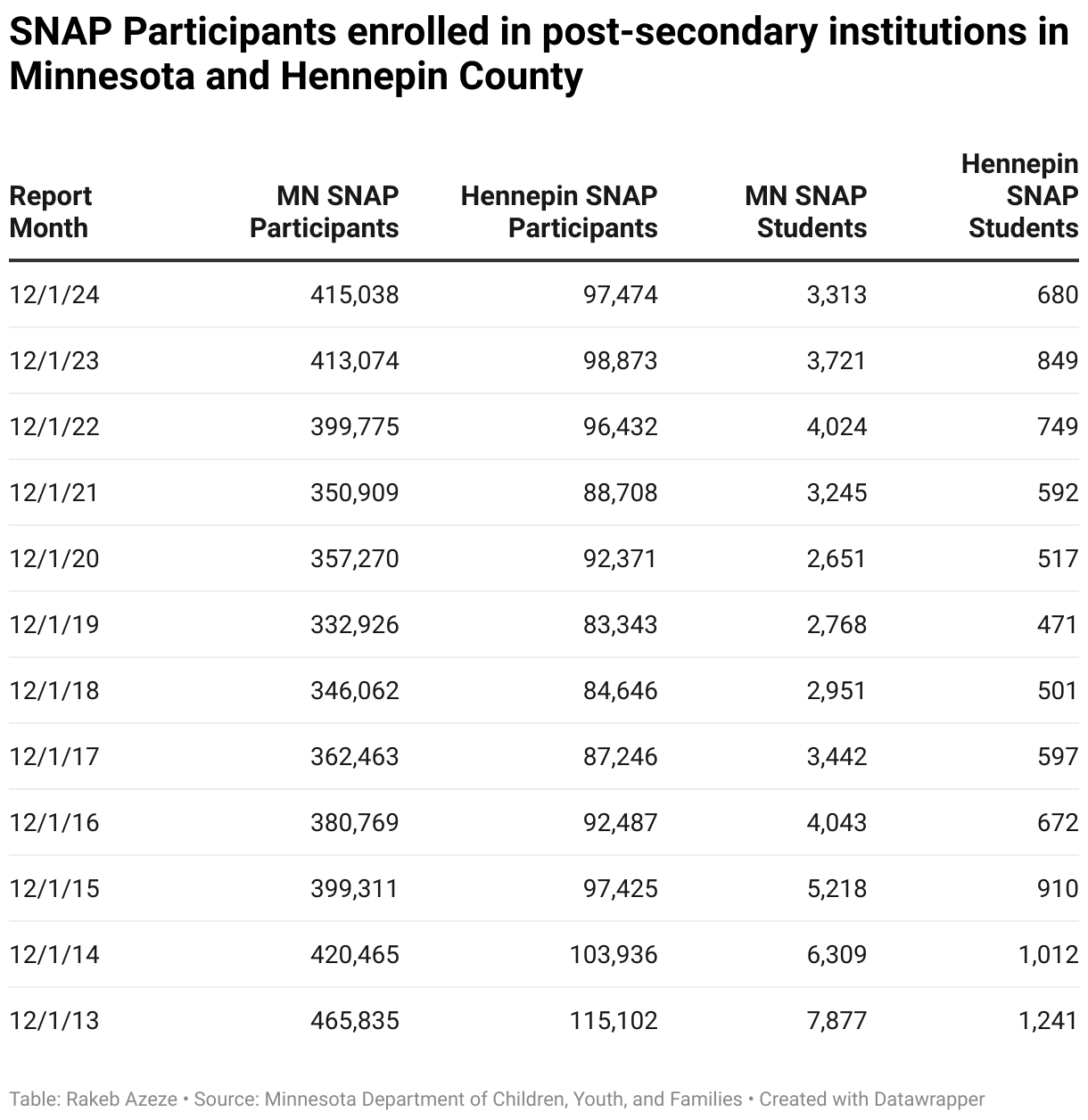
As of December 2024, over 3,000 Minnesota college students were enrolled in SNAP, according to the Minnesota Department of Children, Youth, and Families. Of those students, 680 resided in Hennepin County, home to the University.

Campus Initiatives to Combat Food Insecurity

To bridge gaps in support, UMN’s Nutritious U program provides food pantries to students in need. Established in 2017, Nutritious U is run by Boynton Health, and offers a wide variety of fresh fruits, vegetables, canned goods, meats, milk and other culturally appropriate items. 

Boynton Health Public Health director Michelle Trumpy said approximately 14,277 students were served this past school year. 

“We know that students who are visiting the pantry are struggling with their food,” Trumpy said. “They are worried about getting enough food to eat, and we know that when they come to us, they are feeling less stress and generally getting enough good food to eat during the month that they visit.”

Sixty percent of Nutritious U’s visitors are international students, according to Trumpy. She said this is mainly because international students do not qualify for SNAP or other food assistance programs. 

Challenges for Nutritious U, like funding limitations restricting pantry hours and access to certain areas on campus, remain. Yet, Trumpy said campus-based nutrition services play a critical role in reducing student stress and improving academic access.

Trends 

Despite SNAP’s benefits, enrollment among Minnesota students has declined by over 4,500 between 2013 and 2024. In Hennepin County alone, the number of students on SNAP almost halved from 1,241 in 2013 to only 680 in 2024. 

Though enrollment has dropped, a significant number of students continue to face food insecurity. According to the 2024 Boynton College Health Survey, 21.8% of UMN Twin Cities students reported worrying about running out of food, with 12.4% of those experiencing food shortages without funds to buy more. 

The majority of SNAP recipients among students are undergraduates, with 597 on SNAP in Hennepin County and 2,906 statewide. Graduate students account for a smaller portion, with 258 in Minnesota and 62 in Hennepin County enrolled in SNAP. 

Both younger (ages 18-23) and older students (24 and above) participate, with older students representing a slightly larger share statewide. 

Over 500 students receiving SNAP benefits are full-time students, indicating that even those enrolled full-time face financial barriers to adequate nutrition. 

Awareness and Advocacy 

In addition to the barrier of strict selection criteria, awareness of programs like SNAP and Nutritious U remains limited at the University. 

Janani, who preferred not to share her last name for safety concerns, is a recent international University graduate who said there was a lack of information on campus. 

“Not a lot of people know about programs like Nutritious U,” Janani said. “I found out about it late in my sophomore year, and until then, I didn’t know it was a thing.”

Before discovering the pantry, Janani said she used her part-time job income to afford groceries. She said there is an emphatic need for better University outreach to inform students about the opportunities available to them.

“If I were the University, I would try to market those things more and make an advisory committee where students who need to talk to someone about their struggles to make ends meet can do so,” Janani said. 

A Complex Problem and Hope for Change

The University of Minnesota is addressing these challenges by requesting $1.5 million for basic needs resources in the 2026-2027 biennial state budget. This funding aims to combat food insecurity by increasing food pantry hours, hiring additional staff to assist students navigating assistance programs and providing short-term emergency grants. 

For students like Conners and Janani, these efforts can’t come soon enough. Facing tough choices every month between fresh produce and basic staples, they embody the reality behind the statistics. 

“At the end of the day, we are here to study, so basic needs like food shouldn’t be a worry,” Janani said. 

Students experiencing food insecurity or who want to know more about Nutrious U can visit their webpage.

Posted in UncategorizedComments Off on SNAP enrollment is down as UMN campus food insecurity persists

SNAP enrollment is down as UMN campus food insecurity persists

Holding vegetables in one hand and the strawberries in the other, University of Minnesota fourth-year Taesun Conners struggles to decide between food items as getting both could set her food budget back. Like many college students nationwide, Connors faces food insecurity — a challenge that remains largely invisible.

Food insecurity is a multifaceted problem driven by economic hardships, limited transportation, lack of affordable housing, and strict assistance eligibility. Beyond the Supplemental Nutrition Assistance Program, students rely on a patchwork of campus services like Nutritious U, community initiatives, and peer support to meet their basic needs.

In an email statement released to the MN Daily, the Minnesota Department of Children, Youth and Families said that students who lack consistent access to nutritious meals “lose their ability to concentrate, retain information, and perform well in their studies.” The department added that SNAP supports the “long-term economic mobility and strengthening of Minnesota’s future workforce.” 

Recent data released from the 2019-2020 National Postsecondary Student Aid Study, the first nationally representative data on college student food insecurity, reveals that over 4 million students nationwide are experiencing food insecurity. Twenty-three percent of undergraduate students and 12% of graduate students experience insecurity, according to the study. 

Conners said food insecurity doesn’t get talked about often.

“Most of my friends are talking about which grocery stores to go to, often comparing prices and trying to figure out which is the cheapest option,” Conners said.

According to the 2024 USDA Food Security Report, about 47.4 million people in the U.S. lived in food-insecure households in 2023. This lack of reliable access to nutritious meals can lead to long-term consequences such as poor nutrition, elevated stress and a higher risk for developing chronic diseases.

The Stories Behind the Numbers 

Conners shared her struggles with food insecurity on campus.  

“Frankly, right now, I make less than rent, although I am very fortunate to have a family that can help me with that; there are times where I am freaking out over what to buy,” Conners said.

She often sacrifices quality and taste for affordability, caught in a constant tug-of-war between budget constraints and nutrition.

“More often than not, places on campus aren’t the cheapest option because they inflate their prices, especially at stores like Target or Fresh Thyme, partly due to security staff,” Conners said. 

Without a car, transportation to affordable grocery stores can be a hurdle. When navigating snowy sidewalks and taking public transit, students like Connors have to be creative to find affordable food.

“I wish a lot more was being done about transport,” Conners said. “I can take the light rail, but often the light rail isn’t that safe to transport shopping goods, and I’m worried that they will get stolen.” 

Conners has heard troubling Safe-U alerts about unsuspecting victims held at gunpoint for their groceries, instances that heighten her fears. 

The last recorded Safe-U alert involving a grocery robbery was Oct. 21 of last year, according to the University Department of Public Safety website.

Food insecurity also affects social life. Students like Conners often have to compromise participation in activities in order to save money on food.

“Sometimes I have to limit the amount of times I hang out with friends, especially if it involves outings with money, like going to a restaurant,” she said. 

Challenges with SNAP Enrollment

The Supplemental Nutrition Assistance Program helps low-income families and students to put food on their tables. SNAP benefits are loaded onto Electronic Benefits Transfer cards, which can be used like debit cards at most grocery stores, retailers and farmer markets that accept EBT. 

For many, these benefits bridge the gap between what people can afford and what they need for a healthy diet. 

However, qualifying for SNAP can be difficult for students.

Beyond income limits, students must meet extra criteria, like working at least 20 hours per week or being a full-time single parent. These limitations make it difficult for low-income students who don’t meet these requirements to gain access to basic needs. 

As of December 2024, over 3,000 Minnesota college students were enrolled in SNAP, according to the Minnesota Department of Children, Youth, and Families. Of those students, 680 resided in Hennepin County, home to the University.

Campus Initiatives to Combat Food Insecurity

To bridge gaps in support, UMN’s Nutritious U program provides food pantries to students in need. Established in 2017, Nutritious U is run by Boynton Health, and offers a wide variety of fresh fruits, vegetables, canned goods, meats, milk and other culturally appropriate items. 

Boynton Health Public Health director Michelle Trumpy said approximately 14,277 students were served this past school year. 

“We know that students who are visiting the pantry are struggling with their food,” Trumpy said. “They are worried about getting enough food to eat, and we know that when they come to us, they are feeling less stress and generally getting enough good food to eat during the month that they visit.”

Sixty percent of Nutritious U’s visitors are international students, according to Trumpy. She said this is mainly because international students do not qualify for SNAP or other food assistance programs. 

Challenges for Nutritious U, like funding limitations restricting pantry hours and access to certain areas on campus, remain. Yet, Trumpy said campus-based nutrition services play a critical role in reducing student stress and improving academic access.

Trends 

Despite SNAP’s benefits, enrollment among Minnesota students has declined by over 4,500 between 2013 and 2024. In Hennepin County alone, the number of students on SNAP almost halved from 1,241 in 2013 to only 680 in 2024. 

Though enrollment has dropped, a significant number of students continue to face food insecurity. According to the 2024 Boynton College Health Survey, 21.8% of UMN Twin Cities students reported worrying about running out of food, with 12.4% of those experiencing food shortages without funds to buy more. 

The majority of SNAP recipients among students are undergraduates, with 597 on SNAP in Hennepin County and 2,906 statewide. Graduate students account for a smaller portion, with 258 in Minnesota and 62 in Hennepin County enrolled in SNAP. 

Both younger (ages 18-23) and older students (24 and above) participate, with older students representing a slightly larger share statewide. 

Over 500 students receiving SNAP benefits are full-time students, indicating that even those enrolled full-time face financial barriers to adequate nutrition. 

Awareness and Advocacy 

In addition to the barrier of strict selection criteria, awareness of programs like SNAP and Nutritious U remains limited at the University. 

Janani, who preferred not to share her last name for safety concerns, is a recent international University graduate who said there was a lack of information on campus. 

“Not a lot of people know about programs like Nutritious U,” Janani said. “I found out about it late in my sophomore year, and until then, I didn’t know it was a thing.”

Before discovering the pantry, Janani said she used her part-time job income to afford groceries. She said there is an emphatic need for better University outreach to inform students about the opportunities available to them.

“If I were the University, I would try to market those things more and make an advisory committee where students who need to talk to someone about their struggles to make ends meet can do so,” Janani said. 

A Complex Problem and Hope for Change

The University of Minnesota is addressing these challenges by requesting $1.5 million for basic needs resources in the 2026-2027 biennial state budget. This funding aims to combat food insecurity by increasing food pantry hours, hiring additional staff to assist students navigating assistance programs and providing short-term emergency grants. 

For students like Conners and Janani, these efforts can’t come soon enough. Facing tough choices every month between fresh produce and basic staples, they embody the reality behind the statistics. 

“At the end of the day, we are here to study, so basic needs like food shouldn’t be a worry,” Janani said. 

Posted in UncategorizedComments Off on SNAP enrollment is down as UMN campus food insecurity persists

Community members speak on USAID budget cuts impacting University programs

From the remote regions of Africa to world-class universities, the U.S. Agency for International Development has impacted the lives of people from all corners of the world. 

The advancement of a $9 billion spending cut package and 67,749 federal job layoffs have placed critical programs at risk. These cuts critically threaten the USAID, an agency that has sustained livelihoods, health systems and democratic progress worldwide. 

People around the world are losing their jobs, families and access to necessities. 

In a recent study, it is estimated that around 14 million people could die by 2030 if steep funding cuts to USAID continue. This number alarms many, including the University of Minnesota’s Mandela Washington Fellows, who came to the University to grow their leadership skills and expand their knowledge.

The Mandela Washington Fellowship for Young African Leaders is a program sponsored by the U.S. Department of State, administered by the International Research Exchanges Board Inc., and hosted by various university institutes. Each institute is awarded a subgrant of up to $235,000 to host fellows, funds that are now in jeopardy due to the USAID cuts. 

Despite the grant, institutional partners are required to contribute at least $15,000 to cover expenses such as materials, housing and meals.

The University is one of the institutions that welcomes a diverse group of fellows from across Africa to participate in a six-week leadership symposium where they receive academic and professional training.

Among the 2025 University fellows are Alfred Makotsi from Kenya, Raphael Bukuru from the Democratic Republic of Congo and Mmeli “Bruce” Moyo from Zimbabwe. Their stories reflect the far-reaching consequences of the shutdown.

Alfred Makotsi (Kenya): Jobs gone overnight

Makotsi is finishing a doctoral degree in Diplomacy and International Relations at Masinde Muliro University of Science and Technology. He runs a private consultancy firm and the nonprofit Kakamega County Youth Network, which links youth to entrepreneurship and job opportunities. 

The news of budget cuts came during the interview process for the fellows to get accepted to the program, according to Makotsi. He said he worried about what the cut meant for the fellowship opportunity and its implications for his community. 

Makotsi said clinics lost test kits, youth centers stopped paying staff and food programs were disrupted. 

“We have many stories we could tell, but the matter is the disruption starts from employment down to the programs USAID used to fund,” Makotsi said.

Makotsi said he never saw unemployment as a real issue until he came across a LinkedIn post that asked for a list of people affected by USAID cuts.

“I saw that post, and in thirty minutes the Excel sheet already had thousands of people on it,” Makotsi said. “That is when it hit me, that there are very many jobs being supported by the USAID.”

Raphael Bukuru (Democratic Republic of Congo): “They need help.” 

Bukuru comes from the DRC, where he resides in Kivu province, in Uvira. After attending ISP Uvira, where he studied English, Bukuru was appointed English department chair in January 2024. 

Bukuru’s passion for teaching led him to open the Uvira Everyday Language Center, a nonprofit that teaches English to community members and provides translation and interpretation services. The Uvira center also partners with the nonprofit Save the Children.

Programs like Save the Children have been impacted by the cuts. Bukuru claims that due to a lack of funding, Save the Children has reduced its staff by 50% and made cuts to projects that provide medicines to local hospitals.

“These projects are simply being canceled because they don’t have the funds to get the medicines, and this is impacting health care access for communities because some of the services in hospitals that were free are now being charged,” Bukuru said. 

Bukuru said he had a personal project centered on training teachers for social and emotional learning, a concept he learned through the Access Exchange Program. After months of filling out forms, his grant proposal got accepted.

“I was now waiting for the grants to be issued so I can start implementing the project,” Bukuru said. “Then in February, they called me and told me that the grant would not be issued because of the funding cuts.”  

Bukuru said he remembers feeling shocked and disappointed as he had hopes for the program and what it could do for the community.

Program shutdowns have an impact on war-torn regions in the DRC, according to Bukuru. As of early 2024, approximately 2 million people have been internally displaced due to the M23 conflict. 

Without funding, his partners at Save the Children cannot provide vital shelter, food and educational access to the displaced people in those regions. 

“These vulnerable people have no assistance, they lack food, their children cannot study,” said Bukuru.

The “saving hand” of USAID provided more than just money; it was a home and safe space where people in need could get much-needed help, Bukuru said. He added that with the absence of USAID, the conflict could escalate.

“When people feel that they are not supported, the government is not doing anything, and there is no one caring for them, this pushes more and more young people, for instance, to attempt to join armed groups,” Bukuru said.

Bukuru said almost every tribal group is gaining militia members in the DRC, causing concern among many individuals in the community.

Mmeli “Bruce” Moyo (Zimbabwe): Youth in crisis 

Moyo studied at the University of Zimbabwe, where he majored in political science and diplomacy. He currently serves as a ward councillor for Nkulumane Ward 22. He is active in the youth wing of the opposition party led by President Nelson Chamisa. Moyo also founded and directs the Young Leaders Initiative Zimbabwe, where he mentors young people in leadership and teaches entrepreneurial skills.

As of 2024, 8.55% of the population in Zimbabwe is unemployed. USAID attempted to fill that gap by funding scholarship programs that sent young people to school. 

“There are so many business ideas that we funded through USAID,” Moyo said. “It created a space for young people to get employment and also to redefine their path.”

USAID provided a creative outlet for young people to build and find business opportunities. With the loss of this program, Moyo said a lot of young people are turning to drugs and dropping out of school.

“In my county, more than 20% of young people are being rehabilitated because of drugs and substance abuse in Kulumane,” Moyo said. 

COVID-19 Crisis

With the loss of USAID funds, projects immediately ceased, displaced people no longer had access to food, ARV shots vital to HIV patients were running dry, hospitals were understaffed and community members felt confused and alone. 

“People who are living with HIV and AIDS can no longer access ARVs anymore. Companies were closed.” Moyo said. “So it brought more frustrations, and people are not happy.” 

During the COVID-19 pandemic, around 500 million vaccine doses were shared worldwide in USAID’s Global VAX program. USAID launched thousands of vaccination sites in regions like sub-Saharan Africa. 

Moyo said that without such assistance, the pandemic would have resulted in catastrophic consequences.

“No one was prepared in Africa, but through international relations and friendship, we were able to receive vaccines,” Moyo said. “Imagine if another pandemic is to come, and with the tendency and the level of corruption in our government system, our people will die.” 

USAID: past and present

Established in 1961 by former President John F. Kennedy, USAID is an independent executive branch agency responsible for administering foreign aid and supporting economic growth outside of the U.S. Through its global network of implementing partners, USAID has improved global health, expanded education access and delivered life-saving humanitarian aid.

According to the United Nations, the U.S. government is the largest donor of humanitarian aid in the world, accounting for more than 40% of all aid tracked by the UN in 2024. 

Saving 2.3 to 5.6 million lives annually, USAID serves as a lifeline for many countries. Despite its significant role, the $21.7 billion allocated to international development represents just 0.3% of the total federal spending that year. 

University projects left in limbo

In addition to supporting global development, USAID has long funded research and innovation at U.S. academic institutions. 

Through the funding of projects like Feed the Future and research on international democracy and education improvement, universities can offer multidisciplinary curricula to their students and staff. The University of Minnesota is one of these beneficiaries, dating back to 1954 with a project known as “The Minnesota Project.” 

The Minnesota Project was funded by what was called the International Cooperation Administration, a predecessor to USAID. It supported the reconstruction of Seoul National University and South Korea’s medical and educational infrastructure following the war. 

Over 90 University faculty members collaborated on this project and trained 226 health professionals from 1955 to 1957. 

Other projects funded by USAID included RESPOND (2009-2014), whose goal was to improve capacity to respond to zoonotic diseases around the world; One Health Workforce (2014-2020) co-led with Tufts to develop One Health University Networks in Africa and Southeast Asia; Egyptian Pioneers (2024-2025); Youth Excel Program (2020-2025) and Global Health and Environment in Africa (2021-present).

International Solidarity

The fellows expressed gratitude for Americans’ support, but they also emphasized the need for continued international solidarity. 

Makotsi emphasized how people do not live in an isolated world, meaning there is a need for people to share responsibility. 

“The challenges we are experiencing in Africa, some of those challenges are trans border,” Makotsi said. “Things like climate change and infectious disease.” 

The fellows encouraged students and Americans to realize that a beneficiary relationship is needed to keep people alive. 

Bukuru said the type of relationship the U.S. and DRC had, in terms of resource allocations, necessitates accountability to the people of the DRC. 

“Americans also need to be accountable to the people in Africa who are facing these climate change effects, who are also seeing their soil being exploited but not benefiting as much as they could if they were transforming those minerals locally,” Bukuru said.

As their time at the University of Minnesota concludes, the fellows carry home not only leadership training but a sense of global connection. 

“We are very much hopeful that in the near future, we will be able to find each other, so that we continue with our beneficial friendship,” said Moyo.

Posted in UncategorizedComments Off on Community members speak on USAID budget cuts impacting University programs