
Author Archives | by Maddie Robinson

‘make : magnify’ facilitates multi-disciplinary collaboration

A multi-disciplinary arts festival featuring student and community artists, titled “make : magnify,” will be presented Saturday at 4 p.m. at the Barbara Barker Center for Dance before moving to two other locations in the West Bank Arts Quarter at the University of Minnesota.

The festival is being planned by students in the “Dance Production” course, a two-semester-long class that teaches them how to produce an entire show, according to Talia Marcus, a University dance student and the head of programming and tech for “make : magnify.”

The festival features eight artists, whose work ranges from painting to dance to animation, a portrait photographer and an emcee who will guide the guests through the three locations used for the event. 

Marcus said previous shows put on by the class were typical black box theater performances, but the producers for “make : magnify” wanted to branch out and create a festival-style event incorporating many different styles of art from a variety of artists.

The eight artists applied for the festival separately with an idea of what they wanted to create and were later placed into one of three groups with people who specialize in different disciplines from their own, Marcus said. From there, the groups would devise a 15- to 25-minute piece over a two-week residency period. 

“We were looking for people who were really excited and open to the idea of working with artists of different disciplines from themselves, and who were really excited about multidisciplinary work and kind of non-traditional performance,” Marcus said.

One of the artists in the first group, Hannah MacKenzie-Margulies, is a choreographer and dancer who applied for the festival after seeing the open call in a newsletter called DanceMN. She originally applied with the idea of a duet between a dancer and a ghost, but after getting grouped with her two collaborators, Alana Horton and Amital Shaver, they created a different piece that incorporated all of their ideas. 

The group’s piece is called “No Stable Climax” and includes dancing, poetry, music and elements of improvisation, MacKenzie-Margulies said. The piece will also contain themes of Americana, nostalgia and scientific concepts of natural succession.

MacKenzie-Margulies said the piece is open to interpretation, as her biggest goal is for audiences to feel like they went on an emotional journey with the performers, no matter how small.

“My hope is always just that people feel something and that we kind of break through the numbness or the walls that we sort of put up to protect ourselves in these hard days and hard times,” MacKenzie-Margulies said.

All of the teams featured include at least one University student, Marcus said. The incredibly collaborative nature between student and community artists in “make : magnify” is one of the values the producers of the festival want to uphold. 

“There’s not many spaces where students and professionals can create together in a space where both are respected and both of their opinions and ideas are being met with enthusiasm,” Marcus said.

This collaboration has been particularly valuable for Ella Kooyer, a fourth-year University dance and French student, who was matched with artists Merit Thursday and Ren Edson for their piece. They said events like “make : magnify” allow for them to sink their teeth into the Twin Cities theater scene with established community artists.

The group’s piece is titled “Ex Nihilo,” which means “from nothing” or “out of nothing,” and is inspired by creation stories with Kooyer portraying a creature in the group’s version of an origin story. 

For “Ex Nihilo,” Thursday created an animation in the “crankie” style, which has the story scroll along on a projection while hand-cranked, Kooyer said. Edson created multiple set pieces, including various picture frames and masks. 

Kooyer said the Twin Cities art community is “yearning for collaboration,” especially after the COVID-19 lockdowns. 

“At the core, this festival is about community and just coming together and just spending real time together in a space and creating for two weeks,” Kooyer said. “It’s short and fast, but I won’t be letting go of these connections. I think they’re gonna stick with me for a long time.”

“make : magnify” opens tomorrow at 4 p.m. at the Barbara Barker Center for Dance, with a reception following the program. To reserve a spot, use their RSVP form.
Posted in UncategorizedComments Off on ‘make : magnify’ facilitates multi-disciplinary collaboration

UMN theatre’s ‘Roe’ examines and humanizes the history of abortion rights

University of Minnesota theatre students will present “Roe,” a play exploring the history and people behind the landmark 1973 Supreme Court case, Roe v. Wade, in the Nolte Xperimental Theatre Fridays through Sundays from April 12-21.

The play follows Norma McCorvey, known as “Jane Roe,” and her lawyer Sarah Weddington, in the years during and after the Roe decision, as well as the extreme polarization of abortion debates that continue to this day. 

“Roe” is directly aligned with the theatre department’s theme for their 2023-24 season: bodily autonomy. Kym Longhi, the director of the production, said the show was selected as a direct response to Dobbs v. Jackson Women’s Health Organization, the Supreme Court case that overturned Roe v. Wade in June 2022.

“We wanted to just educate our audience and help them understand what all the complicated issues around Roe v. Wade were and what the story was,” Longhi said.

The play, which has over 25 students involved, has a major emphasis on compressing time, said Theo Collette, one of the assistant directors for “Roe.” The show covers multiple decades in about two hours, which made it critical for the cast and crew to do extensive research and have a strong foundation in historical knowledge from those eras.

One big appeal of the show for Collette was the script, as he said his main theatrical focus was playwriting. 

“I was really drawn to the way that this play utilizes a very large cast, utilizes motifs and utilized these thematic public narratives intermingling of personal lives to tell a story,” Collette said. “That was something I really wanted to explore.” 

Another major reason why many of the cast and crew wanted to get involved was the subject matter and its relevance to current times.

Janine Provencher, who portrays McCorvey, almost did not audition for the show due to an ankle injury but was convinced by her friends to try out. As a young woman, Provencher loves how applicable the story is to today’s society and appreciates how female-focused the play is, especially due to her belief that classic shows tend to disregard female characters.

“I’ve kind of grown up doing musical theater, and I do love musical theater, but I thought also [‘Roe’] was a really big opportunity to do something that’s important,” Provencher said. “It’s a little deeper and it really does dig deep.”

A central theme of the show is showcasing the humanity of both sides of the abortion debate. Rather than advocating for one side or another, “Roe” is meant to highlight the passion activists have for their cause, no matter their stance on the topic.

Luciana Stich, the other assistant director, said the cast and crew of “Roe” gave as much respect to each side of the argument as they could. They want audience members to leave with a newfound understanding of the abortion debate and the people behind it.

Stich added that the play acknowledges the complexities of the characters, which she said makes for a more fascinating and rich viewing experience. 

“[‘Roe’] also does such a great job of humanizing both sides, while also exposing the manipulation that Norma McCorvey had to go through,” Stich said. “She was being manipulated by both sides, she was manipulating both sides.”

The humanization in the show allows audiences to reflect on how polarized the issue has become, especially since the Dobbs decision. 

Riley Boals, who plays Weddington, said it can be easy to lose sight of the fact that real people are involved in abortion rights debates when they are so divided. She added that theater productions like “Roe” can help bring new perspectives to these issues.

“Being a young woman right now is a little bit frightening considering the recent overturning of Roe v. Wade, and I think that it starts an interesting dialogue about how polarized we have become on so many issues when we kind of forget about how those issues actually impact the people,” Boals said.

Longhi and Boals are strong believers that theater can help humanize difficult topics and complex characters that audience members might not agree with.

“There is our complex humanity right in the middle of it, and that we can’t even begin to have a conversation about these things until we find this respect for others’ humanity, whether we agree with them or not,” Longhi said. “I think that theater helps us do that.”

“Roe” opens Friday. At the time of writing, registration for the event is now closed. However, there will be a waitlist for walk-ups if ticket-holders do not claim their seats.

Posted in UncategorizedComments Off on UMN theatre’s ‘Roe’ examines and humanizes the history of abortion rights

Review: BFA students shine in ‘A Midsummer Night’s Dream’

Members of the University of Minnesota Bachelor of Fine Arts Actor Training Program company of 2026 put on a whimsical and hilarious performance of William Shakespeare’s “A Midsummer Night’s Dream” over the weekend.

The classic Shakespearean play follows multiple plot points, including a conflict between four lovers, a wedding between royals Theseus and Hippolyta, a group of laborers trying to put on a play and fairies that manipulate the humans. 

To preface, I’ve seen multiple showings of “A Midsummer Night’s Dream,” from high school to professional levels of theater, but this production was one of my favorites I’ve ever seen. 

The set design was simple yet effective, the costumes and props were fun and all the actors, many of whom had to play multiple characters, did a phenomenal job in their roles.

Before the show started, the actors performed several prepared songs for the audience, all revolving around the theme of love. Some of the songs were “I Won’t Say (I’m in Love)” from Disney’s “Hercules,” “Can’t Help Falling in Love” recorded by Elvis Presley and “Fly Me to the Moon” written by composer Bart Howard. 

The singing performances were light-hearted and sounded great and I appreciated they gave the audience something to enjoy while waiting for the show to begin. With many of the songs accompanied by an upright bass, saxophone or piano, I thought this opening was also a unique way to show off the other talents of the company. 

One of my favorite aspects of the play was the physicality involved. 

On opposite ends of the stage sat two trampolines that the actors frequently used to either bounce onto a higher platform or off the balcony in the theater. This amusing approach to the stage layout brought a lot of life to the action of the show, and it was something I had never seen done before. 

Other physical aspects I enjoyed from the show included the dance between Matthew Smith and Madeleine McKenney (who was in pointe shoes!) in one of the last scenes, the fights between the two couples, and the laborers’ “play within a play” performance about Pyramus and Thisbe, two forbidden lovers. 

The laborers were portrayed by Aidan Folvag, Elisheva Scheuer, Rayyan Khan, Sophia White, Catherine Maki, and McKenney, and their performances were the standout of the entire play. The group was hilarious as their characters attempted to put on a moving play for the royalty, and I thought each actor was perfect in their respective roles. 

Individually, my favorite actor was Scheuer, who played Egeus and Nick Bottom. I can’t remember the last time I’ve laughed as hard at a performance in a show, and the audience seemed to agree. Scheuer’s voices, general physicality and comedic timing of her characters made her a highlight of the entire play. 

Overall, “A Midsummer Night’s Dream” was a brilliant addition to the University’s theater season for this year, thanks to stellar performances by the actors.

Posted in UncategorizedComments Off on Review: BFA students shine in ‘A Midsummer Night’s Dream’

‘The Other Four’ engages every sense but sight

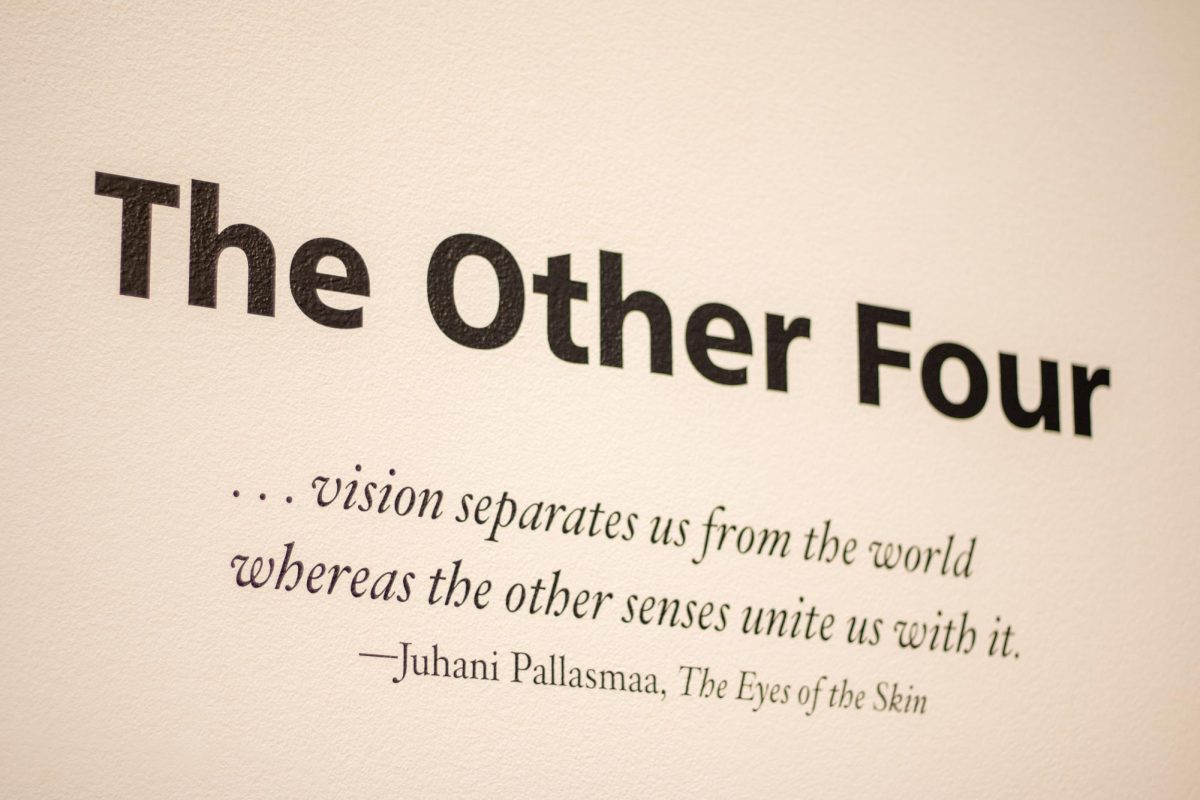
“The Other Four,” an art exhibition at the Weisman Art Museum that explores the human senses of smell, hearing, taste and touch, is about halfway through its run before it closes on May 19.

The exhibition, which opened Feb. 9, features 16 works by 21 artists ranging from a heart transmitter device to paintings with accompanying cello music to silicone sculptures that attendees are invited to feel. 

John Schuerman, the curator for the exhibition, came up with the idea for the project when he noticed how overlooked the other four senses are in gallery settings. After noticing this, he wanted to invert the idea of a traditional museum experience and create a more experiential way for people to engage with art.

“I noticed how one-dimensional the museum experience typically is, and how, I mean, we call it visual art for a reason, right? So, the dominance of the visual senses is really underscored in a museum setting,” Schuerman said.

An earlier iteration of “The Other Four” premiered in 2019 at the Plains Art Museum in Fargo, North Dakota and included many of the artists that are featured in the version at the Weisman, according to Schuerman. 

He added that the current exhibition gave the creators a chance “to refine and improve and advance some of their pieces to be more robust and more interesting for this exhibit.”

Alison Hiltner, one of the artists featured in both versions of “The Other Four,” created “Tethers,” a heart transmitter device that has attendees place a finger on a sensor and feel their own or another person’s heartbeat on a cluster of pumps.

Hiltner’s piece was born after she worked in cardiac laboratories as an artist in residence at the University of Minnesota Medical School. During a surgical procedure in one of the labs, Hiltner got to hold a pig’s beating heart, which led her to the realization of how separated humans are from their own bodies.

“I wanted to replicate a small part of that awe and wonder with the experience to let people kind of start to connect to their physicality as well as others,” Hiltner said.

Another piece featured in the exhibition is “Fossilized Past,” a collaboration between artists Nooshin Hakim and Pedram Baldari and composer Rodrigo Cádiz. According to Cádiz, this is the first time the three artists have worked together after they received a grant from their universities.

“Fossilized Past” is a series of black pipes and speakers that require the attendee to connect a mouthpiece to the contraption and blow. This triggers various sounds, like field recordings the artists captured, industrial noises and Chilean environmental protest audio. 

The work is meant to commentate on the environmental impacts of the oil industry on the soil and water of the Great Lakes region and in Chile, where Cádiz works as a professor, Baldari said.

According to Hakim, the artists visited many oil refineries and pipeline sites and collected contaminated samples to document how ruined soil destroys environmental landscapes and their potential, especially in marginalized communities. Hakim said the process was incredibly collaborative, from the people who gave tours of the refineries to the professors who taught them how to take soil samples to the vocalist who is heard in the recordings. 

The art piece ties in the idea of community and the power many voices can have when standing up to environmental injustices, Baldari said. 

“The project or the sculpture tries to contemplate on the factor of our capability to interrupt and intervene in the dynamic of things in sometimes positive ways,” Baldari said. “Meaning, we have the collective power to talk about these major environmental issues that we are facing.”

Baldari, who is Kurdish, also has a solo piece in the exhibition called “Walling Talks — Talking Walls,” which centers around Kurds and their resistance to the structures that oppress them. The artwork includes mirrors with Kurdish lullabies and resistance songs playing softly behind the walls, as the discovery of these types of music could result in imprisonment, he said.

The crown imperial flower, which is a symbol of resistance and resilience for the Kurdish people, is displayed on the mirrors.

“In our culture, [the crown imperial flower] signifies the land and we believe it grows from the Kurdish blood. Wherever they have killed a Kurd because of their identity, this flower grows,” Baldari said. “That’s the significance of that flower and on its own, it’s a sign of resistance, it’s a sign of promise.”

While “The Other Four” covers a variety of topics, Schuerman has noticed attendees are extremely present with the art and the messages being conveyed. He added that this show is unlike other exhibitions and considers it a more playful and interactive counterpart to traditional museum galleries.

“The Other Four” runs until May 19 at the Weisman Art Museum.

Posted in UncategorizedComments Off on ‘The Other Four’ engages every sense but sight

Review: ‘Cozy’ by Colin Bracewell

“Cozy,” the new EP by up-and-coming indie-pop musician Colin Bracewell released last Thursday and featured in a packed music release show at Fine Line, is some of the band’s best work yet.

Clocking in at just over 10 minutes, the four-track EP covers a lot of ground, with an equal mix of slow and fast songs that tackle relatable topics like love and growing up.

The EP kicks off with the title track, “Cozy,” an upbeat, more rock-influenced track that is just plain fun. While simple in its approach, the main chorus, “You got me feeling m-m-m, m-m-m, cozy, cozy” is an earworm and was stuck in my head for days.

Between the funky guitar riffs and the trumpet solo, performed by band member Nathan Loesch, “Cozy” is a great start to the EP.

The second track is “Dancing,” a slower, more chill love song. It is a good contrast from the title track while still managing to maintain the momentum of the first song. By the time “Dancing” picks up the pace in the second verse, there’s a solid chance you’ll be — like the title suggests — dancing along.

A highlight of this track is Bracewell’s vocals, which perfectly capture the song’s calm nature. His smooth singing on lines like, “Cause I like how you look / in moonlight or in snow. / It blocks out all the noise, / spotlights all your glow,” makes this song an easy and relaxed listen.

The third track, “Dirty Laundry,” is my favorite on the EP and one of my favorite songs Bracewell has written. It is the most driven song on the record with the tempo picking up again and some great drums and guitar.

“Dirty Laundry” details growing up and living in current times and has a more angsty sound before settling into a peaceful resolution. It is a wonderful penultimate track that leaves listeners satisfied yet eager to hear Bracewell’s final song.

The EP concludes with “Alright,” a stripped-down, calmer song that feels like a warm hug. Bracewell described this song as more experimental and lo-fi compared to some of his previous work.

Bracewell’s vocals are, once again, a standout. His upper register sounds gorgeous with the soft strings and harmonica in the background, making “Alright” an exceptional sendoff to the EP.

“Cozy” was accompanied by a release show last Thursday at Fine Line in Minneapolis, with opening sets by Creeping Charlie, Chutes and Pit Stop. Despite the EP coming out that day, the crowd knew every word.

“If you like it and know it, sing along,” Bracewell said before jumping into another song for the energized audience. 

The atmosphere of the release show was unmatched, mostly because of the excellent stage presence of Bracewell and great musical performances by drummer Joseph Sicora, guitarist and bassist Cole Grundhoefer, and trumpeter and bassist Loesch. Pair that with an electric crowd and you get an all-around outstanding show.

Other highlights from the performance were the angelic singing from background vocalist Sarah Brammer and Bracewell going into the audience and playing his guitar with the crowd jumping around him.

Along with the four new songs, Bracewell and his band performed fan favorites like “Slopes” and “Autumn,” as well as covers of “Love You for a Long Time” by Maggie Rogers and “Murder on the Dancefloor” by Sophie Ellis-Bextor and featured in the hit 2023 film “Saltburn.” Overall, there was a little something for everyone.

With the release of “Cozy,” fans can rest assured Bracewell and his band’s impressive talents are not going anywhere anytime soon. 

Posted in UncategorizedComments Off on Review: ‘Cozy’ by Colin Bracewell

After the Oscars, UMN students share their thoughts

The Academy Awards, often considered to be one of the most prestigious award shows in the film industry, had its 96th ceremony last Sunday at the Dolby Theatre in Los Angeles, California.

The ceremony had some of the most memorable moments in recent years, from a naked John Cena presenting the award for best costume design to an elaborate performance of “I’m Just Ken” led by Ryan Gosling.

However, some University of Minnesota students agreed the night had good wins but was overall predictable.

For the technical awards, “Poor Things” and “Oppenheimer” saw plenty of success, with wins in categories such as best makeup and hairstyling, best cinematography and best production design. However, students chose to mention other films that took home the gold in technical categories.

Adam Meyers, a computer science major and an officer for UMN Film Club, specifically mentioned “Godzilla Minus One” winning for best visual effects and “The Zone of Interest” winning for best sound as two highlights of the ceremony. Meyers appreciated the academy choosing to honor international films whose wins were more unexpected rather than giving those awards to cultural juggernauts like “Oppenheimer.” 

“I thought [‘Godzilla Minus One’ and ‘The Zone of Interest’] were really good picks for both of those [categories], and they were not exactly the film that I thought would have been the safe pick,” Meyers said.

With seven wins, “Oppenheimer” was by far the biggest winner of the night, but many of its wins were deemed predictable. 

Carolyn Sackett, a developmental psychology major and another officer for the University’s film club, said films like “Oppenheimer” are often the biggest Oscar winners.

“There’s always a certain type of movie that happens to win the Oscars most of the time,” Sackett said. “It’s always some sort of obscenely long and dramatic movie with a really star-studded cast.”

Eric Patton, a computer science major and president of StudioU, noticed both “Poor Things” and “Oppenheimer” had sections of the film in black and white. While he does not think this is explicitly why the films won the most awards, he agrees with Sackett’s sentiment: these types of films are often the ones to win Oscars.

In contrast, despite its popularity, Patton said “Barbie” is not the type of film that should win many Academy Awards.

“‘Barbie’ was a good movie, but I don’t know how much it should have won anything at the Oscars, to be honest,” Patton said.

On the acting side, students shared the opinion that Emma Stone winning best actress for “Poor Things” over Lily Gladstone for “Killers of the Flower Moon” was one of the biggest surprises of the night.

Mara Ristow, a biomedical engineering major at the University, thought Gladstone was a lock for best actress but thought Cillian Murphy’s best actor win for “Oppenheimer” was well-deserved.

One of the most widely shared opinions about the night was about the musical numbers scattered throughout the ceremony. “I’m Just Ken” from “Barbie,” performed by Gosling, other “Kens” and musician Slash, was deemed one of the best moments of the night.

Another topic that commonly came up was host Jimmy Kimmel. Sam McKenney, a studies in cinema and media culture major and another officer for the film club, wished that someone else would have been chosen to host.

“I would prefer if someone who is actually a more direct, recognizable part of the film industry, hosts,” McKenney said. “That would have been more interesting, you know, a comedic actor or something.”

In a shorter comment, Patton, in response to Kimmel’s hosting, said, “Yikes.” Instead, he would rather have had John Mulaney, another host during the ceremony, take the reins as main host.

Another aspect of note was the ceasefire pins that various guests wore to call attention to the conflict in Palestine, between Israel and Hamas. Ristow was a fan of celebrities using their platform for a cause greater than themselves at a ceremony as well known as the Oscars.

“It was nice seeing people wear ceasefire pins on their lapels,” Ristow said. “That was something that I was looking for and I’m glad I saw some of my favorite actors representing that.”

Despite the predictable nature of this year’s Oscars ceremony, students thought many of the wins were well-deserved and highlighted excellent work in the film industry.

Posted in UncategorizedComments Off on After the Oscars, UMN students share their thoughts

Colin Bracewell to headline EP release show at Fine Line

Ever since Colin Bracewell was young, he has been deeply intertwined with music.

Coming from a musically inclined family, he started playing the violin soon after his cousins did. Later on, as he was growing up, he participated in musical theater and joined a cover band in seventh grade.

Despite his musical upbringing, Bracewell did not decide to create his own music until he came to the University of Minnesota. He started out as a DJ at Radio K, which he said was instrumental in introducing him to the school’s dynamic music scene.

“I feel like the U is pretty connected to the music scene,” Bracewell said. “I mean, there’s the house shows and that’s pretty prevalent throughout Como and Dinky and yeah, [DJing at Radio K] was kind of like a good first step or getting my toes wet.”

Now, Bracewell is set to headline his biggest show yet with his band on Thursday at Fine Line, an iconic Minneapolis music venue that has hosted the likes of Lady Gaga and Prince.

The performance is a release show for his upcoming EP “Cozy,” also out Thursday, which will feature four brand new songs: “It’s Alright,” “Cozy,” “Dancing” and “Dirty Laundry.” The show starts at 8 p.m. with opening sets from Creeping Charlie, Chutes and Pit Stop, all of whom Bracewell has performed with before in what he calls a “full circle moment.”

A departure from his typical work, Bracewell said the music off “Cozy” is more experimental than his previous songs. He added that this EP touches on a multitude of different topics, including growing up, living in the politics of today and deeper experiences that he or his friends have been personally affected by

“With this EP, there’s a lot more variety than what I typically release,” Bracewell said. “Typically it’s just all, you know, love songs.”

While he would not describe it as a “make or break” moment, Bracewell said this show holds a lot of potential and opportunities the group has not experienced before.

Bracewell’s bandmates are also fully aware of how important this performance is for them. Joseph Sicora, the drummer for the band, described Thursday’s show as the next step for the group.

Cole Grundhoefer, who plays guitar and bass in the band, has not been involved in the live music scene for as long as the other members. However, this performance in particular still holds sentimental value to him.

“I remember one of the first shows I ever went to was at Fine Line,” Grundhoefer said. “I remember being there being like, ‘Wow, it would be so cool to play at a venue like this, but that’s so far away,’ and then it was literally like a year later we played it the first time and then another year later, we’re headlining there. So, it’s just kind of mind-blowing for me.”

Their performance at Fine Line is a showing of the band’s growth as a whole. Nathan Loesch, the trumpet and bass player for the group, met Bracewell at the University and started playing gigs with him, which later developed into a permanent spot in the band. Now, Loesch has been in the group for three years.

Loesch specifically remembers a show he and Bracewell played at The Terminal Bar, a smaller venue on Hennepin Avenue, which serves as a testament to their humble beginnings and the steps they have made as a band since then. 

“It’s cool because we obviously have been going at it and rehearsing and developing our sound and getting better as a band over the years,” Loesch said. “It’s just kind of cool to see how the work just pays off as we just continue to do it and obviously it just feels like things are getting bigger and better and we’re doing better and cooler things.”

The “Cozy” EP release show is Thursday at 8 p.m. Buy tickets on First Avenue’s website.

Posted in UncategorizedComments Off on Colin Bracewell to headline EP release show at Fine Line

3 UMN faculty awarded with Guggenheim Fellowships

Tetsuya Yamada, a ceramicist; Pao Houa Her, a photographer; and Kao Kalia Yang, a writer, can now call themselves Guggenheim Fellows.

The Guggenheim Fellowship is a highly distinguished, annually awarded grant for North American-based artists and scholars. This year’s fellows were announced on April 5.

“It is a great honor to count professors Yamada, Her, and Yang as members of the University of Minnesota community,” Rachel T.A. Croson, the University’s executive vice president and provost, said in a statement. “I am delighted to see their hard work and dedication recognized in this way.”

Tetsuya Yamada, honored in fine arts

Yamada was born in Japan and came to the United States in 1994 for graduate school. He completed his MFA at Alfred University in New York in 1997 and has worked as a professor of ceramics for the University since 2003.

Yamada’s extensive background in ceramics stretches back to his childhood when he played with clay in elementary school art classes. He said he began to seriously commit to ceramics as an undergraduate student at Tamagawa University in Tokyo.

Much of Yamada’s work examines the natural world, human nature and the connection between the two.

Yamada has applied for the Guggenheim Fellowship several times but said he applied again this year because he likes “the challenge of it.” He also understands the importance of ceramics specifically being recognized.

Near the beginning of Yamada’s career, he said the artform wasn’t taken as seriously. He would often notice negative comments from art-goers and many museums and galleries would not feature ceramicists.

“Ceramics had a hard time in canon of fine art because ceramic had been looked at as a craft medium,” Yamada said.

Now, Yamada thinks the mainstream art scene has become more accepting of the medium. His Guggenheim Fellowship is another step forward for ceramics being properly recognized in an industry where it was previously more difficult for it to gain traction.

“I always thought that somehow the challenge comes from that sort of, you know, my practice had been marginalized,” Yamada said. “I want us to prove them wrong somewhat.”

Pao Houa Her, honored in photography

Born in Laos, Her’s family fled to Thailand refugee camps before settling in Minnesota in the ‘80s. She had a “very typical Hmong upbringing” in St. Paul’s Frogtown neighborhood.

Her’s love for photography began in sixth grade when one of her teachers gave her a camera and film. Her’s teacher entered one of her pictures, a photo of Her’s great aunt who was living with her family at the time, because of how much he liked it.

“By him acknowledging that it was such a great photograph, I think really sparked my interest,” Her said.

Despite her love for photography, Her originally attended Inver Hills Community College for a paralegal degree. It wasn’t until she saw an exhibit called “Frogtown” by local photographer Wing Young Huie that she transferred to the Minneapolis College of Art and Design to pursue a Bachelor of Fine Arts.

While viewing the “Frogtown” exhibit, Her was shocked to find some of her own family members in some of the pictures.

“There was something about that body of work that I think encapsulates what I thought I wanted to say about photography, but didn’t know that could exist,” Her said.

Her’s work focuses on the lives and history of the Hmong community and the idea of desire. Whether it’s the desire to be seen, the desire to be desired or the desire to be recognized, Her considers the concept to be a “through line” in her work.

This was Her’s first time applying for the Guggenheim Fellowship and she said she hopes her work contributes to an understanding of Hmong people in the 21st century.

“I’m contributing to scholars and academics who are thinking about the Hmong community as its current state, as the past and as the future,” Her said.

Kao Kalia Yang, honored in general nonfiction

Born in a refugee camp in Thailand, Yang’s family came to the U.S. in the ‘80s and lived in east St. Paul.

Growing up, Yang was a selective mute in English. While she could speak Hmong very well, she said she couldn’t find her voice in English and her first novels were an effort to truly hear herself.

“On the page, I’ve always felt a waiting, like the world was waiting to hear what I had to say,” Yang said.

Yang originally attended Carleton College on a pre-med track, but she started writing as a senior in college after her grandmother died.

Her grandmother couldn’t read or write and her greatest fear was being forgotten. To keep her memory alive, Yang started writing a “final love letter to her,” which later turned into “The Latehomecomer: A Hmong Family Memoir.”

“The Latehomecomer” was the first literary work by a Hmong writer to be nationally distributed. With her debut, Yang already knew she was pushing the memoir genre by telling the story of someone who wasn’t “the stuff of memory traditionally.”

More recently, her second book, “The Song Poet,” was adapted into an opera that premiered in March. It is the first story written by a Hmong author to be adapted into an opera and the first Minnesota Opera-commissioned work to sell out six months before opening night.

This is the third time Yang has applied for the Guggenheim Fellowship. With this honor, she hopes she can continue to do the work of building a world where people have a deeper understanding of each other.

“When the life and times of Kao Kalia Yang are done, I want it known that I lived in a world full of love, full of light,” Yang said.

Posted in UncategorizedComments Off on 3 UMN faculty awarded with Guggenheim Fellowships

Golden Magazine presents ‘Dare 2 Be Golden’ at Fashion Week MN

Golden Magazine, a University of Minnesota student-run fashion and lifestyle magazine, will present the “Dare 2 Be Golden” runway show at Fashion Week MN Thursday at 6 p.m. at W Minneapolis – The Foshay.

According to Ava Ojo, the production team lead at Golden Magazine, four student and five local designers will be featured at the event.

This is the second time Fashion Week MN is featuring Golden Magazine in their programming, Ojo said. The first time was in fall 2021.

The team has been preparing for the event since January, Ojo said. Along with the nine designers featured in the runway show, a pop-up event beforehand will showcase collections from five Minnesota-owned vendors.

Ojo does not underestimate the importance of recognizing the work of student designers, especially at large-scale events like Fashion Week MN. Ojo said this event will give students opportunities to gain exposure and network as well as show their creative vision to the Twin Cities community.

“Having these designers showcase their work, I mean it’s important for everyone to see,” Ojo said. “There’s more opportunities for everybody.”

Fashion as an art form

One of the student designers featured in “Dare 2 Be Golden” is Jaylee Rosand, a second-year product design major. This event will mark her fashion show debut.

Jaylee Rosand, who started making her own clothes when she was 12, is one of four students featured in the show. Photo courtesy of Jaylee Rosand.

Rosand began sewing when she was 8 years old, after her grandma taught her how to make doll clothes. However, it wasn’t until she was 12 that she started making clothes for herself.

“I remember realizing that I could make my own clothes the same way I’d been making doll clothes, just on a bigger scale,” Rosand said.

Some of Rosand’s biggest inspirations for her design style include ‘90s runway shows and designers like Alexander McQueen and Vivienne Westwood. As a big fan of historical fashion, she said she enjoys modernizing traditional clothing in her collections, especially from the Victorian Era.

Rosand’s Fashion Week MN pieces fall under a few different themes, one of which involves her biracial identity, a major influence on Rosand’s work. Rosand, who is half-Korean and half-white, said some of her pieces are inspired by Korean culture and include an ink print that mimics East Asian writing characters.

Rosand said she wishes fashion was highlighted as an art form more often, especially for young people who may have fresher takes that deserve to be showcased.

“There’s always going to be new perspectives and new talent and I think it’s good to always kind of keep updating the scene,” Rosand said.

This year, Fashion Week MN is focusing on the theme of “joy,” according to Susan Leppke, the chief operations officer of the organization.

While the theme may seem simple on the surface, it encapsulates many aspects of the feeling of joy, Leppke said. From the joy of being together to the joy of putting on an outfit to finding the joy within yourself, the theme is far reaching.

“We want to get back to a place where we’re just really appreciative of each other and the community and being happy,” Leppke said.

Sustainability and student access at Fashion Week MN

Fashion Week MN prides itself on its efforts to be as sustainable, equitable and inclusive as possible, according to Leppke.

One of their shows, “Into The Studio Sustainable Style: A Fashion Revolution,” held Monday, raised awareness of the slow fashion movement by using organic and recycled materials and emphasizing fair-trade production.

The organization also hosted an all Native American designed fashion show last Tuesday and will host a show on Wednesday featuring more youth fashion and jewelry designers. There will also be a show on Friday featuring only designers of color.

Leppke said Fashion Week MN has always tried to highlight student designers and find a way to partner with the University. Giving Golden Magazine the chance to present their own runway show is a way the organization is ensuring student voices are represented in the Twin Cities fashion community.

Leppke believes highlighting the work of diverse and young artists is crucial because they are the future and have a lot to contribute to the fashion industry.

“I think it’s important to make sure that everyone is offered a seat at the table and it’s very important to make sure that diverse voices are part of that table,” Leppke said.

Tickets for “Dare 2 Be Golden” are available on Fashion Week MN’s website.

Posted in UncategorizedComments Off on Golden Magazine presents ‘Dare 2 Be Golden’ at Fashion Week MN

I tried applying for ‘Love Is Blind.’ Here’s what happened

Kinetic Content, the Los Angeles-based production company that created the smash hit Netflix reality dating show “Love is Blind,” announced a casting call in the Twin Cities on their Instagram account on March 29.

“Attention all SINGLES!!! Kinetic Content casting is back at it and accepting Love Is Blind applications from not one, but three cities,” the caption read. The post quickly went viral among Twin Cities 20-somethings.

In addition to the Twin Cities area, producers are scouting for “brave” and “open-minded” singles in Washington D.C. and Denver.

If you’ve opened Netflix in the past three years, then you’ve probably heard of “Love Is Blind.” Contestants go on dates with each other and can get engaged, but, you guessed it, they can’t see each other’s faces.

In a release of their internal viewing statistics for the first quarter of 2020, Netflix reported 30 million households tuned in to the series. It ranked alongside “Tiger King” and “Outer Banks” in the holy trinity of Netflix’s early lockdown binge content.

Now, truth be told, I’ve only seen 15 minutes of the first episode before I fell asleep, so I wouldn’t call myself an expert on the show. Technically, I’m not even old enough to apply; applicants are supposed to be 21 years old, and I’m still 19.

But, with the extreme national popularity of the show and its recent local virality, I decided to dive into the application.

The application

The lengthy application, consisting of more than 70 questions, seems straightforward at first.

It starts off easy and asks for things like your name, birthday, hair color, occupation and links to your social media accounts. It felt like a slightly invasive job application, but nothing too out of the ordinary.

The questions quickly take a turn, morphing from short and sweet to longer and more complex. If you thought applying would only take a few minutes out of your day, you would be wrong, especially if you want your answers to be thorough.

“Why do you think you are single? What are your thoughts on the dating scene in your city? What has been missing emotionally from previous relationships that you hope to find through this experience?” are just a few examples of questions.

Worst of all, they ask if you have any religious, ethnic or cultural “dealbreakers.”

The casting team also asks you to submit a video of yourself explaining why you are ready to find love on the show. The only requirement? The video cannot be longer than 15 seconds.

Obviously Kinetic Content doesn’t have time to sit through hundreds of long videos, but I was shocked they asked such an intricate question with such a short time limit. If I was actually interested (and legally allowed) to apply, I would be hard pressed to fit everything I’d want to say in that small of a time frame.

Absurdly, the application asks you to submit pictures of your face and full body. Normally, this wouldn’t surprise me for a reality dating show. However, I thought it was a little ironic how a show called “Love Is Blind” has multiple questions pertaining to appearance. Perhaps that’s part of the reason why the show features few plus-sized women.

In fact, everyone in the cast is conventionally attractive. Netflix casts often fall under glossy and conventional beauty standards (think “Outer Banks”), but it’s just a lame shortcut to money. If love truly was blind on this show, it would be interesting if Kinetic Content also couldn’t see the applicants before casting them, but alas, no dice.

If you’re looking for love and want to apply for the show, the application is still open. Who knows? You might just meet “the one.”

Posted in UncategorizedComments Off on I tried applying for ‘Love Is Blind.’ Here’s what happened