Author Archives | by Ava Gilhoi

‘Shrek: The Musical’ Comes to Fridley, Minnesota

Since its 2001 screen release, “Shrek” has captured the hearts of millions of fans thanks to its heartwarming story, unconventional premise and sharp humor.

Seven years after the film debuted, DreamWorks Theatricals and Neal Street Productions brought the beloved story to the stage with “Shrek: The Musical,” written by Pulitzer Prize winner David Lindsay-Abaire and composed by Jeanine Tesori.

This summer, the stage adaptation, produced by Tom Larson and Coral Bode, came to Minnesota at the Fridley Community Theater, running from July 24 through Aug. 1. 

Both the film and the stage musicals follow Shrek on his journey alongside his newfound companion, Donkey, to rescue Princess Fiona from a dragon-guarded tower. In exchange, the corrupt Lord Farquaad promises to clear fairytale creatures out of Shrek’s swamp and return his land.

The musicals do a couple of things differently from the movie, including deepening the narrative and creatively switching some scenes to work more effectively onstage. 

The musicals open on Shrek’s seventh birthday. His parents send him off into the world alone, warning him about the cruelty of mankind in “Big Bright Beautiful World”:

“And just around the bend, there’s a friend or two… But not for you. You’re ugly son, which means that life is harder, people hate the things they cannot understand.” 

This opening immediately frames the story as an allegory for bigotry. Taught that the world will reject him for being different, Shrek learns that his only defense is isolation and intimidation.

The musicals also expand Fiona’s role, giving her as much narrative weight as Shrek. She is quirky, crude, independent and hilarious. 

Like Shrek, Fiona was sent away by her parents at age seven, condemned to a lonely tower to await rescue. One of the musical’s standout moments, “I Know It’s Today,” features three generations of Fiona singing together as time slips away, highlighting her emotional resilience through years of isolation.

This expanded perspective reveals why Shrek and Fiona connect so deeply. While Shrek faces outward prejudice and rejection, Fiona contends with unrealistic beauty standards and rigid societal expectations. In their dynamic duet “I Think I Got You Beat,” what starts as a contest to one-up each other’s childhood misery ends in genuine mutual empathy.

Lord Farquaad also gains unexpected depth on stage. The musicals reveal that his father was one of the Seven Dwarfs and that Farquaad harbors intense shame over his background of abandonment and poverty. Rather than overcoming his trauma, Farquaad weaponizes it, taking out his insecurities on others through tyranny and discrimination.

Translating an animated film to the stage naturally required structural changes. Kinetic action sequences, such as Donkey’s flying escape from the guards, Shrek’s arena brawl in Duloc and Fiona’s martial-arts fight against Robin Hood’s Merry Men, were omitted.

Instead of replicating the movie, the Broadway and Fridley Theater Company productions focus on what they could improve on with a theatrical version. A highlight of both productions is Fiona’s tap dance number in “Morning Person,” where she dances with the Pied Piper’s rats. The scene begins with the stage curtain raised just high enough to reveal the dancers’ rat-shoed feet before lifting fully into an energetic tap sequence that showcases Fiona’s quirky personality.

The Fridley Community Theater production skillfully handled the Broadway version’s technical demands with creative workarounds. Rather than using a puppet for the Gingerbread Man, casting a live actor gave the character vibrant physical energy. Meanwhile, downsizing the Dragon allowed operators to maneuver it across the stage, producing a dynamic and visually engaging chase sequence.

Ultimately, “Shrek: The Musical” does more than recreate a beloved film, it enriches it, using musical exposition and deeper character backstories to underscore the story’s core themes of self-acceptance and empathy.

Catch the last couple of “Sherk: The Musical” shows in Fridley, Minnesota, July 30 and 31 at 7 p.m., or Aug. 1 at 2 p.m.

The post ‘Shrek: The Musical’ Comes to Fridley, Minnesota appeared first on The Minnesota Daily.

Posted in UncategorizedComments Off on ‘Shrek: The Musical’ Comes to Fridley, Minnesota

UMN student band “Aphid” releases its first EP: “Sucker”

“Aphid”, a band composed of four University of Minnesota students, released their debut EP: “Sucker,” on July 10, strategically combining the artists’ unique inspirations and skills to create a dynamic, multi-genre collection of songs.

Vocalist and guitarist Isaac Schroeder, drummer Jack Urtuzuastegui, guitarist Flynn Cramer and bassist Lily Huber established Aphid in January 2026, but their story started long before that. 


The beginnings of the band

The band went through many phases before becoming what it is now, starting as a duo consisting of Schroeder and Urtuzuastegui back in 2022. 

The pair attended the same high school and met when Urtuzuastegui’s older brother introduced him to Schroeder. Under the name “Masonry,” the two worked together to find their sound.

“Isaac and I have been writing and creating music since I was 18 and he was 16. We always just made music because we liked making music,” Urtuzuastegui said. “We knew eventually we had to find a sound and solidify.”

Crowdmembers react to Aphid performing their new EP at Tacos Locos in Minneapolis, Minn. Friday, July 10, 2026

When they both decided to attend the University of Minnesota, they changed their name to “Cilician Gates.”

“We went through a bunch of different members,” Schroeder said. “I was already friends with Lily and Flynn, but I just didn’t know that they played instruments.”

Similarly, Huber and Cramer were in a band together, but it fizzled out. They were on the hunt for a new project. Huber had attended some of Cilician Gates’ gigs and noticed they didn’t have a bassist. Since they all already knew each other, Huber and Cramer seized the opportunity to fill the gap.  

“The original idea was always to be a four-piece,” Urtuzuastegui said. “I was originally going to stop playing drums and start playing guitar with Isaac.” 

Recognizing that their signature sound had come to revolve around Urtuzuastegui’s drumming, the band concluded that the best path forward was to bring Cramer on as a guitarist and firmly establish Urtuzuastegui as the band’s drummer.

To mark the formation of the new quartet, the band adopted the name “Aphid,” inspired by the songs “Aphid” by Matt Champion and “Aphids” by Hum. According to the band, the name often confuses fans. Although aphids are small insects that feed on plant sap, the choice carries no deeper symbolism; the band simply liked how it sounded.


Their sound: Blending emo, indie, alternative and pop

The band’s inspirations have changed over time, which, in turn, has changed their sound. They don’t adhere to a strict genre, but they classify themselves primarily as an emo sound with alternative, rock and pop influences. 

Schroeder said some of his vocal inspiration comes from “They Are Gutting a Body of Water,” a shoegaze, alternative, experimental rock band; “Pavement,” an indie rock band; and Alex G, an indie rock musician.

Aphid guitarist Flynn Cramer performs at Tacos Locos in Minneapolis, Minn. Friday, July 10, 2026

Urtuzuastegui’s influences come from George Daniel of The 1975 and Ringo Starr of the Beatles. His process starts with asking what that song is asking him to play, rather than dominating on the drums. 

Aphid’s sound incorporates elements from a wide range of genres, reflecting the music that inspires each member at any given time.

“We just bring ourselves and whatever comes is what comes,” Urtuzuastegui said. 

Their combined tastes culminate in their songs. Each member brings something different to the process. 

“When we’re jamming, if we’re writing something new, we’ll take this other idea we have from a completely different song that never really went anywhere, and piece them together, kind of like a puzzle,” Urtuzuastegui said. “It will add on to itself.” 

They don’t typically talk about the music when they’re creating – it just comes naturally. Many bands are built around members who like the same artists, while Aphid’s strengths lie within their differences: They’re able to create something new. 

“I don’t know anybody else that makes the music that we do in the style that we do,” Urtuzuastegui said. “What’s better than having danceable pop songs to sing along to that are loud and abrasive?”

Aphid bassist Lily Huber performs at Tacos Locos in Minneapolis, Minn. Friday, July 10, 2026

While they don’t necessarily claim to have discovered a “new sound,” they do pride themselves on authenticity. The writing, jamming, creating and performing aspects are enjoyable for them. 

“If we start getting mad when we mess up, then people in the crowd can definitely tell if we’re all having fun; it’s obvious,” Cramer said. 


“Sucker:” Aphids’ debut EP 

Their new EP, “Sucker,” features four songs: “Big Head,” “Righty,” “Sea Prism Stone” and “Penalty Kill.” 

The name sucker was Huber’s idea, as aphids, the bugs, are sap suckers. 

“It just felt kind of funny,” Huber said. 

Cramer appreciated the idea, too, as there are many different artistic directions you can take with the term “sucker.”

“Righty” and “Penalty Kill” can be mostly attributed to Cramer’s writing, and “Big Head” and “Sea Prism Stone” were created by Schroeder and Urtuzuastegui. Regardless of who the originator was, each song has unique contributions from each member. 

“It was cool for me to play the songs you guys had already written, and kind of feel my part,” Huber said. 

Aphid guitarist Flynn Cramer performs at Tacos Locos in Minneapolis, Minn. Friday, July 10, 2026

The band takes an alternative approach to writing, as they don’t write about their personal experiences. Their main goal is to make good music and have fun while doing so. 

“I treat it more like I’m writing a book, so it’s fake, made-up characters and made-up situations,” Schroeder said. “A lot of the time, I’ll stray off and write about nothing.”

The recording and release process took the band just one and a half months. Each song on the EP brings something new. It’s a cohesive piece without feeling repetitive. 

“We have a couple songs where I feel most bands would go in one direction, but we go in a different direction,” Cramer said. 

To listen for yourself, you can find Aphid on multiple platforms, including Spotify, Apple Music and Instagram. Details for their next show will be posted on their Instagram, @aphid.aphid. 

In the future, the band has plans to release a new single by the end of the year and is considering going on tour. 

“One thing about our writing is that it’s ever evolving. It’s still within our sound, but I think our next single is going to be this song called ‘I Know Something’,” Urtuzuastegui said. “It’s just getting better.” 

While Aphid has just begun as a group, each artist’s background and inspiration bring something different to each song, culminating in a diverse, innovative sound.

The post UMN student band “Aphid” releases its first EP: “Sucker” appeared first on The Minnesota Daily.

Posted in UncategorizedComments Off on UMN student band “Aphid” releases its first EP: “Sucker”

Community at Canterbury Park horse races: Race days have something for everyone

For more than 40 years, Canterbury Park has been the horse racing hub of Minnesota. Today, the crowds span a wide range. Between the horses, the racing, the food and beverage options, the special events and the bets, there is something for everyone to enjoy. 

Before the racers line up, the jockeys and the trainers walk with their horses in a gorgeous pre-parade ring, brimming with beautiful flowers and grass. Located northwest of the track, it gives attendees a chance to see the horses and their jockeys up close. 

A frequent attendee of Canterbury Park, 24-year-old Owen Fuls appreciates many aspects of the park, including the pre-parade ring, the concessions options and watching and betting on the races. 

“Students would probably like it,” Fuls said. “If you’ve ever had an interest in horses, they have the winner’s circle, where you can go meet the horses and the jockeys.”

Huey, a racehorse, is walked to the track at Canterbury Park in Shakopee, Minn. Sunday, July 5, 2026. (Image by Henry Creel)

Horse racing is a unique sport, considering all genders frequently compete directly against each other. Jockeys, who ride the horses during races, are typically short-statured and weigh 110-118lbs, leaving the competition open to everyone.

Canterbury strategically groups horses based on their previous stats. Maiden horses, which are horses that have never won a professional race, competed on July 3. Kelsi Harr, a jockey from Arkansas, was one of the many female jockeys racing that day. 

“It’s a lot funner to race down here and hear a bunch of people hollering than to come out, and nobody’s here,” Harr said.

Kelsi Harr jockeys I’ll Make Bank at Canterbury Park in Shakopee, Minn. Sunday, July 5, 2026. (Image by Henry Creel)

For many, watching the race can bring just as much adrenaline. For Fuls, even the downtime between races can be a source of entertainment.

“There’s a lot of excitement during the actual races, and then in between, there’s a lot of people talking about which horses they’re going to be betting on in the next race,” Fuls said. “So everyone’s having a lot of fun.”

In addition to watching the horse races, there are many other activities, including pony rides, face painting and music. 

Jeff Maday, the media relations and player development representative at Canterbury, said students may appreciate Two Buck Thursdays, where the price of admission drops to $2, along with $2 alcoholic beverages, Pepsi products and hot dogs, with a live DJ between races and beer pong. 

“We used to do buck night back in the day, long before COVID,” Maday said. “So that got to be big, and it was a place where kids came to meet, and it was really young, and so we’re trying to rebuild that. It’s picking up steam now, gradually.” 

Canterbury is also stepping up their food and drink game as their demographic and demand expand.

“Like a lot of other sporting event arenas, we’re becoming a little more focused on food,” Maday said. “You used to just roll out the hot dogs, hamburgers and French fries. Now, we try to offer some different food items.” 

Throughout the main building, there are endless options of elevated American comfort food, including sandwiches, pizza, pasta, sweets, snacks and more.

Fuls has a couple of favorite spots, including Boardwalk, an upscale restaurant on the other side of the tracks, where you can watch the horses take off. In the facility, Fuls enjoys Bravi’s, a craft Mexican kitchen, and Badger Hill Brewing. 

Maday compared the race day at Canterbury to the experience of a Minnesota Twins or a St. Paul Saints game — the experience is often more valuable than the game itself. Canterbury, like many sports arenas, is trying to elevate its approach to become a richer experience overall. 

Canterbury Park has something for everyone. Keep an eye out for some of their upcoming events, such as Two Buck Thursdays, Scratch-off Saturday, where the first 1,000 attendees get a free scratch-off and Extreme Day on July 12, where the track sees races with camels, ostriches and zebras. 

This season, Canterbury is open until September 19, serving the public on select Wednesdays, Thursdays, Saturdays and Sundays.

The post Community at Canterbury Park horse races: Race days have something for everyone appeared first on The Minnesota Daily.

Posted in UncategorizedComments Off on Community at Canterbury Park horse races: Race days have something for everyone

Find yourself at the Cafesjian Art Trust Museum’s “Abstraction & Ourselves” exhibit

Every five months, the Cafesjian Art Trust Museum switches exhibits to showcase different contemporary artists. This season, “Abstraction & Ourselves” takes over the Shoreview museum to inspire creativity, curiosity, and connection through art. 

“Abstraction is so open to interpretation. It really is open to where you’re coming from at that moment. So, there are artworks in here that, depending on your mood and the day, they can feel calm and positive, or they can feel intense and negative and violent,” Linnea Seidling, curator of the Cafesjian Art Trust Museum, said. “These artworks, you can kind of see all the types of things in them, and so it really is about your personal response to everything.” 

Cafesjian offers free entry to all its exhibits and goes above and beyond by hosting free guided tours as well. The guide offers history, the artist’s perspective, and encouragement to reflect on your perception of each piece. 

60% of the works in “Abstraction & Ourselves” are glass sculptures, alongside paintings and other mixed-media works, which is relatively uncommon in museum exhibitions. Another distinctive aspect of the exhibition is its representation of female artists: approximately 85% of the works on display are created by women.

“I love the fact that almost all of these artists are women,” Pat Hurd, Cafesjian Art Trust Museum tour guide, said. “I love that idea. That never happens. They just have never been recognized, and I’m so glad they are now.”

The guided tour starts with the museum’s history, then moves to dissecting individual pieces. The first stop is a mixed media piece by Joan Snyder, “Roxy Red Fugue.” Hurd uses visual thinking strategies to encourage the group to reflect on the piece.

Joan Snyder, “Roxy Red Fugue,” 2017, Oil, acrylic, cloth, rosebuds, glitter, and plastic jewels on linen, 50 x 78 in., featured in the Cafesjian Art Trust Museum’s exhibit, “Abstraction & Ourselves” in Shoreview, Minn. | Photo courtesy of Steve Paneccasio and the Cafesjian Art Trust Museum

In a tour, Hurd’s first question was: “What do you see?” A multitude of answers surfaced; every patron saw something different within the same piece. One said they saw windows with flowers beneath them. Another said a sunrise or sunset. This variety is exactly why individual interpretations are valued in the space, as each individual sees the world through their own lens, including art.

Next, Hurd asked how it made the group feel. Again, he received a wide variety of answers, including perplexed and sorrowful. 

“It’s what you bring with you, it’s what you’ve experienced, and how you feel influences how you look, what you get from a piece of art,” Hurd said. “It can be warmth and tears and blood and love, and it just depends on what a person brings with them to a piece, and abstract art really is about what you’re feeling and what the artist is feeling. There are no wrong answers, so that makes it easy to tour.”

Both Seildling and Sam Jones, another employee, identified the same piece as their favorite: “Blue Concretion” by Stanislav Libensky and Jaroslava Brychtova, a Czechoslovakian husband and wife who worked together for 50 years.

“Blue Concretion” glass and metal sculpture by Stanislav Libensky and Jaroslava Brychtova, 1966, Collection of Cafesjian Art Trust Museum. 2025. | Photo courtesy of the Cafesjian Art Trust Museum

Jones said he liked that it takes up a lot of space and found that it evoked a lack of emotion, akin to a void. 

Another piece by the same artists, “Space I, Space II, and Space III,” is also popular among patrons and employees alike.

Hurd provided some insight into the couple’s history and origins within the art world.

“When they first started working, they were under Soviet rule in Czechoslovakia. Soviets were very controlling about what artists could do,” Hurd said. “However, glass was not considered a fine art, and so they were pretty much left alone, and they became well known in their community, in the glass community all over Europe, Eastern Europe, Western Europe, Scandinavian countries.”

Image of “Space I, Space II, and Space III” glass sculpture by Stanislav Libensky (Czech, 1921-2002) and Jaroslava Brychtova (Czech, 1924-2020) at the Cafesjian Art Trust Museum in Shoreview, Minn., Friday, July 3, 2026.

“When abstract art was developing, people were living in a really traumatic time, a lot like what we’re living in now, and I think that it was a reaction to that time; I think it was also a way of trying to express what they were feeling,” Hurd said. 

As conversations around mental health have become more open, people have also become more attuned to their emotions and the ways they process difficult experiences. In a world still grappling with collective trauma and uncertainty, abstract art offers a space for expression, reflection and catharsis.

That sense of accessibility extends beyond the artwork itself. Unlike sprawling museums that can leave visitors overwhelmed, the Cafesjian Art Trust Museum offers a thoughtfully curated experience that can be enjoyed in as little as 30 minutes or lingered in for much longer.

Whether you’re a longtime art enthusiast or simply looking for a quiet place to reflect, “Abstraction & Ourselves” invites visitors to slow down, engage with emotion through art and leave with a renewed perspective. The exhibition runs through July 31.

The post Find yourself at the Cafesjian Art Trust Museum’s “Abstraction & Ourselves” exhibit appeared first on The Minnesota Daily.

Posted in UncategorizedComments Off on Find yourself at the Cafesjian Art Trust Museum’s “Abstraction & Ourselves” exhibit

Twin Cities Pride Festival: a celebration of community and love

Last weekend, the Twin Cities community gathered to celebrate LGBTQ+ identities in a parade and gathering at Loring Park in Minneapolis. Music, food and love filled the atmosphere as vendors, creators, volunteers and attendees gathered in community to express pride in their identities.  

There was no shortage of activities at Twin Cities Pride. Vendors hosted fun games and handed out free stickers, buttons and prizes. Multiple stages throughout the park featured live music and shows, local food and drink suppliers and artists who sold paintings, jewelry, photographs and clothing. 

At one booth, members of the Minnesota Unitarian Universalist Social Justice Alliance disbursed affirmations and glitter. One affirmation read: “May your voice be heard, your truth be honored, & your identity be celebrated.” 

“Our main thing is love,” Dallas Rising, the senior movement organizer of MUUSJA, said. “It leaves space for pluralism, which is one of our values.” 

By accepting all religions, or those with no religion at all, they have formed a diverse group of identities. Often, people who find MUUSJA have experienced some form of spiritual harm from religious institutions that weren’t accepting of their identities. 

“We’re less concerned about what happens after you die than how we are with how we behave while we’re here making meaning together,” Rising said. 

Their mission of justice, love and acceptance closely aligns with Pride’s mission, which their website says is, “To empower every LGBTQIA2S+ person to live as their true self.” 

Another stand-out booth was Foundations Minnesota, a drug and alcohol rehab facility in Minneapolis. They have two recovery programs: One standard program and one specifically designed for queer people. 

“People can go there and feel safer talking about things,” Kevin Mee, the alumni coordinator for the facility’s PRIDE Program, said. 

In a recovery facility, it is especially important that people feel comfortable expressing their identities. Foundations Minnesota asserts that it provides programming created to support LGBTQ+ individuals by recognizing their lived experiences, addressing social barriers and celebrating their strengths.

Cadre was another booth tailored around health, specifically focusing on preventative care with mental well-being. Founded in 2023, this was the first booth appearance for Cadre at Pride. 

“We feel like this is our time,” Emily Hanson, the company’s vice president of growth, said.

Pride was full of impactful moments for Hanson, but one stood out from the rest.

“During Pride, we’ve been doing little podcasts around learning to be kind to yourself, and we had somebody yesterday actually come out during the podcast,” Hanson said.

Cadre prioritizes creating space for others to come together in community, to listen and to understand. Moments like this reflect the sense of community and belonging that Pride continues to foster. 

Gosh Alice Jones, the MC at the Rainbow stage, has an important role at Pride. She tells people what is going on, greets people, introduces the acts and keeps people entertained in between sets. As a long-time Pride attendee, she said this year’s Pride may top previous years. 

“We see a lot of people out celebrating, enjoying themselves, being their authentic self, and I think that’s such a good message,” Jones said. “We can be who we want and be happy.” 

Pride has a unique way of making attendees feel welcome because of its core values: Acceptance, love, and pride.  

Jones offered sage advice for first-time Pride-goers. 

“They can be themselves; that’s the biggest form of bravery. It’s amazing to do that, and the happiness that comes from that is transformative,” Jones said.

The post Twin Cities Pride Festival: a celebration of community and love appeared first on The Minnesota Daily.

Posted in UncategorizedComments Off on Twin Cities Pride Festival: a celebration of community and love

Shakespeare in the park, all for free

Join Classical Actors Ensemble for their summer production, William Shakespeare’s “The Tempest,” for free in parks around the Twin Cities area through mid-July.

The play is considered to be one of Shakespeare’s last, exploring themes of injustice, forgiveness and the creative process.  

Prospero, an exiled magician, creates a storm to shipwreck his enemies. By the end, he overcomes his desire for revenge and embraces forgiveness. This play has a little bit of everything: Romance, magic, humor, drama and political commentary.

“Its popularity stems from two things. One, the fantastical elements and spectacle: magic, spirits, a monster, the lost island, etc. And two, the theme of forgiveness,” Joseph Papke, the director of the production, said. 

Although some plot devices of magic and exile might seem unrealistic for a modern audience, Shakespeare’s work remains timeless as it examines universal truths about human nature. Watching real people perform his plays makes these ideas more accessible and relatable.

Classical Actors Ensemble performed at Cedar Lake on June 21. Crowds of people gathered with lawn chairs, blankets, food and friends in anticipation of the show. 

“I think that plays, especially Shakespeare, it’s great to see them live because I think that they don’t come alive on the pages as much as they do when performers are bringing them to life,” Dominic DeLong-Rodgers said, who plays Stephano in the play.  

“The barrier of the language can be very present for people. Then you get to see it in action, and it clarifies the meaning and can make it relevant to people in a way that’s more accessible,” DeLong-Rodgers said.

A large part of Classical Actors Ensemble is its educational outreach. It can be hard for students studying Shakespeare to resonate with the language of a different time, but when they see it performed the way it was meant to be, it suddenly becomes much more accessible and easier to understand. 

While 95% of the production is in Shakespeare’s original words, the team took some creative liberties. 

An actor performs on stage during the Classical Actors Ensemble’s rendition of “The Tempest” in Anoka, Minn. on June 25, 2026. (Image by Nate Unger)

“We devised a theatrical opening that covers the same exposition, gets the audience physically involved and hopefully creates a fun on-ramp to Shakespeare’s text,” Papke said. 

To intrigue the audience from the beginning, the actors asked the audience to mimic the sounds of a storm. People were clapping and drumming on their thighs. 

The production used popular music from beyond Shakespeare’s time throughout the play. Songs like “Message In A Bottle” by The Police, “Mr. Sandman” by the Chordettes, “I Want to Hold Your Hand” by The Beatles, “Going to the Chapel” by The Dixie Cups and, hilariously, “Head, Shoulders, Knees & Toes,” a popular children’s song. 

The magical spirits were especially engaging. They performed a multitude of stunts to mimic their magical abilities, with mesh covering their eyes. During one scene, they lifted a character off the stage to demonstrate that he was being moved with magic. 

The comedic characters Trinculo and Stephano made a couple of adjustments to their dialogue to ensure their jokes landed with a modern audience. 

“We generally keep textual interjections to a minimum, but I made an exception for this play because it seemed to suit the actors’ take on their characters,” Papke said. 

DeLong-Rodgers said his favorite line from the play was when a monster from the island, Caliban, asks Stephano if he’s dropped out of heaven because he gave him alcohol, and he says: 


“Out o’ th’ moon, I do assure thee. I was the 

Man i’ th’ moon when time was.” 


Papke said his favorite line from the play was from Prospero: 


“Though with their high wrongs I am struck to th’

quick,

Yet with my nobler reason ’gainst my fury

Do I take part. The rarer action is

In virtue than in vengeance.”


Forgiveness is more noble and admirable than seeking revenge; a lesson that can resonate with us today. 

“The Tempest” will be showing at parks in the Twin Cities area until July 12. To find a time and place that works for you, visit the Classical Actor Ensemble’s website.

The post Shakespeare in the park, all for free appeared first on The Minnesota Daily.

Posted in UncategorizedComments Off on Shakespeare in the park, all for free

Shakespeare in the park, all for free

Join the Classical Actors Ensemble for their summer production, William Shakespeare’s “The Tempest,” for free in parks around the Twin Cities area through mid-July.

The play is considered to be one of Shakespeare’s last, exploring themes of injustice, forgiveness and the creative process.  

Prospero, an exiled magician, creates a storm to shipwreck his enemies. By the end, he overcomes his desire for revenge and embraces forgiveness. This play has a little bit of everything: Romance, magic, humor, drama and political commentary.

“Its popularity stems from two things. One, the fantastical elements and spectacle: magic, spirits, a monster, the lost island, etc. And two, the theme of forgiveness,” John Papake, the director of the production, said. 

Although some plot devices of magic and exile might seem unrealistic for a modern audience, Shakespeare’s work remains timeless as it examines universal truths about human nature. Watching real people perform his plays makes these ideas more accessible and relatable.

Classical Actors Ensemble performed at Cedar Lake on June 21. Crowds of people gathered with lawn chairs, blankets, food and friends in anticipation of the show. 

“I think that plays, especially Shakespeare, it’s great to see them live because I think that they don’t come alive on the pages as much as they do when performers are bringing them to life,” Dominic DeLong-Rodgers said, who plays Stephano in the play.  

“The barrier of the language can be very present for people. Then you get to see it in action, and it clarifies the meaning and can make it relevant to people in a way that’s more accessible,” DeLong-Rodgers said.

A large part of the Classical Actors Ensemble is its educational outreach. It can be hard for students studying Shakespeare to resonate with the language of a different time, but when they see it performed the way it was meant to be, it suddenly becomes much more accessible and easier to understand. 

While 95% of the production is in Shakespeare’s original words, the team took some creative liberties. 

An actor performs on stage during the Classical Actors Ensemble’s rendition of “The Tempest” in Anoka, Minn. on June 25, 2026. (Image by Nate Unger)

“We devised a theatrical opening that covers the same exposition, gets the audience physically involved and hopefully creates a fun on-ramp to Shakespeare’s text,” Papake said. 

To intrigue the audience from the beginning, the actors asked the audience to mimic the sounds of a storm. People were clapping and drumming on their thighs. 

The production used popular music from beyond Shakespeare’s time throughout the play. Songs like “Message In A Bottle” by The Police, “Mr. Sandman” by the Chordettes, “I Want to Hold Your Hand” by The Beatles, “Going to the Chapel” by The Dixie Cups and, hilariously, “Head, Shoulders, Knees & Toes,” a popular children’s song. 

The magical spirits were especially engaging. They performed a multitude of stunts to mimic their magical abilities, with mesh covering their eyes. During one scene, they lifted a character off the stage to demonstrate that he was being moved with magic. 

The comedic characters Trinculo and Stephano made a couple of adjustments to their dialogue to ensure their jokes landed with a modern audience. 

“We generally keep textual interjections to a minimum, but I made an exception for this play because it seemed to suit the actors’ take on their characters,” Papake said. 

DeLong-Rodgers said his favorite line from the play was when a monster from the island, Caliban, asks Stephano if he’s dropped out of heaven because he gave him alcohol, and he says: 


“Out o’ th’ moon, I do assure thee. I was the 

Man i’ th’ moon when time was.” 


Papake said his favorite line from the play was from Prospero: 


“Though with their high wrongs I am struck to th’

quick,

Yet with my nobler reason ’gainst my fury

Do I take part. The rarer action is

In virtue than in vengeance.”


Forgiveness is more noble and admirable than seeking revenge; a lesson that can resonate with us today. 

“The Tempest” will be showing at parks in the Twin Cities area until July 12. To find a time and place that works for you, visit the Classical Actor Ensemble’s website.

The post Shakespeare in the park, all for free appeared first on The Minnesota Daily.

Posted in UncategorizedComments Off on Shakespeare in the park, all for free

“Six:” The musical tale of Henry VIII’s wives

We all know that Henry VIII had a lot of wives, but how much do we know about them? The modern hit Broadway musical, Six, has arrived at the Ordway Theatre in St. Paul to answer that question. 

Through a musical journey, the story of the six wives is revealed using a variety of modern music styles, including dance, electronic, punk, pop, K-pop, soul, rap and R&B. One thing is clear from the beginning: they’re here to tell their side of the story. 

The show starts with the song “Ex-Wives,” performed by all of the queens. They sing, “I’m done ‘cause all this time I’ve just been one word in a stupid rhyme, so I picked up a pen and a microphone, history is about to get overthrown.” The dramatic introduction left the audience hungry to hear the full story. 

The first of Henry’s wives is Cathrine of Aragon, played by Emma Elizabeth Smith. The pair had a daughter together, Mary, but Henry wanted a son. While they were together, he fell for his next wife, Anne Boleyn, and sought annulment. Argon sings “No Way,” a J. Lo- and Beyoncé-inspired song, to rebel against Henry’s wishes to send her to a nunnery and get annulled. 

Next is Anne Boleyn, the woman Henry left Cathrine of Aragon for, played by Nella Cole. She had a daughter with Henry, a child who would end up becoming Queen Elizabeth I, but Henry still wanted a son. When he cheated on her with multiple women, Anne turned the tables on him. 

In her song, “Don’t Lose Ur Head,” inspired by pop artists like Avril Levine, she sings, “Henry is out every night on the town just sleeping around, like ‘What the hell?’ If that’s how it’s gonna be, maybe I’ll flirt with a guy or three just to make him jell.” Of course, for this, Henry accused her of adultery and treason, and she was beheaded. Her fun, modern song highlights the double standards that women face in relationships. 

Jane Seymour, played by Kelly Denice Taylor, is regarded as the only wife that Henry truly loved. Her song, “Heart of Stone,” inspired by artists like Sia and Adele, is about how she loves him, but she knows his love is conditional because she was his only wife to bear a son. But regardless, she’s unbreakable, unshakeable and has a heart of stone. The switch in the tone of her song left the theater speechless, and Taylor’s remarkable performance captivated the audience. 

Seymour died just 12 days after her son was born from birth-related health complications. Henry went looking for another wife. All of the queens join in for an upbeat pop song, “The Haus of Holbein,” that discusses the impossible beauty standards that women are held to. 

One line in the song says, “You bring the corsets, we’ll bring the synches, no one wants a waist over 9 inches.” These unrealistic beauty standards continue to be a relevant issue for modern women, as a couple of lines from the song went viral on TikTok just a couple of years ago. 

Anne of Cleves, played by Hailey Alexis Lewis, was chosen because of a portrait that was painted of her. In the musical, Henry’s selection is compared to swiping on a dating profile. Once she arrived in England, Henry claimed that she didn’t look like her picture, and their marriage was quickly annulled. 

Her song “Get Down,” inspired by popular artists like Rihanna and Nicki Minaj, was an empowering song about how she could do what she wanted; she was free because the King didn’t desire her. It offers a juxtaposed perspective from the other queens, emphasizing the freedom that comes with independence. 

Henry’s fifth wife, Catherine Howard, played by Alizé Cruz, was chosen because of her appearance. Apparently, Henry had her eye on her from the time Howard was sixteen. Her song, “All You Want to Do,” inspired by artists like Britney Spears and Ariana Grande, is about how she was used for her body. 

She sings, “All you wanna do, baby, is touch me, love me, can’t get enough see.” She starts with a sassy tone, but by the end, the connotations are different. When she’s young, she appreciates the praise, but as she grows older, she begins to realize that being adored for her beauty isn’t what she thought. 

She allegedly committed adultery with members of the King’s court, and she, too, was beheaded. 

Henry’s sixth and final wife, Catherine Parr, played by Tasia Jungbauer, performs a song about how she was forced to marry Henry and, consequently, couldn’t marry the man she actually loved. 

In her song, “I Don’t Need Your Love,” inspired by artists like Emeli Sandé and Alicia Keys, she sings, “I’ve got no choice, with the king I stay alive.” She was not given a choice when she married Henry, and neither was any of the other queens. The queens go silent after her performance, which leaves the audience with time to ponder what all of the queens have gone through. 

After Parr’s solo, the queens realize that they shouldn’t be comparing themselves to one another. They perform “Six,” which is a pop number about how they should all be regarded as individuals rather than wives of the king. In a fun mashup, each queen sings part of their song again, but this time, they explain what they would’ve done if they survived Henry. 

The musical ends with the queens feeling empowered. Instead of submitting to the patriarchal pressures to compare themselves, they sing together as a group and reclaim their stories. 

“Six” succeeds at telling a historic tale from a female perspective. It shines the spotlight on one queen at a time, allowing them to have their moment in the spotlight to discuss issues that women have faced for centuries: controlling relationships, double standards, abuse, unrealistic beauty standards and more. To do this, it uses modern music, language and references to make the message more accessible. 

The musical is performing at the Ordway until June 28. Make sure to catch a showing if you’re interested in the history of Henry’s six wives, told from their side of the story. 


The post “Six:” The musical tale of Henry VIII’s wives appeared first on The Minnesota Daily.

Posted in UncategorizedComments Off on “Six:” The musical tale of Henry VIII’s wives

What is “Obsession” trying to tell us?

Released on May 15, the movie “Obsession” has grossed nearly $300 million at the box office, making it the top-grossing festival film of all time. But what’s behind the obsession with “Obsession”?

By portraying the loss of free will, the film offers a critique of the patriarchal structures that limit women’s autonomy. At the same time, it intersects with the intricacies of relationships, highlighting power imbalances that define them.

The movie tells the story of Bear and Nikki, two coworkers at a music store. Bear has a crush on Nikki, but he’s scared to confess. Bear buys her a “One Wish Willow,” a toy that claims to make a wish come true upon snapping it in half. After a failed attempt at expressing his feelings to her, he breaks the stick, wishing that Nikki loved him more than anyone else in the world. To his surprise, the wish comes true, and Nikki becomes obsessed with him. 

At first glance, “Obsession” seems scary due to Nikki’s obsession with Bear and what she does as a result. 

“Nikki is shown to be the obsessed one this whole time, and goes to these crazy lengths for Bear, whether it’s taping up the door, peeing yourself, or killing people,” Julia Faig, a third-year at the University of Minnesota, said. 

But the film’s true horror lies in Nikki’s loss of autonomy, as she is forced to watch her body act in ways that contradict her genuine thoughts and emotions. 

“It’s reaffirming the stereotype of crazy women who are obsessed with you, when that was just not the case,” Faig said. “That wasn’t her, that’s just straight-up not real, but a lot of times that’s what women are watered down to.”

While Nikki may be portrayed as crazy, the audience knows that her behavior is the direct result of Bear’s wish. 

When the wish is finally broken at the end of the film, Nikki regains consciousness only to find herself surrounded by three dead bodies, two of whom she has killed while under Bear’s control. Meanwhile, Bear, the person truly responsible for these events, is dead. 

The film leaves the aftermath unresolved, but the audience can infer that Nikki will suffer the consequences of actions she was never fully in control of, likely facing imprisonment for crimes that Bear ultimately caused.

“At the end, where she makes a wish with the One Wish Willow, I was so mad because he just died right after,” recent University graduate Britta Pietila said. “When she’s about to get him back, of course, he dies, and now she has to deal with all his shit. I feel like it’s very telling of a lot of modern issues, how women continue to get screwed over by men.” 

Pietila said the line that stood out to her most in the film is after Nikki murders Sarah, who holds romantic feelings towards Bear, and goes to comfort Bear. 

“When she says, ‘Bear, this is all your fault,’ like, ‘ You know this is all your fault,’ I loved that one because I was like, ‘Yeah, it is,’” Pietila said.

The scene confirms Nikki is aware of the wish and knows she has been stripped of her autonomy. 

“I was projecting myself onto Nikki the whole time, just like seeing everything from the real Nikki’s point of view. She’s being tortured nonstop, and obviously in the movie it’s supernatural because you can’t make a wish and someone can change like that, but it kind of feels real,” Faig said. “I feel like it’s every woman’s worst nightmare.” 

Even after Bear confirms that Nikki’s behavior is a result of his wish, he continues the relationship, showing he is fueled by a selfish desire for validation and control, not love. If he truly cared for Nikki, he wouldn’t have been satisfied in a relationship where she wasn’t acting like herself, and he would’ve wanted her to be free, regardless of whether she was with him or not. 

Bear’s feelings and actions stem from insecurity, but Bear thinks his feelings are love. When he breaks the “One Wish Willow” and wishes for Nikki to love him more than anyone in the world, his idea of love, which is really an obsession, is what Nikki is overcome with. When Nikki is first possessed, she mistakes the death of Bear’s cat as the death of her own cat, symbolizing that the tables have been turned. 

“I don’t think he was in love with her,” Pietila said. “He was obsessed with her, and then therefore he makes her obsessed with him, and he doesn’t like it, because when they’re in the car, she’s like ‘Bear, do you like me?’ and then he’s like, ‘No,’ and then she’s relieved. He was obsessed, and she didn’t like it, and now that she’s obsessed with him, he doesn’t like that either.” 

Bear doesn’t want love — he wants to control. He doesn’t realize that he’s gone too far until Nikki kills Sarah, someone he had a genuine connection with, rather than an artificial obsession. If he truly cared for Nikki, he would’ve listened to her pleas for him to kill her. Instead, he states the haunting line, “What’s so bad about being with me?” 

By exploring these complex feelings and relationships, “Obsession” examines how women are treated within a patriarchal society. Attempts to dominate and suppress women are often disguised as acts of love, revealing how patriarchal power structures can use love as an excuse for control and suppression.

The post What is “Obsession” trying to tell us? appeared first on The Minnesota Daily.

Posted in UncategorizedComments Off on What is “Obsession” trying to tell us?

Edina Art Fair Recap: Three Artists’ Inspiration

On the weekend of June 5, Minnesota’s longest-running art fair celebrated its 59th anniversary. Hosted in the 50th & France district, the Edina Art Fair showcased talented artists from across the country, along with live music, an artisan culinary marketplace and a Minnesota-made marketplace.

Three Twin Cities artists, Bradley Fritz, Emily Glenn and featured artist Megan Murrell, shared their artistic processes and inspirations during the fair. 

Bradley Fritz, creator of the brand Fritzciti, is inspired by urban landscapes — particularly Minneapolis. While many artists’ work is derived from the peace of nature, Fritz finds the energy of the city more intriguing. 

“I was living in Colorado for the winter and trying to paint some mountains, and couldn’t get all the detail, and I started cutting out newspaper and putting it there, and it really worked,” Fritz said. “There’s this energy of the city, of the people… a positive energy.” 

To encapsulate this energy, Fritz uses multiple materials in his work, including old newspapers, maps, sheet music, acrylic paint and, most notably, gold sheet paper. 

“There’s retro stuff, newspapers and stuff, and an ad for Dial soap,” Fritz said. “We think we’ve changed so much, but you know, 80 years ago, same stuff, different generation.” 

Fritz’s work reminds us there is beauty in our city. To him, the energy of Minneapolis can only be described with artwork from many materials– a metaphor for the diaspora of people within it. They all have different passions, backgrounds and lives, and all coexist in the same place, Minneapolis. 

Bradley Fritz’s artwork of the Minneapolis skyline. @fritzciti. Friday, June 5.

The Edina Art Fair has a block for emerging artists, a place where newcomers can share their work. One such artist, Emily Glenn, has been painting for eight years. Her work is derived from moments she’s experienced that feel special. She remembers these moments and creates a figurative representation of the feeling. 

“Anytime I have special moments is usually when I feel inspired to paint, so a lot of them, especially the ones that feature women, usually come from missing what that felt like,” Glenn said. 

Instead of taking pictures of these special moments, Glenn recounts her memories to encapsulate a metaphorical representation of the feeling. Much of Glenn’s artwork reflects positive emotions, brought to life through tranquil brushstrokes and calming colors. Though known for this approach, she also incorporates techniques such as splatter painting and palette knife work to add texture and variety to her pieces.

Artist Emily Glenn’s painting. @emilyglennart., Saturday, March 14. (Image by Emily Glenn)

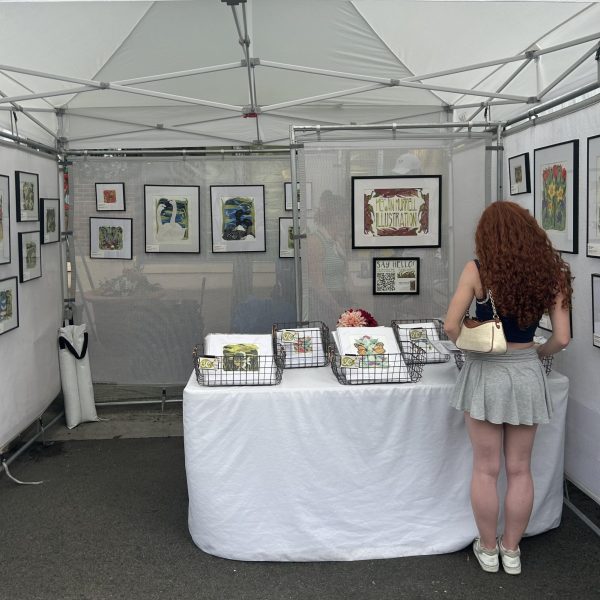
Megan Murrell was the selected feature artist of the fair this year. Murrell’s work depicts nature, and her inspiration comes from her passion to protect it. Her featured piece, “Welcome Migration,” could be seen on every block of the fair. According to Murrell, this piece has a more metaphorical meaning than most of her work. Created in February of this year, “Welcome Migration” reflects on the trauma experienced by the city of Minneapolis during Operation Metro Surge.

“I’m very into pollinators and monarchs and things like that,” Murrell said. “There’s never been a time when that symbol of the beauty of migration has been more important to me.” 

As a teacher and a mother, Murrell felt particularly affected by the turmoil. 

“It impacted students at our school, so I kind of think it’s my way of working it out of my system,” Murrell said. “You look at the humanity of it, too. And you’re dealing with people. And people deserve love. And there’s beauty in humanity, right? And there’s hope in humanity, and that’s kind of like what I want to put out there and remind again, it’s gonna sound cliché, but the beauty of being alive and existing with other people.” 

To push back against restrictive policies and negative rhetoric about immigration, Murrell’s work depicts the beauty of migration as a part of nature and humanity. 

Megan Murrell Illustration’s booth at the Edina Art Fair at 50th and France in Edina, Minn., Sunday, June 7. (Image by Ava Gilhoi)

The annual Edina Art Fair continues to be an important event for Minnesotans. Encounters with artists remind us of the vibrancy of our city and the importance of art in creating community. Next year, Edina Art Fair will celebrate its 60th anniversary, and for the special milestone, organizers plan to make it even bigger.

The post Edina Art Fair Recap: Three Artists’ Inspiration appeared first on The Minnesota Daily.
Posted in UncategorizedComments Off on Edina Art Fair Recap: Three Artists’ Inspiration