
Author Archives | by Ash Jones

UMN Luddite club builds community offline

Created in March, the University of Minnesota Luddite group aims to break down the barriers and difficulties that come with modern technology, with members connecting in-person to discuss aspects of building community outside of the internet.

The Luddites were a group of early 19th-century European workers who protested against textile mills that used automated machinery. The group was made up of textile workers whose jobs were being taken away by the factories mass-producing lower quality products.

Today, the Luddites live on in spirit, as their name has a connotation for those who oppose technology. For group creator Emma Bourne, their name is a symbol for resistance against the dangers of modern technology.  

Bourne said the club is not anti-technology, and neither was the Luddite movement that inspired the group. Bourne said the Luddites were against technology that took away their livelihood.

Meetings typically start with discussion points raised by members, while Bourne guides the conversation. The group usually does physical activity during the meetings as well, such as playing spike ball or throwing frisbee.

Bourne said the two main goals of the club are to create a space for people to explore their technology use and create a face-to-face community at the University. She added she transferred to the University in the fall of 2025 from a small California liberal arts college, and said she felt isolated. 

“I was just really frustrated trying to connect with people,” Bourne said. “So I wanted to create some sort of space where people feel welcome and can talk to other people, rather than like going on your phone.”

Bourne said she does not use social media, but she still uses the internet and has a cell phone. The club has an internal website for members to see announcements or readings they may discuss during meetings. 

“A website isn’t going to take away my livelihood,” Bourne said. “Instagram definitely could. Google Gemini or other forms of AI definitely could.” 

Bourne was inspired by other Luddite clubs forming across the nation. Advertising through posters and word-of-mouth, she said the club is open to anyone who wants to chat with other community members, regardless of their level of technology use. 

Bourne said the club discusses topics outside of just screentime, such as the ethical consequences of technology use. For example, the group’s focus has been on how Artificial Intelligence impacts the environment and how social media companies sell data.

“It is not just about how social media is sucking up our time,” Bourne said. “These companies are selling our data and making millions or billions of profit off of us and manipulating us through advertising.”

The Luddite club began with Bourne and her roommate, Bijou Acers, talking on the St. Paul campus without any technology or homework. Acers and Bourne shared a dislike of social media. 

“These tools of the digital age are marketed as being tools of connection,” Acers said. “We just felt that they ended up making the relationships or potential relationships so much more distant.”

Acers said she advocated for adding Luddite club outings, which are group events planned outside of their weekly meeting time. These events are planned during weekly meetings and are still technology-free.

Along with advocating for the outings, Acers said she added “joyful movement” to the meetings, as discussions can sometimes be draining and dark.

“As much as we are talking about algorithms, we’re also physical people,” Acers said. “We have to remind ourselves that we also have physical agency.”

Club member Alice Bauroth went to her first Luddite club meeting in February 2025 as the first official member, besides Acers. When she went to the atrium, it was just her and Bourne.

Bauroth said they talked for around an hour about their views on technology and felt the club was the social connection she was looking for.

“I wanted to build community, and I get kind of frustrated with how little people think critically about how we are using technology,” Bauroth said. “I feel like you really have to fight hard for spaces where you are meeting new people and getting to know them, not just on a surface level.”

Bauroth said she felt angry at how social media companies took over people’s lives, especially after COVID-19. She said the term Luddite is often used in a negative connotation, but to her it means critically considering what technologies are adding to her life.

“Being able to create these spaces where people are having discourses and bringing new ideas, it makes me hopeful,” Bauroth said. “It makes me think of what other things I could help bring into the world.”
Posted in UncategorizedComments Off on UMN Luddite club builds community offline

UMN Luddite club builds community offline

Created in March, the University of Minnesota Luddite group aims to break down the barriers and difficulties that come with modern technology, with members connecting in-person to discuss aspects of building community outside of the internet.

The Luddites were a group of early 19th-century European workers who protested against textile mills that used automated machinery. The group was made up of textile workers whose jobs were being taken away by the factories mass-producing lower quality products.

Today, the Luddites live on in spirit, as their name has a connotation for those who oppose technology. For group creator Emma Bourne, their name is a symbol for resistance against the dangers of modern technology.  

Bourne said the club is not anti-technology, and neither was the Luddite movement that inspired the group. Bourne said the Luddites were against technology that took away their livelihood.

Meetings typically start with discussion points raised by members, while Bourne guides the conversation. The group usually does physical activity during the meetings as well, such as playing spike ball or throwing frisbee.

Bourne said the two main goals of the club are to create a space for people to explore their technology use and create a face-to-face community at the University. She added she transferred to the University in the fall of 2025 from a small California liberal arts college, and said she felt isolated. 

“I was just really frustrated trying to connect with people,” Bourne said. “So I wanted to create some sort of space where people feel welcome and can talk to other people, rather than like going on your phone.”

Bourne said she does not use social media, but she still uses the internet and has a cell phone. The club has an internal website for members to see announcements or readings they may discuss during meetings. 

“A website isn’t going to take away my livelihood,” Bourne said. “Instagram definitely could. Google Gemini or other forms of AI definitely could.” 

Bourne was inspired by other Luddite clubs forming across the nation. Advertising through posters and word-of-mouth, she said the club is open to anyone who wants to chat with other community members, regardless of their level of technology use. 

Bourne said the club discusses topics outside of just screentime, such as the ethical consequences of technology use. For example, the group’s focus has been on how Artificial Intelligence impacts the environment and how social media companies sell data.

“It is not just about how social media is sucking up our time,” Bourne said. “These companies are selling our data and making millions or billions of profit off of us and manipulating us through advertising.”

The Luddite club began with Bourne and her roommate, Bijou Acers, talking on the St. Paul campus without any technology or homework. Acers and Bourne shared a dislike of social media. 

“These tools of the digital age are marketed as being tools of connection,” Acers said. “We just felt that they ended up making the relationships or potential relationships so much more distant.”

Acers said she advocated for adding Luddite club outings, which are group events planned outside of their weekly meeting time. These events are planned during weekly meetings and are still technology-free.

Along with advocating for the outings, Acers said she added “joyful movement” to the meetings, as discussions can sometimes be draining and dark.

“As much as we are talking about algorithms, we’re also physical people,” Acers said. “We have to remind ourselves that we also have physical agency.”

Club member Alice Bauroth went to her first Luddite club meeting in February 2025 as the first official member, besides Acers. When she went to the atrium, it was just her and Bourne.

Bauroth said they talked for around an hour about their views on technology and felt the club was the social connection she was looking for.

“I wanted to build community, and I get kind of frustrated with how little people think critically about how we are using technology,” Bauroth said. “I feel like you really have to fight hard for spaces where you are meeting new people and getting to know them, not just on a surface level.”

Bauroth said she felt angry at how social media companies took over people’s lives, especially after COVID-19. She said the term Luddite is often used in a negative connotation, but to her it means critically considering what technologies are adding to her life.

“Being able to create these spaces where people are having discourses and bringing new ideas, it makes me hopeful,” Bauroth said. “It makes me think of what other things I could help bring into the world.”

Posted in UncategorizedComments Off on UMN Luddite club builds community offline

UMN Mutual Aid Collective plans community support events for upcoming school year

The University of Minnesota’s Mutual Aid Collective, a student group that aims to support vulnerable communities on and around campus, met Monday to discuss plans for the upcoming school year.

The group officially registered in July 2025, but has hosted events since founder Joe Kyle created the club in January 2025. 

Kyle said the recent presidential election did not impact his decision to create the organization, but the Trump administration’s actions have changed what the club prioritizes.

“Life’s unaffordable for people, especially for young folks,” Kyle said. “I think this is a resource that a lot of people can stand to benefit from at the University.”

Kyle said after U.S. President Donald Trump won the election, he felt disappointed but simultaneously motivated to make a change.

“I remember thinking, ‘Man, this sucks,’” Kyle said. “But, you know, what would make me feel better is getting out there and starting to help.”

The Trump administration ended Household Food Security Reports, which tracked U.S. food insecurity, according to an announcement from the USDA. With this, the requirements for food assistance got harder. 

The Supplemental Nutrition Assistance Program increased the requirements for people to receive benefits, according to a Congressional Budget Office estimation.

The group meets on Mondays in Bruininks 530 from 6 to 7 p.m. to plan events. They also have a table there where anyone can stop by to donate food, clothes, books or anything they think would be useful. 

Kyle said he hopes more people will bring and take supplies. 

“In my ideal world, that’s kind of just how economics would be organized,” Kyle said. “People collectively coming together and sharing the resources they need.”

The group is planning a “Trick or Treat so Others can Eat” food drive for the end of October. 

Olindo Fonseca said he ran a similar event in his hometown every Halloween and received a lot of donations.

Fonseca said they are collecting in the Prospect Park and Seward neighborhoods. On Halloween, they plan to go door to door collecting non-perishable donations, including candy, and bring the donations to a shelter.

Kyle said the Mutual Aid Collective wants to prioritize immigrant communities in Minneapolis that have been targeted by the Trump administration. The One Big Beautiful Bill, passed in July, increased the budget of Immigration and Customs Enforcement to deport more undocumented immigrants. 

Club officer Anahi Nunez said the club is planning to collaborate with the Mi Gente Latinx Student Cultural Center for an immigration aid event. She said they plan to hand out cards with immigrant rights on them and help those who need legal advice. 

Nunez said she transferred to the University last semester and thought the club was a good opportunity to give back to those in need.

“These are trying times with the current administration,” Nunez said. “I feel like minority groups are under attack more than they were in the past.”

Kyle said the club wants to be a resource not just for students, but for everyone in the Twin Cities community.

“It’s very easy for a lot of people to imagine these issues as being very distant from them,” Kyle said. “But this has direct impacts on your neighbors, the people you’re going to see every day, the random guy that helps you on the street or the guy that owns your favorite grocery store.”

Posted in UncategorizedComments Off on UMN Mutual Aid Collective plans community support events for upcoming school year

Sprinkle system failure floods Middlebrook, damaging student property

A sprinkler system failure caused flooding and property damage to dorm rooms in Middlebrook Hall on Sept. 10, according to a statement from University of Minnesota Director of Housing & Residential Life Susan Stubblefield.

A sprinkler on Middlebrook’s 11th floor burst around 5 p.m., causing water damage in 13 rooms, according to the statement. Twenty-six residents were affected, and housing and residential services were temporarily relocated.

Stubblefield said University housing staff are currently investigating why the sprinkler burst. She does not believe the sprinkler was faulty.

First-year Vivian Amos opened her door to leave for a club meeting when she heard a noise from her closet. Suddenly, the sprinkler in her room began to blast water everywhere, spraying Amos with dirty water.

“I was in such a state of panic, and there was so much water,” Amos said. “Normally, the sprinkler’s like a shower head, but this felt like a hose right on me.”

She said the spray knocked one of her AirPods out of her ear and left her soaked. Amos and her roommate called the community advisor on duty for help and grabbed their valuables as water began to flood into the hallway.

“I was freezing,” Amos said. “I was drenched in dirty water. I was so cold, and I was just freaking out because the water was spreading so fast.”

Students and staff evacuated Middlebrook, and after sprinklers were shut off, the community advisors, also called CAs,s told Amos and her roommate to pack up what they could into moving carts.

Most of the students on Amos’ floor had to relocate temporarily.

Amos and her roommate spent around five hours that night in a laundry room washing the dirt from their clothes. Even after a couple of washes, some of Amos’ clothes were still damaged, along with her rug.

From New York, Amos has no family close by. Amos said she had to store some of her belongings in Middlebrook closets. 

Amos said she does not know how damaged those belongings have been, since she has not accessed the closets since the flooding.

Amos said the CAs and staff were very kind, helping students pack and move belongings. She said some parents have reached out to her online, offering to replace damaged belongings. 

In the meantime, Amos said she has been able to store some property in her friends’ dorms.

Amos said she has seen comments online claiming she or her roommate messed with the sprinkler, but said that neither of them has touched it at all.

“I wouldn’t purposely flood my own dorm room the second week of freshman year,” Amos said.

Amos said she spoke with police the night of the flood, and they confirmed the sprinkler’s water did not spray properly. 

After the flooding, the University replaced both sprinklers in Amos’s room.

Kristi King, another Middlebrook resident, was away when she received a text from her friend about the flooding. When she got to her room, some of her clothes and shoes were damaged from the standing water.

“It is a weird feeling,” King said. “It feels like my home was just taken from me.”

On Sept. 12, 10 of the 26 residents were able to move back into their dorms, according to Stubblefield’s statement. Last Monday, six other residents were able to move back in, and the rest of the students, including Amos and King, were scheduled to move back in on Friday.

According to Section 12 of the University’s housing contract, residents’ personal property is not protected by the University, and instead, any damage should be protected by the student’s renter’s insurance.

The residents were offered to permanently relocate, Stubblefield said. She added that there have been no requests for compensation from the affected students.

Stubblefield said the Department of Health and Safety tested the dorms to ensure they were safe to live in. She said they are working with the University’s Health, Safety and Risk Management office to follow up on the incident.

“When unexpected facilities issues occur, the University is committed to addressing the situation as quickly as possible and working across University departments to repair and restore the space,” Stubblefield said.

Posted in UncategorizedComments Off on Sprinkle system failure floods Middlebrook, damaging student property

UMN Katherine E. Nash Gallery opens “Vaivén”

The Katherine E. Nash Gallery hosted the public reception of its latest exhibition, “Vaivén: 21st-Century Art of Puerto Rico and Its Diaspora,” on Sept. 13, gathering the community to embrace Puerto Rican culture.

The gallery is located in the Regis Center for Art on the University of Minnesota Twin Cities West Bank campus. The free exhibit, featuring 43 Puerto Rican artists, will be open until Dec. 6. 

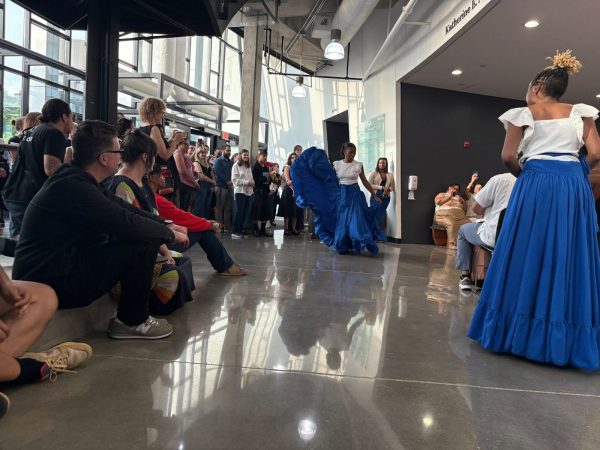
On Sept. 13, viewers observed art pieces, ate Latin cuisine from La Chiva de San Juan food truck and enjoyed traditional Puerto Rican dance performances from the BORIKEN Cultural Center.

Katherine E. Nash Gallery director Teréz Iacovino has worked with José López Serra, the director of Puerto Rican art institute Hidrante, to put together the gallery since 2021. For almost five years, they traveled across the 50 U.S. states and Puerto Rico to connect with artists.

Before becoming director in August, Iacovino served as the Katherine E. Nash Gallery assistant director. She said the idea for “Vaivén” began with the birth of her son in 2019, when she realized she felt estranged from her culture.

“It really started this exploration not only of familial history but cultural history,” Iacovino said. “That really led to me really wanting to work on an exhibition featuring contemporary Puerto Rican art as a way to also learn about Puerto Rican arts and culture.”

The BORIKEN cultural center performing at the Kathriene E. Nash Gallery. (Image by Ash Jones)

Iacovino said the word, vaivén comes from the Spanish term for back and forth movement, and is sometimes used to describe the ease with which Puerto Ricans migrate between the U.S. and Puerto Rico. She said they wanted to explore this concept in many ways, including how the history of migration affects artists. 

“That psychological experience of what does it mean to be in diaspora, to experience a place from afar, to not be able to return to a place, to be displaced,” Iacovino said. 

Iacovino said she feels more connected to her Puerto Rican heritage after curating the exhibition.

“It felt sort of like a homecoming, in a way of really being welcomed into a community that I felt that I didn’t have access to,” Iacovino said.

Artist Cándida González, featured in the gallery, was raised in Minneapolis. Gonzalez said growing up in their community, they saw very few Puerto Ricans, but their father kept their culture close.

Gonzalez said they connected to the theme since their father was banished from his family in Puerto Rico. After his death, she felt they had to connect with their family again.

“That theme of healing, that really shows up in my work,” Gonzalez said. “How do we use art to heal? How am I using art to heal? How can I offer my art as a healing tool to the community?” 

“I did not connect with the island until years later,” González said. “I think that is something that really fuels my art.”

Another feature of the gallery is the mural commission, part of which is displayed in the gallery lobby. The other part is in Rio Piedras, Puerto Rico, and is called “Aquí Nod Quedamos.”

Graduate research assistant Tabatha Cruz co-facilitated community meetings with Puerto Ricans in Minneapolis and Rio Piedras to create the murals. She said they wanted to ensure the murals were unique to each city, while simultaneously being connected.

“Puerto Rico and Minnesota are very far away from each other, and they may seem like opposite spaces of one another, but there are truly some really beautiful connections in between the two,” Cruz said. “Those things are reflected in this mural, especially like the Mississippi, you know, flows all the way into the Gulf, into the Caribbean, and the Caribbean is our home.”

Artist Raysa Rodríguez worked on the mural in Rio Piedras. She said she feels proud of the work she and the other artists accomplished.

“To make community art for me is powerful,” Rodríguez said. “The world needs art to heal, to connect, to learn, to communicate.”

Dancers and musicians from the BORIKEN cultural center performed during the reception. Bomba is a traditional Puerto Rican dance that is done to barilles de bomba (drums), maracas and cuá (wooden sticks).

BORIKEN was founded in 2019, offering art, music, dance and sport programs to preserve cultural traditions. Yari Serrano and her daughter, Jahvi Ortiz, are two Bomba dancers who found community through the organization.

They moved to Minnesota in 2017, after their town in Puerto Rico was flooded by Hurricane Maria. They joined the Bomba workshop five years ago and have performed with the group around the Twin Cities. 

“It is therapeutic,” Ortizi said. “I am able to connect to my community, maybe more than I would have back home.”

Yari said she loves promoting the culture, and the program is open to everyone.

“Everyone has rhythm inside them,” Yari said. “This is like a huge family.”

Posted in UncategorizedComments Off on UMN Katherine E. Nash Gallery opens “Vaivén”