Author Archives | by Abbey Mulcahy

Acclaimed author George Saunders to speak at Northrop Auditorium

Seeing one literary legend is impressive. Getting to hear from two at once is something to remember.

Novelist and short story writer George Saunders will join Regents Professor and novelist Julie Schumacher in conversation at Northrop on Sept. 22, reading excerpts from his #1 New York Times bestseller “Vigil” and discussing the craft of writing.

Saunders has authored numerous books, including the novel “Lincoln in the Bardo,” which received the 2017 Man Booker Prize, and his short story collection “Tenth of December,” a finalist for the National Book Award. Alongside accolades, his stories regularly feature in The New Yorker.

The writer and Syracuse University professor published his newest book, “Vigil,” in January, exploring empathy, the afterlife and humanity’s complexity in under 200 pages.

“Saunders, he’s a terrific writer as well as a terrific literary presence and literary mentor,” Schumacher said. “He’s known for talking about empathy as part of the reading and the writing and the teaching process, about the way in which immersing oneself into the mind of a fictional character or another person on the page can cause us to be more open-minded.”

The University of Minnesota’s own Regents Professor Schumacher, a local novelist and short story writer, will moderate a Q&A with Saunders about “Vigil” and his bookwriting career.

Schumacher has been teaching Saunders’ work in her classes for years, and she said his book on literary craftsmanship is one of the best.

“There are so many books about the craft of writing that are not very interesting,” Schumacher said. “Some of them are very useful, some of them are very informative, but this is the only one I can think of that is original, literary, sophisticated, funny and also incredibly useful.”

The event marks the 25th anniversary of the Esther Freier Endowed Lecture in Literature Series, inaugurated in 2001 by acclaimed essayist and novelist Jamaica Kincaid. 

Since the series’ founding, the English Department has continued to host prominent authors from across the globe, ranging from E. L. Doctorow and Louise Glück to James McBride and Chimamanda Ngozi Adichie.

The Freier lecture is always free and open to the public, drawing in attendees from across the metropolitan area. 

“It helps to cement the U’s position as part of the hub of literary activity that exists in the Twin Cities,” Schumacher said. “It’s such a literary environment that we live in, in the Twin Cities, and the U is a part of that.”

The event, co-sponsored by The Loft Literary Center, begins at 7:30 p.m. on Sept. 22 at Northrup. Whether a voracious reader or just a curious mind, anyone can register to attend for free.

The post Acclaimed author George Saunders to speak at Northrop Auditorium appeared first on The Minnesota Daily.

Posted in UncategorizedComments Off on Acclaimed author George Saunders to speak at Northrop Auditorium

2026 ushers in a renewed interest in horror movies


ABBEY MULCAHY: Hi there. My name is Abbey Mulcahy from the Minnesota Daily, and welcome to The Daily Beat, our podcast dedicated to the arts and entertainment scene of the Twin Cities. If you’re someone who listens to our podcast often, you might not be super familiar with me or my voice, so I thought I would introduce myself to you before we get into the meat of the episode.

Like I said, my name is Abbey and I am the new arts and entertainment editor at The Daily. I’ve worked as a reporter for The Daily since this past fall, writing a variety of stories about theater, music, festivals, and all sorts of things, arts and culture around University of Minnesota campus and the Twin Cities.

About a month ago, I took over as editor after our past editor, Sophia Arndt, graduated. So I’m super excited to be more active doing these podcasts and to continue to indulge in the super rich and vibrant art scene that we have in the Twin Cities. 

I thought that we could start off this new podcast run by talking about this really reinvigorated obsession or passion with horror movies.

This year has seen some really strong horror films come out, and I’ve just noticed a really powerful response to people’s responses to these films. They seem to be really engaged in not only consuming horror movies, but also looking deeper beyond what they see on the screens, digging into characters, motivations, complex plots, what this means on a societal level.

I figured we’d take some time today to go over some of these new horror movies and dig into why these movies are sticking with us so much and why people are kind of coming around to the horror genre in ways that they might not have before.

I will try to stay away from revealing the fun plot twists and secrets that come out, ’cause these films are so full of little details that really tie it all together. But I can’t guarantee that this will be without spoilers. So listen at your own risk.

To dip our toes into this topic, I thought a good place to start would be just by going over some of the films that have come out and have been garnering a pretty big response online.

One that I have seen so much response to—and that we just published an article about—is Obsession. Another one is Backrooms, which for similar reasons to Obsession, has really kind of been floating around the minds of younger moviegoers, and just sparking a lot of discussion online about the horror genre.

But this room has also seen some other interesting things come out as well. Hokum is a movie that I actually just saw in the theaters about a month ago. It’s a little bit of this supernatural, folklorish, thriller, horror energy that’s a little bit of a mystery at the same time.

There’s a lot of layers, and interestingly it really does integrate that tradition of folklore into it. 

Forbidden Fruits, I don’t know if I would classify this as a true horror, but I think it is a thriller in its own right, so I think I added it to this little list as well. That one is pretty fun. Follows four girls working in a mall, but something is a little interesting about the store that they all work at. That’s kind of all I’m gonna tell you about it. 

It stars one of my favorite horror actresses, Victoria Pedretti. If you’re a fan of that and a fan of Victoria Pedretti, highly recommend that you go check out Forbidden Fruits. It’s a little bit more of a light-hearted thriller as well, for those who are not as accustomed or comfortable with some of the slashing and gore and death that permeates the horror genre.

There are two films that I haven’t seen but thought that I would add to this introductory list as well, one being Ready or Not 2: Here I Come, which for any fans of The Pitt, does in fact feature Shaun Hatosy, who plays Dr. Abbott in The Pitt. So if you’re a Pitt fan and you wanna try out some horror with a little bit of action and a tinge of gore, well Ready or Not 2 might be the film for you.

Earlier this year, the movie The Bride also came out, a film that Maggie Gyllenhaal directed, but also starred Jessie Buckley, who just won an Oscar for her role in Hamnet.

I also haven’t seen that one, but we do have a review posted on the website if you wanna learn a little bit more. 

But I bring up these movies not just to give you an easy introduction into the topic, but also because they’re so different, and they talk about a ton of different angles of horror, different ways to approach this one genre that doesn’t really have a single definition. 

I think horror is a really special genre because there’s no one way to do it. And you can say that about anything, about romance, about action. But when it comes to horror, and it comes to being vulnerable and scared and sitting in that theater with all the lights off, and it’s just you and that screen, I feel like something special happens.

The first film that I think we should dig into on this list is Obsession, which I don’t know about you guys, but whether I’m opening Instagram or talking with my friends or simply even just scrolling on my phone and looking for a movie to see, I have heard so much about Obsession.

Last Thursday, I decided to see Obsession. And at first I was a little bit scared because a lot of my friends had seen it, and they said that it was not something I would want to go alone to.

But I went anyways, and it was so much fun. I’ve been a horror fan for a couple years, but something about Obsession really makes it stand out. One thing about it that is true for another film on this list is that it comes from a younger director and more of an independent background than some of the other films that we see hitting our screens.

It was created by Kareem Barker, who is just 26 years old from Alabama. He got his start with filming by making YouTube videos with one of his friends, Cooper Tomlinson, and they just made sketch comedy. He continued with these comedy projects, and in 2024, he made a found footage horror film titled Milk and Serial. Not cereal, the type you eat, but serial, S-E-R-I-A-L. And that was released onto YouTube. 

Obsession I guess like the first huge film that he’s done, came out. It had just a budget of $750,000, and it was released mid-May. And since then, just to give you a little bit of a, I don’t know, just to show you how huge the impact of this film has been, it has grossed over $305 million worldwide.

It’s just such a huge success, and given that the budget wasn’t even $1 million, I think that speaks to it’s not just the money behind the film that’s making it succeed. There’s something about the aspects, the cinematography, the soundtrack, the actors, the costuming, the effects, everything, all these fine details are really what make the movie, not the budget behind it.

And since its release, it’s become Focus Features’ highest grossing film of all time.

To give you a little bit of a synopsis, Obsession is a film about a girl named Nikki and a guy named Bear.

Bear is a socially awkward, yet hopeful young man who works in the same music store as Nikki. They’ve been friends for a while, and he’s been harboring these feelings for her. But instead of declaring them or asking or testing the waters in the way that many of us would try, he decides to buy something called the “One Wish Willow,” which claims to grant whatever wish you make.

So he uses that One Wish Willow, makes a wish that she will love him, and the rest is history. And the old adage of be careful what you wish for has never been more true.

Because when you wish for someone’s love for you, you can’t control where that love begins and where it ends. It really forces us to confront what it means to love somebody and what it means to have control and autonomy over our own bodies and our own desires, and how far you can extend that control into other people’s lives.

It’s definitely a film that is worth the watch. You may need to exit the theater after it’s over and have a debrief session with your friends. I did observe many groups around me doing that, and I think that makes it all the more fun. 

Even though the movie has an endpoint, the discourse that it spurs after you watch it seems to continue well beyond theaters. Highly recommend that one. 

In the same vein, however, we have Backrooms, which was created by Kane Parsons. And much like Curry Barker, Kane Parsons is yet another young filmmaker, he’s just 21 years old, which actually makes him younger than me.

He began publishing a web series titled “Backrooms” on YouTube in early 2022 based on a creepypasta legend of the same name. And if you aren’t super internet-brained, that’s okay. Creepypastas are an early genre of internet horror legends. So there are so many creepypastas. If you know Slenderman, he’s in that realm. So Backrooms comes from a similar beginning. 

So in Backrooms, a struggling and divorced furniture store owner discovers some sort of interdimensional, endless, yellow-stained wall, liminal space that is through the basement. And he ends up exploring this space alongside his therapist, and it is twisting, and it is maze-like, and there’s just things in this abyss, this endless yellow-walled abyss, that don’t really make a whole lot of sense.

And not only is it confronting a creature that is otherworldly to you, but it also forces this furniture store owner, Clark, to confront parts about his own trauma, his own psychological past, that kind of manifest in front of him in this space. So I know that’s not the most detailed synopsis, but it’s one of those things that you have to experience for yourself.

But if you want to engage with some of the pre-movie material, the series that Kane Parsons has on YouTube is still up, and I watched some of it myself the other day. And I can totally see how that translates into the movie that we have before us now. Backrooms, like Obsession, has also been a huge hit, and that’s not entirely because of its YouTube roots, but it most certainly has something to do with it.

The movie, which was also released in May, has grossed over $267 million worldwide, according to IMDb’s Box Office Mojo. And the film has become A24’s highest grossing film to date, which, if you know anything about movies, A24 puts out some brilliant films, so the fact that Backrooms is among that group of movies and is also leading the pack says a lot.

And Backrooms made Parsons the youngest filmmaker in history to have achieved a number one opening at the box office. The movie also, much like Obsession, had a small budget. It was just $10 million, and just on opening weekend alone, it had collected $81 million across North American theaters. So yet another financial success, but also just cultural success.

So many people are familiar with it, and whether they’re in love with Backrooms or a little bit confused by it, they’re still talking about it. Attention is a currency, especially in the internet age, so that so many people are feeling motivated by these films to engage in cinema and engage in these movie-oriented dialogues, says a lot about the power of these films.

I put both of these films up here in a bit of a comparison largely because of their young directors.

A lot of films that we see on the screen, regardless of the talent and the work behind them, are propelled by people who are older and have been engaged in the industry for years. And while that doesn’t devalue those films in any way, having a younger perspective that is reflective of Gen Z’s interests, the ways that Gen Z people consume media and how they interpret it, definitely is showing up

Film and media Studies professor Matt Rapaport at Tufts University told Tufts Now, about Obsession and Backrooms that, quote, “It’s fascinating to watch the way studios are looking for new talented people who already have a clear aesthetic and audience. They are looking to capitalize on the fact that we have a generation of people who have grown up on YouTube, TikTok, Instagram, and Snapchat, and a generation of creators who have cultivated these audiences.”Unquote. 

And I think that quote really speaks to what both Kane Parsons and Curry Barker have done with these films. Both of them engaged in some sort of YouTube creation before they made it big. And that allowed them to cultivate and practice and really hone their artistic visions. But YouTube also isn’t a one-way street.

You have creators making things, putting their time, effort, and energy into a product, and then you have audience members able to like or dislike a video, share it with their friends, leave a comment. In a way, it’s almost like an interactive movie space where you have kind of like a workshop. You have a product in front of you, and you have the ability to respond as a creator to what your audience is proposing, critiquing, or complimenting.

And in that way, you can test out new ideas you might have, new approaches, and not that you ever need to compromise your artistic vision, but you can integrate what those around you think is valuable and think is interesting.

The way in which these younger creators approach making movies, like Professor Rapaport said, it’s different and studios are realizing that. There’s a reason A24 picked up this film, and same for Focus Features, because it’s really grabbing this generation who has grown up on YouTube and Instagram and TikTok and Snapchat. Audiences feel differently involved than perhaps they did in the past.

This good year for horror that we’re having is riding on the heels of the wonderful film year we had in 2025. On the screens we saw Sinners, we saw K-Pop Demon Hunters, there was One Battle After Another, Weapons with its own interesting, unsettling take on horror. Guillermo del Toro’s Frankenstein, Zootopia 2, Superman. So there were just a lot of really good movies that came out that year, and you can tell by a couple of the ones that I listed that horror was also on the screen, and we were looking at it in a way that we hadn’t before.

And I think Sinners is really emblematic of this. If you have listened to our podcast in the past, you’ve most definitely heard mention of the A&E’s desk love of Sinners, and love of Michael B. Jordan, which I think is the only correct Michael B. Jordan opinion to have.

But I wanna talk a little bit about Sinners and how that has led us into this year’s obsession with horror. Sinners is set in 1932 in the Mississippi Delta. Michael B. Jordan plays two twin brothers, Smoke and Stack, who return to their hometown in the Jim Crow South from Chicago with money and a dream to open up a juke joint for the Black community in their town because everyone needs a place to dance and gather and be merry and have fun.

But things don’t quite go to plan. And some sort of supernatural force, not to spoil anything for you guys, interfere with these plans, and it has repercussions on pretty much the entire community that’s gathered there.

So it says a lot, and it says it in a really beautiful and meaningful way. And it was a fantastic movie that came out this past year, and it was very properly awarded for that. At the Oscars, it won Best Actor— Michael B. Jordan—Best Original Screenplay, Best Cinematography, and Best Original Score on top of a slew of other nominations

That being said, Sinners was a blockbuster from the start, directed by Ryan Coogler, who is a critically acclaimed American director who debuted on the scene in 2013 with his feature length film, Fruitvale Station, starring Michael B. Jordan, Melanie Diaz, and Octavia Spencer. He’s also well known for directing Black Panther

Sinners, I remember when it came out going to the theater because people who had seen it before me were insistent on getting others to go and to appreciate this art.

And I think a lot of people didn’t expect the horror twist that went along with it. Because you’re not confronted by horror from the get-go, I think it forces you to get comfortable with the characters, the main characters, understand why they are doing what they’re doing, and in some ways to join their team and root for them.

When the evil forces come onto the scene and you see them and you see how they’re disturbing this piece that you have gotten comfortable with, it really forces you to sit back and analyze beyond just, okay, supernatural beings are messing up their night. 

I think another really strong point that Sinners won was showing that horror is for, and can include, anyone. We’ve seen in more recent years films that star people of color in horror films, not just as a side character in a slasher that gets killed first or second, but as main characters whose personal histories, and even just cultural histories, play important roles in the narrative.

Get Out is one of these. And I think Sinners is another where you cannot remove the setting of being in the 1930s South from this movie. It is integral to not only just the characters, but also the way that the horror resonates when audiences take it in. 

Having had Sinners in 2025, people have been more open and interested in seeing how horror can twist or augment our typical perceptions of movies. Because at the core of Obsession is romance, is love, is desire, is affection, is a relationship.

And we’ve all seen rom-coms and the soapy, sappy romances, and those are fantastic. But when you add an element of thrill, of fear, it makes you interpret that relationship in a different way and pay attention to, like I said earlier, those aspects of control and freedom and autonomy and independence in a way that you might not confront if you’re watching The Notebook. Although those themes are often still there, they just manifest differently. 

So on a broader level, I think when we look and when we examine why people are so into horror, one of the answers is that it’s such a wide-reaching and all-encompassing genre. On the one hand, you have psychological horror, where films use psychological tension, fear, and suspense to really evoke those feelings of dread and unease in yourself.

In older movies, we can see this in Rosemary’s Baby, Silence of the Lambs. But in these 2026 selections, I think you can also argue that Obsession is psychological horror. We are seeing how Nikki’s mind is being tormented by this wish and how her true self is being tucked away while this wish-bound, love-heart-eyed Nikki is pushed to the front.

And even in Hokum, which we didn’t really talk a ton about today, there are still those elements of psychological torment. The question at the end of the movie ends up being, without giving too many spoilers, was any of this real?

And what does it mean for a supernatural event to be real? Is seeing real? Is physically experiencing something real? Or is believing and thinking that it happened enough for it to be real? 

Psychological horror allows you to walk away with honestly more questions than answers sometimes. But I think that’s one of the reasons we’re so drawn into it, because it forces you and prompts you to examine things without always wrapping it up in a neat little bow.

When Obsession ends, I said I saw people debriefing outside the theater, and that was no figurative device. That is true. Because you walk out of there, and I think most people end up having their own reactions to it and their own strong feelings about right and wrong, freedom versus confinement, and all of that.

In addition to psychological horror we have the slashers, the high-octane action side of things, where you have a killer on a spree and victims running at summer camps or running around cornfields. Think Texas Chainsaw Massacre, Friday the 13th. There are also so many modern slashers, too, that are really good fun. I love a good slasher. I think they’re like the action movie of the horror genre, and I think it’s a good balance to have after being, having your mind toyed with other movies. 

One of my favorite things about horror is that there are so many films that kind of are just their own thing. They don’t fit into a neat categorization. Alien is one of these. I think you could say thriller, you could say suspense film, sci-fi of course, but sci-fi and horror have a lot of overlap.

But I think it’s a little bit of everything. You have this supernatural alien creature—and Sigourney Weaver, love Sigourney Weaver—but you have something otherworldly, but you also have a little bit of body horror, but it’s also psychoanalytical. It says a lot about our unconscious desires. Like what does an alien do when it kind of takes on a bit of a procreation motherly role? 

Like, there’s just so much about that film that draws from a bunch of different genres. But at its core, it’s a little bit scary, and it gets your heartbeat going. So I think that it falls into that horror category as well. 

Beyond horror just being such an all-encompassing genre, I think another reason is that people kinda like to be scared sometimes.

After you come home from your 9 to 5 internship or your morning shift at a coffee shop, or even if you were going on a hike that day, sometimes it’s fun to sit down, dim the lights, and put something on that you know is going to get your heart beating a little bit faster. 

In addition to studying journalism I do some English and cultural studies as well. And movies like horror, and this is true for science fiction as well, they allow you to see your world and the problems in your world from a removed and extrapolated perspective.

And what I mean when I say this is when you see a family in a horror movie living in a haunted house, they have their own problems between persons: mom and dad might be fighting, the siblings might be on their own journeys and disappointing their parents or this or that. But then at the center of everything, you have this force that’s terrifying them, and you’re able to analyze what it means for this family to exist with these problems but from another perspective.

You’re not seeing them simply talking through their arguments. You’re seeing them challenge the barriers that stand between them because some other force is pushing them to do so. At the root of it, horror just allows us and encourages us to look at commonplace things with a new perspective.

We see this in Obsession where Bear breaks that “One Wish Willow, makes his wish, and Nikki’s behavior changes at the drop of a hat.

The simplest explanation in that case might just be that she’s having a psychotic break, but we, the audience, know better. We understand that this was some external manipulation, and she has so little control over what’s happening to her. It makes us think of these bigger ideas in that there are things really complicated at play.

And Obsession is speaking to what’s happening in the movie, but there’s no way it exists in isolation. All of Bear’s motivations reflect what we are seeing outside with young people struggling to make these social connections and be forthcoming with each other, and instead going on these roundabout ways to achieving their goals.

And so we’re forced to sit with that and realize why that’s a problem. That’s a really important and key strength of the horror genres. 

There’s so much to say about horror and so many recommendations to give. From this year, again, you gotta return to that list that we went through at the beginning. Go catch Backrooms and Obsession, of course, but also see Hokum.

Try Forbidden Fruits if you’re looking for something that’s a little bit more bubbly. And then Ready or Not 2 and The Bride are also there.

If you’re looking to catch one of these newer 2026 horror movies, a lot of them are still playing in theaters.

Thank you for tuning in on my first solo podcast. Pretty exciting.  Once again, this is Abbey Mulcahy, and thank you for listening. This podcast was produced by Grace Aigner, and if you have any questions, comments, or concerns, you can reach us at podcasting@mndaily.com.  Bye-bye.

The post 2026 ushers in a renewed interest in horror movies appeared first on The Minnesota Daily.

Posted in UncategorizedComments Off on 2026 ushers in a renewed interest in horror movies

2026 ushers in a renewed interest in horror movies


ABBEY MULCAHY: Hi there. My name is Abbey Mulcahy from the Minnesota Daily, and welcome to The Daily Beat, our podcast dedicated to the arts and entertainment scene of the Twin Cities. If you’re someone who listens to our podcast often, you might not be super familiar with me or my voice, so I thought I would introduce myself to you before we get into the meat of the episode.

Like I said, my name is Abbey and I am the new arts and entertainment editor at The Daily. I’ve worked as a reporter for The Daily since this past fall, writing a variety of stories about theater, music, festivals, and all sorts of things, arts and culture around University of Minnesota campus and the Twin Cities.

About a month ago, I took over as editor after our past editor, Sophia Arndt, graduated. So I’m super excited to be more active doing these podcasts and to continue to indulge in the super rich and vibrant art scene that we have in the Twin Cities. 

I thought that we could start off this new podcast run by talking about this really reinvigorated obsession or passion with horror movies.

This year has seen some really strong horror films come out, and I’ve just noticed a really powerful response to people’s responses to these films. They seem to be really engaged in not only consuming horror movies, but also looking deeper beyond what they see on the screens, digging into characters, motivations, complex plots, what this means on a societal level.

I figured we’d take some time today to go over some of these new horror movies and dig into why these movies are sticking with us so much and why people are kind of coming around to the horror genre in ways that they might not have before.

I will try to stay away from revealing the fun plot twists and secrets that come out, ’cause these films are so full of little details that really tie it all together. But I can’t guarantee that this will be without spoilers. So listen at your own risk.

To dip our toes into this topic, I thought a good place to start would be just by going over some of the films that have come out and have been garnering a pretty big response online.

One that I have seen so much response to—and that we just published an article about—is Obsession. Another one is Backrooms, which for similar reasons to Obsession, has really kind of been floating around the minds of younger moviegoers, and just sparking a lot of discussion online about the horror genre.

But this room has also seen some other interesting things come out as well. Hokum is a movie that I actually just saw in the theaters about a month ago. It’s a little bit of this supernatural, folklorish, thriller, horror energy that’s a little bit of a mystery at the same time.

There’s a lot of layers, and interestingly it really does integrate that tradition of folklore into it. 

Forbidden Fruits, I don’t know if I would classify this as a true horror, but I think it is a thriller in its own right, so I think I added it to this little list as well. That one is pretty fun. Follows four girls working in a mall, but something is a little interesting about the store that they all work at. That’s kind of all I’m gonna tell you about it. 

It stars one of my favorite horror actresses, Victoria Pedretti. If you’re a fan of that and a fan of Victoria Pedretti, highly recommend that you go check out Forbidden Fruits. It’s a little bit more of a light-hearted thriller as well, for those who are not as accustomed or comfortable with some of the slashing and gore and death that permeates the horror genre.

There are two films that I haven’t seen but thought that I would add to this introductory list as well, one being Ready or Not 2: Here I Come, which for any fans of The Pitt, does in fact feature Shaun Hatosy, who plays Dr. Abbott in The Pitt. So if you’re a Pitt fan and you wanna try out some horror with a little bit of action and a tinge of gore, well Ready or Not 2 might be the film for you.

Earlier this year, the movie The Bride also came out, a film that Maggie Gyllenhaal directed, but also starred Jessie Buckley, who just won an Oscar for her role in Hamnet.

I also haven’t seen that one, but we do have a review posted on the website if you wanna learn a little bit more. 

But I bring up these movies not just to give you an easy introduction into the topic, but also because they’re so different, and they talk about a ton of different angles of horror, different ways to approach this one genre that doesn’t really have a single definition. 

I think horror is a really special genre because there’s no one way to do it. And you can say that about anything, about romance, about action. But when it comes to horror, and it comes to being vulnerable and scared and sitting in that theater with all the lights off, and it’s just you and that screen, I feel like something special happens.

The first film that I think we should dig into on this list is Obsession, which I don’t know about you guys, but whether I’m opening Instagram or talking with my friends or simply even just scrolling on my phone and looking for a movie to see, I have heard so much about Obsession.

Last Thursday, I decided to see Obsession. And at first I was a little bit scared because a lot of my friends had seen it, and they said that it was not something I would want to go alone to.

But I went anyways, and it was so much fun. I’ve been a horror fan for a couple years, but something about Obsession really makes it stand out. One thing about it that is true for another film on this list is that it comes from a younger director and more of an independent background than some of the other films that we see hitting our screens.

It was created by Kareem Barker, who is just 26 years old from Alabama. He got his start with filming by making YouTube videos with one of his friends, Cooper Tomlinson, and they just made sketch comedy. He continued with these comedy projects, and in 2024, he made a found footage horror film titled Milk and Serial. Not cereal, the type you eat, but serial, S-E-R-I-A-L. And that was released onto YouTube. 

Obsession I guess like the first huge film that he’s done, came out. It had just a budget of $750,000, and it was released mid-May. And since then, just to give you a little bit of a, I don’t know, just to show you how huge the impact of this film has been, it has grossed over $305 million worldwide.

It’s just such a huge success, and given that the budget wasn’t even $1 million, I think that speaks to it’s not just the money behind the film that’s making it succeed. There’s something about the aspects, the cinematography, the soundtrack, the actors, the costuming, the effects, everything, all these fine details are really what make the movie, not the budget behind it.

And since its release, it’s become Focus Features’ highest grossing film of all time.

To give you a little bit of a synopsis, Obsession is a film about a girl named Nikki and a guy named Bear.

Bear is a socially awkward, yet hopeful young man who works in the same music store as Nikki. They’ve been friends for a while, and he’s been harboring these feelings for her. But instead of declaring them or asking or testing the waters in the way that many of us would try, he decides to buy something called the “One Wish Willow,” which claims to grant whatever wish you make.

So he uses that One Wish Willow, makes a wish that she will love him, and the rest is history. And the old adage of be careful what you wish for has never been more true.

Because when you wish for someone’s love for you, you can’t control where that love begins and where it ends. It really forces us to confront what it means to love somebody and what it means to have control and autonomy over our own bodies and our own desires, and how far you can extend that control into other people’s lives.

It’s definitely a film that is worth the watch. You may need to exit the theater after it’s over and have a debrief session with your friends. I did observe many groups around me doing that, and I think that makes it all the more fun. 

Even though the movie has an endpoint, the discourse that it spurs after you watch it seems to continue well beyond theaters. Highly recommend that one. 

In the same vein, however, we have Backrooms, which was created by Kane Parsons. And much like Curry Barker, Kane Parsons is yet another young filmmaker, he’s just 21 years old, which actually makes him younger than me.

He began publishing a web series titled “Backrooms” on YouTube in early 2022 based on a creepypasta legend of the same name. And if you aren’t super internet-brained, that’s okay. Creepypastas are an early genre of internet horror legends. So there are so many creepypastas. If you know Slenderman, he’s in that realm. So Backrooms comes from a similar beginning. 

So in Backrooms, a struggling and divorced furniture store owner discovers some sort of interdimensional, endless, yellow-stained wall, liminal space that is through the basement. And he ends up exploring this space alongside his therapist, and it is twisting, and it is maze-like, and there’s just things in this abyss, this endless yellow-walled abyss, that don’t really make a whole lot of sense.

And not only is it confronting a creature that is otherworldly to you, but it also forces this furniture store owner, Clark, to confront parts about his own trauma, his own psychological past, that kind of manifest in front of him in this space. So I know that’s not the most detailed synopsis, but it’s one of those things that you have to experience for yourself.

But if you want to engage with some of the pre-movie material, the series that Kane Parsons has on YouTube is still up, and I watched some of it myself the other day. And I can totally see how that translates into the movie that we have before us now. Backrooms, like Obsession, has also been a huge hit, and that’s not entirely because of its YouTube roots, but it most certainly has something to do with it.

The movie, which was also released in May, has grossed over $267 million worldwide, according to IMDb’s Box Office Mojo. And the film has become A24’s highest grossing film to date, which, if you know anything about movies, A24 puts out some brilliant films, so the fact that Backrooms is among that group of movies and is also leading the pack says a lot.

And Backrooms made Parsons the youngest filmmaker in history to have achieved a number one opening at the box office. The movie also, much like Obsession, had a small budget. It was just $10 million, and just on opening weekend alone, it had collected $81 million across North American theaters. So yet another financial success, but also just cultural success.

So many people are familiar with it, and whether they’re in love with Backrooms or a little bit confused by it, they’re still talking about it. Attention is a currency, especially in the internet age, so that so many people are feeling motivated by these films to engage in cinema and engage in these movie-oriented dialogues, says a lot about the power of these films.

I put both of these films up here in a bit of a comparison largely because of their young directors.

A lot of films that we see on the screen, regardless of the talent and the work behind them, are propelled by people who are older and have been engaged in the industry for years. And while that doesn’t devalue those films in any way, having a younger perspective that is reflective of Gen Z’s interests, the ways that Gen Z people consume media and how they interpret it, definitely is showing up

Film and media Studies professor Matt Rapaport at Tufts University told Tufts Now, about Obsession and Backrooms that, quote, “It’s fascinating to watch the way studios are looking for new talented people who already have a clear aesthetic and audience. They are looking to capitalize on the fact that we have a generation of people who have grown up on YouTube, TikTok, Instagram, and Snapchat, and a generation of creators who have cultivated these audiences.”Unquote. 

And I think that quote really speaks to what both Kane Parsons and Curry Barker have done with these films. Both of them engaged in some sort of YouTube creation before they made it big. And that allowed them to cultivate and practice and really hone their artistic visions. But YouTube also isn’t a one-way street.

You have creators making things, putting their time, effort, and energy into a product, and then you have audience members able to like or dislike a video, share it with their friends, leave a comment. In a way, it’s almost like an interactive movie space where you have kind of like a workshop. You have a product in front of you, and you have the ability to respond as a creator to what your audience is proposing, critiquing, or complimenting.

And in that way, you can test out new ideas you might have, new approaches, and not that you ever need to compromise your artistic vision, but you can integrate what those around you think is valuable and think is interesting.

The way in which these younger creators approach making movies, like Professor Rapaport said, it’s different and studios are realizing that. There’s a reason A24 picked up this film, and same for Focus Features, because it’s really grabbing this generation who has grown up on YouTube and Instagram and TikTok and Snapchat. Audiences feel differently involved than perhaps they did in the past.

This good year for horror that we’re having is riding on the heels of the wonderful film year we had in 2025. On the screens we saw Sinners, we saw K-Pop Demon Hunters, there was One Battle After Another, Weapons with its own interesting, unsettling take on horror. Guillermo del Toro’s Frankenstein, Zootopia 2, Superman. So there were just a lot of really good movies that came out that year, and you can tell by a couple of the ones that I listed that horror was also on the screen, and we were looking at it in a way that we hadn’t before.

And I think Sinners is really emblematic of this. If you have listened to our podcast in the past, you’ve most definitely heard mention of the A&E’s desk love of Sinners, and love of Michael B. Jordan, which I think is the only correct Michael B. Jordan opinion to have.

But I wanna talk a little bit about Sinners and how that has led us into this year’s obsession with horror. Sinners is set in 1932 in the Mississippi Delta. Michael B. Jordan plays two twin brothers, Smoke and Stack, who return to their hometown in the Jim Crow South from Chicago with money and a dream to open up a juke joint for the Black community in their town because everyone needs a place to dance and gather and be merry and have fun.

But things don’t quite go to plan. And some sort of supernatural force, not to spoil anything for you guys, interfere with these plans, and it has repercussions on pretty much the entire community that’s gathered there.

So it says a lot, and it says it in a really beautiful and meaningful way. And it was a fantastic movie that came out this past year, and it was very properly awarded for that. At the Oscars, it won Best Actor— Michael B. Jordan—Best Original Screenplay, Best Cinematography, and Best Original Score on top of a slew of other nominations

That being said, Sinners was a blockbuster from the start, directed by Ryan Coogler, who is a critically acclaimed American director who debuted on the scene in 2013 with his feature length film, Fruitvale Station, starring Michael B. Jordan, Melanie Diaz, and Octavia Spencer. He’s also well known for directing Black Panther

Sinners, I remember when it came out going to the theater because people who had seen it before me were insistent on getting others to go and to appreciate this art.

And I think a lot of people didn’t expect the horror twist that went along with it. Because you’re not confronted by horror from the get-go, I think it forces you to get comfortable with the characters, the main characters, understand why they are doing what they’re doing, and in some ways to join their team and root for them.

When the evil forces come onto the scene and you see them and you see how they’re disturbing this piece that you have gotten comfortable with, it really forces you to sit back and analyze beyond just, okay, supernatural beings are messing up their night. 

I think another really strong point that Sinners won was showing that horror is for, and can include, anyone. We’ve seen in more recent years films that star people of color in horror films, not just as a side character in a slasher that gets killed first or second, but as main characters whose personal histories, and even just cultural histories, play important roles in the narrative.

Get Out is one of these. And I think Sinners is another where you cannot remove the setting of being in the 1930s South from this movie. It is integral to not only just the characters, but also the way that the horror resonates when audiences take it in. 

Having had Sinners in 2025, people have been more open and interested in seeing how horror can twist or augment our typical perceptions of movies. Because at the core of Obsession is romance, is love, is desire, is affection, is a relationship.

And we’ve all seen rom-coms and the soapy, sappy romances, and those are fantastic. But when you add an element of thrill, of fear, it makes you interpret that relationship in a different way and pay attention to, like I said earlier, those aspects of control and freedom and autonomy and independence in a way that you might not confront if you’re watching The Notebook. Although those themes are often still there, they just manifest differently. 

So on a broader level, I think when we look and when we examine why people are so into horror, one of the answers is that it’s such a wide-reaching and all-encompassing genre. On the one hand, you have psychological horror, where films use psychological tension, fear, and suspense to really evoke those feelings of dread and unease in yourself.

In older movies, we can see this in Rosemary’s Baby, Silence of the Lambs. But in these 2026 selections, I think you can also argue that Obsession is psychological horror. We are seeing how Nikki’s mind is being tormented by this wish and how her true self is being tucked away while this wish-bound, love-heart-eyed Nikki is pushed to the front.

And even in Hokum, which we didn’t really talk a ton about today, there are still those elements of psychological torment. The question at the end of the movie ends up being, without giving too many spoilers, was any of this real?

And what does it mean for a supernatural event to be real? Is seeing real? Is physically experiencing something real? Or is believing and thinking that it happened enough for it to be real? 

Psychological horror allows you to walk away with honestly more questions than answers sometimes. But I think that’s one of the reasons we’re so drawn into it, because it forces you and prompts you to examine things without always wrapping it up in a neat little bow.

When Obsession ends, I said I saw people debriefing outside the theater, and that was no figurative device. That is true. Because you walk out of there, and I think most people end up having their own reactions to it and their own strong feelings about right and wrong, freedom versus confinement, and all of that.

In addition to psychological horror we have the slashers, the high-octane action side of things, where you have a killer on a spree and victims running at summer camps or running around cornfields. Think Texas Chainsaw Massacre, Friday the 13th. There are also so many modern slashers, too, that are really good fun. I love a good slasher. I think they’re like the action movie of the horror genre, and I think it’s a good balance to have after being, having your mind toyed with other movies. 

One of my favorite things about horror is that there are so many films that kind of are just their own thing. They don’t fit into a neat categorization. Alien is one of these. I think you could say thriller, you could say suspense film, sci-fi of course, but sci-fi and horror have a lot of overlap.

But I think it’s a little bit of everything. You have this supernatural alien creature—and Sigourney Weaver, love Sigourney Weaver—but you have something otherworldly, but you also have a little bit of body horror, but it’s also psychoanalytical. It says a lot about our unconscious desires. Like what does an alien do when it kind of takes on a bit of a procreation motherly role? 

Like, there’s just so much about that film that draws from a bunch of different genres. But at its core, it’s a little bit scary, and it gets your heartbeat going. So I think that it falls into that horror category as well. 

Beyond horror just being such an all-encompassing genre, I think another reason is that people kinda like to be scared sometimes.

After you come home from your 9 to 5 internship or your morning shift at a coffee shop, or even if you were going on a hike that day, sometimes it’s fun to sit down, dim the lights, and put something on that you know is going to get your heart beating a little bit faster. 

In addition to studying journalism I do some English and cultural studies as well. And movies like horror, and this is true for science fiction as well, they allow you to see your world and the problems in your world from a removed and extrapolated perspective.

And what I mean when I say this is when you see a family in a horror movie living in a haunted house, they have their own problems between persons: mom and dad might be fighting, the siblings might be on their own journeys and disappointing their parents or this or that. But then at the center of everything, you have this force that’s terrifying them, and you’re able to analyze what it means for this family to exist with these problems but from another perspective.

You’re not seeing them simply talking through their arguments. You’re seeing them challenge the barriers that stand between them because some other force is pushing them to do so. At the root of it, horror just allows us and encourages us to look at commonplace things with a new perspective.

We see this in Obsession where Bear breaks that “One Wish Willow, makes his wish, and Nikki’s behavior changes at the drop of a hat.

The simplest explanation in that case might just be that she’s having a psychotic break, but we, the audience, know better. We understand that this was some external manipulation, and she has so little control over what’s happening to her. It makes us think of these bigger ideas in that there are things really complicated at play.

And Obsession is speaking to what’s happening in the movie, but there’s no way it exists in isolation. All of Bear’s motivations reflect what we are seeing outside with young people struggling to make these social connections and be forthcoming with each other, and instead going on these roundabout ways to achieving their goals.

And so we’re forced to sit with that and realize why that’s a problem. That’s a really important and key strength of the horror genres. 

There’s so much to say about horror and so many recommendations to give. From this year, again, you gotta return to that list that we went through at the beginning. Go catch Backrooms and Obsession, of course, but also see Hokum.

Try Forbidden Fruits if you’re looking for something that’s a little bit more bubbly. And then Ready or Not 2 and The Bride are also there.

If you’re looking to catch one of these newer 2026 horror movies, a lot of them are still playing in theaters.

Thank you for tuning in on my first solo podcast. Pretty exciting.  Once again, this is Abbey Mulcahy, and thank you for listening. This podcast was produced by Grace Aigner, and if you have any questions, comments, or concerns, you can reach us at podcasting@mndaily.com.  Bye-bye.

The post 2026 ushers in a renewed interest in horror movies appeared first on The Minnesota Daily.

Posted in UncategorizedComments Off on 2026 ushers in a renewed interest in horror movies

Spring Jam 2026: One festival, endless activities

With the finals grind in full swing, a day of live music, art activities and inflatables is more than called for.

This past Saturday, the annual campus festival Spring Jam brought exactly that to Coffman Union, filling the afternoon and evening with an assortment of attractions and events all free for students.

Battle of the Bands

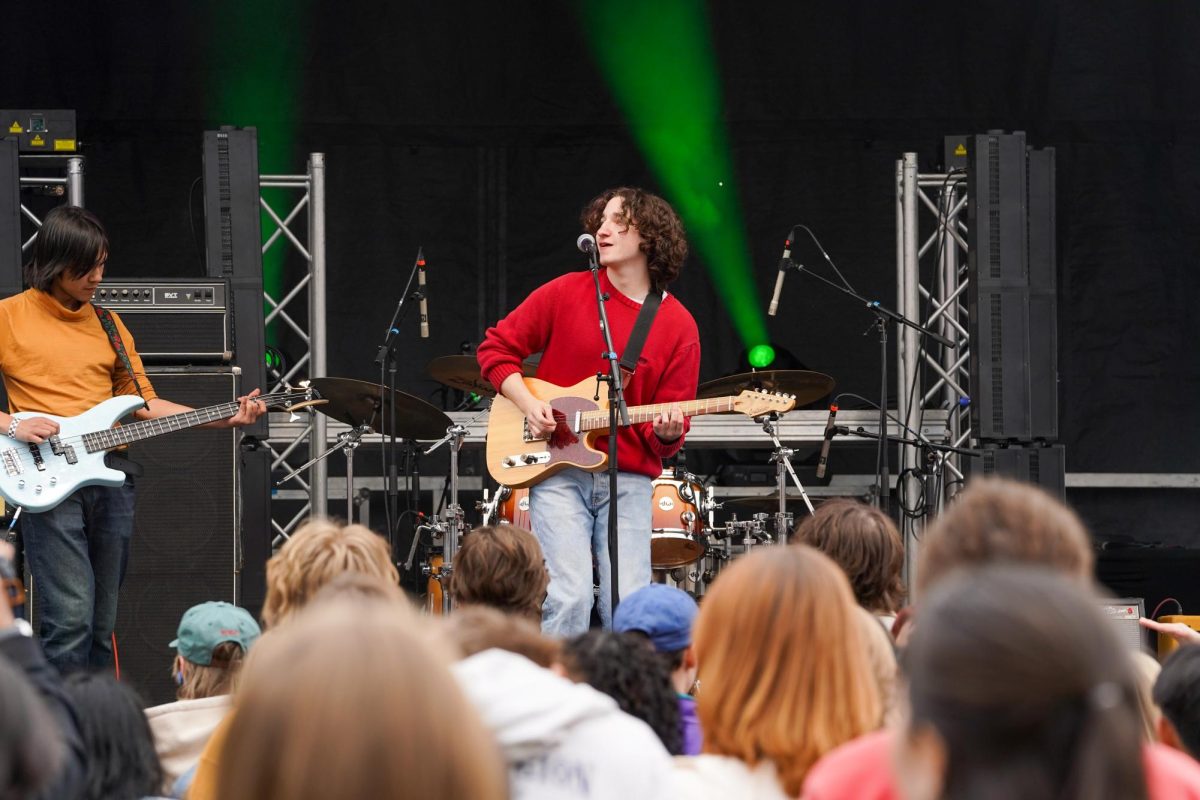
The centerpiece of the festivities was the final Battle of the Bands faceoff. Beginning at 4 p.m., the winners of the preliminary rounds in the Whole Music Club — Syncline, Blimey, Yellow Roses., Weeklong Weekend and Spiderlily — took to the stage on the Riverbend Plaza and played their hearts out.

Wearing matching green shirts, the four members of Syncline kicked off the afternoon. Their joyous indie rock jamming set the tone for the rest of the performances, encouraging audience members to bob along to the bands’ music.

Next up was Blimey, whose song “Vespa” got the audience squatting and jumping along to the chorus. They gave an energetic performance of their original hardcore indie rock music.

Yellow Roses. followed. All four musicians gave full-body performances, with guitarist Javier Soto sinking to his knees as he tore up his instrument with intensity. A small mosh pit formed in the audience to fully appreciate the punk music.

Weeklong Weekend ushered in the true Midwest emo energy. On stage, the band didn’t hold back from headbanging, and neither did their audience. The group concluded their set by calling out the University administration for not divesting from Israel and asking listeners to support Students for a Democratic Society.

The final student band was Spiderlily. Vocalist and guitarist Emily Wangberg’s striking black-and-white eye makeup hinted at the group’s alt-rock and punk music. After their set was done, audience members chanted for the group to play an additional song, for which they happily obliged

After all the bands finished, University President Rebecca Cunningham announced Weeklong Weekend as the winner.

Snacks and energizers

Refreshments were not far from the stage.

El Jefe food truck had Mexican street food available for purchase. If students were simply looking for an energy boost, both the Coca-Cola and Monster Energy promoters were handing out free cans.

String lights reached from the outdoor entertainment area to Coffman’s southern entrance. Complemented by pink flowering trees on the Riverbend Plaza and brightly colored balloon chains on the stairs, the back side of Coffman had never looked so alive.

The front lawn matched this whimsy. 

Throughout the entire day, an inflatable shark slide sat menacingly near the front entrance — encouraging those who didn’t even plan on attending Spring Jam to stop by.

More to explore inside

Inside Coffman, there was a whole world to explore.

The casino and craft space started to fill up as the evening rolled in. One room housed poker tables, while the other had snacks and crafts. 

Ada Vinger, a second-year student studying special education, bedazzled a rubber duck at the casino and craft station, gluing black and yellow gems to transform her duck into a bumblebee. She said she thought the activities at this year’s Spring Jam made it more exciting than the previous ones. 

“I see people I wouldn’t normally see,” Vinger added. “Except for gen eds, I see the same people in all my classes.”

On the ground floor, numerous student groups sat at tables offering activities. One such was the University’s chapter of the United States Institute for Theatre Technology. 

Rather than running an information booth, the club officers invited Spring Jam attendees to sit down and make their own gobo, an object that casts a shadow when placed in front of a light. They could carve their own designs into small aluminum foil trays and watch as the theatrical light cast their creation onto the wall in front of them.

The table was full of crafters all day, said Simona Simha, the club’s vice president and third-year student studying English and theatre arts. Although the majority had never heard of a gobo, they eagerly created fun designs, including the bat signal, Monster Energy logo and a little pig.

“We can be very isolated in the bubble of the theater community and the theater network,” Simha said. “But it’s great to go out and meet people and have a fun craft for them to do.”

Simha also pointed out technicians were behind much of Spring Jam — from the concerts outside to the activities in the Whole Music Club — so it was useful to have a table representing their efforts. 

Another hot spot was the Clothing Closet.

Racks of pants, shirts, shoes and accessories invited people to peruse free of cost. If shoppers needed a bag to carry their thrifted things, Twin Cities Tees had a screen-printing station in the same room where they made and distributed tote bags adorned with the Spring Jam logo. Tables of iron-on patches were sprawled throughout, giving plenty of opportunities for customization.

On the first floor, lines for the henna and caricature artists stretched long down the hallways. For those who grew tired of waiting but still wanted something to show for their efforts, they could try their luck at the temporary tattoo station, where it was a free-for-all to cut and apply the cutest tattoos.

While Timberwolves and Lynx DJ Mad Mardigan put on a high-energy show outside — complete with an air guitar competition — a live band carried karaoke in the Whole. From classics like Fleetwood Mac’s “Dreams” to recent hits like Chappell Roan’s “Red Wine Supernova,” the band accompanied solo singers and groups as they bravely bore it all on the stage.

By the time the end of the spring semester rolls around, the energy around campus tends to take on a tense, exhausted air. This year’s Spring Jam provided an escape from that pressure, bringing the student body together for a few hours of music, creation and fun.

The post Spring Jam 2026: One festival, endless activities appeared first on The Minnesota Daily.

Posted in UncategorizedComments Off on Spring Jam 2026: One festival, endless activities

There’s nobody quite like a sister: ‘Louisa May Alcott’s Little Women’ review

Whether it’s 2026 or 1868, some things never change: Teenage defiance, boy best friends catching feelings and childish squabbles with sisters. In “Louisa May Alcott’s Little Women,” the four March sisters go through all of these things with a humorous, heartwarming edge.

The show, which opened at the Guthrie Theater April 23, blends Louisa May Alcott’s beloved novel with fictional reflections from the author. Through family troubles and little victories, the show holds a mirror not only to Alcott and Jo’s similarities, but also to the timeless particularities of sisterhood.

The play centers around Jo March and her three sisters, Meg, Beth and Amy, as they navigate through their final years as children and into adulthood. While domestic disagreements and societal pressures occasionally create rifts between the girls, they always return to one another with forgiveness and affection.

Rather than solely recreating the plot of the book, this adaptation by Lauren M. Gunderson leans into the autobiographical quality of “Little Women.” Isabella Star LaBlanc plays both Jo and Alcott, appearing on stage as the author to explain how she based the characters in her novel on her sisters, and Jo on herself.

The oldest sister, Meg, played by Stephanie Anne Bertumen, is sophisticated and responsible, acting as an anchor for her sisters. May Heinecke’s Beth is prone to illness and thoughtfulness, and her affinity for music makes her a quiet but respected presence. The youngest sister, Amy, played by Audrey Parker, has big dreams of society, art and romance, often butting heads with her big sister Jo, whose determination and drive for independence propel her beyond her hometown.

In addition to including Louisa May Alcott as a character, the play leans into its metatheatrical techniques by having the characters narrate their own thoughts and actions on top of their dialogue. 

At times, this looks like the March sisters reciting how they’re arranged on the couch while they read a letter from their father over their mother’s shoulder. In other instances, like when Jo first meets Theodore “Laurie” Lawrence, the March’s young and wealthy neighbor, played by Daniel Petzold, they speak their internal reactions aloud, giving viewers a peek into their minds.

The narration is both a strength and a weakness. While it paints a fuller picture of each character and gives the play an enjoyable bookish quality, it also means the actors do a lot of telling and not as much showing.

Still, the cast does a fantastic job of capturing the youthful, layered energies of the main characters.

LaBlanc brings out Jo’s nuances with conviction and tact. Torn between staying and leaving, love and independence, LaBlanc emboldens Jo to feel multiple emotions at once, always staying true to her beliefs even when it’s painful. She speaks her mind bluntly but lets her soft side show, especially when caring for Beth at the height of her sickness.

Petzold shapes Laurie into a playful, boyish charmer. He bounces around the stage, initiating secret handshakes with Jo one moment and saving Amy from a near-death experience the next. He delivers his lines with sincerity and humor, eliciting laughs from the audience throughout the show.

Amy especially grows into herself. By the end of the play, Parker has evolved Amy from the tween who ruins her sister’s manuscript in a rage into an educated, aware woman who’s found her place in the world.

Although the play is adapted from a 19th-century novel, the dialogue comes across as modern and easy to understand. Paired with the timeless themes of family, resilience and growth, the characters’ words feel familiar. 

The stage is transformed into a scene from a fairytale for this play. Trees reach into the rafters in the background, while patches of bright green grass bring a pop of color to the ground. The story takes place over years, and to signify the passage of time, leaves and blossoms of various seasonal colors fall from the ceiling onto the stage. 

For a story so focused on domestic scenes in the home, the image of the outdoors is a fresh — albeit slightly trivial — change. 

At the end of the play, LaBlanc steps back into Louisa May Alcott’s shoes and describes the impact of the novel “Little Women.” We learn that it not only provided for Alcott’s family’s well-being, but also gave generations of readers after her a story of girlhood and love. The novel has never gone out of print.

Regardless of whether you have sisters, the play is a fun reprieve from everyday life. You can buy tickets to see it at the Guthrie Theater until June 21.

The post There’s nobody quite like a sister: ‘Louisa May Alcott’s Little Women’ review appeared first on The Minnesota Daily.

Posted in UncategorizedComments Off on There’s nobody quite like a sister: ‘Louisa May Alcott’s Little Women’ review

You’re never too old to go to the book fair

Nearly every elementary schooler impatiently awaits the Scholastic Book Fair. Whether it’s just a reprieve from fractions or a chance to pick up some new animal-shaped erasers, the fairs are a highlight of the school year.

Now, grown-ups, too, can put their worries aside for a few hours and return to the fantastical escape of a book fair. 

The Rewind Book Fair came to the State Fairgrounds on April 18 and 19, welcoming visitors to indulge in an adult version of the nostalgic book fair. Tinges of childhood were everywhere, with visits from well-known children’s authors and trinkets that would make a 7-year-old’s heart happy.

While this weekend marked the first Rewind Book Fair, co-creator Rachel Silberman started its predecessor, the Book Fair for Grown-Ups, in early 2025 at Inbound BrewCo. The fair was a hit and expanded to the Education Building at the Fairgrounds months later. 

Rewind is a new, separate fair. To make it a reality, Silberman partnered with Ben Penrod, the founder of the company behind Twin Cities Con. The pair were able to book well-known authors like Kate DiCamillo and Bruce Coville for Q&As and signings, alongside more underground local talent.

In Penrod’s eyes, the fair gives people the chance to discover the unknown while exploring a common interest — books.

“I love shopping at a bookstore, but it’s not really a community event—that’s a retail event,” Penrod said. “This one, it’s like there’s a buzz and a vibe that goes along with it, and everybody’s just there for a common purpose.”

About 250 booths filled up the first floor of the grandstand, creating a hedge maze of literature and crafts. The most prominent book genres were romance and fantasy, sometimes blended in the BookTok-favorite amalgam “romantasy.”

Among these love-centric booths was Swoonworthy, a romance bookstore located in White Bear Lake run by sisters Stephanie Phenow and Emily Arcand. Everything they carry — from novels to bookmarks — is romance-adjacent, featuring some sort of happily ever after.

Phenow said the positive atmosphere at the book fair was a draw for both her and her audience, allowing them to cultivate community amongst book lovers.

“It gives authors visibility, that’s really important,” Phenow said. “I think it also gives readers visibility into what authors are like, and a chance to meet new authors.”

Just a few booths away was Pencil x Paper Publishing, a local poetry publishing company started by author and poet Jennae Cecelia. The table had two volumes of her poetry available for purchase alongside others published by Pencil x Paper.

Cecelia attended the fair at Inbound Brewing last year, and the experience was so successful that she returned to the Rewind Book Fair this year.

“People have been really excited and pleasantly surprised there’s poetry books here,” Cecelia said, pointing out the quantity of fantasy, romance and mystery booths. Her goal at Rewind was to be a voice for poetry and poetry lovers.

At Rewind, books are only one piece of the puzzle. Bookish bags and trinkets are everywhere, reminiscent of the novelty items kids would spend their allowances on at their book fairs.

“A Scholastic Book Fair had bookmarks, erasers, gel pens and all these types of things, and so we wanted to bring that back,” Silberman said.

One of the first booths by the entrance was The Geek Boutique, selling customizable flannels with options to sew on patches of literary references. 

Down the row from the boutique was Frostbeard Studio, a book-themed candle shop that sells soy candles and wax melts named after literary places and people. If you’ve ever wondered what Mr. Darcy’s Pemberley gardens smell like, Frostbeard has just the candle for you.

The crafted items felt like they were made with readers in mind. 

Cassie Van Heel, creator of Elixir Threads, uses recycled materials to handmake everything in the booth. The creations range from embossed felt hats, tote bags and carriers for e-readers called Hemingway pouches.

Van Heel modified her pouch design to accommodate readers’ lifestyles — It’s large enough to fit most small reading tablets and includes special rings for people to clip straps onto for a hands-free e-reader carrying experience.

To Van Heel, the book fair helps redirect focus from corporate stores to local artists. 

“When someone buys a product from me, they’re also buying from all of the other small businesses that I’ve chosen to support,” Van Heel said. “It’s bringing things away from large-scale fast fashion and bringing it into the smaller village, community-type situations.”

Just because you’ve aged into adulthood doesn’t mean the magic of a book fair has to end. 

The Rewind Book Fair reinvigorated that zest for fantastical escape last weekend, and creators Silberman and Penrod would love to see the fair continue to grow into other states.

The post You’re never too old to go to the book fair appeared first on The Minnesota Daily.

Posted in UncategorizedComments Off on You’re never too old to go to the book fair

Porch performances to festival stages: A Q&A with the Spring Jam bands

On April 25, five bands will take to the Riverbend Plaza stage behind Coffman Union in the final showdown of Battle of the Bands. Only one will emerge victorious.

Syncline is the first band performing Saturday, consisting of three brothers and their friend: Jacob and Caleb Goetz on guitar and vocals, their drummer Connor Goetz and Taliesin Sutton on bass.

The band came together last year in April, but Caleb and Connor Goetz had been playing music together for years. Their first performance as a whole group was at Jacob Goetz’s house. Since then, their sound has formed into a sort of indie alternative rock. 

Blimey will step on stage after Syncline, bringing hardcore indie rock tunes to the fore. The group has four members: Levon Stanfield as their vocalist and guitarist, Ethan Heide on bass, Jared Burnett on guitar and Zach Peterson on drums

The band was formed in June of 2025 in an empty room in Stanfield’s then-apartment in Dinkytown. Some of the members met in another band, called Collective Ex, before forming Blimey.

The third group to play will be hardcore punk Yellow Roses, founded almost four years ago by Javier Soto and Jahai Lilley on a high school trip that gave them the time to bond over music. Lilly is the band’s drummer, and Soto is the vocalist. Owen Jahn is their lead guitarist and Domingo Basso plays bass.

The final band of the night will be Spiderlily. Although the band’s member makeup has shifted over the two years of its existence, Emily Wangberg, vocalist and rhythm guitarist, and Linnea Sorensen, drummer and backup vocalist, have stayed the same.

Matteo Sforza, lead guitarist, joined a year and a half ago, and Julia Wettschreck, bassist and backing vocalist, completed the band when she joined last February. Their genres range from alternative rock to pop punk to indie.

Minnesota Daily: Why play music?

Jacob Goetz: “We did piano lessons when we were kids, so it’s kind of like a full circle moment where we were coming back and doing it all together again, which is awesome. And then me, personally, no matter what, there’s always going to be, you know, a guitar there that I can play, or like songs to sing.”

Soto: “I feel like music makes you connect with people on this almost spiritual level. It’s like, no matter where you are, who you are, what you play, everyone feels the same power and emotion. And I think that’s what I love.”

Lilley: “I love performing. That’s like my favorite thing in the world, you know, getting up on the stage — or maybe not up on a stage, typically we’re in a garage or a basement or something — but being really close to people is nice, and seeing their faces and hearing them sing along, it’s very intimate.”

Stanfield: “I feel like the music is meant to be performed, and when you have a really good audience and everyone’s having a good time, it’s just like the highest, biggest dopamine hit ever.”

Wangberg: “For me, it’s a really good emotional release. You can write about all the stuff that you’re frustrated or happy about, and then you can play it. Music’s always been just a very emotional experience, even when it’s not something you’re playing and just listening to.”

Daily: Why enter Battle of the Bands?

Jacob Goetz: “They have the largest variety of bands come play Battle of the Bands, and that’s what I really liked about it. I knew we’d be competing against people in the first round that are kind of like us, because that’s kind of how they set it up, but everything after that, like Spring Jam, there’s a bunch of bands that aren’t the same vibe.”

Stanfield: “It’s a really great opportunity. I played Battle of the Bands two years ago, and we lost, so this is a little bit of a redemption arc. And it’s a really fun place.”

Lilley: “We just thought it was a cool opportunity to get ourselves out there. And when can a band say they played Battle of the Bands? You only see that in movies. And we were like, ‘Why not?’”

Wangberg: “Linnea and I were both students there, and I remember walking through Coffman to get food and seeing the poster last year, and then we missed the sign-up. So we were like, ‘I’m graduating this year, it’s our last chance, let’s do it.’”

Daily: What are you looking forward to at Spring Jam?

Jacob Goetz: “It’s a very cool opportunity to be able to play on a stage of that caliber, not being as big or together as a local touring band. It’s a cool opportunity because that can give a lot of confidence installed in the bands that are playing. I know for us, being able to do this show will give us a little bit more confidence that we can land bigger shows.”

Stanfield: “I’m really excited because there’s gonna be a ton of people, and so we have a really great opportunity to make a really big impression on a lot of people. We’re hoping to do something that makes people go like, ‘What the hell is happening?’”

Lilley: “Just, just to play, honestly, just having that opportunity. We were so surprised that we even got this opportunity and just want to give a good show and have fun.”

Wangberg: “Being on a big, professional-sized stage will be very cool. We know almost all of the bands that are playing the final round, which is cool. The only band we don’t know is Syncline, and I’m sure we’ll play with them and be like, ‘Oh, it’s these people.’”

The bands will be musically battling each other behind Coffman Union on April 25 at Spring Jam, starting with Syncline at 4 p.m. and ending with Spiderlily’s 6:00 p.m. performance. The winner of this final round will be announced at 6:30 p.m. that night.

Posted in UncategorizedComments Off on Porch performances to festival stages: A Q&A with the Spring Jam bands

‘The Pitt’ Season two: Just what the doctor ordered

When it comes to pulse-quickening, blood-gushing TV, Season two of HBO Max’s “The Pitt” might be one of the best shows out there. 

In the same vein as the first season, most of Season two takes place at the Pittsburgh Trauma Medical Center, dubbed “The Pitt” by doctors and nurses. 

15 real-time episodes take us through a Fourth of July shift in the emergency room, where Dr. Michael “Robby” Robinavitch, the tortured-yet-driven attending physician played by Noah Wyle, tries to keep things running smoothly on his final day before embarking on a three-month sabbatical. 

The cast is made up of a medley of medical students, residents, nurses and attending physicians, each tasked with helping as many people as possible. When the hospital’s online charting system goes down, and firework-related injuries start rolling in, the stress levels multiply, pushing everyone to their limits.

This season, however, felt more like a character study than the last. We are helpless as we watch Robby’s emotional barricades crumble as the day crawls by; hastened by tough cases, the return of Dr. Frank Langdon, played by Patrick Ball, and decades worth of unaddressed trauma bubbling over.

Wyle expertly brings out the intricacies of his character, especially in the final few episodes, where audiences finally get a peek into the man behind the stethoscope. Small snippets about his troubled childhood and dashed dreams of adulthood slip out in conversation.

That being said, even as a Robby defender, I found him increasingly irritable. This is most notable in his treatment of Dr. Samira Mohan, played by Supriya Ganesh, whom he snaps at throughout the season for being too emotional on the job, suggesting she look into geriatrics for its slower pace.

Fiona Long, a third-year genetics student at the University of Minnesota, said Robby’s short fuse has been hard to endure, especially in his treatment of Mohan.

“Robby is killing me this season,” Long said. “I know that it’s the point, but I don’t appreciate condescending men.”

Katherine LaNasa’s charge nurse, Dana Evans, is more fierce than ever, going the extra mile to personally protect her nurses from assault and ensure the police properly handle the hospital’s rape kits. Her determined presence is a good balance to Robby’s chaotic, snappy spiral.

Halfway through the season, Dana performs a sexual assault forensic exam on a woman who was assaulted at a barbecue by a male friend. Dana walks the patient through every step of the exam, giving her the space to take breaks and leave when she wants.

This was Long’s favorite scene in the series. She said she appreciated how the show preserved the patient’s autonomy throughout the process.

“I thought it was really well-done,” Long said. “It felt kind of independent from everything else going on, and it was very touching.”

Because of this character-driven narrative, the first few episodes feel slow. Luckily, there’s a litany of fun cases that pick the action back up, including a nun who comes in with gonorrhea in her eye, ironically labeled an immaculate infection by Isa Briones’ Dr. Trinity Santos.

Not all cases are as humorous. The season uses its revolving door of patients to address current issues in cities and hospitals across America.

In Episode 11, United States Immigration and Customs Enforcement agents bring a woman they injured during a raid into the emergency room. A nurse intervenes when they get too pushy, and the agents quickly detain him, too.

Wyle told Variety in an interview that HBO had discussions with executive producer John Wells about how to represent the issue in the episode.

“The negotiation was being driven by political reasons, creative reasons, fear, uncertainty, all sorts of legitimate reasons,” Wyle said. “I’ll be honest and say that I was concerned about the edits we were making initially.”

The final product, Wyle said, ended up being a good decision for the show’s storyline. As a viewer, the scene feels tense and all too familiar — nurses and patients fleeing the hospital out of fear, younger staff pulling out their phones to record and an air of uncertainty floating over everything.

The rest of the season is similarly artful. The Pitt uses almost no music, forcing audiences to sit through beeping machines and the doctors’ panicked shouts that it’s time to intubate. Prolonged, musicless shots of Robby as he walks through the ER show his involuntary flinching at the noises around him, speaking to the trauma he’s resistant to confronting. 

Despite there being so much Robby this season, the other characters have moments of their own. 

The internet’s beloved night shift returns for the last few episodes, bringing with them their refreshing jokes and clear heads. We also get to see how months of living together have changed the relationship between Santos and Dr. Dennis Whitaker, played by Gerran Howell. 

“The Pitt” isn’t an easy show to sum up. Between the never-ending cases and doctors constantly on the edge of a breakdown, it can be tough to know what things deserve highlighting. But I think that’s reflective of the hospital experience the show attempts to replicate: Chaotic and exhaustive, but worth it for the lives saved and bonds made.

Posted in UncategorizedComments Off on ‘The Pitt’ Season two: Just what the doctor ordered

Choose your own adventure at the Minneapolis St. Paul International Film Festival

A day at the Minneapolis St. Paul International Film Festival, MSPIFF, feels like a real-life choose-your-own adventure book. 

Whether you’re looking for foreign films, want to hear tips from local filmmakers or are itching to mingle with fellow cinephiles, MSPIFF’s event catalogue offers enough activities to keep you entertained for the entire day.

If you’re anything like me — a curious movie viewer with a penchant for heartfelt stories — your day might end up looking something like this:

Stop 1: MSPIFF Headquarters

Located just a block Northwest of The Main Cinema, MSPIFF headquarters is where the party happens — literally. 

Guests can stop by the festival information office to pick up their passes and learn about the day’s happenings. From questions about logistics to film recommendations, the staff at the information office are ready to help. 

Headquarters are also the place to learn about film organizations and resources. 

On Saturday, Explore Minnesota Film and the Upper Midwest Film Office were among the groups tabling, sharing information about a tax credit program that Minnesota film production companies can apply for.

“We’re all working together to get more films made in Minnesota,” Shari Marshik said, executive director of the Upper Midwest Film Office.

Connection doesn’t end there. Past the tabling area in a wood-panelled room is where the panels take place. 

Saturday’s panels — free for attendees — covered the process behind creating a documentary and introductions to organizations that make up Minnesota’s film industry. Audiences got the unique opportunity to hear firsthand about speakers’ filmmaking experiences.

“Once we know the visiting filmmakers who are coming in, we develop these conversations that both people who are in the industry might be interested in, but also the general public as well,” Jesse Bishop said, MSP Film Society programming director.

Stop 2: The Main Cinema

It wouldn’t be a film festival without some films, so let’s head over to The Main Cinema, the festival’s primary theater.

Depending on the day, the Main during festival season fluctuates between modest and packed. Lines for some weekend screenings stretch throughout the building, with volunteers herding eager movie-viewers forward with practiced calmness. 

Attendees can buy tickets at the box office in person. If their desired film is already sold out, they can hop in the rush line, filling any no-show seats.

The popcorn machine is one of the festival’s heroes, working around the clock to pump out buttery treats.

Ticket in one hand and popcorn bucket in the other, you’re ready for the final destination: the screening room.

Stop 3: The screen 

With each of the Main Cinema’s five screens working daily to show festival films, attendees have an adventure waiting for them behind every door.

I caught showings of “Nomad Shadow,” the story of a woman reintegrating into life in Western Sahara after being deported from Spain, and “Bigfoot Woods,” where a small town is happier to believe in Bigfoot than a teenager’s gender transition.

Some screenings have people who worked on the films in attendance. At Saturday’s screening of “Bigfoot Woods,” the scriptwriters, two actors, the producer and director watched the film with the audience, doing a Q&A session afterwards.

Like the panels, these Q&As allow audiences to connect with the creatives behind the films, asking about their processes and ambitions, which can be hard to gather from just watching a movie.

“I just wanted to make a happy ending for my kid,” Bruce Pavalon said, one of the writers and producers of the film, when asked about why he wanted to make it.

After each screening, guests could score the film out of five stars on a paper ballot. The scores go towards determining the winners of the audience choice awards.

Whether you’re a film buff or just looking for something to do over the weekend, the Minneapolis St. Paul Film Festival has something for you. You can choose your own adventure at MSPIFF through April 19. 

Students can buy all-access passes for $75 and a pack of six passes for $30.

Posted in UncategorizedComments Off on Choose your own adventure at the Minneapolis St. Paul International Film Festival

Catch a movie and a vibe at the Minneapolis St. Paul International Film Festival

A true movie theater experience comprises three things: a bucket of buttery popcorn balanced precariously on your lap, candy wrappers crinkling as you extract the contraband from your bag and overhead lights dimming until the mood is just right.

As Nicole Kidman reminds us in her famous AMC monologue: “We come to this place for magic.”

That movie magic is palpable at the Minneapolis St. Paul International Film Festival, MSPIFF. Run mostly out of The Main Cinema, the 12-day festival connects audiences and filmmakers from around the world through films, panels and parties.

Known as the largest annual celebration of international cinema in the region, the festival’s lineup this year includes more than 200 films that will be shown between April 8-19. 

In addition to the Main, viewers can catch these movies at venues throughout the Twin Cities, including daily showings at the Edina 4 Mann Theatre, plus select screenings at the Landmark Center and Film North in Saint Paul, Capri Theater in North Minneapolis, Pop’s Art Theater in Rochester and one screening at the Minneapolis Institute of Art.

This year marks the festival’s 45th anniversary. While it’s evolved, its attitude of excitement has remained consistent, said MSP Film Society programming director Jesse Bishop.

“It’s a whole celebration of cinema and movies that we embark on each spring,” Bishop said. “It’s a lot of fun.”

Bishop, who works with a team to select movies for the festival, first got involved with the film society selling tickets at the now-demolished Oak Street Cinema as a University of Minnesota student.

When looking for films to show at the festival, Bishop said his team emphasizes new and international work. They also try to curate a large selection of work by emerging artists who have few feature films under their belts.

“We’re trying to find stories that may be familiar but are told from perspectives that you don’t always get exposed to,” Bishop said. 

Audiences aren’t the only ones eager for the festival. Filmmakers, too, are excited to bring their work to MSPIFF’s screens.

Director Elizabeth Chatelain, who first screened at MSPIFF in 2017, is showing her film “Bigfoot Woods” at the festival  April 10 and 11. 

Her film follows a father-child duo as they stumble upon evidence of Bigfoot, tussling with a small town’s eager acceptance of a mythical sasquatch over a teen’s transitioning gender.

“The viewers in Minneapolis are always really open-minded and really excited about film,” Chatelain said. “I’m really looking forward to reaching these audience members here.”

Beyond outreach, the festival specialises in presenting artful films. 

“I see film as being an art form,” Chatelain said. “I know not everybody sees it that way, but I think specifically the types of films that come to film festivals are artistic. And you get to see films that you wouldn’t necessarily see, like you wouldn’t necessarily get the opportunity to see.”

What makes these artsy films so powerful, according to Bishop, is their capacity to encourage empathy. 

“If you’re a fan of the movie culture and cinema in general, this is like a little staycation for you,” Bishop said. “But I think more than that, in the times that we’re in, where people are othered constantly, and in our face, this is a way to really build up your empathy muscle.”

Aside from the films, MSPIFF will host a variety of panels where presenters will share insight with both industry professionals and the general public.

Have festival passion but not festival money? MSPIFF has some options for you: Students are eligible to purchase an MSPIFF45 all-access pass for $75 or a six-pack of passes for $30. This year is also introducing moonlight pricing, where anyone can buy discounted tickets for all MSPIFF screenings after 9 p.m.

Go experience that movie magic!

Posted in UncategorizedComments Off on Catch a movie and a vibe at the Minneapolis St. Paul International Film Festival