
Author Archives | Billie Corsetti, News Reporter

City of Eugene moves to implement recommendations for economic development, adds three new city positions

Eugene’s city council voted 4-3, broken by Mayor Kaarin Knudson, to implement the Technical Advisory Group on Fiscal Stability’s economic development recommendations, which include adding three new city positions.

The advisory group was formed after a council vote in July 2025 moved to create an ad hoc committee that would serve as a financial advisory panel to guide the council through the city’s budget crisis. The group began working in September, and delivered a final report with recommendations in February.

The city has been struggling with long and short term financial challenges for years, with its biggest issue being a structural deficit of the general fund. For the 2025-27 budget, the city has $445.1 million, which is the primary source of funding for public safety, recreation, cultural services and more. Currently, public safety takes up the largest amount of the general fund budget, using $142.1 million. Property taxes are 71% of the fund’s source of revenue.

The top three areas that the group recommended the city focus on are operational efficiencies, revenues and economic development. The group found that the city has gotten lucky with the little growth it’s had, despite not having “prioritized a cohesive or coherent economic development strategy that can grow the tax base and support a flourishing community.”
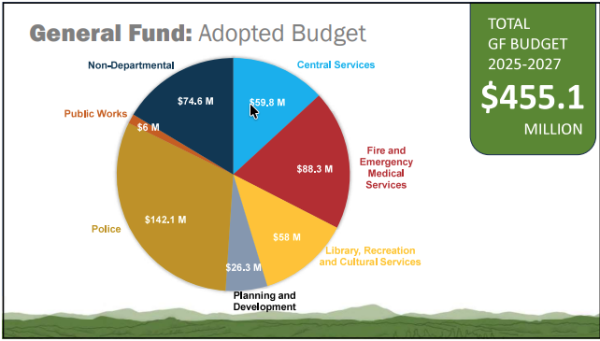
Graphic depicting the City of Eugene’s adopted general fund budget. (Courtesy of City of Eugene)

While researching data on Eugene’s current economic development, the TAG found that compared to other cities, Eugene’s employment grew 33% between 1991-2024. The median household income for householders is the lowest among compared cities at $70,781.

“Eugene’s households have jobs that pay less than their peers in these other cities,” Anne Pfeiffer, the city’s Economic Development Manager, said during the work session. “ One reason we have lower income is because there’s fewer economic opportunities, it’s harder to move up to a better job.”

Using their recommendations provided, the TAG believes the city would generate 14,000 new jobs and gain $25 million in tax revenue within the next 10 years.

The group’s general recommendations focus on supporting and reinvesting in existing small businesses, encouraging new businesses with loans from the city, working on proactive recruitment from outside the city and collaborating with regional partners.

The Southern Willamette Valley Innovation Corridor is one of the city’s biggest partnerships regionally, working with the University of Oregon and Oregon State University to create connections between the schools and science and technology industries to foster research investment.

“With engaged private and public partners, it has the opportunity to obtain the next generation of talent coming out of our educational institutions,” Will Dowdy, the Community Development Director, said. “Already our city manager is engaged in high level regional conversations, Anne and I are talking with partners. But unless it’s time to start talking to individual businesses, we lack the ability to develop and implement an action plan.”

Currently, the city has two jobs that mainly focus on economic development: the Business Liaison and the Business Loans Analyst. To expand the city’s area of focus, the TAG recommended three new positions be added to focus on project management, program development and implementation.

The proposed Business Development Manager would be the primary lead for the implementation of economic development and the TAG’s recommendations. The Business Development Analyst would bring support to prioritized strategies and programs. The Housing Production Analyst would help increase the housing supply outside of existing affordable housing efforts, to support the working population. All three of the positions would be funded by the general fund.

One other existing position, the Development Liaison, is currently vacant but would be self-funded by Building Permit Services. This job would be relaunched and bring support to permit applicants and improve communication between the city and businesses.

“Because of the long range financial planning, these positions now make sense,” Dowdy said. “We have a clear understanding why they are needed, what they need to accomplish, how they can connect to the work of our partners, how we can measure success, and how the investment pays off in increased tax revenue and prosperity.”

The total cost of funding the three positions would be $800,000 a year from the general fund. However, the TAG expects $10 million in new taxes by year ten of implementation, meaning a 1150% return on investment.

The city council appeared to be split on voting for a motion to direct the city manager to begin implementing the TAG’s recommendations, including the proposed positions. 

“I am supportive of these positions, and this work is highly needed to be able to meet our goals, I just am not ready to designate this level of funding, without having that information at hand first. So that’s just where I’m sitting right now. But I love this work,” Ward 7 Councilor Lyndsie Leech said.

“It’s my opinion that this is the only way for us to move forward in a healthy fashion. That’s it,” Ward 6 Councilor Mike Clark said. “We have no hope in my opinion of getting ourselves off the road to bankruptcy, unless we have a very clear plan about how we will grow our local economy. So it sounds like a good first step. I’m in favor of starting, but I want to have a lot more conversations about this, in a similar way.”

Other councilors similarly voiced that they were in favor of the recommendations, but felt that the timing of the implementation was too early, and more conversations would have to be had about how the $800,000 would be taken out from the general funds.

Councilors Yeh, Zelenka and Clark voted in favor to pass the motion, and Councilors Leech, Kashinsky and Keating against. Ward 3 Councilor Alan Zelenka and Ward 5 Councilor Greg Evans weren’t present to participate in the vote. Mayor Knudson broke the tie by voting in favor of passing the motion.

The post City of Eugene moves to implement recommendations for economic development, adds three new city positions appeared first on Daily Emerald.

Posted in UncategorizedComments Off on City of Eugene moves to implement recommendations for economic development, adds three new city positions

Ideal Option selected as provider for Peer Navigation Pilot Program

After months of bidding, the city of Eugene has selected Ideal Option as the provider for the new Peer Navigation Alternative Response pilot. 

“Ideal Option was selected because their proposal directly and comprehensively aligned with the city’s request for peer navigation services,” the city’s news release said. “Ideal Option has demonstrated experience delivering peer navigation in Eugene and other communities throughout the region.” 

Ideal Option is a nationally recognized organization that works with medicine-based treatment in multiple clinics across Oregon, providing individuals struggling with addiction medical support.

The proposed pilot program for the Peer Navigation Alternative Response aims to fill the gaps left behind after the closure of the Crisis Assistance Helping Out On The Streets program in April 2025. White Bird Clinic announced it would be ending services from CAHOOTS in Eugene after drastic budget cuts. The program went from working 24 hours, seven days a week, to no availability in the matter of days.

The city of Eugene released a report in October, analyzing the impacts of the closure. Eugene Springfield Fire Chief Mike Caven said in a previous interview with The Daily Emerald that the gaps of service were not as dire as the city anticipated, due to the collaboration between the Eugene Police Department, the Eugene Springfield Fire Department and mobile crisis units to fill in the gaps.

However, not all gaps were able to be patched up. The report found that mid-acuity behavioral health incidents, youth crisis response, harm reduction and other non-emergency calls were still largely unfulfilled. After this founding, the city began working on an alternative response pilot program with peer navigators.

“This pilot program will run for one year to fill specific gaps in Eugene’s alternative response, such as welfare checks, non-emergency transport, proactive outreach and connecting people to services before situations escalate,” the news release said.

Downtown Eugene currently has two working peer navigators that work with the downtown co-responder team to provide outreach for unhoused individuals. The new alternative proposal would operate outside of downtown around Highway 99, River Road, the Whiteaker Neighborhood and West Eugene.

Eugene residents have expressed concerns about the program during public comment at a public meeting on Feb. 9, specifically about the program’s ability to reach individuals citywide and provide care comparable to CAHOOTS. Some urged city councilors to direct the city manager to amend the RFP.

“If the city needs peer navigators, that needs to be a separate process decoupled from the efforts to return alternative response to Eugene,” Robert Parish, one commentator, said.

The pilot program will run for one year, during which the city will collect data to figure out the impacts of the peer navigators, and what’s still missing.

The post Ideal Option selected as provider for Peer Navigation Pilot Program appeared first on Daily Emerald.

Posted in UncategorizedComments Off on Ideal Option selected as provider for Peer Navigation Pilot Program

Meet the candidates for Ward 3

The Daily Emerald has profiled candidates for four wards in Eugene that will hold contests in Oregon’s May 19 primary elections. Ward 3 encompasses the University of Oregon and surrounding neighborhoods.

Two candidates are running for the ward’s office after councilor Alan Zelenka announced he would not be running as an incumbent after two decades as the ward’s representative. The Emerald reached out to both candidates for interviews with the same set of questions. For candidates that did not respond for an interview, The Emerald used available information from their campaign websites and public history.

Ward 3 candidate John Barofsky did not respond to The Emerald’s request for an interview.


John Barofsky

Hometown: East Grand Rapids, Michigan; resident of Eugene since 1982

Educational Background: Lane County Community College

Occupation Experience:
Eugene Water and Electric Board of Commissioners
Eugene Planning Commission (8 years)
Eugene Budget Committee (7 years)
Affordable Housing Trust Fund Committee
Owner and partner of Beppe & Gianni’s Trattoria

Endorsements:
Congresswoman Val Hoyle
Former Congressman Peter DeFazio
Eugene Area Chamber of Commerce
Lane Professional Firefighters Association

Campaign Website:
johnforeugene.com


Jennifer Smith

Hometown: Southern California; resident of Eugene since the 1970s

Educational Background: South Eugene High School, University of California

Occupation Experience:
President of SEIU 503 Local 085
Los Angeles County Transportation Planner
University of Oregon Labor Education Research
Center Coordinator
Oregon Higher Education Coordinating
Commission
Eugene Permanent Shelter Task Force
Lane Transit District Budget Committee
Endorsements:
Democratic Party of Lane County
Oregon Working Families Party
Eugene City Councilor Eliza Kashinsky
Eugene City Councilor Alan Zelenka
Eugene City Councilor Jennifer Yeh
Former Eugene Mayor Kitty Piercy
Former Eugene Mayor Lucy Vinis

Campaign Website:
electjennifersmith.org


Q: What are the biggest issues facing your ward, and Eugene as a whole?

John Barofsky:

Barofsky outlines three main priorities for his campaign: housing stability and affordability, responsible use of public dollars and public safety and quality of life.

“Eugene is facing real challenges — rising costs, growing demands on city services, a shortage of housing supply and a homelessness crisis that reflects deep gaps in how our systems are working. These issues didn’t emerge overnight, and they won’t be solved with simple answers,” the website reads.

When it comes to housing stability and affordability, Barofsky says he supports solutions that increase the housing supply but protect neighborhoods and encourage long-term stability.

“Residents should feel confident that city resources are being managed carefully and right now we’re falling short. Transparency and fiscal responsibility are essential. With my business experience and service on the Budget Committee, I can hit the ground running to be sure Eugene is on
solid financial footing for the long term.”


Jennifer Smith:

In response, Smith thinks of when she and her mother moved to Eugene, back when Eugene “was a place where you could come and just sort of show up and make a life without a big plan and without a big nest egg.”

“It’s not all about paying (your) mortgage or paying (your) car payment. You also should have money left over for enjoyment and for pursuing their endeavors. So that’s ideal to me, is that people aren’t living to work.”

When it comes to housing, Smith believes that residents feel trapped due to the lack of housing options in the city.

“We need to build actually affordable housing, not ‘affordable’ housing, which, that word has been quite slippery in the last few decades. We need more housing density; we need more housing along transit corridors.”

Making strides toward climate recovery is a priority to Smith, as she believes the city hasn’t been keeping up with other communities that are more prepared.

“We made community agreements over and over again (and) we developed as a city the climate recovery ordinance goals, where we would reduce our fossil fuel use by 50% by 2030. We are not on track for that.”


Q: Why do you think you’re best fitted to address those issues?

John Barofsky:

Barofsky’s website points to his decades of experience in the city as a small business owner and a public figure.

“John Barofsky brings decades of real-world experience to public service — as a longtime Eugene resident, civic leader and partner of Beppe and Gianni’s,” his campaign website reads. “His prior civic work has focused on responsible decision-making, long-term planning and making sure public resources are managed carefully and transparently.”

Barofsky has experience in handling budgets, as he spent seven years on the Eugene Budget Committee, and is currently on the EWEB’s board of commissioners. He also is a member of the Affordable Housing Trust Fund Committee, which gives advice to the city on where funding should go and reviews proposals for AHTF projects.

As an owner of a local restaurant for 28 years, Barofsky says he has long term community ties and can bring a “real-world perspective to city policy and decision-making.”


Jennifer Smith:

“I’m a renter and a homeowner… I believe we need more housing desperately; that’s just something that is not really negotiable,” Smith said. “And I’m a biker and a walker. So I care very deeply about the texture of our built environment and neighborhoods of our city. I’m looking at it everyday on very fine-grained detail.”

Smith has served on the Lane Transit District Budget Committee, which she believes has given her good experience in budgeting.

“I also have been involved in budget discussions, very difficult budget discussions. So I feel very comfortable being in tough negotiations that have real-life consequences.”

As president of a union that represents around 1,500 classified workers at UO, Smith believes she has the experience to handle decision-making pressure and to be a leader of a community.

“I have experience in building solidarity and consensus across a wide variety of stakeholders and people who have different perspectives and different life experiences,” Smith said.

The post Meet the candidates for Ward 3 appeared first on Daily Emerald.

Posted in UncategorizedComments Off on Meet the candidates for Ward 3

Eugene council rejects ordinance restricting driver donations to pedestrians

The new Eugene City Hall will be located in Downtown Eugene on 4th Ave. replacing the former Eugene Water and Electric Board administration building. (Alyssa Garcia/Emerald)

During a Feb. 18 work session, the Eugene City Council failed to pass a motion on an ordinance that would penalize drivers for donating to pedestrians from inside their vehicles.

The ordinance would amend Sections 5.170 and 5.990 of Eugene’s code to prohibit drivers from reaching out of vehicles at a right-of-way to give items to pedestrians. Violators would face a $50 fine.

The ordinance was first proposed in 2019 after Springfield passed a similar measure, but it failed on a 2-6 vote. It was reintroduced in 2025 and prompted a public hearing, where four people spoke in favor of the ordinance and one opposed it.

During the work session, the mayor and all councilors except Ward 6 Councilor Greg Evans were present.

Supporters said the ordinance is intended to promote traffic safety and discourage pedestrians from entering roadways. Some councilors argued the measure would disproportionately punish Eugene’s unhoused population who panhandle.

“If it really was about public safety, why has no one addressed the fact that several people have died on bicycles in right-of-ways in the past year, and we have not spoken out about that?” Ward 7 Councilor Lyndsie Leech said.

Eugene Police Chief Chris Skinner also attended the work session and spoke in support of the ordinance.

“I actually, quite honestly, blame the motorist more than I do the pedestrian for enticing someone into the roadway,” Skinner said. “They’re likely not going to pass up that opportunity for money and/or food.”

Ward 5 Councilor Mike Clark introduced a motion to postpone action until all councilors were present to vote. That motion failed 3-4.

The motion to pass the ordinance failed 2-5.

The post Eugene council rejects ordinance restricting driver donations to pedestrians appeared first on Daily Emerald.

Posted in UncategorizedComments Off on Eugene council rejects ordinance restricting driver donations to pedestrians

Eugene City Council discusses federal activity, new city manager at packed meeting

The Eugene City Council held a meeting Monday night, where public commentators spoke about increasing activity of federal officers, the future of Automated License Plate Readers in the city and a variety of other topics.

All council members were present for the public meeting, with Councilor Greg Evans of Ward 6 calling in from Zoom.

During the committee reports and items of interests discussion, Councilor Lyndsie Leech of Ward 7 introduced a motion to pass recommending the city manager to establish a grant program for the Human Rights Commission for local nonprofits that are assisting those impacted by immigration enforcement in the community. 

There was previously $50,000 set aside to the council contingency fund, pending assessment by the Office of Community Equity and Community Engagement to recommend the best use of the money to assist those in the community.

“Its director has brought us a clear recommendation to establish a grant program administered through the Human Rights Commission,” Leech said. “This would allow the city to deploy these funds quickly and responsibility to local nonprofits providing direct services to (those impacted).”

The motion passed 7-1, with Councilor Mike Clark of Ward 5 voting no due to concerns regarding budget shortfalls.

“It’s not that I don’t think these funds spent would be wasteful in any way… There are quite a lot of things that need to be done in a difficult budget year where we know we may face some shortfalls and have to cut things, so it’s money that I don’t believe we can afford to spend in any way,” Clark said before voting no.

Both Councilor Alan Zelenka of Ward 3 and Councilor Matt Keating of Ward 2 said that they will be attending the Better Eugene-Springfield Transportation safety forum on Thursday, where the community and organization will discuss and workshop the future of bike and pedestrian safety in the city. 

The safety forum comes after the tragic death of Erick Munene Nijue, a doctoral student at the University of Oregon studying special education after teaching high school in Kenya. Nijue was killed in a collision on Jan. 22 at 22nd Avenue and Patterson Street.

“I know I, as well as all of us in this room, see accidents like the one that killed Erick almost occur regularly on these two lane, one way streets,” Rhonda Nese said during public comment. “Now I am not an expert in traffic (controlling) measures… But one thing that I know is that these tragedies can be prevented and that our community members need safety.”

The council voted unanimously to approve the city manager employment agreement, with council-elected former city manager of Beaverton Jenny Haruyama starting as the new Eugene city manager on April 15, according to Councilor Zelenka.

The council also unanimously passed a resolution that was previously introduced and drafted by Leech, which declares a humanitarian crisis in the city of Eugene due to ongoing federal activity.

Public comment began around 8:30 p.m., with 43 commentators signed up to speak.

The Party for Socialism and Liberation posted on Instagram four days before the meeting, asking followers to pack public comment to urge councillors to reject the possibility of future implementation of ALPRs. The city council is expected to hold a future work session on operating agreements regarding ALPRs.

“We don’t need to help companies like Palantir build databases that track our movements and tell us and tell goons who are looking at our locations and where we are. We don’t need that,” Scott Lambert, one public commentator, said. “What we need is local governments to stand up against things like that and gum up the works so that we don’t get to a point where the FBI is knocking onto your door if you’ve gone to a federal building protest.”

A few commentators talked about the recent request for proposal regarding the Eugene Police Department’s developing Peer Navigation Alternative Response, which has been introduced in hopes to fill the gaps that the closing of CAHOOTs left. They expressed disappointment in the RFP, which they stated failed to fill the gaps that the city themself had identified, and urged the city manager to amend the RFP.

“Peer navigators as case managers, disconnected from non-emergency dispatch, is no replacement for the service Eugene lost last April, when Whitebird stopped running CAHOOTs in Eugene,” Robert Parish said. “Less than 7% of the RFP’s requirements have anything to do with the work of a community responder service like the one Eugene had for 36 years.”

A large number of commentators focused on the impacts of federal immigration enforcement, with some speakers discussing their experience as protestors at Eugene’s old federal building.

“I was refused to have a female officer search me in DHS’s holding cell,” Anna, who did not provide a last name, an organizer with the Transalliance of Lane County, said. “I pleaded with them to allow a female officer to search me, they refused and they said there wasn’t one available.”

Another resident defended daily protests at the old federal building in Eugene.

“Words that I’m tired of hearing are unprecedented and peaceful protests. We are nonviolent protestors, it is nonviolent by design,” Shelly Devine said. “It is a nonviolent resistance tactic and it is meant to be disruptive, and we will continue to be disruptive, because the point of protest is not for everyone else’s comfort.”

Rebecca McCrosky, one speaker, received a round of applause for her comments.

“ICE ramps up, we stay in the streets. Singers, surgers, legal observers, veterans, grannies, neighborhood workers, slugs and frogs, and planet preservers. We need to know that the city has our backs. It’s not enough to tell us to stay away from the federal building. We won’t, and we can’t stay away.”

City council meetings are held the second and fourth Mondays of every month. The next public meeting will be held on Feb. 23.

The post Eugene City Council discusses federal activity, new city manager at packed meeting appeared first on Daily Emerald.

Posted in UncategorizedComments Off on Eugene City Council discusses federal activity, new city manager at packed meeting

Eugene City Council declares humanitarian crisis

The Eugene City Council passed a resolution during a public meeting Feb. 9 declaring a humanitarian crisis in Eugene due to “federal immigration actions.”

“This resolution declares that the impacts of federal immigration enforcement constitute a humanitarian crisis for all residents of the city of Eugene,” Councilor Lyndsie Leech, who represents Ward 7 and introduced and drafted the resolution, said during the meeting. “It affirms our core values to support human dignity, community belonging and access to essential services.”

Multiple cities in Oregon have passed similar resolutions, including Woodburn and Hillsboro, which each declared a “state of emergency” due to the impacts of federal immigration regulation.

“The City Council affirms its commitment to human rights, due process, family unity and human dignity, and condemns actions that result in detention or deportation without meaningful access to legal protections,” the resolution reads.

Eugene has seen an increase in federal activity since January, with protests against that activity rising. The Eugene Police Department declared one protest at the old federal building on Jan. 30 an “active riot.”

The measure is symbolic opposition to ICE and does not include additional funding or services.

Last week, Knudson held a press conference Feb. 1, joined by Gov. Tina Kotek, U.S. Rep. Val Hoyle, Sen. James Manning, Sen. Floyd Prozanski and Rep. John Lively, to address increased federal activity in Oregon cities, specifically Eugene.

Knudson also cosigned a letter from Kotek with 30 other Oregon city mayors addressed to Department of Homeland Security Secretary Kristi Noem and Tom Homan, the executive associate director of enforcement and removal operations.

The letter demanded “an immediate halt to federal immigration enforcement” until incidents of violence and force used by federal officers are thoroughly investigated in Portland and Minneapolis.

Councilors voted unanimously to pass the resolution.

The post Eugene City Council declares humanitarian crisis appeared first on Daily Emerald.

Posted in UncategorizedComments Off on Eugene City Council declares humanitarian crisis

Basic Needs Program announces establishment of an on-campus food pantry

A “little free pantry” near Monroe Park in Eugene, Ore., contains non-perishable food items that are donated by community members. Among their other initiatives, Burrito Brigade has built food pantries in several neighborhoods throughout Eugene and Springfield, Ore. (Summer Surgent-Gough/Emerald)

The Basic Needs Program at the University of Oregon announced that it will be establishing a food pantry on campus for students.

“Over the past year, the Basic Needs Program secured funding for an on-campus food pantry, hired a student food pantry coordinator, and engaged with campus stakeholders to begin envisioning the future campus pantry,” the BNP said in their announcement.

The BNP provides students at the UO opportunities to ease financial burdens regarding housing, technology access, textbooks, food and healthcare. The program also helps with connecting students to resources like the federal Supplemental Nutrition Assistance Program and the Epicospal Campus Ministry Student Food Pantry in Eugene, Oregon.

The on-campus food pantry aims to create a thriving community that recognizes financial burdens on students, a goal prioritized by the university in its Oregon Rising framework, a strategic plan to increase student success that was adopted by the university in 2023.

“Our hope is the UO Student Food Pantry will be more than a place for students to shop for fresh, nutritious foods,” the announcement said. “It will be a space for gathering, conversation, and learning about basic needs services on and off campus. It will be a place where students can come to receive support and resources that empower them to thrive academically and personally.”

The pantry will be supported and run by student workers and volunteers.

“Similar to the ECM Student Food Pantry, we will operate with a combination of student workers and volunteers. It is important to us to continue to have students involved in all parts of running the pantry,” Naomi Friedman, the Student Food Pantry Coordinator, said in an email to the Daily Emerald.

The campus food pantry will be located in the Student Conflict Resolution Center at 1691 Columbia Alley. Due to renovations, the pantry does not have a set opening date, but the BNP is aiming to open it within the next year.

While the campus pantry is being designed, students are encouraged to connect with the ECM Student Food Pantry if they are in need of groceries.

The post Basic Needs Program announces establishment of an on-campus food pantry appeared first on Daily Emerald.

Posted in UncategorizedComments Off on Basic Needs Program announces establishment of an on-campus food pantry