
Author Archives | Becca Most

University grad student develops Brazil’s first biodegradable pad

In Brazil, University of Minnesota graduate student Karla Godoy da Costa Lima said many women feel unseen in society.

Growing up in a favela in Pernambuco, Brazil, Godoy da Costa Lima said societal conditions in her country often limit women’s abilities to go to college or have the financial stability to pursue their own dreams and support their families.

Godoy da Costa Lima said she wanted to find a way to reduce poverty among women.

At 16 she became a chief marketing officer for Life UP, a software development startup designed to aid people with physical disabilities. In 2018 she founded EcoCiclo, a startup designed to make Brazil’s first biodegradable sanitary pads. Now she’s at the University’s Humphrey School of Public Affairs working on her second master’s degree at age 24, with plans to launch EcoCiclo products by August.

Brazil’s first biodegradable pad

Once sitting at a table on a lunch break with friends back in Brazil, Godoy da Costa Lima said she started discussing periods and cramps with some of her peers. Her male friends were visibly uncomfortable with the topic, something that frustrated Godoy da Costa Lima.

“We are in the 21st century, how [can] you listen to that? How [do] you still feel uncomfortable talking about natural situations that you know that [happen],” she said.

Around the world, menstrual poverty is a problem for many women, who sometimes cannot find menstrual products that are safe, affordable and comfortable.

Menstrual products also contribute greatly to plastic waste. In their lifetime, a person who menstruates can use 10,000 to 50,000 sanitary pads and tampons. A typical pad takes up to 500 years to decompose, Godoy da Costa Lima said.

Although there are eco-friendly alternatives, like reusable pads or menstrual cups, Godoy da Costa Lima said many of these are not practical for women living in places like Brazil who do not have access to running water or a private bathroom.

“During interviews, we talked with our customer base. They told us that what is practical is not sustainable, and what’s sustainable is not practical,” she said. “We said, ‘Okay, we have to make something practical and sustainable at the same time.’”

EcoCiclo’s products look like typical sanitary pads but are made with cotton and a biodegradable liner rather than plastic. They will also be produced by Brazilian women living in low-income areas and favelas of Brazil.

The pads will also come in different sizes and be sold in packages of eight, she said. Godoy da Costa Lima plans to develop tampons in the future, and work to make these products more affordable — the current price is three times the cost of a typical Brazilian pad, she said.

Developing a virtual marketplace

Centric to Godoy da Costa Lima’s vision is the creation of a virtual marketplace, which her team will launch in partnership with Inter-American Development Bank on May 8. Here, Brazilian women will have a platform to buy and sell homemade sustainable products, including clothing, hair and body oils, flowers, plants and other goods. Godoy da Costa Lima’s pads will be available on the site by August.

“EcoCiclo is modal. It’s just the beginning,” she said. “Taking care of nature is also taking care of people.”

Godoy da Costa Lima said giving women a platform to share their products in turn will make them more financially independent, on top of supporting the environment and moving away from single-use items and plastics.

“We connect women to other women. We try to create this community that pushes women forward. And it’s really good to feel that, because even though we’re not selling anything yet, I can feel like they’re rooting for us, they want to buy our products, because they know our story,” she said. “They know what we do. And it feels awesome.”

Changemaker

Aibi Sasore served as a mentor for Godoy da Costa Lima when she participated in the Global Youth Advancement Network Summit organized by Michigan State University in 2019.

“I was fascinated by, first of all, all the work they were doing. They’re creating a biodegradable sanitary towel for women, and their project straddles so many sectors. It was reproductive health, economic empowerment, environmental sustainability,” Sasore said.

In Brazil, women make up 40% of their family’s breadwinners. When women are given the tools necessary to succeed, a ripple effect of empowerment and financial stability follows, Sasore said.

“Karla inspires me,” she said. “One of the things that makes Karla remarkable is that she’s the first person to go to college in her family, and she’s currently doing her second master’s degree. And so just from doing that it’s almost a given that her children and her grandchildren will go to college, and have some kind of postgraduate education. So if you can just break that cycle with one woman, the effect across the community and, also, to future generations, will be great.”

Godoy da Costa Lima said the support of the other women in her life has helped her become the strong woman she is today.

“I think EcoCiclo is like a daughter to me,” Godoy da Costa Lima said. “I love that I’m trying to reduce the impact that we cause on Earth. I love that we’re trying to reduce poverty among women. And I think that it’s what I was born to do.”
Posted in UncategorizedComments Off on University grad student develops Brazil’s first biodegradable pad

UMN medical professionals, students urge equity in vaccine distribution to address racial disparities

Although white Minnesotans make up about 82% of the state population, they have received about 91% of all the state’s vaccinations, according to data released by the Minnesota Department of Health (MDH) on March 5.

The data release comes nearly a month after hundreds of University of Minnesota medical professionals, students and other organizations signed a petition addressed to Gov. Tim Walz and several other state officials calling for the department to prioritize Black, Indigenous and other people of color in the vaccine rollout.

Using the data

BIPOC people are exposed to and die from COVID-19 at disproportionately higher rates compared to white people. The petition called for distributing the vaccine to community organizations and centers and emphasized the direct engagement of trusted community leaders in the process.

“Vaccine distribution phases must recognize that prioritization by age alone exacerbates disparities and misrepresents the disproportionate toll of COVID-19 among Black, Native American, Asian, and Hispanic populations who are younger on average yet face higher risk of exposure and death,” the petition said.

Because the first phases of the vaccine rollout focused on vaccinating those working or living in healthcare facilities or long-term care settings, much of the data reflects that, Kristen Ehresmann, director of the Infectious Disease Epidemiology, Prevention and Control Division at MDH said.

Of all Minnesotans aged 65 and older, 95% of them are white, Ehresmann said.

Ehresmann said MDH could address the gaps in vaccine distribution and work to eradicate them by collecting this data.

“We want to make sure that we’re not only addressing issues of access but also acknowledging that there’s some legitimate hesitancy in those populations [of color] that we need to work with them on,” she said.

Part of the department’s plan involves partnering with 30 different media organizations around the state, including outlets that broadcast or publish information in different languages, to disseminate information about the vaccine, she said. They also plan to expand vaccine distribution to various community clinics around the state and will have some mobile vaccine units.

Addressing disparities

Dr. Mary Owen, the director for the Center of American Indian and Minority Health and member of the Tlingit Nation, has been vocal about the need to prioritize people of color in the vaccine rollout, especially in vulnerable populations, like people experiencing homelessness and those in prisons.

Owen signed the February petition for MDH to make data related to race and ethnicity readily available for public review.

“It brings me to tears sometimes when I look at the COVID-19 dashboard for the state of Minnesota, and the Native people are 50% higher than all other populations … It doesn’t take a genius to recognize the inequities there,” Owen said. “We already have bad health disparities, so we knew this was going to happen … but why does it continue to happen? Why are we not addressing the social determinants of health that we also know are barriers to people having good access to healthcare and good healthcare outcomes?”

Establishing trust

Because community healthcare providers are often trusted resources for the communities they serve, it is important they are some of the first places vaccines are distributed, said Jewelean Jackson, the former governing board chair for the University’s Community-University Health Care Center.

Jackson said historical abuse, rape and trauma that white doctors inflicted on Black and African-American people have made many fearful of medical providers. In 2019, the Centers for Disease Prevention and Control found that Black women are three to four times more likely to die from pregnancy-related causes than white women. Black patients are also less likely than white patients to receive pain medication.

Before getting her vaccine last month, Jackson had promised her daughter she would not get vaccinated for fear of dying after receiving medical treatment. When her daughter found out that Jackson changed her mind, Jackson said her daughter was distraught.

“She was distraught, almost in tears. You know, ‘Mother, I want you to live a long time. These white folks are gonna kill you’ and ‘You don’t know what’s in the vaccine,’” she said. “It’s been a little surprising to me because one would think that for folks that feel that level of intensity, it would be us old folks because we were the ones [involved in] the civil rights movement … I mean, there’s really this fear of the system.”

Without the community’s trust and a system in place to provide culturally and linguistically relevant care, Jackson said it is much harder to ensure the equitable distribution of the vaccine.

“It’s even more of an issue if you’re already thinking that you’re less than, that you’re a second class citizen,” she said.

Srilekha Garishakurti contributed to this report.

Posted in UncategorizedComments Off on UMN medical professionals, students urge equity in vaccine distribution to address racial disparities

University research could be key to addressing sickle cell patients’ pain without opioids

A new University of Minnesota study shows companionship, diet changes and a common antidepressant called Duloxetine can reduce pain in mice with sickle cell disease. Although the researchers have yet to test their research in humans, this work could open new opportunities for pain treatment in sickle cell patients, a disease that almost exclusively relies on opioid treatment.

Sickle cell disease is a genetic condition that results in the variation of oxygen-carrying proteins in the blood. People with this condition have red blood cells that form a crescent, or sickle, shape. This means the cells do not circulate as they should and clump together, sometimes ceasing blood flow to certain regions of the body and causing painful inflammation.

Dr. Kalpna Gupta, lead author of the paper and professor of medicine at the University of California, Irvine, said she was intentional about publishing the study on Feb. 1, the first day of Black history month, as a tribute to African Americans with sickle cell disease.

According to the Centers for Disease Control and Prevention, one in every 13 Black Americans have sickle cell traits, and one in 365 has sickle cell disease. Worldwide the disease affects millions of people and is particularly common among those with ancestry from sub-Saharan Africa, the Caribbean, South and Central America, Saudi Arabia, India and Mediterranean countries like Turkey, Greece and Italy.

Because the pain for many patients with sickle cell disease is constant and hard to treat, many doctors prescribe opioids because it is one of the only forms of medication that can provide relief, Varun Sagi, a third-year medical student at the University and co-author of the paper, said.

Many patients who are prescribed opioids for chronic pain become so dependent on the medication that they cannot function without it, he said. Labeled addicts, opioid patients often face stigmatization in society, and added barriers of racism and discrimination have further criminalized those reliant on these drugs, Sagi said.

Studies have shown that physicians are more likely to prescribe opioids to white patients compared to Black patients. Additional research has shown that physicians are less sensitive to Black patients’ pain, and racial stereotyping, including concerns about opioid addiction and patients selling medication, contribute to chronic pain undertreatment among Black patients.

Many providers are also not trained to fully understand the disease, so some may overprescribe or underprescribe opioids for patients, Gupta said.

Additional guidelines from the CDC that limit the amount of opioids prescribed to patients further diminish providers’ ability to prescribe them, she said.

Living with the disease

Because those with the disease live with it for their whole lives, this chronic pain impacts a patient’s quality of life significantly, said Dr. Karim Sadak, a pediatric hematologist and oncologist in the University of Minnesota’s Department of Pediatrics. Sadak treats patients with cancers and blood disorders, like sickle cell disease, at the University’s Masonic Children’s Hospital, working alongside Dr. Alexander Boucher, who specializes in sickle cell disease research.

Some of the patients Sadak sees with sickle cell disease are infants, and others he has watched grow into adulthood with the condition.

Sadak said there is a broad spectrum of pain associated with the disease. Some patients experience minor pain with rare flare-ups that a straightforward medical plan can treat. Others have more severe pain with larger, more intense flare-ups that can fixate in the back, chest, abdomen or joints.

He said sometimes it is not even the physical pain itself that weighs on these patients but the anxiety about when the pain will flare up and its severity. Doctors visits, complex treatment plans and the effects of the condition on social development and interaction can be life-altering for both children and their parents, Sadak said.

Children can have to leave school, and parents often miss work to spend time at the hospital. Disruptions to daily life and activities, combined with the financial burden to pay for medical treatment and the stress associated with care, can contribute to depression, anxiety and post-traumatic stress issues later on, Sadak said.

“The anecdote that really sticks with me is seeing the desperation in the eyes of children and their parents when they’re in fear of pain and how much that detracts from the age-appropriate joyfulness we expect in children,” he said. “It extends well beyond the physical — before, during and after episodes of pain.”

Gupta emphasized the significant role of relationships and environment on a person’s well-being, something especially important during a pandemic.

Sadak said pain can be treated on a variety of fronts, and a comprehensive plan that considers the social and emotional well-being of patients helps physicians provide the most holistic care. This research brings physicians one step closer to giving their patients more choice in their treatment options, he said.

“The patients that we serve could benefit from us, their providers or medical team, having more options, more things in our tool belt to help prevent inadequately controlled pain,” he said. “There’s always room for improvement, and that’s definitely the case for chronic diseases of childhood, like sickle cell disease, where most patients, they’re living with this for their entire life.”

Posted in UncategorizedComments Off on University research could be key to addressing sickle cell patients’ pain without opioids

University researchers look into ways to help forests adapt to the climate crisis

A small forest starts to grow around a three-and-a-half acre harvest area at the University of Minnesota’s Cloquet Forestry Center. Supplemented by the growth of dark charcoal-like material, the Center is testing these trees for a new type of fertilizer called biochar.

Biochar, a material made from organic resources like wood, grasses and manure, is heated to an extremely high temperature, and when processed properly, biochar can return carbon and other nutrients to the soil. Researchers think it could ultimately help forests in Minnesota combat drought caused by the climate crisis.

“With climate change expected to increase drought prevalence and some of our soils being really, really sandy so they hold very little water in the first place, if we can increase that water-holding capacity, will that increase resilience to climate change?” asked Dr. Marcella Windmuller-Campione, a professor in the Department of Forest Resources at the University.

Windmuller-Campione said biochar has been used in agricultural settings before, but there is little research about its use in a forest capacity. Some of her research has been testing different amounts and varieties of biochar on forest sites around the state. The work is long-term, and she will continue to monitor tree sapling growth in the coming years.

Because the seedling stage of a tree is an especially vulnerable time for the plant, some saplings have died in recent years because they have not had enough resources, Windmuller-Campione said.

Biochar could allow trees to maximize the water they can hold in their roots so they can grow bigger and tolerate droughts better in the future.

Another function of biochar is carbon storage.

Plants absorb carbon and typically release it into the atmosphere. Because biochar could help these trees grow, as adults, the plants could absorb more carbon dioxide in the future and continue storing carbon in their roots. Carbon dioxide is a gas that traps heat in the atmosphere and contributes to global warming.

“If we store carbon, that’s one way to increase resilience of the system,” Windmuller-Campione said.

Biochar can also be made using wood from trees that have died from the emerald ash borer or woody materials like bark, limbs and branches left behind by loggers, she said.

Using these types of materials could be a natural solution for climate change in Minnesota, said Ashley McFarland, executive director of Dovetail Partners, a Minnesota environmental nonprofit that has been working with partners like the University to research biochar. It is a way for old trees to help new trees grow.

Finding a market

One of the challenges of integrating biochar in forests comes with the infrastructure and application process. Unlike a flat agricultural field, forests are uneven — which can make applying biochar tricky.

Windmuller-Campione said the process can be expensive and time-consuming. Others involved with this research are exploring potential markets for biochar and ways to integrate them if her research can prove its effectiveness.

“It’s trying to figure out which piece of the question is needed: Is there a market for it, and is there a market to develop it? And then, if there is a market to develop it, who’s going to use it? And then if someone’s going to use it, how are they going to apply it?” she said.

Moving forward, Windmuller-Campione said her team will continue its research this summer and will look into how soil functions in these plants in a greenhouse environment.

“I like to think of forest management … as these tools in the toolbox,” Windmuller-Campione said. “And with climate change, it means we need all the tools that we can have.”

Posted in UncategorizedComments Off on University researchers look into ways to help forests adapt to the climate crisis

UMN research shows CBD use during pregnancy affects long-term behavior and brain activity in offspring

Cannabidiol (CBD) is not hard to come by anymore. Since Minnesota legalized the sale of CBD in January 2020, stores around the state advertise the product as a natural remedy for pain or other ailments, including at shops near the University of Minnesota.

In a study published last month, University researchers found some potential adverse effects of CBD, especially when taken during pregnancy. Their preliminary study in mice shows CBD has a lasting impact on offspring even into adulthood.

Although this study has not been conducted on humans yet, researchers say people should be wary of using CBD while pregnant, especially as more people use CBD to alleviate symptoms like nausea or pain that often accompany pregnancy.

According to a 2019 global analytics poll, 20% of people ages 18-29 use CBD consistently, and 64% of Americans are familiar with CBD products.

“[CBD has] now exploded in popularity and yet, we don’t have very much information about what it does during gestation in humans,” University researcher and co-author Dr. Christopher Faulk said. “There are many, many humans who are taking these compounds, almost certainly during pregnancy, so it’s vital for us to find this out.”

Dr. Nicole Wanner, a postdoctoral fellow in the College of Veterinary Medicine and co-author of the study, said their work is even more critical now as CBD and tetrahydrocannabinol (THC) become legalized in different states around the country. While CBD and THC are both chemical compounds found in cannabis plants, THC produces a “high” when smoked or ingested.

“The fact that CBD is indicated for a lot of things that might happen during pregnancy, like nausea or pain, makes us pretty concerned that this would be a potential exposure for people,” Wanner said. “Some people can also perceive something that’s from a plant as maybe more natural compared to using a conventional drug. But that isn’t always necessarily the case. Plants can contain some very active ingredients that can be just as impactful as any other drug.”

For many decades federal regulations prevented the study of cannabinoids, like THC, and other illicit drugs, which made it difficult or even impossible to study these kinds of compounds, Wanner said. She said their work attempts to fill a “huge hole in the literature” about CBD’s safety or possible consequences.

After giving pregnant mice CBD daily during pregnancy and in the nursing period, Wanner and Faulk studied the behavior of the mice’s offspring, which had no CBD exposure after weaning them. Researchers used mice for the experiment because they wanted to study the effects of CBD on mammals with a shorter lifespan, enabling them to see the results in their offspring within a couple of months. Wanner said they gave mice an amount of CBD that was roughly equivalent to the amount a person taking CBD would consume to mimic human usage.

Although male mice had relatively few behavior changes, the female mice had thousands of changes in their gene expression. Female mice also had worsened anxiety but improved memory behavior compared to males despite having no direct contact with CBD.

“If you see an effect that’s transmissible to a new generation, that’s kind of concerning,” said Dr. David Brown, a University professor in the Department of Veterinary and Biomedical Sciences who has conducted cannabinoid research in the past.

Brown said this study is important because it is one of few looking into inherited traits due to CBD usage. It is also one of the few studies examining the effects of cannabinoids other than THC on female animals and their offspring.

Historically, many research studies have focused solely on male subjects because researchers did not want to deal with breeding cycles, pregnancies or hormonal changes in female subjects, Brown said. But doing so negates the research conducted on half of the global population and does not consider the impact of differences caused by sex, he said.

Wanner said they plan to conduct additional studies, particularly exploring CBD’s impact on mice’s adolescent development. She said adolescence is a typical age for the onset of mental health disorders in humans. Because few regulations prohibit those under 18 from purchasing CBD products online, Wanner said looking into CBD’s effects on brain development in youth is especially important.

“I struggle to think of any sort of category of substance where research into it had been essentially prohibited for decades and then all of a sudden humans started taking massive quantities of it,” Faulk said. “There’s a huge gap in the human use and in the human research. It’s almost unprecedented compared to other substances. … We got to catch up.”

Posted in UncategorizedComments Off on UMN research shows CBD use during pregnancy affects long-term behavior and brain activity in offspring

University of Minnesota Music Library seeks to diversify its collection

While putting together music for his second Master’s recital in 2019, University of Minnesota alum Jared Miller said finding music by Latinx or Spanish composers was difficult, even impossible at times. “Latinx” is a gender-neutral term for Latino.

Set on finding a particular piece written by his favorite Mexican composer, Miller said he could not find sheet music anywhere, despite scouring the University’s collection, the internet and a number of other libraries.

He later found the score was only published in Cuba, and after some detective work by University music librarian Jessica Abbazio, the two eventually secured a copy from an Oklahoma cellist who had performed the piece for an heir of the composer 30 years prior.

Since then, Abbazio has made it her mission to diversify the University’s Music Library, an immense task but one she has taken to heart. The physical collection houses over 100,000 items, including music scores, recordings, books and CDs. Abbazio estimates 85% of the collection is from a white or European repertoire.

“There really has been this myth that these Western canon composers are the ultimate musicians,” Abbazio said. “And not taking anything away from them — but by setting up this, like, hall of master works, it’s kind of a closed loop … There’s a bubble of classical music that I really think needs to either expand or burst.”

Curricula focused on the Western canon

Miller said throughout his career, classic music education has centered Western artists like Beethoven or Mozart, who are seen as the “standard” music students should learn and play. This by association often equates African, Asian, Latinx or Spanish music as “lesser,” especially if the music was derived from folk traditions, he said.

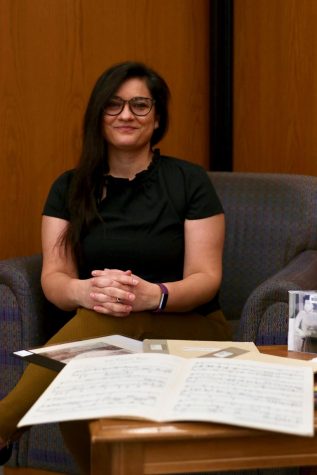
Music Librarian Jessica Abbazio poses for a portrait inside Wilson Library with a few pieces from the University of Minnesota’s music library on Wednesday, Jan. 13. Abbazio is working to diversify the selection of compositions available within the collection. (Audrey Rauth)

Growing up, he remembers choir directors choosing to add a Spanish piece to their program as a way to “add a little spice” or “because it’s fun, or it’s different” rather than study or appreciate the musicality of the piece in the same way they did other songs they studied. While a student at St. Olaf College, two semesters of his vocal literature class were dedicated to learning English, German, Italian and French songs. Only one day was spent learning songs in Spanish.

“Since high school and onward it’s been frustrating for me, and I’m sure it has been for my other Latin American musician friends,” he said. “Because I did not grow up knowing that Latin America had classical music.”

Because many music schools focus primarily on producing classically-trained musicians who perform in an orchestral setting, students are taught about predominantly European composers, said Anne Briggs, a second-year Ph.D student in the University’s ethnomusicology department.

Briggs said Abbazio’s work will give teaching assistants like her the resources to show students an “unimaginable breadth of music performance” they would typically not get from their standard textbooks.

“What’s particularly exciting about [these] efforts … is representation,” Briggs said. “Without an attention towards what’s missing, who’s being left out of the conversation, what are we not including in our library catalog— sometimes you don’t even know it exists.”

Lasting impact

Abbazio said this work is crucial for an institution like the University of Minnesota, whose collections are available to not only the whole student body, but also others in the community who can access the — often expensive — materials through interlibrary loans.

Moving forward, Miller said he would like to see change come from teachers as well. Not only does he want to see more professors utilizing the Music Library’s resources, there needs to be a change in the curricula to reflect a greater appreciation for a range of music and styles, he said.

“There’s something so important about venturing outside of the Western canon because, for me, it helped me discover and explore my own personal and cultural identity,” he said. “I know that sometimes, to no fault of their own, teachers are hesitant to [teach outside of their comfort zones], because they themselves don’t know about it. But that’s an opportunity for growth for them as well as their students.”

Posted in UncategorizedComments Off on University of Minnesota Music Library seeks to diversify its collection

Proposed community housing project addresses homelessness, accommodates pandemic

A model housing unit sits in the parking lot of a northeast Minneapolis church. With a small bedroom and bathroom, modern furniture, decor and household necessities, the tiny gray house is a hint of a new housing initiative to come.

Three years into the Envision Community project, advocacy groups, faith groups and other organizations, including the University of Minnesota, have been working to develop an equitable housing model designed to foster community and combat homelessness. Since the pandemic, architects on the project have had to adapt their design of the model home to accommodate space for quarantine measures.

Led by people who have personal experience with homelessness, the collaboration’s efforts highlight and uplift those who historically have not been heard while addressing housing insecurity in the Twin Cities.

“When you’re homeless, you are invisible, ignored, and you lose your voice,” said John Cole, the interim director of Align, one of the partners of the project. “To have their input and to have them as partners is really exemplary and is actually a model that should be replicated for anyone who wants to do anything with persons experiencing homelessness.”

About the units

The proposed two-year project’s design consists of 15-40 micro housing units, which will be clustered around a community center and green space, said Jacob Mans, an assistant professor at the University who is an architect on the project. Two people will live in each unit.

Since the pandemic, Mans said the team has needed to re-evaluate nearly every aspect of the initial design. Now, instead of smaller units with shared bathrooms, each unit will have its own full bathroom and a working kitchenette, which will enable people to quarantine if needed.

The larger community space will have a bigger kitchen, a recreation area and a place where people can receive social services and medical support, he said. The team is currently acquiring land for the project on the corner of Fremont Avenue North and North 41st Avenue.

Mans said architects are typically called to design buildings for clients with large disposable incomes rather than projects like this one that find creative solutions to address systemic issues like homelessness.

“It’s really rethinking architectural practice models and finding opportunities for architects to serve people they traditionally have not been able to serve,” he said.

Mans said he wanted to design buildings that would address homelessness without building structures that emphasize difference, thus othering people or putting them under a microscope.

Twenty percent of those living in these units will have experienced chronic homelessness and have more serious health issues, 60% will have experienced housing instability and 20% will never have experienced housing instability. Although all residents will pay monthly rent, many of them qualify for subsidies, which will offset the low cost of living.

Homelessness can be a traumatic experience that leaves many people still in “crisis mode,” where they are focused on short-term survival like finding food, transportation and shelter, Cole said.

When stuck in that mindset, it can be hard to make long-term plans, even in safe housing, he said. Having a supportive network of neighbors who can empathize with those experiences and others who can provide an outside perspective will ultimately enable and support upward mobility, Cole said.

Community building

Freddy Toran, a leadership consultant for the project, has been doing this kind of advocacy work for 15 years. As someone who experienced homelessness and addiction, Toran said he knows what it feels like to not have a safe place to live or take his medicine.

Over time, many people experiencing homelessness give up on themselves when faced with constant societal rejection and judgement, he said. Because some people experiencing homelessness struggle to find housing due to income, a criminal record, substance abuse, prior evictions or poor credit history, Envision does not disqualify anyone due to these factors.

This project is designed to meet people where they are and build a trusted community where they feel safe, Toran said.

“People with [lived experiences of homelessness], they bring great ideas and information to the table,” he said. “You got a lot of educated people out here that’s homeless: a lot of talent, a lot of skills — it’s just something causing them to lose their home.”

Even though Rochelle Washington, the project manager, has lived in her rented home for 12 years, her landlord recently gave her a 30-day notice to vacate after she mentioned she wanted to become the first person in her family to purchase a home.

Although evictions have been suspended in Minneapolis due to the pandemic, Gov. Tim Walz’s peacetime order expires on Dec. 14.

“Having affordable housing is key,” she said. “Even me, thinking my housing was secure — it’s not. … Anyone can lose their housing for any reason. And homelessness [happens] so quick.”

Washington has been working with grant writers, developers, neighborhood associations and Minneapolis city officials on the project. Although it has been a long process, she said building homes like these can slow down homelessness and even potentially stop it.

Fulfilling a need

Cole said Minneapolis is in a housing crisis where there are not enough affordable homes or apartments on the market, which has forced some to stay in their current houses rather than move, creating a bottleneck in the system.

The pandemic has brought about additional challenges for those whose housing is insecure, he said. Some who would typically stay with friends or family now cannot, and shelters, which were at full capacity even before COVID-19, are now swamped.

According to 2019 data from Minnesota’s Homeless Management Information System, people of color made up 65% of people experiencing homelessness in Minnesota. Black people made up 42% of those experiencing homelessness in Minnesota despite making up 7% of the state’s population. Eleven percent identified as American Indian or Alaska Native although they make up 1% by population. These statistics only reflect those staying in shelters or transitional housing programs and are likely higher today and with those experiencing unsheltered homelessness.

The $13.25 minimum wage for large businesses is often not enough to pay rent in the city, even while working multiple jobs, Cole said. And with winter coming, the situation is even more dire.

“This provides one solution to what is a complex problem, and it requires a multiplicity of solutions,” Cole said. “We need to recognize and accept that housing in Minnesota is a crisis and unless decisive action is taken to comprehensively address this once and for all, we will always be having to deal with homelessness”

Posted in UncategorizedComments Off on Proposed community housing project addresses homelessness, accommodates pandemic

‘There has to be a point when we say enough’: University students, faculty and alumni voice opposition to Line 3 pipeline

Following the approval of several key permits through Nov. 30, a new Line 3 crude oil pipeline is set to run across northern Minnesota, with construction already underway.

Citing concerns about the environmental impacts of oil spills, the health risks and effects on Indigenous communities, some University of Minnesota students, faculty and alumni have been fighting the Enbridge Energy pipeline for years.

The new Line 3 pipeline will replace an older Line 3 pipeline that was built in the 1960s and will run from Alberta, Canada through North Dakota and northern Minnesota before ending in Superior, Wisconsin. This new pipeline can transfer nearly 760,000 barrels of crude oil per day and will emit 273.5 million tons of carbon dioxide per year.

Enbridge Energy was responsible for the largest inland oil spill in the country when a Michigan pipeline burst in 2010 and leaked at least 1 million gallons of oil into the Kalamazoo River.

MSA calls for the University to make a statement

Maddie Miller, a University of Minnesota third-year individualized studies major, started the Students Against Pipelines student group last year and interned with nonprofit MN350 to do pipeline advocacy work last fall and summer. She is also the Minnesota Student Association’s environmental accountability director.
When the Minnesota Pollution Control Agency approved a crucial water permit on Nov. 12, 12 of its 17-member Environmental Justice Advisory Group resigned. In response, Miller helped draft a petition to University President Joan Gabel, urging the University to make a public statement opposing the pipeline.

“As the largest public educational institution in the state, the University of Minnesota is greatly influential in Minnesota’s economic and scientific future,” the petition said. “The University of Minnesota also prides itself on its environmental stewardship and intends to become carbon neutral by 2050, but an oil pipeline with the carbon emissions of 50 new coal-fired plants would be a detriment to much of that progress.”

Because the University also prides itself on its location on the Mississippi River, an oil spill would drastically impact the river’s water quality and livelihood of nearby ecosystems, the petition said. Though the University acknowledges that the college rests on land forcibly taken from Dakota and Ojibwe people, the letter added that the University needs to take further responsibility and advocate against a pipeline that would directly violate treaty lands and harm Indigeneous communities.

Signed by MSA, the American Indian Student Cultural Center, UMN Climate Strike and several other student organizations, the letter was passed by MSA unanimously on Nov. 24. Miller said they are still waiting on Gabel’s response.

Impact on Indigenous people

Tara Houska, a University alum, tribal attorney and Couchiching First Nation citizen, has been fighting the Line 3 pipeline for nearly seven years, leading national policy work and talking with lawmakers and shareholders.

Founder of the Giniw Collective, an Indigenous women and Two-Spirit-led pipeline resistance group, Houska and other advocates have been living in a community resistance camp 200 yards from the pipeline’s route, growing food and training others in direct action. The pipeline will disrupt land treaties of the Anishinaabe people, detrimentally impacting the Red Lake, White Earth, Leech Lake, Fond du Lac and the Big Sandy Lake Bands reservations, Houska said.

The pipeline will also run within half a mile of 17 wild rice beds around the state. Wild rice is a culturally significant staple of food and source of revenue for many Indigenous people, said Wabigonikwe Raven, a member of the Giniw Collective and enrolled member of the Lac Courte Orielles Anishinaabe tribe.

“Not getting this pipeline built is really important to me,” Raven said. “It’s bigger than all of us, because once it gets put in the ground, it doesn’t just stop there. Pipelines leak and destroy ecosystems.”

Although she was not surprised to hear of the governor’s response to the pipeline’s construction, Raven said it is saddening to see Gov. Tim Walz have no empathy for people who will be affected by the pipeline and that this is just another example of historic oppression and disregard for Indigenous people.

“Engaging with these big companies to try to force them to transition away from fossil fuels is about our survival as people,” Houska said. “This project is one project among many, but there has to be a point where we say no more. There has to be a point when we say enough.”

Houska said the young people coming into this space will step out as tomorrow’s leaders.

“And, you know, what kind of world do you want that to be? I hope it’s one that has clean drinking water and human rights being upheld and treaties no longer being broken,” she said.

University health, water experts denounce pipeline

Laalitha Surapaneni, an assistant professor of medicine at the University, has been giving testimonies and pushing against the pipeline for years. She was one of many medical professionals who held a teach-in at the State Capitol in January calling for the governor to acknowledge the negative health impacts caused by fossil fuels and potential oil spills.

Surapaneni said the pipeline’s construction has come under fire by frontline workers in northern Minnesota where the construction will take place. Although Enbridge has said the pipeline will create thousands of jobs, most of the workers are not from the communities they are operating in, and some are from out-of-state areas with higher rates of COVID-19.

She said this has alarmed rural health care providers whose hospital beds are already full.

In November, a petition submitted to Walz and the Minnesota Department of Health from Aitkin County health care professionals and residents called for a temporary delay of the project due to the pandemic.

Christy Dolph’s involvement with Line 3 started in 2017 when she testified against the Public Utilities Commission about the environmental impacts of the new pipeline. A former University water resources scientist, Dolph specializes in streams, rivers, lakes and wetland ecosystems.

Dolph said freshwater species are some of the species most heavily impacted by mass extinction worldwide, and the best way to preserve these ecosystems is not to put them at risk in the first place.

Line 3 is set to run through 818 wetlands, over 200 streams and lakes, including Lake Superior, and across the Mississippi river twice. Tar sands oil, the type the pipeline will transfer, is different from other types of oil because when spilled, it sinks below the surface of the water rather than floats to the top, which makes it more difficult to clean up.

“We don’t have time to sit back and passively do research in our lab when the stakes are so high, and the crisis is so dire,” Dolph said. “If we want to solve these problems, we really have to take what we know and start making decisions upfront, … especially when we know fossil fuel use needs to be downscaled or eliminated immediately. We have a handful of years to really turn things around.”

A previous version of this article misattributed a quote said by Tara Houska.

Posted in UncategorizedComments Off on ‘There has to be a point when we say enough’: University students, faculty and alumni voice opposition to Line 3 pipeline

University herbarium collection goes digital

Walking into the University of Minnesota Herbarium collection is disorienting.

Housed in a collection hidden on the eighth floor of the Biological Sciences building on the St. Paul campus are almost a million pressed plants, some from 2020 and others dating back to the early 1800s. Stored in upright filing cabinets, large manila folders of pressed plants are color coded by continent. In the scanning room, a wooden cabinet holds jars of algae preserved in hundred-year-old alcohol. In other drawers around the collection are small boxes of lichen clinging to scraps of gray rock.

As part of a statewide effort to digitize historically preserved collections like this one, the University has been working to scan, upload and label hundreds of thousands of specimens, which have long remained in the depths of their archives.

Though painstaking, the process will allow researchers to access data that will help them analyze how plants have evolved, changed or disappeared from an area over time. Researchers will also be able to extract DNA from the physical specimens in the collection, analyzing their composition.

“Having this record of plant diversity through time, ecologists have come to realize the value of these specimens to their studies, not just studies of plant biology but also studies of plant ecology,” said Tim Whitfeld, the curator of the herbarium collection. “Depending on the species or the location, some of these pieces are flowering two or so weeks earlier on average than they did 150 years ago. So this is an interesting kind of documentation of the effects of climate change.”

The data will be uploaded into the Minnesota Biodiversity Atlas, a web portal launched by the Bell Museum in 2016. Containing over five terabytes of information, there are 16,000 species catalogued so far, including other Bell Museum collections of mammals, fishes and birds.

The atlas also includes collections from other entities like the University of Minnesota-Duluth, the Science Museum of Minnesota and the Leech Lake Band of Ojibwe.

Katie Noren, the herbarium curatorial assistant, said uploading all the collections together on one site will allow people to see how different species interact.

“Each of these specimens are a unique snapshot of a time in history that is irreplaceable. You know, you can’t just find a new version of something that existed 70 years ago,” Noren said.

Because one-third of the University’s herbarium collection includes plants native to Minnesota, Whitfeld said the database is useful for University researchers, local botanists and ecologists and even students and citizens interested in plants. Citizens can also donate their time and transcribe handwritten labels for the project through an online portal.

Having these collections online makes the data more accessible to a global audience, Whitfeld said. Before, people wanting to view the collection would either have to visit in person or request the specimens on loan, which were sometimes shipped around the world.

Bec Skelton, a third-year arts major, started working on the project about two months ago. Taking photographs and labeling birds held at the Science Museum, Skelton also scans plants from the herbarium collection on campus.

Over time, Skelton said they get to know the names of collectors and learn to understand the historical context in which the plants were collected. For instance, Skelton said they see a lot of specimens from the early 1900s and the 1920s but hardly any in between, which could be an indicator that naturalists were not working during World War I.

“I enjoy working with primary documents, just from a historical perspective,” they said. “You’re able to draw a lot of little connections that you wouldn’t get otherwise. … You kind of get one little historical puzzle piece that everything else falls into.”

Posted in UncategorizedComments Off on University herbarium collection goes digital

University continues work on national insect curation project, despite pandemic

Walking through the University of Minnesota Insect Collection, curator Robin Thomson pulls a series of cases from one of dozens of shelves lining the storage facility. Opening it up, she pulls out a glass slide, pointing to a small louse pressed up against a flat surface.

As one of 28 universities and museums part of a national project called the Terrestrial Parasite Tracker, the University is working to digitize parasite data in order to make it more accessible to researchers around the world.

Uploading photos and transcribing data for terrestrial parasites like lice, fleas, ticks, mites and various groups of biting flies, a group of curators and bug enthusiasts around the country are compiling data in ways they have not been able to before. Some of the data they collect includes the location where the insect was found, its scientific name and the name of the person who found it.

Thomson said it is sometimes challenging to share insect information with researchers out of state. If a researcher in Arizona, for instance, wanted to access a type of louse in the collection, she would have to mail the specimens to them directly or type up the data needed and send it back.

“It’s kind of physically inaccessible,” she said. “So the idea is to take all of this data sitting in these collections, and somehow get it online and available to the public and to general researchers.”

The University is compiling images and data for all of the fleas and lice in its collection, which includes over 8,000 specimens of fleas, 14,000 specimens of sucking lice and 242,000 specimens of chewing lice.

Through this work, researchers will be able to better understand the evolution of the parasites’ behaviors and health challenges they cause, said Jennifer Zaspel, the director of the project and a research curator at the Milwaukee Public Museum.

“These collections are libraries of life on our planet, and represent those organisms where they have occurred over long periods of time,” Zaspel said.

Digitizing these collections allows researchers to access information about when, where and what organisms were collected over the past 100 years, Zaspel said. Such baseline data can help them better understand environmental change, habitat loss, pollinator distribution and invasive species, she said.

Zaspel said there are numerous challenges involved with documenting these collections. Many insects are stored in different locations inside museums or universities. They are also stored differently depending on size and anatomy, sometimes pinned, put in vials or placed on microscope slides, which can also pose a challenge for photographing the specimens, she said.

“We’re going to have to deal with hosts and parasites, and understanding those kinds of evolutionary dynamics will help us deal with them in the future,” said Sarah Bush, an associate professor at the University of Utah who is also involved with the project. “Getting this data is a good solid foundation to start.”

All of this work is done by hand, and with COVID-19, the transition to working from home has been relatively well-suited for this work, she said. For the last eight months, Bush has been scanning specimens on her dining room table, with the help of her two 12-year-old sons.

Members of the public can also assist the team by interacting with the University’s Notes for Nature website, where they can view insects and transcribe handwritten labels from microscope slides that computers cannot interpret. Participants can identify lice from the University’s collection or fleas from Chicago’s Field Museum.

“We’re using volunteers to help get this information, and that is really fun because they see things from places all over the world,” Bush said. “Sometimes they’re from an albatross collected … just after World War II, or sometimes it’s something that was collected last year. We have some specimens that were from 1850. So it’s kind of a nice window into museums that most people don’t get to see.”

Posted in UncategorizedComments Off on University continues work on national insect curation project, despite pandemic