Author Archives | admin

8 Best SEO Analysis Tools for the 3 Ways Audits Fail (2026)

8 Best SEO Analysis Tools For The Three Ways Audits Fail (2026)

In spring 2026 we commissioned a full site analysis for a client with 40,000 URLs. It came back beautiful: 1,240 issues, colour-coded, exportable, delivered on a Tuesday. Three months later I checked it. The ledger: 38 hours to produce, 19 issues shipped. The autopsy: I bought a document, not a decision, and signed it off proudly.

That isn’t a vendor failure. SEO analysis tools are better at finding problems than ever, and the web is still broken in basic places: only 66% of desktop pages have a non-empty H1. The category keeps selling the scan, which was never the constraint.

Analysis fails in three ways, and I have shipped all three. A report nobody actions. A score that isn’t a diagnosis. A surface nobody measured. Eight SEO analysis tools, ranked by which of the three each one closes.

The 847-Flag Report That Nobody Ever Worked Through

Volume is the first failure. SEO analysis tools return hundreds of issues at equal weight, because the crawler has no model of your business. The SEO analysis report is a completeness artefact. A team needs a work order with an owner.

As Adam Heitzman, Co-Founder and Managing Partner at HigherVisibility, puts it: “You open your audit tool and it hands you 847 issues.” Dan Lauer, Director of SEO and GEO at Walker Sands, writes that crawlers will happily hand you 10,001 problems.

The people who can fix those issues rarely commissioned the audit.

The Authority Score That Moved While The Pipeline Stayed Flat

Then the score. SEO analysis tools hand you a number that looks like a diagnosis and isn’t one. John Mueller, Google’s Search Advocate, said in 2023 that Google does not use scores from third-party SEO tools or services. A vendor’s grade compares sites; it doesn’t fix yours.

Our score moved, the pipeline didn’t, so we stopped reporting scores. My team’s bar instead has four parts: linking page indexed, topically adjacent, referring domain sends real traffic, anchor natural.

The Surface Your Audit Never Looked At, And The Traffic It Never Counted

Scope is the third failure. Standard analysis covers on-page and technical, reduces links to a sidebar number and skips AI answers. In one company’s nine-month measurement, 22.4% of AI Overview referrals landed in the direct bucket instead, so the traffic analysed was already wrong.

The mechanism moved. Authority did not. Sites with 350K+ referring domains are over 5 times more likely to be cited by ChatGPT than sites near 200. Correlation, not cause.

SEO analytics tools that can’t show referring-domain quality beside AI-answer presence are reading yesterday’s surface.

Three Properties That Separate Analysis From A Flag List

The first is a prioritised work order, not labels. The evidence under a tool’s headline number, since 54.8% of 131 surveyed SEO professionals still put backlinks in their top three. Crawl, links and AI answers in one workspace, where domain traffic predicts AI Mode citations roughly three times more strongly than content length.

Five verifiable criteria:

  • Does a finding carry its fix and affected pages?
  • Does the headline number drill to its rows?
  • One subscription for crawl, links and AI answers?
  • Limits published as numbers? One tool below fails it.
  • Can two audits be compared, audit over audit?

How each SEO analysis tool was scored: those five criteria against the vendor’s published pricing and limits, re-read on 16 September 2026.

The 8 SEO Analysis Tools Side By Side, In Dollars And In Hours

The failure column names which of the three each tool closes. SEO analysis tools closing more than one rank higher.

Rank Tool Failure it closes Turns findings into a work order? Evidence behind the headline number Link and AI-answer surface Entry price and billing unit Hardest published limit
1 SE Ranking All three Yes, severity, fix steps, affected pages Five weighted markers, per-link explanation Both, five AI engines covered $129/mo, per plan 1 manager seat on Core
2 Sitebulb Unactioned report, part of the score Yes, ranked Hints with readable reasons Hint text and affected URLs Neither, crawl workspace only From GBP 10/mo, per user 10,000 URLs per audit on Lite
3 LinkResearchTools Score not diagnosis, unmeasured surface Partial, disavow verdicts, no build plan 150+ metrics per recrawled link Links only, 25+ sources recrawled $599/mo, per plan 1M links of crawl budget, resets unused
4 Similarweb Unmeasured surface, score not diagnosis No, market estimates, not site findings Modelled panel and clickstream estimates AI answers, quoted as separate suites From $125/mo, per quoted package None published
5 Ahrefs Unmeasured surface, links only No, you set the fix order yourself Own link index, rows capped at 2,500 Links only, its own index $129/mo, per plan plus seats 2,500 rows per report on Lite
6 Screaming Frog SEO Spider Score not diagnosis, it holds none No, prioritisation is entirely your job None, it reports raw crawl data Neither, local crawl only GBP 199/yr, per user One paid licence per user
7 Semrush Unmeasured surface, partly Partial, findings listed, not sequenced One shared data set across disciplines AI answers, 50 prompts from Starter $139/mo, per plan plus add-ons 5 websites monitored on entry plan
8 Google Search Console Score not diagnosis, first-party truth No, reports only, no fix instructions No headline score, first-party rows Links only, thin and unsortable Free, per verified property 16 months, verified properties only

Ranked By The Failure Each Tool Closes

Every card names what it costs and where it stops.

1. SE Ranking

SE Ranking runs technical crawl, referring-domain profile and AI-answer tracking in one workspace, the only SEO analysis tool here covering both surfaces.

Best for: agency teams needing crawl, link profile and AI-answer presence in one workspace.

Standout feature: Website Audit runs 115+ checks across 13 categories and turns a crawl into a ranked fix list with the affected pages attached: each issue carries a severity level, fix instructions and a “+X pts” label for what the Health Score recovers.

Pros:

  • Traces each toxicity verdict to five weighted markers and scores every referring domain on 15+ parameters.
  • Compares two audits with New and Fixed status, making “we fixed it” provable.
  • Tracks AI Overviews, AI Mode, ChatGPT, Gemini and Perplexity on both plans.
  • Schedules PDF reports and guest links off that crawl, so the SEO report generator is not a second job.

Cons:

  • The heaviest agency add-ons are annual-billing only, so that stack cannot be assembled monthly.
  • Website Audit page allowances reset monthly, so unused capacity does not bank.
  • The raw backlink index is smaller than Ahrefs’ own, and full parameter-rechecked analysis bills separately.

Pricing: Core $129/mo, or $103.20/mo billed annually. Growth $279/mo, or $223.20/mo billed annually. Agency Pack from $69/mo, annual billing only, adds client seats and white-label reporting.

The ledger: the hours an agency loses are handover hours, and this is the one tool here that removes the second subscription and the retyping together. Take it when the analysis has to survive a client.

2. Sitebulb

Sitebulb is an SEO audit tool that scores, explains and ranks every issue it finds.

Best for: technical leads defending a fix order to developers who won’t accept a flag list.

Standout feature: Desktop Pro carries 300+ Hints, each with a stated priority and a written reason instead of one grade, and Audit Comparisons run two crawls of the same property against each other, so a shipped fix reads as evidence.

Pros:

  • Explains each Hint in language developers accept.
  • Compares audit against audit, so progress is provable.
  • Exports customised PDF reports on Pro, a real SEO report tool.

Cons:

  • Lite caps audits at 10,000 URLs; Pro is the floor.
  • Cloud needs two users; desktop Pro’s ceiling is hardware.

Pricing: Desktop Lite from GBP 10/mo, Pro from GBP 45/mo per user, Cloud from GBP 95/mo.

The autopsy: Sitebulb ranks and explains where the field only lists. Use it when a development team refuses the fix order. It won’t price the fix, and a ranked list still has to survive a quarter planned before the crawl ran.

3. LinkResearchTools

LinkResearchTools decides which referring domains are a liability before Google does, on evidence no score carries.

Best for: link teams doing link-risk and disavow work on a penalised or acquired domain.

Standout feature: It aggregates 25+ link data sources, recrawls every link and scores it on 150+ metrics. A referring domain gets a verdict, not a score. That’s closer to my own bar than to a grade: indexed page, topical adjacency, natural anchor.

Pros:

  • Includes Link Detox, Link Simulator and Link Monitoring on every paid tier
  • Carries unlimited domains and users on Superhero Small
  • Buys extra crawl budget without upgrading a tier


Cons:

  • Meters on profile size, and unspent budget resets
  • Says what is risky, never what to build

Pricing: Superhero Small $599/mo, Standard $999/mo, Plus $2,499/mo, with 1,000,000 links of crawl budget on Small.

Earned, not asked for: Run it when someone has to sign the disavow. A typical top-10 domain of 15 years or more holds 27 times more referring domains than domains under two. Forensics protects that ledger, never builds it.

4. Similarweb

Similarweb estimates where a site’s visits come from, the traffic check behind a referring domain.

Best for: authority teams proving a referring domain sends real people before earning a placement.

Standout feature: Similarweb’s panel and clickstream modelling puts an estimated visit count and channel mix behind a domain. A crawl-based SEO website analysis tool is not built to produce that. It’s how the “sends real traffic” clause gets tested before pitching starts.

Pros:

  • Reads referral traffic behind a placement
  • Covers AI traffic trends, brand visibility and prompt analysis
  • Scopes up to 37 months of history and 100+ countries

Cons:

  • Every figure is a modelled estimate; small sites are unreliable
  • Publishes no row, query, seat or crawl limit; quotes every package

Pricing: Web Intelligence published from $125/mo; every business package is quoted.

What the campaign actually returned: Use it to test a traffic claim, never to audit your own numbers. One study of ten sites found 49 of their top 100 organic pages pulled no LLM traffic. An estimate beats an assumption.

5. Ahrefs

Ahrefs holds its own link index. On link velocity it’s still one of the reference points.

Best for: in-house teams asking who else is linking to a topic, and how fast.

Standout feature: Ask which domains began citing a subject last quarter and how fast the count climbed, and this is built to answer it. Site Explorer, Site Audit and Content Explorer share one login, so the link and page reads happen together.

Pros:

  • Reads referring-domain growth as a time series
  • Keeps crawl, keyword and link data together
  • Shows which pages earn new domains

Cons:

  • Lite caps reports at 2,500 rows, a multi-client wall
  • Lite keeps 6 months of history, so before-and-after needs Standard
  • Each extra viewer adds $40 to $100/mo

Pricing: Lite $129/mo, Standard $249/mo, Advanced $449/mo, Enterprise $1,499/mo on annual commitment.

The demotion: Link depth alone would seat it second. Here it lands fifth, closing half of one failure and leaving the work order alone. 73.2% of 518 surveyed SEOs think links still move AI visibility. Belief, not measurement.

6. Screaming Frog SEO Spider

Screaming Frog SEO Spider runs the raw crawl on your machine and returns what came off the wire, unranked.

Best for: engineers who want nothing between them and the response headers.

Standout feature: Screaming Frog surfaces no health grade to optimise. No vendor row or crawl cap on the GBP 199 licence. The ceiling is your machine’s memory, or the database storage mode for a large site. Nobody prioritises for you.

Pros:

  • Returns headers and redirects as recorded
  • Crawls with no vendor row cap
  • Keeps the crawl on hardware you control

Cons:

  • Point-in-time: nothing is watched between crawls
  • No shared workspace or client-facing report

Pricing: Free up to 500 URLs per crawl; paid licence GBP 199 per year, per user.

The autopsy: Cleanest data here, least actionable artefact. It can’t sell a false diagnosis, because it holds no score. It produces no work order either. Pair it with something that watches the gaps, and keep its exports as an unmodelled record.

7. Semrush

Semrush covers organic, paid, content, and AI visibility from one data set, useful when analysis crosses teams.

Best for: paid, content and organic analysis running off one data set.

Standout feature: Semrush’s shared data set is what matters here. The term your content team writes for and the term your paid team buys sit one filter apart. The question gets answered in the SEO analysis tool rather than in a meeting.

Pros:

  • Monitors 5 websites, tracks 500 keywords daily
  • Adds AI prompt tracking at Starter, 50 daily
  • Keeps cross-discipline reporting in one account

Cons:

  • No AI prompt tracking on the entry SEO plan
  • Every extra person reading the data starts at $45/mo

Pricing: SEO $139/mo, or $117.33/mo billed annually. Starter $199/mo. Pro+ $299/mo. Advanced $549/mo.

What it actually costs: Breadth on one data set is a real answer when analysis crosses disciplines. The catch is metering: the AI half begins at Starter, seats and reports bill beside the plan, so the table figure is not the bill.

8. Google Search Console

Google Search Console reports what Google recorded about a property you verified. Nothing else here does.

Best for: reconciling a vendor estimate against what Google itself recorded.

Standout feature: Other SEO analysis tools model the search engine. Google Search Console reports it. When an estimate and the first-party record disagree about a page’s impressions, clicks or average position, that’s the row you check, with no vendor model in between.

Pros:

  • Reports clicks, impressions and position as recorded
  • Shows indexing and crawl status firsthand
  • Opens to everyone who needs that property

Cons:

  • No SEO competitor analysis tool here: verified properties only
  • 16 months of history, heavily sampled, and it returns the top rows rather than all
  • Anonymised queries cut the long tail

Pricing: Free, with verified ownership the only requirement.

The ledger: It answers the smallest question here, truthfully: your property, your rows, nothing about the domain you pitch next week. Keep it open beside whatever you pay for: when a channel report disagrees with it, start here.

The Ledger On All Eight, And Who Should Skip The Shortlist

If analysis keeps dying at the handover, a better scanner won’t save it. Measure the next audit honestly: hours in, issues shipped.

SE Ranking clears all five criteria, so shortlist it first. Its crawl sits beside watching the same domain inside AI answers, a surface the category has not settled: llms.txt is present on 2.13% of desktop sites. The gap: agency add-ons bill annually.

Skip if: LinkResearchTools, unless link risk has a deadline: a forensic recrawl of a healthy profile confirms what you believed. Screaming Frog as your primary tool, if nobody owns prioritisation: it worsens failure one.

Steal the bar: indexed linking page, topical adjacency, real referring traffic, natural anchor. Shortlist two against your last unactioned audit.

Frequently Asked Questions

What are the top 5 SEO audit tools?

The five SEO audit tools here are SE Ranking, Sitebulb, Screaming Frog, Semrush and Google Search Console. Ahrefs crawls your site too, though its centre is the link index. An SEO audit tool returns issues; a platform also reads links and AI answers. Judge both on whether findings arrive as a work order.

Can ChatGPT do an SEO audit?

Not on its own. ChatGPT does not crawl your site, so it can’t inventory your pages, check every status code or confirm what Google indexed. Give it a crawl export and it’s good at what SEO analysis tools handle worst: deciding what to fix first. MCP connections supply that data.

How do you do an SEO analysis?

Run an SEO analysis in four steps: crawl the site, reconcile every estimate against first-party Search Console data, judge the link and AI-answer surfaces standard SEO analysis tools leave out, then convert what survives into a work order with an owner and a date. Most analyses stop before that step.

What Are The 10 Best SEO Tools?

Eight, not ten: SE Ranking, Sitebulb, LinkResearchTools, Similarweb, Ahrefs, Screaming Frog, Semrush and Google Search Console. Stopping short was deliberate: two categories were excluded. Content-optimisation tools grade drafts rather than diagnose sites, and a free SEO analysis tool mostly returns a score with no evidence.

The post 8 Best SEO Analysis Tools for the 3 Ways Audits Fail (2026) appeared first on Daily Emerald.

Posted in NewsComments Off on 8 Best SEO Analysis Tools for the 3 Ways Audits Fail (2026)

Annual 9th and 9th Street Festival connects the community to local vendors


Community members gathered last Saturday, Sept. 19, at the intersection of 900 East and 900 South for the neighborhood’s Street Festival, presented by the East Liberty Park Organization. This year marked the street’s 33rd consecutive year of festivities and the largest one yet. 

Vendors lined the street for two blocks and converted the busy road into a bustling marketplace. The brick-and-mortar businesses alongside the street also opened their doors to the crowds of people by hosting sidewalk sales and specials. The festival accepted a wide variety of booth applications that included artists, local businesses, churches, nonprofit organizations, musicians, and political campaigns. 

“This is a great time for people to see our work,” said Steve Brown, a ceramicist vending with Iron Desert Arts Studio. “It’s a good opportunity to show off my art and earn some extra money while doing it.” 

Pottery at the 9th & 9th Street Festival on Sept. 19, 2026. (Photo by Addy Cowley | The Daily Utah Chronicle) (Addy Cowley)

A neighborhood tradition

The Street Festival is the most highly anticipated event held at 9th and 9th and continues to be the largest and most popular in the area. Since its beginning in 1993, the festival has maintained its prioritization of local businesses to shed light on regional businesses while keeping attendance completely free. 

This year, the festival featured over 150 local entrepreneurs and businesses selling different kinds of handmade goods, dining and treats. 

Pichpanit Kongtawonvait, who owned the Yummy Tummy matcha booth, expressed her initial intrigue in vending at the 9th & 9th festival. “I wanted to do it because this is a really cool area,” she said. “I love the businesses here and wanted to do one myself.” 

April Mao is an artist who had vended at the street festival a year prior. She said the turnout and improvement in the organization of the festival delighted her. “This is set up well, better than last year’s. It is something worth returning to,” she said. “There have been a lot of people interested in buying our work.” 

A booth at the 9th & 9th Street Festival on Sept. 19, 2026. (Photo by Addy Cowley | The Daily Utah Chronicle) (Addy Cowley)

Community and accessibility

A highlight of the festival was the accessibility for all attendees. Diverse crowds of guests lined the streets and organizers encouraged them to bring strollers, leashed dogs and children. An ongoing tradition of face-painting and children’s activities at the street festival notably returned to promote the family-friendly environment.

The festival was also a good way for non-locals to experience Salt Lake City culture. Attendee Leah Monica brought two foreign exchange students to the festival to show them the city culture. “I wouldn’t have come initially if I weren’t showing them around here, but it is actually cool,” she said. “I like the ceramics and art.”

Locals browse at the 9th & 9th Street Festival on Sept. 19, 2026. (Photo by Addy Cowley | The Daily Utah Chronicle) (Addy Cowley)

m.htun@ustudentmedia.com

@Myahtunn

The post Annual 9th and 9th Street Festival connects the community to local vendors appeared first on The Daily Utah Chronicle.

Posted in NewsComments Off on Annual 9th and 9th Street Festival connects the community to local vendors

How to Build a Resume in 2026: Skills, Evidence and Better Applications

How to Build a Resume That Gives Recruiters Something to Believe

The Class of 2026 is entering a hiring market that rewards proof more than polish. NACE’s final Job Outlook 2026 Spring Update raised the projected increase in new-graduate hiring to 5.6%, up from the 1.6% estimate in its earlier report, and 70% of surveyed employers now report using skills-based hiring. For Colorado State University students, that shifts the resume conversation toward evidence: campus jobs, internships, class projects and volunteer work all count when they show how a skill was used. A resume is not an autobiography; it is a case for a specific interview.

The Job Posting Is Your Editing Desk

Start with the posting, not the template. NACE found that employers reviewing Class of 2026 resumes are especially looking for evidence of teamwork, problem-solving, and communication, while 81% use skills-based practices when creating job descriptions. Good resume tips begin by matching genuine experience to those requirements, then cutting material that does not help answer the employer’s problem. A resume builder can keep margins, dates, and headings consistent, and it can help a first draft look orderly, but it cannot decide which accomplishment deserves the top third of the page or whether a bullet actually proves the skill named in the posting. Evidence wins.

A Campus Shift Still Counts as Experience

Students often discount ordinary work because the job title does not resemble the career they want after graduation. NACE’s spring 2026 update says more than 40% of respondents value on-campus student work, while CSU’s Career Center advises students to construct bullets around an action, the skill used, and the result or value created. A dining-hall shift can show queue management and conflict resolution; a newsroom role can show deadline control, editing and source verification. Those examples are stronger than “responsible for customer service” because they give a recruiter something concrete to test in an interview.

Product Knowledge Can Become a Portfolio Story

Digital-product applicants have another source of evidence: a clearly labeled independent case study. A student in UX, analytics, or product operations could map how a sportsbook handles changing odds, live events, and account history, then document the workflow without implying employment by the company. Official product information shows that MelBet provides live scores and odds, quick access to bet history, live events, and mobile apps for Android and iOS.

Bullets Need Outcomes, Not Job Descriptions

The weakest bullet simply repeats a duty: “helped customers,” “managed social media” or “worked on a team.” Use strong action verbs and metrics instead when they are available. There’s much more information in phrases like “trained four new employees,” “edited three stories per week,” or “resolved 25 support requests during a shift.” Numbers must be real; invented precision is worse than an honest qualitative result. Details count.

Your Portfolio Should Show the Work Behind the Tool

Technical resumes get stronger when a tool is tied to a real task instead of just listed in a long software section. A student reviewing mobile products could break down things like navigation depth, live data behavior, account flows, and where the app fails, then explain how they tested each part in a portfolio. A case study built around the MelBet apk, for example, can look at how the Android install process works, how real-time betting updates appear, how bet history is accessed, and how users move through live events based on what the official mobile page describes. Framing it as an independent project keeps the resume honest while still showing careful observation, structured testing, and real product thinking instead of just saying you’ve “used the app.”

A CV Is Not Just a Longer Resume

A resume and a curriculum vitae are built for different purposes. Colorado State University describes a CV as a detailed record of academic background, experience, and achievements, typically used for teaching, research, or administrative roles, while its resume guidance focuses on short, targeted evidence tailored to a specific job. Students looking at CV examples for graduate school or research positions shouldn’t assume that format works for a private-sector internship. Follow the employer’s instructions carefully, double-check dates and job titles, and remove any claims you can’t support.

The post How to Build a Resume in 2026: Skills, Evidence and Better Applications appeared first on The Rocky Mountain Collegian.

Posted in NewsComments Off on How to Build a Resume in 2026: Skills, Evidence and Better Applications

Questrom reinstates research study requirement, students call it ‘busy work’

Students rush to and from class in the foyer at Questrom School of Business. The college brought back its research study requirement this semester as part of the SM 131 course. (NICOLE LIPNER/ DFP PHOTOGRAPHER)

The Questrom School of Business brought back its research study obligation this semester, requiring students in Business, Markets, and Society, or SM 131, to complete a behavioral research study outside class time for a grade.

SM 131 is an introductory business course all first-year Questrom students must take in their first term. The purpose of the course is to teach students a philosophical and economic understanding of businesses, markets and stakeholders in society.

Last semester, the requirement did not affect students due to a capacity issue with the behavioral research lab that hosts the study. However, students in the course this semester will be required to complete the study, as was mandatory in years prior to last spring.

To fulfill the requirement, students must go to the behavioral lab center and partake in an unpaid survey-style research study twice a semester, with each session taking about 45 minutes. The studies are done by applied psychologists and focus on business strategy and applied economics.

Questrom Undergraduate Associate Dean and professor Jeffrey Furman said the study is a part of the course’s goal to introduce students to different facets of Questrom — in this case, the school’s research programs.

“We’d like [students] to begin feeling like they’re part of the alumni network from day one, so we try to introduce them to alumni throughout the course,” he said. “We’re trying to achieve both academic goals and a series of socialization goals, and that both of those are relevant for the behavioral lab.”

Business students, especially those lacking exposure to research projects, often find faculty research “opaque,” wrote lab manager and Questrom professor Paul Stillman in a statement to The Daily Free Press.

Furman said many top business schools, like University of Pennsylvania Wharton and New York University Stern, highlight their research studies and require students to take part, helping them explore opportunities, even if they are just participants in a study.

“Just by participating in the study, that doesn’t automatically turn students into researchers or necessarily give them a full view into what academic researchers are doing at Questrom,” Furman said. “But it provides at least a little bit of a glimpse into the types of work that faculty do.”

Sophomore Hilary Dossett, who is currently taking SM 131, said she sees the “value” in the required research study but would prefer if the assignment was optional or offered for extra credit. 

“I feel making it a requirement on top of all of the other work already required for SM 131 is just a bit extra,” she said.

Furman said students have the choice to opt out of the study and complete an “alternative research-related assignment” instead. Dossett said the extra assignment was not explained thoroughly to the class, and it seemed like “more work” than doing the study.

Sophomore Clare Bonacci, an economics major, added the additional requirement felt like “busy work” and was unnecessary on top of the other readings and lectures.

Questrom sophomore Reet Tharwani said she would like the research requirement to be completed during class time, as students are already busy outside of class with other responsibilities.

“There could be workshops that are kind of built into SM [131] on when you guys have workshops one day a week where you can do [the study] on each other or something like that,” she said.

Dossett added she was frustrated students do not get paid to participate in the studies, especially when other voluntary participants in the behavioral studies lab get compensated. 

“It’s framed that the payment is credit for class, but it says on the behavioral lab website you get compensated if you voluntarily do the study, so it is a bit unfair,” she said.

Sophomore Vivaan Suri, who is a teaching assistant for SM 131 this semester, said he sees the value in the research study, even though the actual study did not help him with the class. It allowed him to explore different research opportunities that Questrom has to offer.

“I didn’t take much from it, but I’ve always wanted to do research, and so now I know that there’s like avenues open towards it,” he said.


Posted in NewsComments Off on Questrom reinstates research study requirement, students call it ‘busy work’

This campus parking ticket policy delays registration for some students, withholding diplomas and transcripts


Three unpaid parking tickets can trigger a hold on a University of Utah students’ account, blocking registration, diplomas and transcripts until the matter is resolved. Campus parking enforcement says the holds are meant to ensure accountability — but some students say the tickets cost more than they can afford. 

The policy directs the Office of the Dean of Students to place a registration hold on students’ Campus Information Services (CIS) accounts after they accumulate three or more parking tickets that remain unpaid for 10 days. After the hold is placed, students must meet with the dean to have it removed. 

April Pavelka, director of student rights and responsibilities for the Office of the Dean of Students, told The Daily Utah Chronicle that their office has “a case manager that’s specifically dedicated to student parking ticket issues” who helps students work through their options. “We understand that things are happening in students’ lives … that’s why we want to be flexible with students,” she said. “We want to help the students make sure that they don’t get any more tickets, because I don’t think anyone wants a parking ticket.”

Pavelka said their office will “take every student’s case individually,” which often involves requesting that parking enforcement reduce ticket costs, helping students create a tailored parking plan and more. Auxiliary Services, the body that oversees campus parking enforcement, declined request for an in person interview, but answered the Chronicle’s questions via email. 

Financial frustration

This past Thursday, the Chronicle interviewed multiple students on campus who have received parking tickets. Colette Dunn, a junior, said she received a ticket over the summer while working as a campus orientation leader. After parking on campus without realizing her parking pass expired, she said she was ticketed — and the fees later accumulated to over $170. “I was frustrated and honestly kind of shocked with how expensive it was. When I was at [Salt Lake Community College], parking tickets were like 50 bucks,” she said. “$170 is way too much for a parking ticket.”

Dunn hasn’t paid the ticket yet and now has a registration hold on her account. “I can’t afford to spend $170,” she said. “It’s too late to make an appeal, technically, so I think eventually I will just have to pay it, even though I don’t really know when that will be.”

The MEB Parking Lot on the University of Utah campus in Salt Lake City on Feb. 28, 2024. (Courtesy of The Daily Utah Chronicle Archives) (Xiangyao Tang)

Adrianna Hoy, a senior, hasn’t gotten a ticket this year. She said she received multiple citations last spring that led to a hold on her account. “I had to figure out how to come up with that money to pay it so I could register for my spring classes,” Hoy said. “I was living in Salt Lake and I had to pay rent, so that took out a portion of my groceries, out of my fun spending, out of my savings.”

What U can do

Collin Simmons, the executive director of Auxiliary Services, oversees campus parking enforcement. He said they offer a once-per-semester Canvas course that allows students to remove a ticket from their account under specific guidelines. 

“Eligible students may be offered the opportunity to complete the course in lieu of paying a qualifying citation once per semester,” Simmons said in an email to the Chronicle. “We introduced the program as part of our broader effort to emphasize education and student support before punitive measures. The course has been successful in helping students learn parking expectations while reducing the financial impact of a first citation experience.”

Simmons described the course as an “educational alternative” that can “help students better understand campus parking regulations, parking availability, permit options, and the reasons parking policies exist.”

Pavelka recommended students meet with their office. “We’re super flexible with students, we don’t have a matrix,” she said. “We work pretty closely with commuter services to get adjustments to balances based on how we’re working with a student.”

Affecting student success

Students with multiple parking tickets may see two different holds in their CIS account, one from Commuter Services and the other from the dean’s office. Pavelka said the Commuter Services hold is meant “to ensure accountability to Commuter Services and the payments.” This is similar to staff members who receive payroll deductions for unpaid ticket balances, she said.

Simmons acknowledged account holds from parking tickets can affect students on campus. “Registration and graduation holds can affect a student’s ability to register for future courses or complete graduation-related administrative processes until the underlying obligation has been resolved,” he said. “We recognize that any hold has the potential to create challenges for students.”

Regardless, he said he views the hold as an accountability measure. “The purpose of a hold is not punishment. Rather, it is the mechanism available to the university for resolving outstanding obligations,” he said. “Holds are typically considered a last step when previous efforts have not resulted in resolution.”

Simmons emphasized their goal is to resolve issues as quickly as possible as to avoid interfering with a student’s academic progress. “The overwhelming majority of citation matters are resolved before reaching the point where they could affect registration or graduation,” he added.

Response to criticism

When asked about student feedback on the parking ticket system, Simmons described feedback as mixed, which “is not surprising given the nature of parking enforcement.”

“Students who receive holds often express frustration, particularly when the hold impacts registration or graduation timelines. Common concerns include the financial burden of citations, awareness of parking regulations, and concerns about the consequences of unresolved tickets,” he said. “At the same time, many students, faculty, staff, and visitors also express concerns when parking regulations are not enforced consistently.”

Pavelka said the holds system was implemented to address safety concerns. “When President Randall first started his tenure, one of his initiatives was to remove parking boots, like tire boots,” she said. “It used to be if you had three unpaid tickets, you got your car booted, and that’s a safety issue.”

As time goes on, Pavelka wants to help prevent more students from receiving campus parking tickets. “I would like to hope that our process is headed towards being more proactive and helping,” she said. “Again, I’m going to hammer down, helping students not get tickets in the future, and that’s what I hope this process gets to.”

w.ruzanski@dailyutahchronicle.com

@will.ruzanski

The post This campus parking ticket policy delays registration for some students, withholding diplomas and transcripts appeared first on The Daily Utah Chronicle.

Posted in NewsComments Off on This campus parking ticket policy delays registration for some students, withholding diplomas and transcripts

Classifieds – September 23, 2026

The Daily Trojan features Classified advertising in each day’s edition.  Here you can read, search, and even print out each day’s edition of the Classifieds.

Click the Classifieds icon to download the PDF of today’s Classifieds:

Click to Download the Classifieds as a PDF

To place an ad, please contact an ad representative:

(213) 740-2707

USC Student Publications Student Union – Room 402

Los Angeles, CA 90089-0895

https://dailytrojan.com/ads

The post Classifieds – September 23, 2026 appeared first on Daily Trojan.

Posted in NewsComments Off on Classifieds – September 23, 2026

The dying art of student protest

Safiyya Lambert/The Cougar

Campus today is quieter than it used to be. UH saw only half the number of student protests in the 2025-26 year compared to the year before, from 12 to six, according to an analysis by The Cougar. This marks the second consecutive year of decline from the 2023-24 academic year, which saw 15 protests.

Prominent student activists attribute the decline to changes in the national political environment, fears over deportation and a sense of frustration over the inefficacy of protests.

Recently, UH was also ranked 183 out of 261 schools in the 2027 College Free Speech Rankings with a score of 58 out of 100 and an overall grade of F in speech climate, published by The Foundation for Individual Rights and Expression.

But in Texas, recent legislative restrictions have also limited the scope and scale of student protests. Senate Bill 2972 went into effect Sept. 1, 2025, resulting in a host of new constraints.

Student protesters are now prohibited from using amplification devices, engaging in “expressive activities” during the last two weeks of a semester or between 10 p.m. and 8 a.m., making encampments and wearing facial coverings. Students must also present proof of identity upon request.

The bill has already been called unconstitutional and criticized for its vagueness and the potential for overregulation. But if its intended effect was to muffle student voices, it is perhaps succeeding.

“It is quite obvious that there is a lack of student protests and a lack of political outbursts compared to recent years,” said political science and philosophy senior Rafael Jimenez, who formerly served as the co-chair of the UH branch of the Young Democratic Socialists of America. “My first year here as a student, campus political culture was definitely much more intense. Then you compare that to events recently and it’s much more clear that student and faculty outrage isn’t as obvious as it was.”

A history of outrage

There certainly is no shortage of topics to be outraged about, according to student protestors. Jimenez points to safety for immigrant students and the rise of Flock cameras as two major areas of concern, in addition to what have become staples in the protesting sphere: Palestine, restrictions on DEI and specific to UH, safety on campus.

There are also other topics that have strayed to the edges of popular consciousness, but have historically been motivators for large-scale student protests: a new international war, major blows to environmental progress and large-scale funding cuts for U.S. health and humanitarian agencies. 

In the 1960s and 70s, the Vietnam War provoked massive protests at college campuses across the nation; now, though the Iran war has received attention at UH, no such collective demonstrations have emerged.

Young people were at the forefront of climate protests in the 2010s, but college campuses have been largely silent about major rollbacks on climate policy. While the shutdown of USAID has triggered international humanitarian crises, no domestic movement has emerged.

“It’s a combination of complacency, student frustration and incredibly hostile state and federal policy that makes organizing on a campus like ours incredibly difficult,” Jimenez said. “I think we’re going to continue to see less political action as this policy becomes more and more aggressive.”

In the fall 2023 alone, students protested the closure of the LGBTQ Resource Center, held two protests for Palestine and two separate walkouts, one in support of Palestine and the other in protest of the closure of DEI offices.

Near the end of the semester, Students for Justice in Palestine also staged a sit-in on the steps of Student Center South aimed at raising awareness about ongoing boycotts of Starbucks and McDonalds due to their alleged funding of Israel.

The momentum persisted: in spring 2024, students protested everything from Senate Bill 17 to President Renu Khator’s rejection of Student Fee Advisory Committee recommendations and a new sculpture installation on campus.

Calls for divestment also escalated over the course of six separate student-led events: protests, an encampment, a week-long sit-in from 8 a.m. to midnight at the Student Center steps and a community prayer. 

Even then, student protests weren’t always welcome: two students were arrested at the UH encampment. That same spring, students at the University of Texas at Austin set up a pro-Palestine encampment that was dismantled by law enforcement — who also arrested over 100 protestors. 

Then, Donald Trump was elected as president. In addition to continued calls for divestment — which was the subject of four protests from fall 2024 to spring 2025 — students rallied against Trump himself and the effects of his policies on immigrant communities. 

It was at this time that UH students also held what Deeds at UH President Mina Vuong remembers as an extraordinarily successful protest. The focus? Safety on campus after a series of high-profile crimes. 

“It was something that I could noticeably see that a lot of students were involved in — not just students in organizing, but also just students who cared or were affected or passionate about student safety on campus,” Vuong said. “I felt very good about that protest.”

Both Vuong and Jimenez agree that protests dwindled in the 2025-26 academic year — but not immediately. Even after SB 2972 went into effect, there were four student protests in the fall, including a hunger strike for divestment. 

In the spring, there were only two: a protest against the deadly crackdown on Iranian demonstrators and a call for divestment at a Board of Regents meeting.

Vuong doesn’t attribute the decline to state policy, though — she said she actually didn’t know that SB 2972 existed.

“I think a very, very big reason that I had no idea is that you don’t protest on these people’s terms,” Vuong said. “These are the oppressors and the very institutions that we are protesting against. It’s not very effective to protest on their terms. That would defeat the whole purpose of the protest.”

Yelling into a void

But students often don’t have a choice anymore. Without megaphones or speakers, students are having to simply cup their hands and shout their message, according to Jimenez. 

They’re also scared about potentially being surveilled at protests or risking their visa status. Even those who aren’t concerned about their immigration status still have to contend with the threat of facing criminal prosecution.

“It hinders the ability to create a proper disruption,” Jimenez said. “If you’re unable to really do what a protest is supposed to do and be loud and somewhat disruptive, then what’s the point? You might as well just write a little notecard to President Renu Khator and pray that she reads it.”

It feels like yelling out into a void. Futile and potentially perilous, Jimenez said.

But that’s not to say student activists have been idle — protest is far from the only form of political expression available to the American people.

Politically active student organizations, from YDSA and SJP to the Progressive Student Union and Coogs RISE, were hosting regular meetings and film showings and training sessions even as protests declined in number. 

“It’s this internal dissent that if these traditional types of protest aren’t working, what else can we do?” Jimenez said. “As long as UH and the state government try to continue limiting these protests, I think the conversation is always going to be: What else can we do in order to get our message across?”

It still isn’t certain what campus political life will look like this year. Jimenez, who will be a member-at-large of YDSA, plans to prioritize the comfort and safety of students.

“That’s one of the most heartbreaking things about being a student organizer: at the end of the day, we are still students, and we still have all our lives ahead of us,” Jimenez said. “Organizing is just an unfortunate thing that we have to do because we feel like something is so unjust that we have to do it.”

A note on the methodology: Protests are defined by the language used by the organizing groups. For instance, while healthcare advocacy efforts by graduate students in spring 2026 garnered widespread attention, Graduate Student Solidarity student organizers did not define their press conference as a protest. 

Protests included in the analysis were led by or involving UH students, and took place either on-campus at UH or at the location of a UH Board of Regents meeting. 

Further, ‘one’ protest is typically contained on one day and oriented on a single topic, but longer demonstrations that centered on a single theme were counted as just one protest. The hunger strike led by Students for Justice in Palestine lasted for weeks but is counted as one protest.

news@thedailycougar.com

—
“The dying art of student protest” was originally posted on The Cougar

Posted in NewsComments Off on The dying art of student protest

Open Dialogue Project covers how to facilitate meaningful interactions

.flex_cell.av-38knbvf0-1967e6349af4bc6f2e1051f758b336f6{
vertical-align:top;
}

Open Dialogue Project covers how to facilitate meaningful interactions

The interactive workshop explored how to find value in conversations with different perspectives.

#top .hr.hr-invisible.av-2un0fufg-bb27aeff9a5a03c134fa90f286739eb2{
height:10px;
}

By REILLY SIMONS

#top .hr.hr-invisible.av-2f9757v0-f6f9fea28939a2987b1ef738427ab3a0{
height:10px;
}

.avia-image-container.av-285zbwgc-8699d74f15da3666ac30eeb9bec91c56 img.avia_image{
box-shadow:none;
}
.avia-image-container.av-285zbwgc-8699d74f15da3666ac30eeb9bec91c56 .av-image-caption-overlay-center{
color:#ffffff;
}

Jonathan Webster, managing director of StoryCorps’s national One Small Step program and a USC alum, ran the workshop about difficult conversation as part of Open Dialogue Project programming. (Reilly Simons / Daily Trojan)

.flex_cell.av-77deojw-4a4ecaf593052489e8fad2607bca181b{
vertical-align:top;
}

.flex_cell.av-1oigmll8-ad25bf6d967c2e39dbacb112c0227abf{
vertical-align:top;
}

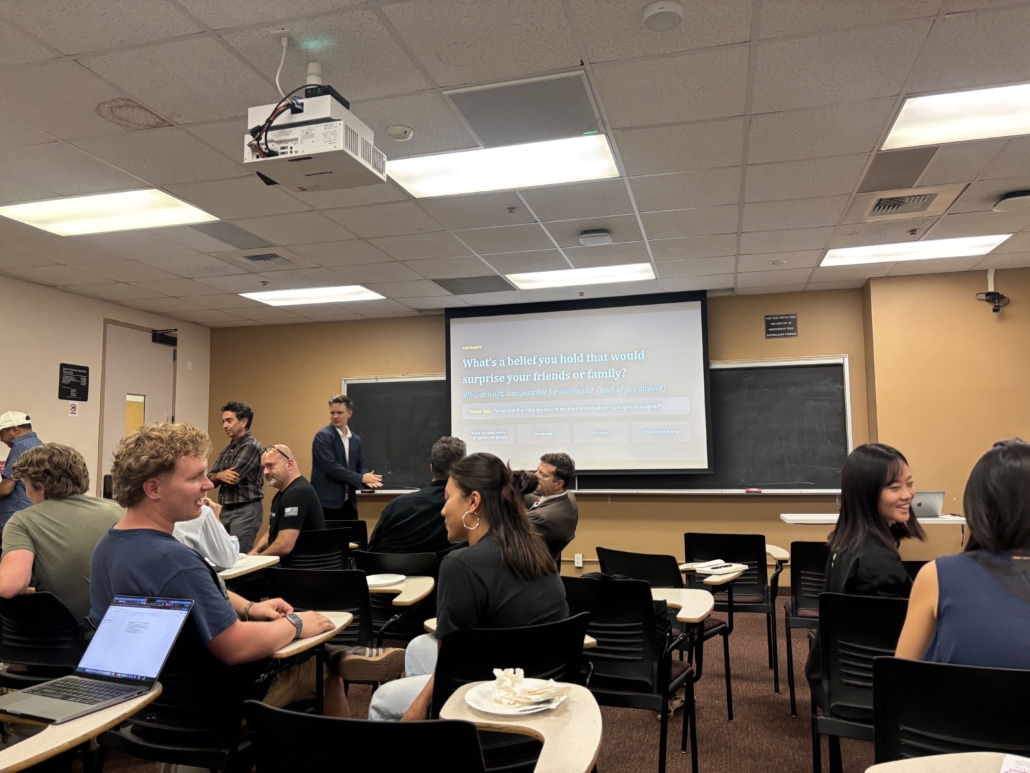
“What is the profession of this participant?” was a question posed to attendees at the Why Some Conversations Change Minds (and Most Don’t) interactive workshop, hosted by the Open Dialogue Project, on Monday.

In a poll, attendees were given various photos of individuals and asked to guess their professions. Jonathan Webster, a USC alum and managing director at StoryCorps, a nonprofit focused on storytelling, hosted the workshop. He said the poll was “intended to illustrate that automatic process that follows from a question like that” and how humans tend to take in information that affects their responses before actual conversations.

“You’re presented something like this — what does this person do?” Webster said. “You’re already taking in input that’s going to inform your answer even before you’ve begun to actively engage with the question.” 


Daily headlines, sent straight to your inbox.

Subscribe to our newsletter to keep up with the latest at and around USC.

After the initial poll, attendees were asked to think about something they used to believe and no longer do. Forty-two percent of respondents said new information or evidence changed their belief. This specific polling result would not match a broader sample taken from an audience representation of the United States, Webster pointed out. 

When asked to give an example of a belief changed by new information, Wesley Clum, a sophomore majoring in political science, said his past support of artificial intelligence development in the U.S. He later changed his mind after learning more about the topic.

“The new information around the future of AI and what it’s been doing recently is changing my mind pretty significantly,” Clum said.

Clum also spoke about the value of attending these events as a USC student, since they offer fresh perspectives. 

“Having an opportunity for people to go learn about something that is outside of their bubble is really important,” Clum said. “It makes students here more knowledgeable and better thinkers as well.”

The dialogue then moved toward the question, “Why does everyone argue?” Webster explained the mechanism of “what gets rewarded gets repeated” and used social media as an example.  

“We communicate a lot in comment sections, and what is the thing that gets rewarded?” Webster asked. “Dunking on someone, an effective dunk, definitely gets rewarded. … The reward is in winning. You’re trying to own the other side. You’re trying to dominate them. It’s not about an exchange, and it’s not about listening.”

According to Webster, the solution is listening closely, sharing openly and asking genuinely. 

Attendees were instructed to have a conversation with someone from a different background. After these one-on-one conversations concluded, many people said they could have used more time, reflecting a sample of a wider group where 70% of polled NPR listeners “wanted to talk to the same person again.” 

Additionally, guests were challenged to apply this mindset to their day-to-day lives by incorporating an extra question that isn’t necessarily required in their next conversation.

During the questions and answers portion, Angelina Silvestri, a master’s student studying science in integrated design, business and technology, said she wondered whether this advice would change in a setting involving one-directional communication, such as educational content. Webster noted a significant difference by pointing to the anonymity online conversations provide and the lack of constraints that comes with it. 

“I’m always looking to grow, expand my knowledge base, and [I] love when someone can change my mind or when I learn something new,” Silvestri said. 

At the end of the event, Webster acknowledged that it wasn’t important if anybody’s mind was changed by their conversations — their ability to understand the other person’s perspective was what truly mattered. 

“You shouldn’t really go into a conversation trying to change things,” Webster said. “You should go into a conversation trying to understand their mind, and from there, you’re gonna have a much better idea of where to go next.”

#top .hr.hr-invisible.av-1daqy5fw-b9fd85876bd9179a4a7cd5e0fb7cab27{
height:20px;
}

.flex_cell.av-gmjxq8c-6134c313735e7555123414a119f8c156{
vertical-align:top;
}

ADVERTISEMENTS

Looking to advertise with us? Visit dailytrojan.com/ads.

The post Open Dialogue Project covers how to facilitate meaningful interactions appeared first on Daily Trojan.

Posted in NewsComments Off on Open Dialogue Project covers how to facilitate meaningful interactions

Administrators strike down University Senate vote against health benefits plan

On Friday, Sept. 18, the University of Minnesota Senate voted 150-6 on a resolution calling for a pause on the implementation of this year’s healthcare benefits plan, which was announced July 22. 

Both the Faculty and University Senates met on Friday for special sessions, which included employee testimonies on how the changes to benefits will strain their livelihoods. 

The resolution, which was endorsed by members from the Student, Faculty, Civil Service and Professionals and Administrators Senates, called for the publication of cost and share analyses and at least a one-year pause. The resolution cites unsustainable employment conditions under the new plan, especially for lower-salaried employees. The resolution says the request is necessary for the University Benefits Advisory Committee to be able to conduct a cost-impact analysis of the new plan.

The BAC advises Vice President of Human Resources Ken Horstman, but its recommendations are not binding on the administration. While the University said it cannot comment on a University senate resolution until it has been officially reviewed, representatives said the healthcare plan must move forward to ensure clear coverage.

“To offer a clear set of benefits to employees during open enrollment in October and have them fully active by January, we must move forward now,” the statement reads. “This timing balances our commitment to provide competitive benefits, adequate time for employee review, and shielding employees from significant premium increases that would likely result from a delay in offering a clear set of benefits.”

Timothy Johnson, the chair of the Faculty Consultative Committee, said in the Sept. 18 Faculty Senate meeting that the University had given a response to the resolution prior to the vote. 

Johnson said President Rebecca Cunningham made it obvious at a Sept. 10 FCC meeting that the University would not be able to pause the rollout of the benefits plan right off the bat, though the minutes of the FCC meeting have not been posted by the University.

Jerry Cohen, the vice chair of the Faculty and University Senates, said the University giving a response to the resolution at the time of the FCC meeting was not in its best interest.

“You don’t want to tell a bunch of people who actually form the University that you’re not going to listen to them before they have a chance to speak,” Cohen said.

With the overwhelmingly negative response from employees, Cohen said he questions Cunningham’s commitment to the shared governance at the University and her attunement to the University community.

The University’s chapter of the American Association of University Professors President William P. Jones said if the University were to pause the implementation of the benefits plan, it would give shared governance bodies time to discuss and give input on the plan. 

FCC member Travis Workman said the committee was only consulted less than 48 hours before the benefits plan was sent to all employees.

Stephanie Taylor, the transplant Division Administrator & Project Manager of the Surgery Department in the Medical School, wrote a petition launched on July 27 that calls for the pause of the plan. 

The petition now has over 3,200 employee signatures. Taylor called for an immediate pause of the plan.

“Affordable health benefits have long been one of the University’s strongest recruitment and retention tools,” Taylor said. “Dismantling them undermines the University as an employer of choice”

Cohen questioned how the changes to the benefits plan will affect recruitment of new faculty, especially those who want to start families.

“Childbirth is a relatively simple process of biology, fraught with many difficulties in terms of things that can go wrong and things that cost a lot of money,” Cohen said. “So it’s not something that a young family enters into with a precarious health plan, right?”

Outside the University’s government response, Jones said the AAUP is encouraging the University to inform employees of the changes to the benefits. 

After the initial announcement of the benefits plan, Jones said the University held information sessions, but not all employees were able to attend.

While he does not belong to the demographic of employees greatly affected, Cohen said he is concerned for the lower-paid employees alongside him as a professor in the Department of Horticultural Science.

“If you get an $8,000 charge on a $50,000 salary, you tell me that doesn’t hurt,” Cohen said. 

The University Senate will further discuss with University administration on Thursday, Sept. 24, at Coffman Union at 2:30 p.m.

The post Administrators strike down University Senate vote against health benefits plan appeared first on The Minnesota Daily.

Posted in NewsComments Off on Administrators strike down University Senate vote against health benefits plan

Provost’s office discusses goals for retaining UO students

During the University of Oregon Academic and Student Affairs Committee meeting on Sept. 21, administrators in the office of the provost discussed UO’s lagging retention rates and harnessing alumni connections for career guidance.

“(Administrators) need to tackle, head-on, the sobering fact that we lose almost one-quarter of our undergraduate students after their second year here, which tells us that we’re not providing the distinctive experiences or the sense of belonging that we, and our students, expect,” Provost Christopher Long said.

Retention issues 

According to Ron Bramhall, associate vice provost for academic affairs, 14% of students leave UO after just one year, and 22% leave before the end of their second year. UO’s four-year graduation rate was 59% for 2026. Administrators said they want to increase that number to 70% – a percentage that Bramhall called a “lofty goal.”

“Every faculty, every staff member has a role in addressing this issue because every interaction we have with our students matters,” Bramhall said.

One issue looming larger than friendliness, though, is price. UO’s resident tuition falls around $15,000, and non-resident tuition costs roughly $45,000.

“We sort of have a double whammy. We are among the most expensive institutions for out-of-state students in the Big Ten public schools,” Bramhall said. 

This creates an “equity gap” with high rates of admission and low rates of retention for first generation students, students on Pell Grants and students of an “underrepresented race/ethnicity.”

“These are really tough dynamics,” Bramhall said.

To raise retention rates, UO plans to create more first-year interest groups and designate these groups as “opt-out” experiences for students that are at-risk to leave the university. 

The vice provost also said students will have increased access to advising and more holds will be placed on 100-level and 200-level courses for incoming students who are sometimes forced into upper-level courses during registration.

Further, UO is working to modify strict account hold requirements for students registering for classes. According to the university, in fall 2025, 36% of students had a hold at the start of registration and over 200 had a hold during the first day of classes. 

Clear career pathways and alumni connections

Administrators said they want to provide UO students with more concrete employment plans. 

“Increasingly, students and families are basing their choices of where to go to school on whether they feel confident that there will be a clear return on their investment,” Kate Morris, executive vice provost for academic affairs, said. 

Yet, Morris said, students don’t know where to direct their efforts when looking into activities, or connections to advance their careers. 

“Even with an increased attention and pressure placed on employment outcomes, studies show many of our students do not intentionally engage with career services until late in their undergraduate career,” Morris said.

To address some of these challenges, the academic affairs department is developing a university website where students can search for and connect with alumni in their field. 

Morris noted that some colleges and schools at UO already have platforms to connect students with alumni, like the Lundquist College of Business, College of Design and the School of Journalism and Communications. Morris said academic affairs wants to support these existing models and expand similar models.

Academic affairs has already hired two new “career communities” directors covering the fields of environment and law, and health, education and wellness.

“(Career communities) will create sustainable partnerships rather than transactional relationships … and it will help us turn a passionate but currently un-coordinated alumni network in their 30s and 40s, who have significant workplace capital, into one of the most powerful forces in our students’ career preparation,” Bramhall said.

No more applying for graduation

Over the past 6 years, nearly 2,000 students officially received their degree at least one term after they graduated and hundreds of these students waited more than a year to claim the degree, according to UO.

Bramhall said the office of the registrar now plans on defaulting to handing out degrees, unless students opt-out. Bramhall said this will make things easier for students and also streamline how UO tracks student graduation. 

“We are going to move to an automatic graduation process,” Bramhall said. “If you have completed 95% of the requirements, we can predict that you’re going to meet the rest of your final term and we’re just going to sign you up to graduate.”


The post Provost’s office discusses goals for retaining UO students appeared first on Daily Emerald.

Posted in NewsComments Off on Provost’s office discusses goals for retaining UO students