Author Archives | admin

Two cheers for gentrification | Alternating Current

Gentrification: what is it good for? If you were to ask this question on the average college campus, there’s a decent chance you’d get immediately pelted with tomatoes, but it’s worth asking anyway. Before we can answer it, however, we must first define our terms. To the extent that everyone can agree on what it means, gentrification denotes the process whereby a neighborhood’s character changes. This most often refers to demographics, more specifically an influx of affluent residents — or “gentry” — enticed by the prospect of jobs and development.

On its own, this doesn’t seem like an intuitively detrimental phenomenon — and indeed, in practice it’s frequently the opposite. Putting aside the composition effects of a neighborhood’s median resident becoming richer, gentrification creates a structural incentive for local economies to do more for consumers. The reason for this is simple: rich people can afford to splurge. As a result, gentrified neighborhoods often witness a Cambrian explosion of new restaurants, retailers and creative spaces — establishments which in turn act as boons to local employment.

And the benefits don’t stop there. Statistically speaking, richer neighborhoods also tend to suffer from less crime. Per person, the effect this produces is obviously negligible, but on net it can be fairly substantial. According to one study of gentrification in Cambridge, for example, in-migration of affluent residents since 1995 has driven a 16% fall in local crime rates, saving the city an average of $10-22 million annually and generating nearly $200 million in new property values.

With the above noted, no account of gentrification is complete without mention of the D-word: displacement. It’s often asserted that rich people moving into poor neighborhoods amplifies the risk that preexisting residents will be driven out. The most commonly proposed mechanism for this is rising property values, which themselves cause rising rents and property taxes, thereby rendering certain neighborhoods unaffordable for those without the means to pay.

Or so it’s thought. In truth, studies of high-powered datasets find that while gentrifying neighborhoods can modestly increase the risk of displacement, the risk they do face nonetheless remains comparable to those of non-gentrifying ones. One reason for this is that most poor neighborhoods simply aren’t very stable to begin with. Whether because of economic pressure or personal struggles, low-income residents are less capable of weathering turbulence in the housing market than the rest of society, gentrification or not.

That isn’t to say buffers don’t exist, however. Through interventions like rent control, inclusionary zoning and social welfare, cities across the United States have done a tremendous amount to prevent our nation’s poor from being frozen out of some of the planet’s most valuable real estate. They primarily accomplish this by decreasing the effective cost of urban living for existing residents, thus making it easier for them to stay in place regardless of whether the market thinks they should. 

And yet that may be exactly the problem. Although we like to regard these policies as essentially cost-free, they only work by coercing housing markets into supporting equilibria they wouldn’t generate otherwise. Whether by forcing developers to forego revenue so they’ll sell units below market value or making it almost impossible for landlords to evict unruly tenants, they produce an effect scarcely distinguishable from a tax on the construction and provision of new homes.

The ramifications aren’t hard to predict. Besides artificially constraining the housing supply, modern urban policy also makes its distribution conspicuously unfair. Paradoxically, this hurts gentrifiers the most: despite being significantly more willing to pay for access to desirable units, carve-outs for existing residents prevent them from outbidding these units’ current occupants. The result is an inversion of how markets normally operate, with incumbency effectively diluting — if not displacing — price as a signal for deciding who gets to live where.

Viewed this way, gentrification is more than a benign microeconomic process — it’s arguably a necessary pillar of urban justice, not least considering the many indignities America’s cities have suffered over the past century. A powerful case in point is Detroit. Once known as the “Paris of the Midwest,” the city’s demographics famously plummeted during the 20th century thanks to an unholy fusion of deindustrialization and violent crime. This was aggravated by the mayorship of Coleman Young, whose racially-coded policies led one local activist to opine that he “treated whites as second-class citizens.”

But times are changing. Thanks to revitalization efforts sponsored by the city’s upper crust, downtown Detroit is undergoing an urban renaissance, with local bosses investing generously in amenities like housing and security precisely so they can attract gentrifiers. And indeed they have, so much so that Detroit has actually grown its population by nearly 15,000 people since 2023. Economists note additional gains, including a $60 million budget surplus and a forecast 4.9% increase in real wages from 2019 to 2030.

Boston, take notes.

Posted in NewsComments Off on Two cheers for gentrification | Alternating Current

University of Minnesota celebrates 175 years

The University of Minnesota turned 175 years old this year, with Gov. Alexander Ramsey founding the institution on Feb. 25, 1851. The university spent this year celebrating the anniversary with multiple events, a timeline of accomplishments and a signature ice cream flavor.

In September, the University’s welcome week featured celebrations of the anniversary. These celebrations will continue through fall, Ann Aronson, the University’s Chief Marketing Officer, said, with annual celebrations like Oct. 24’s Homecoming marking key festivities for students, staff and community members.


Looking back

With the institution being chartered seven years before Minnesota’s founding in 1858, much of the University’s activity has influenced much broader statewide history, politics and culture.

Erik Moore, the head of the University Archives and the director of the University’s digital conservancy, said student activism efforts make up a core part of the University’s history. 

Moore said the 1969 Morrill Hall takeover, which led to the establishment of the University’s Department of African American and African Studies, is an obvious instance of student-driven change at the University, but is not the only one. 

He said it may be hard to see change in the short amount of time students attend the University, but over the course of time, student voices determine its path. 

First-year student Paige Welliver said it felt good to be a part of a history that includes student activism.

“It makes me feel happy to be here,” Welliver said. 

Aronson championed the long list of innovations that come from University faculty. She named retractable seat belts in cars, the cardiac pacemaker and Norman Borlaug’s Nobel Prize-winning wheat varieties as some life-saving examples. 

“Just go down Scholar’s Walk,” Aronson said. “That’s a good encapsulation of a lot of what’s happened.”

However, Moore said when celebrating the University’s history, it is important not to stop at the confines of campus.

“The University is an institution, and an institution is people, so it’s really about the people at the University,” Moore said. “Students, faculty, staff, who have made important discoveries, have had an impact in the communities, have interacted globally in their work.” 

John Chang graduated from the University in 2000, with a degree in Sociology of Law and Criminal Deviance. He said while he was not a part of any student activism, he felt like he was exposed to ideas that helped him grow. 

Chang said the University has changed for the better since his time here. He cited the renovations to Coffman Union completed in 2003, the opening of Huntington Bank Stadium in 2009 and the closure of Washington Avenue to public traffic in 2011 as notable positive developments.


Looking forward

The University’s history of innovation is not something that is going away, Aronson said. She cited the Spud Cell, the world’s first synthetic cell, as a recent discovery that continues the tradition. 

Although many of the University’s celebrations have highlighted major discoveries, Aronson said each current student is a part of the University’s history.

“They [students] are a part of this,” Aronson said. “We hope that they feel that way.”

Moore echoed this sentiment in his work with students. He said he likes to highlight the fact that every current student is a part of the University’s history.

“We want them to see themselves in the archives,” Moore said. “In the sense that the students they’re studying were just 19, 20, 21-year-olds too.” 

Chang said his family has three generations of University alumni. He grew up hearing stories of the University from his father. Chang was married at the Campus Club at Coffman Union and has watched nieces and nephews of his attend the University.

“There’s so much pride associated with that,” Chang said. “There’s so much history.” 

The post University of Minnesota celebrates 175 years appeared first on The Minnesota Daily.

Posted in NewsComments Off on University of Minnesota celebrates 175 years

Benefits of Playing Togel123 Login on a Trusted Site Today

mustangdaily.net – In the ever-expanding world of online gaming, Togel123 has become a popular platform for lottery enthusiasts. With its easy access and engaging gameplay, many players are drawn to try their luck. However, the key to a safe and enjoyable experience lies in logging in and playing on a trusted site. Here are the top benefits of choosing a reliable and secure Togel123 login site today:

1. Security of Personal and Financial Information

When you use a trusted Togel123 platform, your personal data and financial transactions are protected with the highest standards of encryption. This minimizes the risk of hacking, identity theft, and fraud, giving you peace of mind while you play.

2. Fair Play and Transparency

Reputable Togel123 sites operate under strict regulations and use certified random number generators to ensure fair gameplay. This transparency guarantees that all lottery draws are unbiased and every player has an equal chance to win.

3. Reliable Customer Support

Trusted platforms provide dedicated customer service to help you resolve any issues or answer questions. Whether it’s assistance with login, payment processing, or understanding game rules, support teams ensure smooth and satisfying user experiences.

4. Easy and Fast Transactions

A dependable Togel123 site offers efficient deposit and withdrawal processes. Fast transaction speeds mean you can enjoy your winnings quickly, without unnecessary delays or complications.

5. Attractive Bonuses and Promotions

Legitimate sites often reward loyal players with welcome bonuses, cashback, and promotional offers. These incentives enhance your playing power and increase your chances of earning rewards.

6. User-Friendly Interface and Mobile Compatibility

Trusted Togel123 platforms are designed with users in mind, featuring easy navigation and mobile compatibility. You can log in and play your favorite lottery games anytime, anywhere, without hassle.

7. Community and Competitive Environment

Playing on a recognized platform allows you to join a community of like-minded enthusiasts. You can participate in tournaments or group plays, enriching your gaming social life. Choosing to play togel123 login on a trusted site is essential for a secure, fair, and enjoyable lottery experience. From data protection and quick transactions to excellent support and exciting bonuses, these platforms deliver numerous benefits that enhance your chances of winning while safeguarding your interests. So, log in today on a reputable Togel123 site and enjoy your gaming adventure with confidence!

The post Benefits of Playing Togel123 Login on a Trusted Site Today appeared first on MUSTANGDAILY.

Posted in NewsComments Off on Benefits of Playing Togel123 Login on a Trusted Site Today

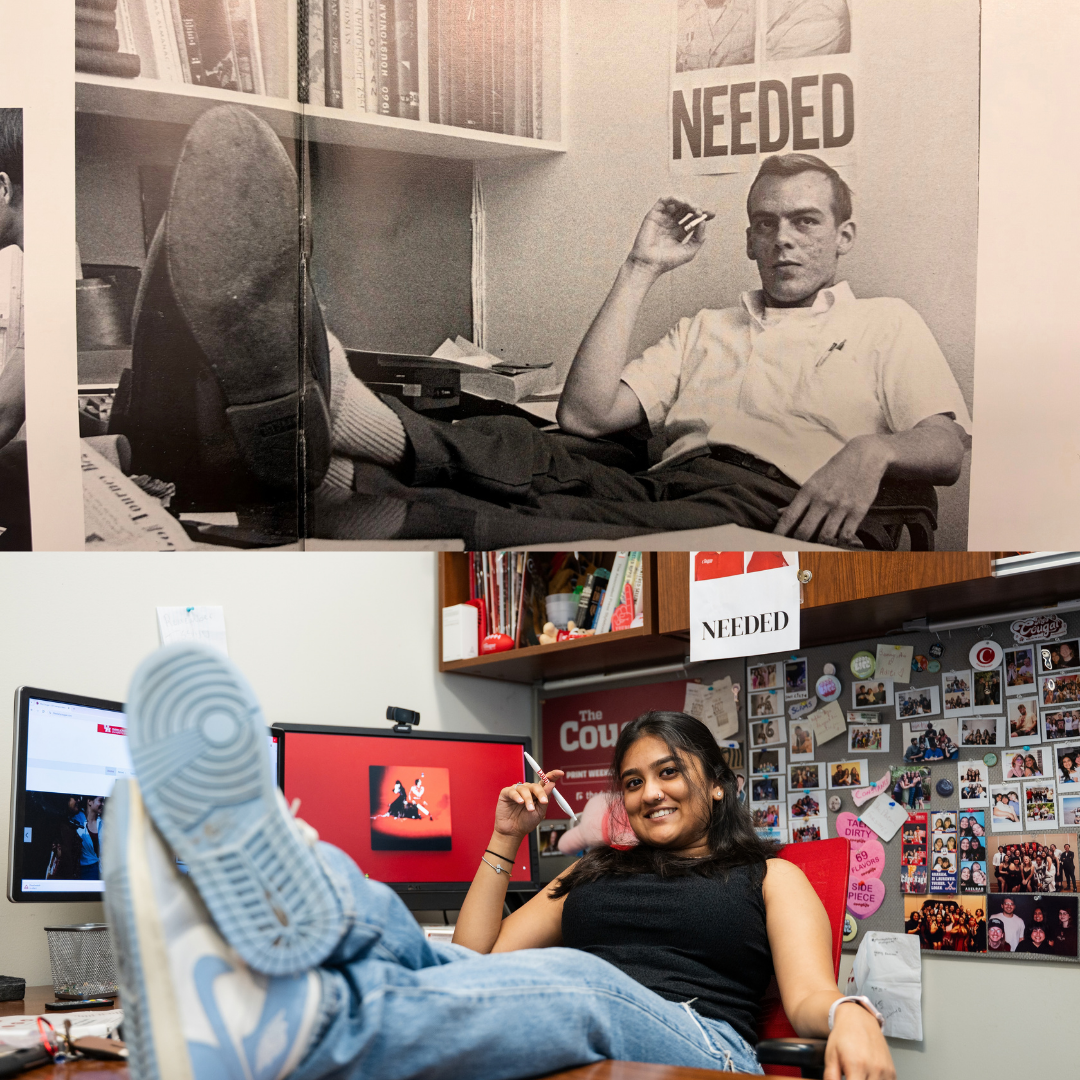
Daily Cougar Day: The legacy continues

Courtesy of The Cougar

Happy Daily Cougar day to the UH community! About three years ago, I never knew Oct. 5 would become such an important day in my life. This year marks the 92nd anniversary of the publication. 

However, what a lot of readers don’t know is that The Cougar actually came into existence in 1928 with its first issue in April, when our University was Houston Junior College. This technically makes us more than 98 years old. 

Last week, I dove deeper into the history of the publication and I realized how big of a part The Cougar has been over the years at UH and in Houston. 

Looking through the photos I could sense how the editorial board, for every Editor-in-Chief, is more than a team. It’s their family they get super lucky with and get to spend some incredible time, creating priceless memories. 

What started as a classroom project, quickly became an integral part of the University, resonating voices of everyone who associates with UH. 

The Cougar, being the oldest student organization on campus, is the bearer of witnessing UH’s unique story, every achievement, improvement and development. With each volume, The Cougar is a testament of the University’s legacy. 

We have covered everything ranging from campus, local, national and international news. It was truly a humbling experience to realize that Vol. 92 is now an integral part of something so important. 

However, I also realized something else. Over the past decade, a lot has changed: typewriters were replaced by laptops, telephones with smart phones and physical prints everyday with digital publishing. 

One thing that remained constant was The Cougar’s commitment towards the UH community. It was you, our readers and our passion to keep making your voices heard that kept us going. 

The publication has endured fires, floods, pandemics and storms, but we have never missed a beat and kept the UH community informed. Rain or shine, The Cougar has always been there. 

As Editor in Chief, I truly feel honored that I share my name with a list of some incredible voices like former Motion Picture Association of America Chairman Jack Valenti and Pulitzer-prize winning photographer Adrees Latif, who were once a part of The Cougar as well.

Not to mention, all the journalists who have worked for the Houston-area newspapers, television and radio stations over the many years relentlessly to keep the industry going. 

The Cougar is more than just a newspaper. It’s a place for everyone who has a passion for storytelling and wants to seek the truth behind every reasoning and in between every line. 

It unites the community and all student journalists together. While for some the newspaper acts like their reliable source of information, for others, like me, it becomes a family!

editor@thedailycougar.com

—
“Daily Cougar Day: The legacy continues” was originally posted on The Cougar

Posted in NewsComments Off on Daily Cougar Day: The legacy continues

Modular Classrooms as a Flexible Solution for Enrollment Growth

Academic planning involves more than just schedules and courses; space is one of the biggest and most complicated factors to address. It involves funding, design, permits, and construction, as well as the need to plan ahead and anticipate future needs with long-term projections.

Meanwhile, institutions must find immediate solutions every year. This is where portable classrooms come in: they add space within weeks and can be removed when the need passes.

Enrollment Growth Is Real, but Uneven

In higher education, enrollment is growing again, though not evenly. In the fall of 2025, college enrollment rose by 1%, with 187,000 more students, according to the National Student Clearinghouse. Community colleges grew by 3% and public four-year universities by 1.4%, while undergraduate enrollment at private nonprofit four-year institutions fell 1.6%.

Below the college level, the trend points the other way. According to the National Center for Education Statistics (NCES), U.S. public school enrollment fell by 2% between 2014 and 2024, from 50.3 million to 49.4 million students. Meanwhile, the U.S. general fertility rate fell 22% between 2007 and 2024, according to the CDC, a trend that could shrink incoming classes in the years ahead.

When planning an academic strategy, this means that growth exists, but it is neither uniform nor guaranteed. An institution may need ten more classrooms one year and no longer need them the next.

Why Does Flexibility Matter More Than Size?

Building a permanent structure is a long-term commitment. These types of decisions tie up capital for decades based on projections that do not always materialize. If enrollment stabilizes or declines, the space becomes underutilized, yet the costs remain.

In these cases, modular classrooms can be a solution, as they allow the space to be adjusted to actual demand. If enrollment continues to rise, units are added to the existing complex; if it falls, they are removed. And because delivery is quick (Nadler Modular, for example, typically sets up classrooms within one to four weeks of an order), the decision can wait for actual enrollment figures for that term.

Renting vs. Buying When Growth Is Uncertain

Renting is the most logical option when it’s unclear how long the peak will last. Contracts typically have a 12-month minimum, which covers a full school year and gives time to see whether demand holds. If demand is confirmed, leasing or purchasing becomes a more sensible option.

This is not a niche solution. According to the Modular Building Institute, school districts in North America have approximately 200,000 relocatable classrooms.

Planning for “Temporary” That Lasts

The “risk” of implementing this type of construction is that many classrooms installed as a temporary solution end up remaining in place for years. There are many possible reasons for this: enrollment doesn’t drop as expected, the budget for the new building is delayed, or, quite simply, the temporary solution works.

To ensure this decision is no longer a risk, the best strategy is to choose them as if they were here to stay. Most units now arrive ready for teaching, and accessibility features can be added. 


Planning based on projections is not easy and often involves significant investments. Modular classrooms offer a flexible solution to respond when demand arises and adapt when it changes. In the face of uneven enrollment growth, flexibility may be the best way forward.


The post Modular Classrooms as a Flexible Solution for Enrollment Growth appeared first on The Rocky Mountain Collegian.

Posted in NewsComments Off on Modular Classrooms as a Flexible Solution for Enrollment Growth

A balanced attack from No. 17 Oregon helped them take down Illinois in four sets

When an unstoppable force meets an immovable object, something has to give. Both teams came into this game playing their best volleyball of the season. Oregon (12-2, 3-1 Big Ten) was coming off their best win of the season: a reverse sweep over No. 10 Purdue. Illinois (11-4, 3-1 Big Ten) was coming off three wins against ranked opponents in a row, two of which being sweeps. 

In this case, it was Oregon that passed the immovable object. 

The collision course was set for an elite matchup, and it did not disappoint. The atmosphere at Matthew Knight Arena helped the Ducks get off to a hot start, taking the first three points of the match, featuring a service ace from libero Reese Sheppard. 

“I really appreciate our student section,” Trent Kersten said. “All the energy that they brought, I think they made the difference for us and carried us through the match.”

Illinois’ block was difficult to deal with for the Ducks to open the match, but Alanah Clemente was able to find two kills early to bring energy to the Oregon attack. 

Sheppard made some critical defensive plays that saved the Ducks from conceding points in the first set. The two sides went back and forth in the first set, but neither team was able to string more than four points in a row.

It wasn’t until outside hitter Laura Eitchert and middle blocker Iva Sucurovic came up with a huge block late in the set that the Ducks went on a run. They made the lead 24-21, only for Illinois to come right back with a 3-0 run of their own, making it 24-24. Illinois took the next point, causing Oregon head coach Trent Kersten to put Valentina Vaulet in, facing a one-point deficit. This decision proved to help the Ducks as they reclaimed the lead, until Illinois answered once again.

It went back and forth for a while, neither team being able to deliver the finishing blow, until finally, when the score was 30-29, Sucurovic and Clemente made one of Oregon’s best blocks of the season to win set one.

Clemente and outside hitter Sjakkie Donkers led the Ducks in the first set with six kills each. 

The second set was more straightforward. Illinois maintained control the whole set, taking an early 7-3 lead before Kersten called a timeout. The Ducks couldn’t get it together, though, as the Illini extended the lead to 11-3. 

Oregon started to put some points on the board thanks to Vaulet and Clemente finding openings through the Illinois block to get some kills, but it wasn’t enough to surmount the Illinois lead. 

A huge factor in Illinois’ dominance in the second set was their blocking ability. It was difficult for Oregon to find gaps for kills as the Fighting Illini totaled 11 blocks in the game. Even with Illinois’ strong defense, the Ducks hurt themselves with errors. 

The Fighting Illini took set two 25-15, capped off by an uncontested kill from Alyssa Aguayo.

After set two, Kersten made some adjustments.

“We just started playing better volleyball at the end of set two,” Kersten said. “We were really good on our defensive assignments.”

Set three opened favorably for the Ducks, with a service error from Illinois. Now it was Illinois’ turn to make errors. Oregon capitalized on this by extending the lead to 9-4. Clever placement from Clemente and a service ace from Vaulet paved the way for Oregon control set three. 

By the third set, it looked like Oregon had figured out Illinois’ block. 

“In the first sets I was kind of everywhere,” Donkers said. “I started to make some more angles and use the block more.”

Clemente and Vaulet were elite to close the third set. The two hitters delivered kill after kill, beating the Illinois block; however, it was Donkers who delivered the winning kill with a powerful hit to take set three, 25-20.

Set four was back and forth again. It was 3-3, then it was 10-10, all the way until the 12-12 mark, when the Ducks took over. Sucurovic had an emphatic overpass kill, setting the tone for the fourth set and extending the lead to 17-12. To close out the set, it was all Donkers. She had several powerful hits that the Illinois defense couldn’t do anything about. 

Clemente delivered the final blow with a strong cross-court hit to win the game.

Oregon wins 3-1. 

It wasn’t the cleanest game from either team, but Oregon got it done in the ugly moments, which was a crucial part of their win. 

Oregon displayed a balanced attacking effort the whole game, with Clemente, Vaulet, and Donkers each having over 14 kills. Setter Marina Crownover was of course a big part of this, delivering the Ducks’ hitters with 51 total assists. While still not 100% after missing the Purdue game, Vaulet made her mark on the game with 14 kills and a service ace. 

The Ducks head to East Lansing, Mich on Oct. 9 to take on Michigan State.

The post A balanced attack from No. 17 Oregon helped them take down Illinois in four sets appeared first on Daily Emerald.

Posted in NewsComments Off on A balanced attack from No. 17 Oregon helped them take down Illinois in four sets

CSU launches new Veterinary Hospital & Education Complex with goal of improving vet education, patient care

A dog named Wonder cut the ribbon at Colorado State University’s grand opening for its new Veterinary Hospital and Education Complex on Thursday, Oct. 1, signifying a new era in veterinary medicine at the university.

The new $230 million facility borders Drake Road and is an expansion of CSU’s already existing vet hospital program. The project broke ground in early 2024 and gives the university capacity for more students to enroll in CSU’s Doctor of Veterinary Medicine program. It is expected to see 42,000 patients annually, according to a press release reviewed by The Collegian. 

Morgan Berner-Jones, a fourth-year D.V.M. student ambassador who attended the grand opening, said she watched the project be built from the ground up.

“My senior year gets to be spent partially in this building,” Berner-Jones said. “It’s really cool. It’s been a vision since I came in as a first year.” 

The building will be home to the university’s new Ascend D.V.M. curriculum, which has been in the works for longer than a decade and will emphasize clinical reasoning, hands-on experience, classroom engagement and more. 

“With its systems-based approach, students will begin working with patients in their first year of veterinary school instead of their third year,” the press release reads. “The change is expected to enhance career readiness upon graduation.”

Berner-Jones said she is excited for the hands-on opportunities the building offers, noting incoming students will be able to gather surgical experience on site.

University leaders, members of CSU System Board of Governors, donors, elected officials and more gathered outside the complex for the grand opening, which included a number of speeches and allowed attendees to take a self-guided tour through the building. Attendees were welcomed by Sue VandeWoude, dean of CSU’s College of Veterinary Medicine and Biomedical Sciences.

The event began with a land acknowledgement, which was followed by a statement from CSU President Amy Parsons, who highlighted the impact of the building and thanked donors.

“There are moments in the life of a university when we get to see our ambitions become tangible, when years of ideas and planning and building and generosity become something that we can actually walk into,” Parsons said. “This is one of those moments. Today we aren’t simply opening a remarkable new facility. We’re making a statement about the future of veterinary medicine and about Colorado State University’s intention to help lead it.”

Colorado is one state of many facing a severe veterinary services shortage. A 2024 CSU study found over 65% of livestock producers experienced difficulty in finding services in 2023. Pet owners face a similar reality, with another 2023 CSU survey finding 71% of veterinary practice managers and owners had to turn away clients at least once a week. The same publication reported it takes 10.8 months to fulfill positions at their respective place of employment, on average.

Colorado Gov. Jared Polis also spoke at the grand opening, expanding on the impacts of Colorado’s veterinary shortage and sharing information about state initiatives that support animal health. 

In 2024, Polis signed Colorado HB24-1231, which in part provided $50 million for the construction of the facility. Sen. Barbara Kirkmeyer, who represents Larimer and Weld County, was a prime sponsor on the bill and was also in attendance at the opening.

Following voter approval of Prop. 129 in 2024, Colorado HB25-1285 established the role of veterinary professional associates, who, under certain circumstances, may practice veterinary medicine. 

“This facility will allow a larger class of veterinarians, as well as the very first class in the entire nation of veterinary professional associates,” Polis said. “That’s a movement that’s going to take off across the country. There are going to be many, but we have to remind everybody in the circles we run in that that started right here at CSU.”

The complex has the capacity to increase enrollment in the DVM program by 20% each year, bringing the Fall 2026 class to a total 174 students and contributing to the effort to address the shortage of veterinary care in the United States.

CSU’s DVM program has long been recognized as one of the top programs in the nation; the vet school ranked third in the 2026-27 Best Veterinary School Rankings from the U.S. News & World Report.

Other speakers at the grand opening included United States Congressman Joe Neguse, who represents Colorado’s 2nd congressional district, and Dr. Chad Johannes, executive director of clinical care at the veterinary teaching hospital.

Reach Chloe Rios at news@collegian.com or on social media @RMCollegian.

The post CSU launches new Veterinary Hospital & Education Complex with goal of improving vet education, patient care appeared first on The Rocky Mountain Collegian.

Posted in NewsComments Off on CSU launches new Veterinary Hospital & Education Complex with goal of improving vet education, patient care

More than a diagnosis: The importance of breast cancer awareness

The day my mom told me she had breast cancer, we were on an errand to our local gardening center. My window was rolled down, warm August air wafting into the car as we drove. I was supposed to be leaving for my freshman year of college in a week, and suddenly, what was supposed to be an exciting — and nerve-racking — time, was replaced with fear and unknowing for the future of my family.

Oct. 1-31 is Breast Cancer Awareness Month: a month dedicated to supporting and raising awareness for the millions of women and families impacted by breast cancer. According to the American Cancer Society, one in eight women are diagnosed with breast cancer in their lifetime. In the U.S. alone, four million women are actively living with a breast cancer diagnosis, making it the leading type of cancer in women. 

Breast Cancer Awareness Month was created in 1985 by the American Cancer Society to promote early intervention and reduce the stigmas surrounding physically-altering treatments such as mastectomies. First Lady Betty Ford served as the face of the movement after undergoing a total mastectomy following her diagnosis, and she was later backed by First Lady Nancy Reagan.

Both first ladies used their public positions to advocate the importance of preemptive checkups, which resulted in both women’s diagnoses. These women were trailblazers for raising awareness and reducing the stigmas associated with breast cancer, and modern-day celebrities such as Jenna Fischer, Cynthia Nixon and Maya Rudolph continue to advocate for proactive treatment and the normalization of breast cancer.

Breast cancer awareness is necessary not only to provide support for women combatting this disease, but also to raise awareness for the preemptive ways in which women can be checked for breast cancer — resources which are imperative for early intervention.

When my mom received her diagnosis, she was incredibly lucky that it was caught at an early stage. Although she’s still actively undergoing treatments a year after her diagnosis, my mom is now a huge advocate for yearly mammograms, seeing as that’s how she — and countless other women — have been able to detect malignant growths.

So what are the preventative measures, and who should be undergoing these procedures? The most common type of intervention is mammograms. These low-dose X-rays screen breast tissue for abnormalities and are often done annually. Additionally, ultrasounds or MRIs may be performed if mammograms reveal abnormalities.

While most healthcare professionals recommend women to begin yearly mammograms in their early 40s, it’s been found that women whose families have a history with breast or ovarian cancer should begin yearly checks with healthcare professionals as early as 10 years before the age of their family members’ diagnosis, or anytime before age 40. 

Additionally, women who have a family history with cancer should be checked for mutations in their BRCA1 and BRCA2 genes, which are causes of cancer development in young adults. According to the National Cancer Institute, “More than 60% of women who inherit a harmful change in BRCA1 or BRCA2 will develop breast cancer during their lifetime,” meaning that awareness about these genetic mutations is imperative to prevent breast cancer.

The day I learned about my mom’s diagnosis was life-changing. You never expect these things to happen to you or your family until you’re thrown into the middle of it. As difficult as this past year has been, it’s served as a reminder of the importance of support and resilience. 

Breast cancer changes the lives of millions of women and their families, and it’s imperative that these families have access to the healthcare and support systems needed not only to overcome this disease, but to prevent it as well. Breast Cancer Awareness Month is a time to acknowledge and support the women fighting breast cancer every year. Showing your support through donating, volunteering or simply spreading awareness helps the millions of women impacted by this disease every year.

For more information on breast cancer screening, awareness efforts and support, visit https://www.nationalbreastcancer.org/.

Posted in NewsComments Off on More than a diagnosis: The importance of breast cancer awareness

Satire: If I were President…

For no particular reason, I’ve recently been thinking about what I’d do if I were the President of the United States.

Would I make the world a better place? Would I earn my place in the history books?

The truth is, if I were president for even just a day, I know exactly what I’d do: Make my name unforgettable.

Firstly, every major policy initiative coming from my office would have my name plastered all over it. MatthewCare, the Jegers tax plan, the State of the Matthew address… if Obama can have Obamacare, why can’t I have those?

But policies are boring and weird. I’d be in control of so many cool things as President that I could add my own personal flair to!

For example, I could rename parts of the military. After all, the U.S. spends hundreds of billions of dollars on our military, and I can’t think of any better purpose than to use it as a prop to express my own greatness and unfathomable bravery.

Since many naval ships already carry the names of former presidents, I could just paint my name on the side of some aircraft carriers. But that’s way too boring!

I’d have people design a bunch of fancy new boats that I could call Matthew-class battleships. Money wouldn’t be an issue; it’s not like the nation’s in debt or anything, so we could build hundreds of these in my honor!

Heck, why stop there? I could rename the entire navy after myself! 

Every ship in my fleet would have the designator “USM” before its name — United States of Matthew. Imagine how much more dignity the U.S. Navy could have if they were all my personal billboards.

I doubt the sailors will mind that I haven’t spent a day in uniform, and I’d fire the admirals if they raised a fuss. Problem solved!

But we can’t have the only things carrying my name be out at sea all the time. Vanity starts at home, and there’s no place better to honor the best President ever than in Washington, D.C.

Banners with my face would hang from every government building in the city, just to remind everyone who’s in charge. Maybe I’d throw in a historical president or two just to compare myself to them, but those dead old farts could never compete with my handsome profile.

Speaking of historical presidents, why should they get all of the attention for their achievements and whatever when I’d be the one in control now? 

I’m not just talking about JFK’s little talent show or some building full of pencil-pushing nerds who get in my way. Washington, D.C. is full of public buildings, but if I were president, all public property would be my property, so I could do what I want with them.

The Lincoln and Jefferson memorials could use a new coat of paint, so I’d have my servants replace their statues with stunning renditions of yours truly. No one remembers the Gettysburg Address anyways, and since I’d have delivered far better speeches to trillions of people, I think I’d deserve a little more credit.

The Washington Monument would be a bit trickier, but with all of that open space, there should be plenty of room to paint my face in gold on each of the sides.

And since George Washington’s been dead for more than 20 years, he surely won’t care if I went just a tiny step further and renamed our nation’s capital after the true paragon of American virtue: Me!

But besides people who live in Jegers D.C. and any tourists who visit the new buildings that carry my name and face, not very many people across the country would truly understand how cool I am. I’d have to think bigger and ensure my face is unavoidable in everyday American life!

So, I’d turn to my personal favorite thing: Money. I’d make up some big new denomination of dollar bills — bigger than anyone’s ever seen before — and slap my face onto it. I think a $450 bill would be perfect, since 45 is my favorite number.

While I know that not a lot of Americans may be seeing $450 in cash very often in this economy, I’d have a backup plan for the “poors” in the form of new dollar coins. Then everyone could see I’m just as valuable to this country as Sacagawea, Susan B. Anthony and other woke figures

In fact, why not have my face and signature on every bit of money that Americans handle? Ben Franklin’s irrelevant, and Hamilton can star in another hit Broadway show for all I care. As long as Americans can’t go a few hours without seeing my name or gazing into my beautiful eyes, America will be great again.

It doesn’t matter that it’s illegal. The Treasury Department works for me, so they have to do whatever I want.

With all of the power I’d have and all of the things that would be named after me, it’d almost be like… I am America. And if I’m America, why not take this rebranding global?

I could just slap my face on American passports, but that’s much too small. By threatening a few mapmakers, I could easily rename the Atlantic Ocean in my honor, or maybe create the Matthew-terranian Sea!  No international body of water would be too big or small to escape my Sharpie.

The United Nations may protest, but when faced with Matthew-class battleships, I think they’ll come to enjoy their new maps.

I wouldn’t stop there either. All nations starting with the letter “M” better watch out, or they might find themselves with a far better name that they can really bask in the glory of.

At the end of my term, I would get to sit back and look at my successes. My name on every building, my face on every dollar. Other presidents had to work and wait for their successors to honor their legacy, but not me. I would carve my legacy into everything I could reach without even having to do that pesky thing called governing.

Now, if only someone would elect me president…

The post Satire: If I were President… appeared first on The Minnesota Daily.

Posted in NewsComments Off on Satire: If I were President…

USC football wins close one over Washington

.flex_cell.av-av_cell_one_fourth-07d30e11a6a5b37cb8a80b2906d41ea3{
vertical-align:top;
}

USC football wins close one over Washington

Several second-half scores allowed the Trojans to take Saturday night’s game.

#top .hr.hr-invisible.av-av_hr-3cdc9664f29087702913853352eac422{
height:10px;
}

By DILLON ZAMPERIN

#top .hr.hr-invisible.av-av_hr-3cdc9664f29087702913853352eac422{
height:10px;
}

.avia-image-container.av-mutaekvb-f1fbc17258c0d1caa9f42a7f6dd8607d img.avia_image{
box-shadow:none;
}
.avia-image-container.av-mutaekvb-f1fbc17258c0d1caa9f42a7f6dd8607d .av-image-caption-overlay-center{
color:#ffffff;
}

Redshirt senior running back Waymond Jordan rushed for an 8-yard touchdown in the second quarter of USC’s win over Washington. (Zach Carter / Daily Trojan)

.flex_cell.av-av_cell_one_fourth-07d30e11a6a5b37cb8a80b2906d41ea3{
vertical-align:top;
}

.flex_cell.av-av_cell_one_fourth-07d30e11a6a5b37cb8a80b2906d41ea3{
vertical-align:top;
}

After one of the worst first halves the Trojans have seen this season, USC came back in the second half with a vengeance, converting multiple late scoring opportunities for the 25-21 win.

Washington (3-2, 0-2 Big Ten) threatened early in the third quarter, leading by as many as 11 points. However, No. 18 USC (5-1, 2-1) responded in a big way, ending the game with 15 unanswered points to secure the victory Saturday night.

A kickoff temperature of well over 90 degrees was about the only hot thing in the first half, as both offenses struggled to score. As the game progressed, the temperature cooled, but USC’s defense and receiving core started to heat up.


Daily headlines, sent straight to your inbox.

Subscribe to our newsletter to keep up with the latest at and around USC.

Redshirt senior quarterback Jayden Maiava cleaned it up in the second half after an interception in the second quarter, and looked more like himself for the first time since the win over Rutgers (1-4, 0-2) two weeks ago. Maiava completed 21 of his 34 passes for 245 yards, throwing a touchdown in the third quarter to sophomore wide receiver Tanook Hines.

Hines reemerged after struggling to connect with Maiava during the first five games of the season. On Saturday night, he secured five catches for 51 yards and a crucial touchdown. Redshirt sophomore wide receiver Zacharyus Williams also broke out, catching four passes for 78 yards and putting the Trojans in good field position throughout the game.

In total, the Trojans’ offense garnered 360 combined yards, with 81 of their 115 rushing yards coming from redshirt sophomore running back King Miller. Miller’s counterpart, redshirt senior running back Waymond Jordan, found the end zone on an 8-yard rush to help the Trojans take the lead early in the second quarter.

The game shifted in USC’s favor in the third quarter, when redshirt sophomore linebacker Elijah Newby smacked the ball out of Washington junior quarterback Demond Williams Jr.’s hands. The forced fumble was recovered by USC sophomore defensive tackle Jahkeem Stewart and taken back to the house for a touchdown, the first of Stewart’s career.

The Trojans recorded five sacks by five different players, helping to account for the win. Senior safety Christian Pierce was a force to be reckoned with in the secondary, recording nine solo tackles in an all-around strong game.

USC will take on a reeling Penn State (3-2, 0-2) Saturday at 4:30 p.m. at Beaver Stadium in University Park, Pennsylvania.

#top .hr.hr-invisible.av-av_hr-82f5be0ae0af6a64fe3091010b237709{
height:20px;
}

.flex_cell.av-av_cell_one_fourth-158c56ad4987fbee32a30a1d6c306202{
vertical-align:top;
}

The post USC football wins close one over Washington appeared first on Daily Trojan.

Posted in NewsComments Off on USC football wins close one over Washington