Author Archives | Adam.Hermann

A freshman’s guide to men’s bball

Shooting guard Chris Fouch will play for the Dragons this season in his sixth year of eligibility. The NCAA granted Fouch a second redshirt year following an ankle injury he suffered during Drexel’s third game of the 2012-13 season.

[media-credit name=”Ken Chaney” align=”alignleft” width=”300″] Shooting guard Chris Fouch will play for the Dragons this season in his sixth year of eligibility. The NCAA granted Fouch a second redshirt year following an ankle injury he suffered during Drexel’s third game of the 2012-13 season.

Eighteen months and 10 days ago, the Drexel men’s basketball team had a chance to play in the NCAA Tournament. It was an extremely realistic chance if you ask any of the college basketball analysts who wrote articles the next day about the Dragons being snubbed from going dancing.

Alas, the 2011-12 men’s basketball team never found that No. 14 seed that awaited them in the play-in rounds. They reached the National Invitation Tournament quarterfinals before falling to the University of Massachusetts Minutemen, a disappointing and arguably unjust ending to a 29-7 season that saw a 19-game win streak go unrewarded.

That season marked the end of Samme Givens’ storied career as a Dragon, but around Drexel’s campus the program was seeing a rebirth of hope that carried over to the “Revenge of the Dragon” campaign in 2012-13. The team was picked No. 1 in the Colonial Athletic Association preseason poll, then-junior point guard Frantz Massenat was named the preseason player of the year, and all signs pointed to a successful re-up bid at the tournament.

But the Dragons saw their attempt at spiteful vindication go up in flames. They finished 13-18, the second-worst season in James “Bruiser” Flint’s tenure as Drexel’s head coach.

“It definitely was a step backwards; that goes without saying,” Flint said. “Everybody knows that. We have to tighten up because last year we didn’t prepare ourselves well and we didn’t get ready.”

On one hand, the campaign was a failure. There was campuswide disappointment as the yellow-clad DAC Pack members had their egos checked at the door. The raucous fervor that had engulfed the student body less than a year before had been halved.

The enthusiasm behind the men’s basketball team took a massive hit.

However, while it is easy to call last season a step backward, it is can also be seen as a source of lessons and motivation for Flint and his players.

“We’ve got to come to play,” Flint said. “Guys have to be ready. I think we’ve prepared a little bit better than we did the year before, but we have to do better come fall. I thought we had a good summer. I know our guys worked hard in the summer — I thought we challenged ourselves a lot, and the coaches challenged the players — and so now we have to show it in the fall.”

The Dragons were handed a slice of humble pie last season without actually losing integral players, an unbelievably lucky occurrence in collegiate athletics. Typically, the thrifty four-year window of eligibility limits team building between a consistent crew. Between graduation and draft chasing, a redo is almost unheard of. But this year, the Dragons will essentially have just that.

The aforementioned Massenat, junior guard Damion Lee, and sixth-year guard Chris Fouch, the three pillars of what will likely be the most potent guard-oriented offense in the CAA this season, are all returning for this chance at redemption. Their ability to play together for three straight years despite Fouch being three years ahead of Lee is a rare thing.

Fouch’s story is the most remarkable part of the Dragons’ chances this year. In his fifth year of school and final season of NCAA eligibility, Fouch broke his ankle in the third game of the 2012-13 season against the rival University of Pennsylvania.

His injury played a big role in the nightmarish outcome of last year, and the Dragon faithful feared that they watched the guard’s last chance at the NCAA Tournament go down in a heap at the Palestra.

But this past spring the NCAA granted him an additional year of eligibility due to the short amount of time he played last year, reuniting the three-headed guard attack for the upcoming season.

Along with returning forwards Kazembe Abif and Dartaye Ruffin, who are more than serviceable players, the team has a chance to take the step that the student body was waiting for last season.

A hot start to the season would pack the DAC; a hot season would pack it for the next five years. Here at Drexel, the student body lacks a college football team — when you look past our improvisational comedy group, that is — which is a common rallying point for most college students, whether they’re rabid sports fans or not.

It isn’t necessarily about the actual game being played or the statistics being recorded and plays being called. Rather, it’s about celebrating together as a singular student body. The unified heart of a university beats with its most publicized sports team, a title the Drexel men’s basketball team could hold aloft if it lives up to expectations this season.

This was proven in the 2011-12 season mentioned earlier. During the red-hot streak of beautiful basketball, the DAC was packed every time the Dragons played a home game, leading University of North Carolina Wilmington head coach Buzz Peterson to call it a scary place to play. The DAC Pack made the top 10 in a national search for the best college basketball student section in America. The belief was contagious, and the players believed, too.

There was a mutual respect and belief in each other; if the Dragons showed up on the court, the fans would show up in the stands. After the team won the regular-season title, Givens and a number of other Dragons celebrated in the stands with the DAC Pack. That iconic Drexel basketball photo was seen as signaling a new age for the men’s basketball program.

“The home-court advantage is huge for any team, including us,” Flint said. “People don’t like to play here because they feel uncomfortable with the students real tight to them.

“A lot of people made a lot of comments to me, like, ‘Hey man, your place always looks exciting,’ and a lot of that has to do with the DAC Pack. They do a great job bringing excitement to it.”

This year, with the help of the student body, the team can take the torch and act as if last year was just a building block. The talent is present, and when the talent is present, belief is never far behind.

In the end, all it takes is execution.

Image courtesy of Ken Chaney

The post A freshman’s guide to men’s bball appeared first on The Triangle.

Posted in UncategorizedComments Off on A freshman’s guide to men’s bball

Baseball’s non-steroid storylines deserve attention

Oakland Athletics third baseman Josh Donaldson follows through after connecting for a three-run homer off Cincinnati Reds pitcher Homer Bailey during the fourth inning at O.co Coliseum in Oakland, Calif., June 26.

[media-credit name=”Anda Chu Bay Area News Group/MCT Campus” align=”alignleft” width=”300″] Oakland Athletics third baseman Josh Donaldson follows through after connecting for a three-run homer off Cincinnati Reds pitcher Homer Bailey during the fourth inning at O.co Coliseum in Oakland, Calif., June 26.

To the casual sports fan, it may seem like baseball’s regular season has ended. To the casual sports fan, the main storyline in baseball at the moment might appear to be the downfall of a disgraced former superstar and his impending suspension. After all, the important parts of the season, like games and pennant races, are over, right?

Well, casual sports fan, you’ve been duped. The sporting society has indeed turned its white-hot, always narrow-minded gaze upon a slew of negative stories. But, believe it or not, the league is actually still playing enthralling baseball games every night.

There are a handful of teams competing for division titles that were laughingstocks of Major League Baseball in years past. One of those teams hasn’t had a winning season in two decades, and yet that very team has the best record in the major leagues.

How have you not heard more about this supreme team? They have witnessed the evolution of a third baseman from a potential franchise player into league-leading home run hitter and the turning of an already rabid sports city on its head.

When you say it like that, producers across the country are salivating at the idea of covering this team at the top of the hour.

When you tell them the team is the Pittsburgh Pirates, they pick their jaws up off the floor and return to their 23rd straight day of covering a boat in a lake in Connecticut.

Connecticut doesn’t have a major league team, but there might just be a gun in the bottom of a lake there!

You shouldn’t pretend to understand the methods behind mass sports media’s increasing madness. Instead, you should buckle up and learn about three teams that are playing supremely entertaining baseball with fewer than 50 games remaining in the season.

The first team, as previously mentioned, is the Pirates. The Buccos, as they’re colloquially known in the Steel City, are in a fistfight for first place in the National League Central with the St. Louis Cardinals. Fans entered the season with their sights set on an 82-80 record because the team has not experienced a winning season since 1992, when the team played in a different division. Now, if the team finishes the season with 82 wins, fans will be unfathomably disappointed.

It doesn’t seem like that will be the case, though. Players up and down the roster have elevated their respective levels of play this season, but none more so than third baseman Pedro Alvarez. Once viewed as the future of the downtrodden franchise, “El Toro,” the second overall pick of 2008, has parked 27 home runs and 73 RBIs in 104 games so far this season.

His 27 home runs are the top in the National League, a distinction a Pirate hasn’t held at the end of the season since first baseman Willie Stargell back in 1973. That’s right, 40 years ago.

It’s a resurrection season at PNC Park.

Moving northwestward up the Rust Belt, the Cleveland Indians are playing inexplicably powerful baseball and have found a way to keep pace in the American League Central, resting only seven games behind the Detroit Tigers as of Aug. 8.

The Tigers, stacked with superstars like Justin Verlander, Miguel Cabrera and Prince Fielder, have a plus-139 run differential. The Indians? Plus-47.

Their best offensive producer is second baseman Jason Kipnis, who leads the team in home runs, RBIs, runs, on-base plus slugging, and — naturally — batting average. Yet he doesn’t have a single leap-off-the-page statistic.

In the American League, Kipnis is 15th in batting average, tied for 28th in home runs, and tied for 10th in RBIs. He’s the Tribe’s best offensive player, and yet Cleveland is ranked fourth in MLB in runs scored this season.

Instead of world-beating stars, the Tribe has adopted the mantle of balance and consistency. The team has eight players who are on pace to finish the season with 100 or more hits, and while there isn’t a single 20-home run man in the lineup, they will more than likely roll into the last days of the season with eight 10-home run men.

All this offensive balance has left the Indians just a half game out of a wild-card spot in the postseason. And if they happen to reach the postseason, there won’t be fear of a drop in production from their best player because there are seven more players lined up behind Kipnis, ready to knock a few balls into play night in and night out.

And then there’s a thrilling team out west, sporting the best color combination in baseball and sitting above two teams with payrolls that more than double its own.

The Oakland Athletics are busy proving that last season was not a fluke.

After Barry Zito led the A’s to the American League Championship Series in 2006, Oakland was mired in a streak of losing campaigns, competing with the Seattle Mariners for the AL West basement. But last season, in their first full season under manager Bob Melvin, the A’s broke out their run of bad luck and pushed the Tigers to Game 5 in the American League Division Series.

This year, they have picked up right where they left off. In a fashion similar to the Indians, they don’t have a breakout offensive star or even one player who leads the team in a bunch of offensive stats.

Third baseman Josh Donaldson leads the team in RBIs in his first full season in the majors, while Home Run Derby champion and bat-flipping left fielder Yoenis Cespedes is tied with first baseman Brandon Moss for the home run lead on the team at 17.

It never hurts to have one of the best pitchers in the AL, either, but it’s not who you would expect. Forty-year-old Bartolo Colon has put together his best season since he won the AL Cy Young Award in 2005, piling up a 14-4 record and currently boasting the sixth-best ERA in the AL. He won’t win the Cy Young again this year — Detroit’s Max Scherzer is making sure of that — but according to the wins above replacement metric, Colon has been Oakland’s MVP this season. He ages well.

If you had never heard of a few of the players referenced in this article, it’s excusable. Alvarez, Kipnis and Donaldson don’t use steroids, don’t commit crimes, don’t break league rules, and don’t spend many rambunctious nights out on the town.

But these are the three teams you should watch if you enjoy watching sports instead of following court cases.

These three teams just play good baseball. It’s not flashy enough to lead off on SportsCenter, but it may just be effective enough to play into October.

Image courtesy of Anda Chu Bay Area News Group/MCT Campus

The post Baseball’s non-steroid storylines deserve attention appeared first on The Triangle.

Posted in UncategorizedComments Off on Baseball’s non-steroid storylines deserve attention

MLB busts Braun for PED abuse

Baltimore Orioles Chris Davis watches the flight of his two-run home run against the Washington Nationals during the seventh inning at Oriole Park at Camden Yards in Baltimore May 29.

[media-credit name=”Gene Sweeney Jr. Baltimore Sun/MCT Campus” align=”alignleft” width=”258″] Baltimore Orioles Chris Davis watches the flight of his two-run home run against the Washington Nationals during the seventh inning at Oriole Park at Camden Yards in Baltimore May 29.

Major League Baseball suspended Ryan Braun of the Milwaukee Brewers July 22 for the final 65 regular-season games and any potential postseason games of the 2013 season.

I’ll give you three guesses as to what he was suspended for.

Yes, once again, Braun was tagged by the league for performance-enhancing drug involvement and abuse. For those of you counting at home, 10 of the last 24 winners of the American and National League MVP awards were players who have admitted to using PEDs.

Alex Rodriguez, Barry Bonds, Miguel Tejada, Jason Giambi, and now Ryan Braun have all tested positive for PEDs and subsequently admitted to using them.

The Steroid Era, as it has come to be known, has ruined the enjoyment of modern baseball because it has destroyed the possibility for another Hank Aaron. There will never be another Babe Ruth, Reggie Jackson or Ted Williams.

In today’s baseball landscape, success now comes with a subconscious price tag. It’s almost reflexive: If a player is both new and suddenly good, he must be cheating. There is no other way.

There was a time when I would have been enthralled by this year’s power-hitting monstrosity, Chris Davis of the Baltimore Orioles, who tied Jackson’s record mark of 37 home runs before the All-Star break July 14.

Tying a record — especially a record set by a baseball icon as tall as Mr. October — is as good as it gets for baseball, players and fans alike. The game is so intrinsically tied to numbers, with each turn making a season the equivalent of a gigantic role-playing game, that when a historic number falls, it’s meant to mean something.

MLB’s records are meant to be tied and broken, but they are meant to be tied and broken on level ground, men topped by equal men.

Instead, when I witnessed Davis tie Jackson’s record, I was struck by an overwhelming sense of cynicism. It was impossible to believe that this epic feat meant anything beyond providing damning evidence for yet another PED abuser in baseball. Davis’ totals, to that All-Star break date, were already higher than his totals from all 139 games he had played the year before. He had always possessed a power-hitting prowess during his days with the Texas Rangers; however, he never played more than 60 games in a season from 2009 to 2011 because of his penchant for striking out.

Then, after a fortuitous trade, he got a shot with the Orioles last season. He hit 33 home runs, drove in nearly 100 runs, and progressed quickly. Davis is now one of the two best sluggers in the game this year.

So this means that it took just two years and a change of scenery for Davis to go from hitting .192 in Texas to hitting 37 home runs before the All-Star break in Baltimore.

See why it’s so hard to believe?

It really shouldn’t be this way for baseball players. In sports, while they always seem random on a case-by-case basis, pop-up superstars are a pretty common phenomenon. A player finally figures out a mechanical fix for whatever was plaguing his or her game, and all of a sudden the floodgates open.

In baseball, however, it has become a different story. No longer are fairytale players plausible or believable. Players like Rodriguez, Bonds, Giambi and Braun have done their best to ensure this. And still Rodriguez, Giambi and Braun maintain MLB contracts. There has been no true punishment for defaming and defacing a sport once beloved for its workmanlike approach to recognition and adoration.

That those three players remain employed in the very league they have cheated time and time again is a testament to why the success of players like Davis, Jose Bautista, and even perennial slugging champion Miguel Cabrera must be viewed with a grain of salt.

This is why it’s time for Commissioner Bud Selig and MLB to start banning players. For life.

It may seem like an extremely dramatic step, the lifelong banning of players for transgressions that seem to be only skin deep. The MLB Player’s Association would certainly have something to say on the matter. Passing such a rule would be an extremely convoluted process in today’s MLB.

And what’s the point? Rule-breaking happens every day, you might say.

But in the common workplace, you and I can’t repeatedly break key company rules and realistically expect to retain our jobs. Were I to test positive for an illegal substance during a random company-wide drug test at any job, I would fully expect to be fired. There would be no safety net, no expectation of returning to the company, and no adoring fans to fall back on.

Breaking explicit rules should result in discipline. It’s time for the bosses of MLB to start behaving like the bosses of the rest of our country’s organizations and corporations.

And this isn’t just pointed at repeat offenders. This is pointed at any player who breaks the rules outlined in the league’s Joint Drug Treatment and Prevention Program. Under Section 2, the rules clearly outline a list of 65 performance-enhancing drugs that are banned while participating in MLB.

There’s no shaky legal speak in Section 2. It’s extremely straightforward:

“All Players shall be prohibited from using, possessing, selling, facilitating the sale of, distributing, or facilitating the distribution of any Drug of Abuse, Performance Enhancing Substance and/or Stimulant (collectively referred to as ‘Prohibited Substances’).”

In short, players are not allowed to be associated with the drugs.

Which is why, once a player is proven guilty beyond reasonable doubt of breaking this excruciatingly clear and rigid rule, that player should be banned from the league whether or not admission is ever given publicly or privately.

Because, as we were once taught, when you break a rule, there are consequences. When you cheat fans, teammates, opponents, coaches and owners of their time and hard-earned money, there are consequences. And if the league doesn’t back up its own policies and rules with a punishment harsh enough to ensure that they will no longer be broken, there is no reason in even putting the rules in place.

By not banning players after they break a rule as important and prevalent as PED use, the league is essentially endorsing their use. They are telling players that while they will be punished in one sense, they will also be allowed to return to seven figures and lavish lifestyles relatively soon.

There were rumblings during the Mark McGwire and Sammy Sosa home run duels in the late ‘90s that MLB executives and higher-ups willingly ignored PED use because it fueled fan interest. But it became very clear during Bonds’ eventually successful run at Aaron’s home run record that fans don’t want tainted records. They don’t want the game that they have loved for years to become tarnished by players who feel the need to step on over a century of bare-bones skill and determination.

To expect 20-year-old All-Star Bryce Harper of the Washington Nationals to indulge in the same diet as Ted Williams in 1941 is unrealistic. To ask these men to adhere to customs 70 years before their time is foolish.

But what isn’t foolish is asking them to adhere to rules set by the league that has afforded them the chance to play the sport they love. Nor is it foolish to expect the league that has 144 years of history to defend the honor of the men who came before the Steroid Era.

The most curious part of this era, in fact, is that MLB actually has a history of banning players for cheating.

Take, for example, the case of the 1919 World Series “Black Sox” scandal, in which the eight White Sox players charged with throwing the games were declared ineligible by Commissioner Kenesaw Mountain Landis. He cited the need to maintain the game’s clean image.

In 1989, Pete Rose, at that time the manager of the Cincinnati Reds, was placed on the league’s ineligible list by Commissioner Bart Giamatti after a report by lawyer John M. Dowd provided evidence that he was spending north of $10,000 per day wagering on Reds games.

Both of these instances resulted in lifelong bans because of Rule 21 in the MLB rulebook, Section D:

“Any player, umpire, or club or league official or employee, who shall bet any sum whatsoever upon any baseball game in connection with which the bettor has a duty to perform shall be declared permanently ineligible.”

It seems time for the league to institute a new rule on misconduct in the wake of the past two decades of “baseball” that can only be labeled as a gross misrepresentation of the sport.

Let it read:

“Any player who is determined to have violated the league’s Substance Abuse Policy whatsoever shall be declared permanently ineligible.”

With the passing of that rule, the game would have a chance to be restored to its glory days, a time when baseball was as much a religious gathering as anything held on Sundays. Ballparks were chapels and pitchers the pastors; the baselines were the aisles and the bleachers were the pews. Fans gathered to watch men who had spent countless hours just swinging, throwing and running to reach this point. The players were the saints of the two-seams.

Today, if they don’t cheat, they’re just victims of the unpunished violations.

Oakland Athletics General Manager Billy Beane once said that it’s hard not to be romantic about baseball.

Unfortunately, it feels like another saying may be creeping into the sport’s vernacular: “It’s hard not to be cynical about baseball.” The players who play and the men who pay both seem unwilling to make a change that is necessary to maintain the integrity of baseball.

While Braun, Giambi and Rodriguez continue to remain tied to professional baseball teams, there are hundreds, and thousands, and maybe millions of twentysomethings around the world chomping at the bit to get a shot under the MLB spotlights. They don’t bring needles and pills; instead, they bring a love for the sport and a desire to play, not just win.

To the players who don’t cheat, the phrase “at any cost” means something completely different than it does to the players who do. As we wait for an answer from those who run a league rapidly running out of wiggle room, there is the question of “What is that cost?” which has been sitting at Selig’s feet for the past decade.

Because in the ultimate sport of numbers, there is no place in the box score for “PEDs used.”

Image courtesy of Gene Sweeney Jr. Baltimore Sun/MCT Campus

The post MLB busts Braun for PED abuse appeared first on The Triangle.

Posted in UncategorizedComments Off on MLB busts Braun for PED abuse

Flyers sign three new free agents

From left, recently acquired Mark Streit, Ray Emery, and Vincent Lecavalier don their new Philadelphia Flyers sweaters during a news conference in the Hall of Fame room at the Wells Fargo Center in Philadelphia July 9.

[media-credit name=”Alejandro A. Alvarez Philadelphia Daily News/MCT Campus” align=”alignleft” width=”300″] From left, recently acquired Mark Streit, Ray Emery, and Vincent Lecavalier don their new Philadelphia Flyers sweaters during a news conference in the Hall of Fame
room at the Wells Fargo Center in Philadelphia July 9.

The Philadelphia Flyers experienced this past season what nobody in the City of Brotherly Love expected: regression. After tangoing with, and topping, the rival Pittsburgh Penguins in the first round of the 2012 Stanley Cup Playoffs just one season before, this year was a marked step backward.

The team underperformed at every position, and the result was an absence from the NHL postseason for the first time since 2007. Fans felt it was obvious: The Broad Street Bullies-turned-Babies needed some kind of jolt this offseason, and the front office decided to listen.

To many Canadians and a handful of American hockey fans, last Friday was basically a national holiday. At noon on July 5, the NHL free-agency period began, releasing a field of widely sought-after players.

However, the Flyers decided to make the biggest of their free-agent splashes ahead of the holiday when they signed former Tampa Bay Lightning center Vincent Lecavalier to a five-year, $22.5 million deal.

Lecavalier, 33, will join the Flyers this coming season after 14 years with the Lightning, a run that saw him lead his team to a Stanley Cup win in 2004 and operate as a key part of the franchise for his entire tenure.

Yet Lecavalier’s best season of hockey — offensively speaking — came in the 2006-07 season when he scored 108 points in 82 games. The separation between then and now begs the question of how effective he will be when he steps into the orange and black this October.

If the Flyers had signed Lecavalier before the 2003-04 season, the franchise would have been in for quite a treat. But since that peak season six years ago, the four-time All-Star has seen his points per game decrease each year, save this year’s lockout-shortened campaign.

Flyers General Manager Paul Holmgren made offense a priority with the team’s big signing. After dropping nearly 0.5 goals per game from 2011-12 to last season, the team needed to try to find scoring from any outlet. After losing Danny Briere to the Montreal Canadiens, fans will undoubtedly question whether a 33-year-old on the downside of his career is what they asked for.

For now, it is a wait-and-prognosticate-and-see type of game.

Outside of the Lecavalier pickup, the Flyers made a pair of other notable signings, one via a trade in mid-June with the New York Islanders and one via a July 5 free-agency signing.

Both were signs of the times down at the Wells Fargo Center.

The first, a trade with the Islanders for veteran defenseman Mark Streit, was a backside-bolstering move. Last season, the Flyers allowed more goals than they scored for the first time since that hideous 2006-07 season. By signing Streit, Holmgren has made it clear that he does not want to see that happen again.

It is also an interesting move when one considers Chris Pronger’s career trajectory. At 38, having played just 63 games in the last three seasons due to post-concussion symptoms, it seems that Pronger’s time in the NHL is over. He has been advised by specialists not to return to hockey. With the Flyers assuming that they have lost their old veteran defensive presence for good, they now turn to Streit, hoping he will fill the gaping hole left by Pronger in these last few years.

The second move, and the Flyers’ only big addition July 5, was the signing of veteran goaltender Ray Emery to a one-year, $1.6 million deal. Just 10 days after buying out Ilya Bryzgalov’s contract, a free-agency bust if ever there was one in Philadelphia, the team added Emery to its bullpen of goaltenders.

Emery, 30, will likely compete with Steve Mason for the starting job next season, although Mason’s advantageous youth and high potential compared to Emery will probably give him the edge for the job. Still, the signing marks a progression for the franchise away from the unsuccessful Bryzgalov era.

From an age-free perspective, basing these moves solely on the three players’ respective hockey reputations, team chairman Ed Snider’s proclamation that the Flyers are now a better team would seem realistic.

“We just think that we’ve got three great veteran players here to go with our kids,” Snider said during a press conference at which he introduced all three acquisitions.

And veterans they certainly have: With an average age of 32.6, there are 30 years of NHL experience being added to the Flyers’ roster, with 10 future years combined in the players’ contracts.

Philadelphia could be the last stop for Streit and Lecavalier on their tours of duty. Emery, at 30, could possibly play the best hockey of his career in these next few seasons. All of this means that there is little room for growth with these three players. Still, they are expected to be immediate contributors to the Flyers’ attempts to rebound and compete come October.

Hockey teams certainly lean on veteran leadership in the postseason. The big question remaining for the Flyers is not whether they have enough left in the tank but whether these three players will be able to help them return to prominence in the first place.

Image courtesy of Alejandro A. Alvarez Philadelphia Daily News/MCT Campus

The post Flyers sign three new free agents appeared first on The Triangle.

Posted in UncategorizedComments Off on Flyers sign three new free agents

LeBron comes up huge in thrilling Game 7 win

Game 7 of the NBA Finals: San Antonio at MiamiWith 27.9 seconds remaining in the most important game of his career thus far, LeBron James buried a 19-foot jumper.

They were points 34 and 35 of the night for James, ensuring that his career average in Game 7s — the highest in NBA history — would increase. Twenty-eight seconds later, he would be an NBA champion and Finals MVP for the second straight year.

The most remarkable part of James’ performance was that he relied on a mid-range jumper to cap off this game, of all games.

A 6-foot-8-inch, 240-pound dunking machine with a much-improved three-point shot that had been clicking all night decided to rely on his mid-range game to put Game 7 effectively out of reach for the opposing San Antonio Spurs.

James has reached a new level. However, he is not as good as Michael Jordan was. Not just yet.

James scored a game-high 37 points, pulled down 12 rebounds and led the Miami Heat June 20 in Game 7. Facing a team overflowing with experience, including all-time great winners like Tim Duncan and coach Gregg Popovich, James put on an MVP-worthy performance on a night when one member of Miami’s vaunted “Big Three,” Chris Bosh, was held scoreless.

He scored nine points and assisted on two Shane Battier three-pointers in the fourth quarter, including the aforementioned game sealer and two subsequent dagger-driving free throws before raising the Larry O’Brien Trophy.

This game came less than 48 hours after a jaw-dropping final 17 minutes of Game 6 in which James scored 18 points, bringing the Heat back from the brink of elimination; an offseason of disappointment; and an ESPN news cycle of vapid, dystopian analysis of Miami’s future.

For a more succinct version, he scored 55 points in the last 65 minutes of the NBA Finals.

But James is still not as good as Jordan. Not yet.

That is not the problem at hand. The problem is that our sporting society feels the need to proclaim someone “the greatest” after every championship. Nobody called Jordan “the greatest” after his second NBA championship, but he was on his way.

While the Stephen A. Smiths of the world refuse to allow James the same evolutionary period, that is exactly where he stood on the first day of the 2013 offseason. He is a 28-year-old superstar, a man who carved out his place in NBA history with the past two postseason runs and is looking to expand his trophy case as his pursuit of greatness continues.

For a player with the skill set of James, two championship trophies cannot create a legacy. Two championship trophies are two stepping-stones.

This is why James is not yet as good as Jordan. He is on his way.

His decisive mid-range jumper is a sure sign of this progression.

To make this shot, his 23rd field goal attempt of the evening, James came around a screen and saw that he had room in front of him — maybe four feet between him and Danny Green, with 15 feet between Green and the hoop. There were nine seconds on the shot clock.

As he demonstrated in Game 1 of the Eastern Conference Finals, James is capable of sprinting from the three-point line to the hoop for a layup in less than two seconds. He had nine seconds with an inferior basketball player defending him.

He was faced with a decision.

This would have been an ideal situation for James in 2007 because of his unencumbered speed. This was how he beat the Detroit Pistons in Game 5 of the Eastern Conference Finals that season.

This would have been a nightmare situation for James in 2011 because of his absence of confidence. It was how he lost the NBA Finals against the Dallas Mavericks, a team of destiny made up of players who simply believed in themselves more than the first iteration of the super Miami team.

However, it was the perfect situation for James in 2013 based on how his play has evolved. He has become a player as confident in his jump shot as he is in his post game, as confident in his three-pointers as he is in his dunks.

But it did not happen in just one season. Once upon a time, in his rookie year nine years ago, James shot 41.7 percent from the field, a career low. In 2011 he shot 51 percent from the field but just 33 percent from behind the arc. This year he shot 56.5 percent from the field and 40.6 percent from behind the arc, both career bests.

James took that 19-footer because of the player he has become. He would not have attempted that jumper in 2007 or 2011. But in 2013 he attempted it and knocked it down without grazing the rim.

This season does not cement him just beneath Jordan in the NBA’s legacy tree. Not every championship must elevate him on that list. This one in particular moved him to No. 5, behind Jordan, Bill Russell, Magic Johnson and Hakeem Olajuwon.

There can be an open debate, but the progression up the tree seems natural. It was just another branch on the tall, gnarled, majestic tree of basketball hierarchy. There is no longer the question of whether James will land in the highest reaches of the tree’s canopy. The only question that remains: Which branch he will claim for himself?

The man, as previously mentioned, is a 28-year-old, two-time NBA champion. He is climbing a tree that is 67 years old. He is chasing four players who are all at least 22 years older than he is.

This has been just one year in the LeBron James story. He nearly broke a record when his team won 27 straight games. He had the most improved shooting season of his still-young career. He won three more trophies, including the most important one of them all.

But it was just one season. When he is done playing, we can ask the big-picture questions.

For now, he is busy finishing up his rough draft. Let’s give him some room to continue working.

Image courtesy of Jim Rassol Sun Sentinel/MCT Campus

The post LeBron comes up huge in thrilling Game 7 win appeared first on The Triangle.

Posted in UncategorizedComments Off on LeBron comes up huge in thrilling Game 7 win

Men’s bball recruiting class bolsters roster

Junior shooting guard Damion Lee will join sixth-year senior Chris Fouch and senior Frantz Massenat in the Drexel frontcourt for the 2013-14 season. Lee led the Dragons in scoring last year, averaging 17.1 points per game.

[media-credit name=”Ken Chaney” align=”alignleft” width=”300″] Junior shooting guard Damion Lee will join sixth-year senior Chris Fouch and senior Frantz Massenat in the Drexel frontcourt for the 2013-14 season. Lee led the Dragons in scoring last year, averaging 17.1 points per game.

The Drexel men’s basketball team began the 2012-13 season with sky-high expectations. The Dragons were predicted by their peers to win the Colonial Athletic Association and seen as capable of making some noise near the top 25 in the nation.

Instead, Drexel finished 13-18, and with its previous campaign not going as planned, the team will seemingly start anew this upcoming fall. The stars have aligned to give the Dragons one more go at fulfilling the season that was meant to be.

They will not enter the season as the conference favorites, lining up behind the tall, black and yellow shadow of Towson University. However, head coach James “Bruiser” Flint’s squad will, minus a couple of important yet replaceable graduating players, remain intact.

However, there is always room for improvement, and making use of fresh talent is always one way to see accelerated success. The Dragons are bringing in three key recruits for the 2013-14 season, all three of whom could have an immediate impact with the team.

One key recruit that Drexel was able to pull in is power forward and center Mohamed Bah from Quincy, Mass. Originally from Bamako, Mali, the 6-foot-9-inch Bah has the potential to be a serious player in the Dragons’ offense in the short and long term.

Bah’s size will be key in both grabbing precious rebounds and growing his post moves, which have already seen evolution from the summer of 2012 to this past season. His mastery of the pump fake, a move lost on Drexel big men Daryl McCoy and Dartaye Ruffin this season, is encouraging. With his improvements, Bah could become a pre-eminent force in the paint, both next season and into the future.

Another addition to the frontcourt is 6-foot-7-inch power forward Rodney Williams from Richmond, Va., a player described by ESPN’s RecruitingNation as “built to be a block player and play in the lanes.” Williams averaged a double-double during his senior year with 19 points and 10 rebounds per game, with three blocks each night to boot.

If Williams and Bah can rise to their respective potentials in the next year or two, the Dragons could have one of the most intimidating frontcourts in the CAA.

The team’s third incoming recruit is guard Major Canady, a Pennsylvania product who played for The Kiski School on the western side of the state. Canady will slide into the bench rotation at a good time. With this upcoming season being Frantz Massenat’s last and junior Aquil Younger transferring out of Drexel in search of more playing time, Canady can expect to get quality experience in game situations during his freshman year.

Most importantly, all three players should be able to have an impact on the Dragons’ offense. One big problem the team encountered this past season was offensive inconsistency. The Dragons were able to score 75 or more points in only five of their 31 games last season, while failing to eclipse the 60-point mark 10 times.

It was hard to pin the offensive woes on one factor when the entire team was seemingly to blame, but the loss of Chris Fouch in the third game of the season certainly dealt the offense a tough hand. Through his first two and a half games, Fouch was averaging 18.5 points per 30 minutes, a metric generally used to measure raw scoring potential of a player’s given playing level.

Theoretically, giving Fouch 30 minutes of a possible 40 each night, he could have produced nearly 19 points per game, good for best on the Dragons as well as 2.7 points per 30 better than the CAA’s leading scorer last season, Devon Saddler of the University of Delaware.

It is hard to overstate the importance of Fouch’s return to the team this fall for his sixth year. He will give the Dragons a much-needed third head in a backcourt that was so often a one-man Massenat show last season while Damion Lee nursed an injured knee.

The Dragons can expect to use this elevated guard play to their advantage come this fall. With the graduation of the aforementioned Saddler, along with the departure of James Madison University’s Devon Moore and Georgia State University’s move to the Sun Belt Conference, Drexel’s backcourt is primed to be the best in the CAA.

The big challenge ahead will be how the Dragons’ forwards play against the best player in the conference, Jerrelle Benimon of Towson.

If the Dragons hope to make the NCAA Tournament next March, the road to the conference championship looks like it will run through the Tigers and the versatile Benimon. With the loss of Daryl McCoy to graduation, the Dragons’ premier  big man becomes Ruffin, who showed marginal growth in production while tag-teaming the big-man duties with McCoy last season. However, his 6.9 points and 6.8 rebounds per game will not cut it if he plans on defending the paint at the DAC this fall.

Besides growing his occasionally inefficient inside offense — specifically, making sure he makes layups with regularity — Ruffin will look for help from teammates to contain Benimon and the rest of the conference’s power forwards and centers.

This is where Bah and Williams might be able to see solid minutes on the floor, Bah in particular. His size and ease of movement will be put to use against the equally big and slippery Benimon, whose shiftiness around the hoop created numerous problems for the immobile McCoy and Ruffin last year. With Delaware’s Jamelle Hagins and the University of North Carolina Wilmington’s Keith Rendleman both out of the conference after graduation, Bah and Williams have a chance to create the most fearsome frontcourt in the CAA next year.

When you pair the most fearsome frontcourt with the most talented backcourt, it’s hard to think of a better team on paper. The end results, however, come only from execution.

Image courtesy of Ken Chaney

The post Men’s bball recruiting class bolsters roster appeared first on The Triangle.

Posted in UncategorizedComments Off on Men’s bball recruiting class bolsters roster

Wrestling team ready for move to EIWA in fall

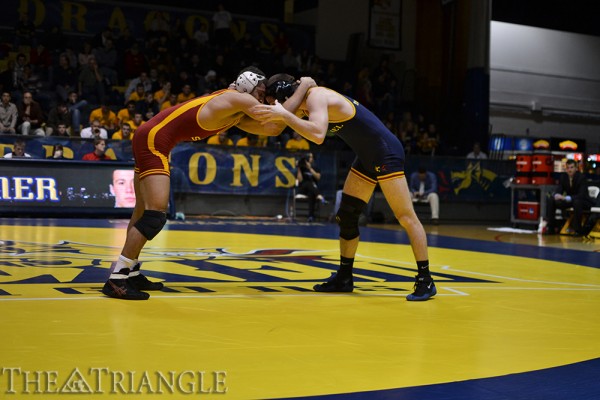
Senior Austin Sommer grapples with an Iowa State University wrestler Jan. 1 at the DAC. This fall, the Dragons will make their debut in a new conference, the EIWA.

Senior Austin Sommer grapples with an Iowa State University wrestler Jan. 1 at the DAC. This fall, the Dragons will make their debut in a new conference, the EIWA.

This fall, the Drexel men’s wrestling team will begin competition in the Eastern Intercollegiate Wrestling Association, and head coach Matt Azevedo thinks a batch of incoming recruits will be able to contribute.

During the Dragons’ first year in the EIWA, they will be facing an elevated level of competition, and they will look to a number of young players to help the team against high caliber schools.

Azevedo has four in mind who he said he believes will be able to contribute immediately.

“Zach Fuentes, Johnny Dutrow, Austin Rose and Alex DeCiantis are four individuals that we are expecting to see a lot out of,” Azevedo, who will be entering his third full season with the team, said. “We think this group has the potential to earn several All-American honors and will play a big part in our team’s future success.”

Fuentes, from Norristown, Pa., will step into the 125-pound weight class and challenge Cornell University sophomore Nahshon Garrett, who finished third at the NCAA Championships. Fuentes accrued a 181-36 record during his high school career. He finished first at District 1 Championships and the Southeast Regional Championships, and second in the Pennsylvania Interscholastic Athletic Association Championships his senior year.

Dutrow, from Council Rock High School in Newtown, Pa., enters the 141-pound weight class, another class dominated by Cornell. The Big Red’s Mike Nevinger, who finished fifth at the NCAA Championships, will return as a senior after going 32-9 last year, leaving Dutrow with his work cut out for him.

Rose, who went 19-2 in his senior year at Central Dauphin High School, will be wrestling in the 157-pound weight class. This is a class that was dominated by Drexel’s juniors and seniors in 2013, which could potentially limit his ability to move up during his first year as a Dragon.

And DeCiantis, from western Pennsylvania’s North Allegheny High School, will come into the 184-pound weight class, another hard class to break into for freshman.

But Avezedo still has a lot of confidence in his young wrestlers next year. He will also depend on improvement from a number of his returning wrestlers, including Brandon Palik, a senior who Avezedo expects to be the Dragons’ best wrestler.

“He is a two-time NCAA qualifier, and we are looking for him to be an All-American next year,” he said of Palik, who went 25-4 this year.

But no team can rely solely on one top performing wrestler.

“Jamie Callender has a ton of potential, but has yet to complete a full season due to injury. He has the ability to be an All-American as well,” Azevedo said.

“Kevin Devoy is our top returning red-shirt.  He had a very successful red-shirt freshman year, placing at three open tournaments and winning the National Collegiate Open. He will wrestle at either 125 or 133 pounds and will be ready to compete against the best in the country.”

Another red-shirted wrestler Azevedo expects big things from is Matt Cimato. He will wrestle in the 141-pound class, and his head coach said he could make some noise on the national scene.

In the top-caliber wrestling organization of the EIWA, Drexel will be facing the daunting task of entering a new and more competitive league. With an influx of incoming talent and the retention of their best wrestler, the Dragons appear to be in line for a season of improvement this fall.

However, Azevedo wants to be realistic.

“Right now I think we are about the middle of the pack in the EIWA. We will be very young next year and that could be a good thing or a bad thing,” he said. “My goal every year is to get as many guys to the NCAA Tournament as possible. The more we [qualify], the better we do in the EIWA Championships.”

Yet resigning himself to the weight of a new conference also is not in the cards for Azevedo and the Dragons. He expects his young men to push themselves to reach his lofty goal for the upcoming season.

“My goal will be to place in the top five [in] the conference,” Avezedo said. “That will be very challenging, but we need to challenge ourselves.”

Expectations, concrete predictions and assessments aside, Azevedo is simply ready for the season to start and to see how his team of newcomers and returning wrestlers alike will respond to the challenge.

“I’m definitely excited to get our team wrestling on a big stage to prove what we are capable of and show where our program is going,” he said. “We have been working very hard this offseason and we are looking forward to putting the work to use next season.”

Image courtesy of Aditya Kothiwal

The post Wrestling team ready for move to EIWA in fall appeared first on The Triangle.

Posted in UncategorizedComments Off on Wrestling team ready for move to EIWA in fall

Paulin covers crew regatta for 6ABC

CoOp_Courtesy_WEBSeeing a former athlete in the broadcast booth has turned into a common occurrence in today’s sporting landscape.

However, a sport like crew typically lacks big-name stars, so when Drexel University graduate Alexandra Paulin found her way into the 6ABC booth for the Aberdeen Dad Vail Regatta May 10 and 11, it was quite the noteworthy occasion.

Paulin, who graduated this year with a bachelor’s degree in communication, was a successful member of the women’s varsity crew team during her time at Drexel. She guided the women’s varsity eight boat to a first-place finish at this very regatta her senior year.

One year later, she broadcasted the event for a television audience.

“[Not being part of the race] was a little different,” Paulin said, “but being on crew teams, I’ve watched so many races that I’m not in anyway, so I was kind of used to it.”

Paulin stepped into the booth with poise after three co-op opportunities with production assistants at different television stations. She also had numerous medals and four years of collegiate crew knowledge to her credit, which is why she said the experience, while amazing, was not too intimidating.

“I didn’t think it was incredibly difficult just because I know the sport so well,” Paulin said. “However, I still did a lot of extra research on the teams and the event, looking for any interesting tidbits, which I wouldn’t normally do if I were just going to the race.”

She also said that a few of her friends from high school who attend other local schools were able to give her information on their respective institutions’ teams, an extra insider’s advantage for someone who was already an insider.

However, while she and her friends and former teammates know the sport inside and out, crew is not an extremely mainstream sport. Paulin said she and her fellow anchor Ducis Rodgers made an extra effort to explain the rules and terms of crew to their audience, explaining terms such as coxswain along the way.

“[Rodgers] didn’t know a lot about crew,” Paulin said. “We were going over the rules during the broadcast, and I know the sport well enough to explain it.”

The former Dragon said that the hardest part was finding a way to avoid being a biased Blue and Gold cheerleader.

“In the beginning I came in not wanting to be too pro-Drexel as the broadcaster,” Paulin said. “As it went on, though, it was impossible. The last hour was a complete Drexel commercial, especially after the men’s varsity eight.”

After the Dragons’ largesse of success at this year’s event, it seems that Paulin was the team’s good luck charm on channel 6. However, she said she does not have any immediate plan for broadcasting jobs.

“It was a one-time thing, as far as I know,” Paulin said. “I would love to work for them in the future, but I’ll probably start somewhere a little bit smaller.”

As for what we can expect when she does find her way back to the broadcast booth, Paulin said that while it is not her strong suit, she would not be opposed to continuing her young sportscasting career.

“I’m up for anything, really, including sports, but general broadcasting is what I want to do,” she said. “In sports I can talk about baseball and crew, but crew doesn’t get a lot of coverage, as it’s a smaller sport. I couldn’t talk about something like hockey during a broadcast, but really, I would cover any topic if I was broadcasting it.”

Having proven her ability to represent Drexel and bring luck to the Dragons crew team, it would not be surprising if Paulin appeared on the Dad Vail broadcast team next year, flying the Blue and Gold underneath her broadcast uniform.

The women’s team will try for its third straight title in 2014, and the Dragons are bound to need their good luck charm.

Image courtesy of Photo Courtesy/Alexandra Paulin

The post Paulin covers crew regatta for 6ABC appeared first on The Triangle.
Posted in UncategorizedComments Off on Paulin covers crew regatta for 6ABC

Trade for Bynum backfires as Sixers miss playoffs

Philadelphia 76ersNow in the conference semifinals round, all four series in the NBA playoffs currently stand deadlocked at 1-1 as of May 8.

In the Eastern Conference, the Miami Heat and New York Knicks used their second games in the series to recover from befuddling losses to lower-seeded opponents in their respective series openers.

In the Western Conference, the Golden State Warriors have averaged over 110 points per game against the San Antonio Spurs, and the Memphis Grizzlies are still pinching themselves over Russell Westbrook’s absence from the Oklahoma City Thunder.

But where are the 76ers? Why is Philadelphia’s fine basketball franchise not represented in this spring’s collection of the finest teams in the land?

It is quite befuddling because they seem to have followed this year’s playoff recipe.

For example, a key component to winning a first-round playoff series was having an All-Star on your roster. LeBron James, Carmelo Anthony, Kevin Durant and the like are still competing for the title. In fact, all eight teams remaining have an All-Star on their team.

The Sixers have one of those shiny All-Stars, too. His name is Jrue Holiday, and he is widely regarded as one of the hottest things in the field of point guard, a position that draws more scrutiny than anything in the NBA outside of the aforementioned James. Holiday was voted to his first career All-Star game this season; typically, that is a sure sign of a progressing talent level.

But the Sixers still missed the playoffs.

Philadelphia’s squad also matched teams from Indiana, Memphis and Chicago in a curious yet consistent facet of the game this season: finishing in the bottom five in the NBA in points per game. The old adage is that defense wins championships, and the Pacers, Grizzlies and Bulls are currently proving that the idea is not dead in modern basketball. They all ignored offense in lieu of defense, and all three teams have advanced to the second round.

But the Sixers still missed the playoffs.

If one had not checked in on the Sixers’ progress since the preseason, confusion would be natural. This team seems to have all the makings of a playoff team, but the Sixers were relegated to remain in Philadelphia while 16 other teams gallivanted off with the NBA’s bountiful supply of basketballs.

The missing link, it seems, is the peskiest topic in Philadelphia sports over the past seven months: Andrew Bynum. More precisely, that link comes in the form of a trade they executed to bring Bynum to the city.

Because if there is one thing that the Sixers lacked this year, it is players who have actually reached the playoffs in the past. That does not mean you would not recognize any of their former players in the postseason, though.

The name Andre Iguodala might ring a bell. Just last year, the once-beloved face of the franchise with the nickname “Iggy” hit the series-winning free throws in Game 6 against the Derrick Rose-less Bulls, sending the Sixers to a second-round matchup with the ageless Boston Celtics.

Iguodala almost willed the team to a berth in the Eastern Conference Finals against the Heat, as the Sixers came up just short despite his team-leading 18 points in Game 7.

After the trade for Bynum sent Iguodala to the Denver Nuggets, Iguodala helped the offensive-minded team improve its defensive rank by six spots and earn the No. 3 seed in a top-heavy West.

Meanwhile, Bynum spent the regular season alternating outlandish hairstyles and reinjuring his knee while bowling. Because, as everybody knows, the best rehabilitation for a franchise cornerstone with a history of knee injuries is hitting the lanes for a few rounds of duckpin.

It is hard to sit at a computer, armed only with sarcastic statistics and retrospect, and say that the Sixers’ front office made the wrong decision by trading Iguodala to get Bynum. The potential for success when a center like Bynum is paired with a point guard like Holiday is almost limitless.

But if you were to rewind the franchise to those days before the trade went through and question Sixers general manager Tony DiLeo, some warning would be in order. Without the trade, the Sixers had a surefire playoff berth. With the trade, they had a coin flip chance of either competing for an NBA Championship or failing miserably.

The reality of the situation is that DiLeo made the trade. And the Sixers still missed the playoffs.

Image courtesy of Charles Fox Philadelphia Inquirer/MCT Campus

The post Trade for Bynum backfires as Sixers miss playoffs appeared first on The Triangle.

Posted in UncategorizedComments Off on Trade for Bynum backfires as Sixers miss playoffs

Wrestling plans move to new conference in ’13-14

The Drexel wrestling team plans to leave the CAA to play in the more competitive EIWA beginning in the 2013-14 season.

The Drexel wrestling team plans to leave the CAA to play in the more competitive EIWA beginning in the 2013-14 season.

Forty-seven days after the Drexel men’s wrestling team competed in the Colonial Athletic Association Championships, the program announced its intention to leave the CAA for the Eastern Intercollegiate Wrestling Association next season.

The Dragons, who accrued an 8-12 overall record with a 3-3 record against CAA opponents, will join the EIWA next year along with longtime conference rival Hofstra University, as well as Boston University and Binghamton University. Drexel will join a stable of schools that includes Cornell University, home of four top-five NCAA finishers in their weight classes, and local competition in Lehigh University.

Head coach Matt Azevedo, fresh off the more successful of his two seasons at the helm of the program, had a big hand in the change.

“When asked by the administration of a change in conferences, I said I would like to join the EIWA, and they agreed,” Azevedo, who coached at Drexel’s new conference competitor Cornell during the best stretch in that program’s history, said.

Azevedo sees the move as a positive chance for the Dragons to increase their wrestling program’s profile moving forward.

“This move to the EIWA is going to help us on many levels,” Azevedo said. “The EIWA is the largest conference in Division I wrestling and the second-most successful. Our team will be challenged at the highest level, which is exactly what we want and need to reach our goals of producing All-Americans on a yearly basis.”

This year’s Drexel team produced two competitors in the NCAA Tournament, redshirt junior Brandon Palik and senior Frank Cimato, but was void of an All-American wrestler. The EIWA, on the other hand, produced six All-American wrestlers this year, which highlights the kind of step-up the Dragons could experience next season.

Azevedo does not expect his team to be intimidated, as he hopes for more of his wrestlers to follow in the footsteps of Palik and Cimato.

“I believe we will compete very well in the EIWA next season and the years to come,” Azevedo said. “We are hoping to qualify more wrestlers to the NCAA Tournament due to the fact that the EIWA has more qualifying spots.”

Drexel Athletic Director Eric Zillmer echoed Azevedo’s sentiments, citing the extra chances for qualifiers, higher level of competition, and conference profile as the primary reasons for the shift. He also acknowledged that the EIWA will present a challenge for the team.

“The thing we need to do is step up a little bit, but I have complete confidence in Coach Azevedo,” Zillmer said. “He knows what he’s doing, and our job is to create an infrastructure that he can succeed in. So I really think that all of these moves are good, necessary moves, and the best is yet to come for us.”

The departure of Drexel, whose campus was the birthplace of CAA wrestling before the 1992 season, leaves the conference’s wrestling collection in dire straits. Zillmer acknowledged that after the departure of George Mason University and Old Dominion University this spring, the truth was that “[the conference’s wrestling program] was on life support probably for a while.”

While not directly related, the transition is a notable departure from Zillmer’s remarks about the men’s basketball team earlier this year in relation to conference realignment.

In a previous interview with The Triangle, Zillmer spoke to his belief in “making [the CAA] stronger” in response to a question about the prospect of the Dragons leaving the conference in basketball. Just 20 days after that interview was published in the April 5 issue of The Triangle, Drexel announced the EIWA plan for the wrestling team.

Yet Zillmer reaffirmed his belief in the CAA as the Dragons’ primary home in a more recent interview May 1.

“As athletic director, you would love to have all of your teams in one league, but that’s not the reality,” Zillmer said. “But we’re not looking to diversify our sports. We’d rather be in the CAA.”

Next year, though, Drexel wrestling will be a member of the EIWA, which holds its conference championships at the University of Pennsylvania. Only time will tell how the change will affect the program, but the heads of Dragon wrestling seem confident in the move.

Image courtesy of Aditya Kothiwal

The post Wrestling plans move to new conference in ’13-14 appeared first on The Triangle.

Posted in UncategorizedComments Off on Wrestling plans move to new conference in ’13-14