Author Archives | Adam Hermann

Water main bursts at 33rd and Market

The scene at the water main break at the corner of 33rd & Market streets. (Adam Hermann - The Triangle)

The scene at the water main break at the corner of 33rd & Market streets. (Adam Hermann – The Triangle)

Update, 6:03 pm: The outpouring of water has been stopped at the site of the rupture, and power has been restored to the buildings affected by the outages, according to the University.

The University issued a DrexelAlert which said 33rd Street will be closed from Chestnut Street to Market Street until further notice.

SEPTA is diverting trolley service to 40th & Market due to the break. Market-Frankford service remains unaffected at this time.

***

A water main burst at the corner of 33rd Street and Market Street around 3:45 pm July 21.

The rupture caused breaks in the concrete and water to run down 33rd Street towards Chestnut Street.

Philadelphia Police and Drexel Public Safety shut down 33rd Street between Chestnut and Market streets.

The break also affected power in surrounding university buildings, causing power outages at Hagerty Library and the Drexel University Recreation Center.

The Triangle will continue to update this story as more information becomes available.

Photos of the break below courtesy of Gina Vitale.

IMG_0025

IMG_0026

IMG_0028

IMG_0022

IMG_0018

The post Water main bursts at 33rd and Market appeared first on The Triangle.

Posted in UncategorizedComments Off on Water main bursts at 33rd and Market

Massenat making a name for himself in Germany

Frantz Massenat drives against Delaware during the 2013-14 regular season. (Ken Chaney - The Triangle)

Frantz Massenat drives against Delaware during the 2013-14 regular season. (Ken Chaney – The Triangle)

Frantz Massenat had never really, truly lived away from home.

When he spent four years on Drexel’s campus, from 2010 to 2014, he was always a car ride from his home town of Trenton, New Jersey. Just across the Delaware River, salvation and comfort awaited.

So when it came time to travel to Europe and embark on the opening leg of his professional career, Massenat had to adjust.

Sitting in an empty row of bleachers July 17, dripping with sweat after a disappointing first-round loss in The Basketball Tournament, Massenat talked about what the transition was like with perspective.

He sported a longer, scraggly beard and plenty of new muscle from his first year abroad.

“I had to get adjusted to everything,” he said.

It was the first time Massenat and his trademark smile played a meaningful basketball game in Philadelphia since February 26, 2014, the final home game of his Drexel career.

After he graduated in June 2014, Massenat received an invitation to participate in the Washington Wizards’ Summer League team, but a guaranteed contract from German club Middeldeutscher Basketball Club was too good to turn down.

So Massenat signed a contract, boarded a plane and began the newest chapter of his life in a country he’d never experienced.

In his first season, Massenat averaged 10.1 points, 3.9 assists and 1.9 rebounds per game. He tied for the second-highest scorer on his team.

But in his first months with Middeldeutscher, Massenat said he experienced the precociously nervous period that most young ball players go through when they join a new team.

“It was like a real rookie season for me,” Massenat admitted. “In the beginning, I was just trying to learn the game.”

He said the game as a professional struck him as more cerebral, especially as a point guard. He had to think about the game differently, both on and off the court.

Playing basketball for a living, Massenat said, is an entirely different experience than college ball.

He had to adjust to two practices per day. The team even held practices on the players’ days off.

There was no time to let up. Basketball was everything.

“Winning or losing, you’ve got to keep the same mindset,” Massenat explained. “You’ve got to push every time. It’s a job. There were four guys on my team that got sent home. You have to be able to come all the time, because at the end of the day, you’re playing for your job.

“You’re going into the game thinking, ‘Oh, I’ve got to play good. If not, I’m not earning my money.’”

And then there’s learning to balance a new life off the court.

He received an overwhelming amount of love from the fans of Middeldeutscher. Any time he would walk around the city of Weissenfels, where the team is located, fans would ask to take pictures with Massenat.

Massenat is the only player from Middeldeutscher returning to the team next season.


His face is emblazoned on the landing page of the team’s website. A fan page cropped up on Twitter in the middle of May, and it’s gained over 100 followers in the past two months.

He is being marketed as the face of the franchise, and Middeldeutscher’s fans have responded.

“It’s a whole different type of basketball,” Massenat said, laughing. “They bring drums to the games. They see you out, they’ll ask for pictures, autographs, all that stuff. I liked it.”

While he endeared himself to a whole new fanbase, however, Massenat had to deal with being thousands of miles away from the only place he had ever called home.

His parents. His best friends. His girlfriend. All of it was across the ocean.

“You’re six hours ahead, you’re living on your own, you’re away from everybody,” Massenat said. “I missed the people here so much.”

He would often stay up late to watch his former Drexel teammates play, pulling hard for Damion Lee who is now at Louisville University. He kept in touch with Chris Fouch and Dartaye Ruffin, who were both playing professional ball abroad as well.

When he returned, he tried to explain what the year was like to his friends, but it’s tough. They ask if he had time to vacation and explore Europe.

“You’re like, ‘Um, no.’ I practice during the week and I play on the weekends,” Massenat said, shaking his head. “It’s a job.”

It was yet another adjustment Massenat had to make. But he figured it out, and ended the season on a high note, averaging 16.6 points and 5.4 assists per game in the final month of his rookie campaign.

“I kind of got thrown in the fire early, but that’s fine,” he said, smiling once again.

Massenat thinks he developed a lot as a player in his first year, from start to finish. He said his coach was in his ear all season long, keeping him confident.

“I guess he saw potential in me,” Massenat said.

Now he’s settled in to his new home, and ready to head back in mid-August. Massenat signed on for another year in June, and he said he’s excited to return.

“I like the country, and I like the basketball,” he said. “There’s a lot of guys that were in the NBA there, there’s a lot of guys. It’s just really good, competitive basketball.”

The post Massenat making a name for himself in Germany appeared first on The Triangle.

Posted in UncategorizedComments Off on Massenat making a name for himself in Germany

Bah eager for chance to represent Mali

Drexel forward Mohamed Bah, pictured dunking here, will play for the Malian  national team this August in AfroBasket 2015 for a spot in the 2016 Olympics. (Ken Chaney - The Triangle)

Drexel forward Mohamed Bah, pictured dunking here, will play for the Malian
national team this August in AfroBasket 2015 for a spot in the 2016 Olympics. (Ken Chaney – The Triangle)

Growing up in Bamako, Mali, Mohamed Bah and his best friend Ibrahim Djambo would watch the Malian men’s national basketball team, and they would dream.

“I was just waiting,” Bah said on a recent Thursday afternoon. “We would watch the national team back in the day and talk about, you know, ‘Maybe one day, that’s going to be us.’”

Little did the two know.

Bah, a junior forward on Drexel’s men’s basketball team, and Djambo, an incoming senior forward at Hofstra University, were both named to join the Malian national team June 19 after 10 days of tryouts in Bamako, just a 30-minute drive from where Bah lived when he was younger.

He has a few aunts and uncles remaining in Mali, but most of his family members live in Central Africa or in Paris. With his parents, Fatoumata Sylla and Amadou Bah, and his younger brother and sister, Bah moved back and forth between West Africa and Central Africa growing up.

He moved to the United States in 2010 to attend high school, but Mali is still his home country.

The tryouts marked the first time in over five years when Bah played serious basketball in Bamako.

“It’s been a long time,” he said, rubbing his head as it hit him just how little he’s seen of his country since crossing the Atlantic.

He’s only visited Mali twice since moving to the States.

The first return trip came last summer, a 12-day jaunt when he needed to renew his visa to travel to China with his Drexel teammates. The second trip came a few weeks ago, for the tryouts.

Bah stayed in a hotel for the duration of the tryouts, because, he said, the team treated it like “a business trip.” Serious stuff.

After the tryouts, however, he was able to see plenty of his friends from Bamako to celebrate his new spot on the team.

Bah will be a member of the team for AfroBasket 2015, the qualifying tournament for the African zone of the International Basketball Federation. The winner of the tournament will earn FIBA Africa’s berth to the 2016 Summer Olympics in Rio de Janeiro.

Mali’s best finish in AfroBasket came in 1972, when the team earned a bronze medal.

This year, Mali is ranked No. 11 of 54 in the FIBA Africa rankings, but Bah said the team is focusing on its youth and is eager to change its narrative.

“Our new generation, we want to play and we want to contribute now,” Bah said. “We’ve got older people who have retired and don’t want to come to the national team, so it’s our time now to show how we can do.”

He and Djambo are the only two college students on the Malian roster. The rest of the team is composed of young professional players, some from Paris and Spain. Bah said he spent time playing with plenty of the players on the team at different points of his time in Mali growing up.

Djambo, who began his collegiate career at Clemson University, sat out the 2014-15 season after transferring to Hofstra. He will play for the Pride this season, and he and Bah will go head-to-head twice during conference play, once in Hempstead, New York, and once in University City.

But for those 10 days in Bamako, Bah and his best friend were back on the same side.

As he discussed the first few days of the tryouts, Bah leaned back in his seat and groaned, a begrudging smile creeping across his face.

“Oh, it was tough,” Bah said, grinning. “The coach [Jose Ruiz] is from Paris, so he’s a little bit tough. He wants to see some new stuff because he doesn’t want to keep losing in the Africa Cup. He wanted to bring some new things in. Mali’s a basketball city, so he wanted everybody to focused on every single detail. It’s so important for him.

“He’s tough, but he pushes us to get better. We are young, and we’ve got a lot in the future,” he continued.

The first three days of the tryouts, Bah said, were run intensive. After that, the games began.

By the end of the 10 days, Ruiz was pleased with what he saw from Bah, who averaged 3.9 points per game, 4.6 rebounds per game, and shot 54.5 percent from the field this past season. But Ruiz didn’t want the 20-year-old to be complacent with making the team.

“[Ruiz] said he likes me,” Bah explained. “He said, ‘I want you on my team, but you’ve got to work hard. To make a team is good, but you need to play, too. It’s a competition now.’”

“I made the team, but I don’t want to sit on the bench,” Bah said. He feels good about his ability to contribute.

And while a trip to the Olympics might be a little far-fetched for a young, inexperienced Malian national team, Bah is focused on the opportunity of a lifetime.

“Every year we need a new generation to represent your country as well as you can,” Bah said. “This year is our time, I would say.”

The post Bah eager for chance to represent Mali appeared first on The Triangle.

Posted in UncategorizedComments Off on Bah eager for chance to represent Mali

Big men have the chance to reverse narrative, loom large

Rodney Williams, No. 24, will play a big role in Drexel’s interior game this fall.  Williams averaged 8.2 points per game last year. (Ken Chaney - The Triangle)

Rodney Williams, No. 24, will play a big role in Drexel’s interior game this fall.
Williams averaged 8.2 points per game last year. (Ken Chaney – The Triangle)

The big men of Drexel men’s basketball team couldn’t shake the team’s streak of bad luck last season.

In April, it was a torn anterior cruciate ligament injury. In November, it was a foot sprain. In December, a torn meniscus and a stress fracture. In February, it was the flu.

The Dragons’ forwards were decimated, and it showed. The team’s offense stalled in the second half of the conference slate. Opposing defenses knew that Drexel was a shooting team, and they weren’t terribly afraid of what happened near the rim.

This season, there’s a chance for the recent narrative surrounding Drexel’s big men to finally change.

Without a truly dominant guard — or a collection of dominant guards — the team’s offense should look to find a more well-rounded attack, which might just involve throwing it in to the low post for the big men to work.

The Dragons’ inside game will revolve largely around its two supposed starters, graduate student Kazembe Abif and junior forward Rodney Williams, as well as junior Mohamed Bah and sophomore Tyshawn Myles.

But the big focal point will the starters, Abif and Williams, and the potential for two forwards who can actually score on their own terms as opposed to just serving as rebounding machines.

Abif missed the entire 2014-15 season with a torn ACL he suffered in April, in addition to sitting out the final eight games of the 2013-14 season with a broken hand.

However, before the deluge of injuries, Abif was playing excellent basketball in his third season with the team, averaging 7.2 points per game, 6.6 rebounds per game.

Abif plays with a physical edge to his game, which makes his slightly-undersized 6-foot-7-inch frame sufficient against players with a couple of inches to their advantage. He mixes it up in the paint and can out-muscle those taller players for offensive rebounds.

Most importantly, Abif can score at the rim. In that 2013-14 season, cut short by injury, he was attempting 51.9 percent of his shots at the rim, according to Hoop-Math.com, and converting 60 percent of those shots into two points.

In 2011-12, when he was a force in the CAA, Samme Givens shot 50.5 percent of his shots at the rim and made 62.5 percent.

With their shooting splits almost identical and both averaging just a smidgen over 30 minutes per game, the difference comes down to shot frequency. Abif averaged 4.8 field goal attempts per game in 2013-14, while Givens averaged 8.4 field goal attempts per game in 2011-12.

Whether that can be chalked up to decision making when Abif has the ball or the general flow of the offense looking for guards more than forwards, it’s something that head coach James “Bruiser” Flint should take note of.

With more shots, Abif could potentially produce at the level of Givens, a similarly undersized but physical forward.

Taking a different approach to the starting frontcourt, Williams has the athleticism and strong, lean frame to average double-digits.

In the 2014-15 season, when he wasn’t sidelined by a stress fracture, Williams was far and away the most athletic-minded big man at Drexel’s disposal.

He averaged 8.2 points per game, 7.0 rebounds per game and an eye-popping 1.5 blocks per game. Williams will begin his junior season 12 on Drexel’s career blocked shots list with 69, and needs just seven to move into the top 10.

But one game last season showed what he can really accomplish on the offensive end.

In Dragons’ regular season finale against the College of William & Mary, with just seven players at their disposal, Williams dropped 18 points on five-of-10 shooting and added nine rebounds in the upset win.

He knocked down eight of 11 free throws and dominated the Tribe in the paint, flashing back-down prowess and smooth shimmies.

And, in a similar vein to what Abif brought in the 2013-14 season, Williams attempted 53 percent of his shots at the rim and converted 58.9 percent into buckets.

His athleticism and 6-foot-9-inch frame make him a player primed for a breakout season in 2015-16.

When it comes to reserves, the Dragons will make use of junior Mohamed Bah and sophomore Tyshawn Myles in relief roles.

Bah spent the entirety of the 2014-15 season as the team’s starting center, starting all 30 games throughout the season.

The Mali native was not the team’s most prominent offensive power, averaging just 3.9 points per game last season, but he shot 54.5 percent from the field, the best mark on the entire team.

His offensive game consists largely of putbacks from offensive rebounds and slamdunks off assists. Bah doesn’t create a whole lot of offense for himself, but that’s not what Flint and his coaching staff are demanding of him.

On this team, with two offensively gifted forwards in front of him, Bah’s role will be simple: continue to improve on defense and grab as many rebounds as possible.

His offensive rebounds are especially valuable. Bah grabbed at least one offensive board in 22 games last season, and when he can get a look close to the rim, he often comes away with points.

Bah shot 80.5 percent from the free throw line last season, capitalizing on drawing fouls on the opponent’s big men.

He’ll be a good third option for the Dragons, when foul trouble strikes or one of the two starters needs a breather.

In Myles’ case, his freshman season was an up-and-down affair.

He showed flashes of potential, like his breakout game against the University of Delaware when he scored 11 points and grabbed 11 rebounds.

He also looked lost at times, and was largely inconsistent when finishing at the rim. According to Hoop-Math.com, he shot just 38.9 percent on shots at the rim, a startlingly low number for a 6-foot-8-inch forward.

But his rebounding is where he truly stood out. Adjusting Myles’ statistics for an average of 30 minutes per game, he averaged 8.8 rebounds per 30 minutes, the highest mark of any Dragon.

He won’t be called upon to do anything near 30 minutes per game this season, but Myles is a good, reliable backup at the power forward.

If he can work on improving his offense, which is no doubt what the coaching staff will have him focus on this summer, he can be a force in the final two years of his career at Drexel.

This season, he’ll be a good depth option.

Meanwhile, sophomore Austin Williams had a largely uneventful freshman season after missing a month early in the season with a leg injury.

He averaged 10.5 minutes per game, and scored less than one point per game in his time on the floor. Williams saw time in the second half of the season because of the team’s perilously short bench, but he wasn’t very productive.

Even though there are no incoming forward recruits, the return of Abif is essentially worse for Williams’ potential playtime. He will be the No. 5 big man option, which means he’ll play the role Goran Pantovic did during his time at Drexel: he will be called upon only in the most dire situations. Don’t expect to see too much of Williams this season.

The post Big men have the chance to reverse narrative, loom large appeared first on The Triangle.

Posted in UncategorizedComments Off on Big men have the chance to reverse narrative, loom large

Eclectic trio of shooters will determine m. bball’s fate

Tavon Allen goes up for a shot against St. Joe's University's DeAndre Bembry Nov. 17. (Ken Chaney - The Triangle)

Tavon Allen goes up for a shot against St. Joe’s University’s DeAndre Bembry Nov. 17. (Ken Chaney – The Triangle)

There are three distinct, unique parts that make up the Drexel men’s basketball team’s perimeter situation heading into the fall.

We have the seasoned veteran in senior Tavon Allen. Then there is the upside-heavy young gun in sophomore Sammy Mojica. And, to round it out, there’s the unknown commodity in junior Ahmad Fields. They’ll each vie for playing time in an offense with a newfound logjam at the guard positions.

These three are here for their shooting, but they each bring something different to the table. It will likely take some time to figure out where each fits in this season’s iteration of the Drexel offense, which has been based largely on three-point shooting and guard play in the last three seasons.

In evaluating the three pieces, it makes sense to begin with the veteran.

Tavon Allen got a little taste of being the team’s primary scorer when Lee missed time down the stretch last season. With Lee donning red and white this season, Allen will be Bruiser Flint’s oldest and most seasoned guard. But his statistics have yet to reflect a player the team can depend on for an entire season.

Tavon Allen's statistics, year by year.

Tavon Allen’s statistics, year by year.

After redshirting his first year and putting up an intriguing freshman season, Allen was expected to refine his shooting. In his second season, Allen’s field goal percentage jumped two percent, but his three-point shooting fell eight percent and his free throw shooting dropped 10 percent.

While he fixed his free throw shooting last season, catapulting back up to a dependable 80 percent from the stripe, Allen shot a woeful couple of splits from the floor. He connected on just 31.5 percent of his shots from the field, including just 28.3 percent from behind the arc.

In short, when Allen shoots at a higher volume, his efficiency tumbles. He averaged fewer points in his junior season last year (11.2) in three more minutes per game than his sophomore season, and his field goal percentage dropped eight percent.

If he’s asked to do even more this fall, there’s no telling what those numbers could look like. According to Ken Pomeroy’s numbers, Damion Lee used 29.1 percent of Drexel’s shots when he was on the floor last season. Allen used 28 percent of the team’s shots when he was on the floor.

The minimal, one-percent gap means that we likely saw what Allen will look like when he’s the offense’s primary operator. With Lee gone, Allen needs to be better if Drexel wants to compete with the top teams in the Colonial Athletic Association.

Moving on to a younger piece, there is Sammy Mojica. In a season otherwise riddled with injuries and frustration, the then-freshman Mojica was the ultimate bright spot as far as the program’s future is concerned.

After a slow start to the season, stuck behind Lee, Allen and London for playing time as a guard, Mojica exploded in the second two-thirds of the year. He finished the season averaging 7.7 points, 3.5 rebounds and 2.1 assists per 30 minutes of action. He shot 39.3 percent from the field, a passable mark, but his 36.9 percent shooting from the three-point line was a big part of his game.

In his final 11 games before suffering a knee injury Feb. 25, Mojica played his best basketball of the entire season.

Sammy Mojica's freshman statistics, a tale of two seasons.

Sammy Mojica’s freshman statistics, a tale of two seasons.

In those 11 games against conference opponents, he averaged 9.5 points, 2.8 rebounds and 2.0 assists per game, shooting 51.3 percent from the field, 50 percent from the three-point line, and 75 percent from the free-throw line. He averaged 27.8 minutes per game in those 11 contests.

It was a streak of basketball that, paired with the consistently staggering Damion Lee, allowed Drexel to creep back into conversation for the conference title weeks after the Dragons had been relegated to the middle of the CAA pile.

Mojica is one of the hardest-working players on the team during games, constantly willing to give up his body for a loose ball and crashing the offensive boards harder than much taller opponents.

And then, of course, there is the course of a player whose identity is largely unknown. Evaluating a player based on four pick-up games and a perilously small pool of data is a difficult task. This is what makes junior guard Ahmad Fields such an intriguing prospect.

As a freshman at the University of Utah, Fields was stuck behind guard Delon Wright, who was selected in the first round of the 2015 NBA Draft June 25, in his hunt for playing time.


Fields saw just 7.5 minutes of action per game as a freshman at Utah, but he put his 143 minutes of on-court time to use, shooting 47.5 percent from the field and 40 percent from deep.

Averaging his largely stifled statistics out over 30 minutes per game, Fields 13.2 points per game, 8.4 rebounds per game and 2.0 assists per game. These would be largely ideal numbers for Drexel’s offense, especially considering the accuracy with which he shot the ball at Utah.

That said, sizing up Fields’ fit with the Dragons is mainly speculation. After transferring from Utah to Drexel in the summer of 2014, Fields sat out the entire 2014-15 season because of National Collegiate Athletic Association transfer rules. So his cohesion with teammates and Bruiser Flint’s playing style is entirely up in the air.

However, Fields looked smooth in a handful of pick-up games with his teammates in the Daskalakis Athletic Center in late May. He has a smooth, quick release when shooting from deep, and his movements in the half-court offense are compact and exacting. Fields’ drive to the hoop is fluid, far more so than that of Tavon Allen despite being equally lanky at 6-feet, 5-inches and 195 pounds.

Allen will be the go-to guy for Drexel’s perimeter shooting in the early going because of seniority and established experience in Flint’s offense. But it wouldn’t be a surprise to see Fields command that same level of usage in the team’s offense after a few games. He has a lot to offer a team in desperate need of scoring after the departure of Fields’ good friend Damion Lee.

Because the crowd in front of him features two older players, Mojica will likely start the season on the bench as the team’s No. 3 wing, behind Allen and Fields. But the sophomore has serious talent, and if Allen or Fields even so much as stumbles, Flint would be remiss not to give Mojica a starting look. He showed down the stretch last season that, given a chance, he can be one of the Dragons’ best shooters. And with Lee’s possessions now up for grabs, those numbers could look even better in Mojica’s second season.

Sometimes, value is lost in a crowded field. For Drexel and Flint, after last season’s barebones roster was barely able to cobble together 50 points each night, a crowded roster isn’t a problem. The only question will be how to find time for each player to have the proper impact.

The post Eclectic trio of shooters will determine m. bball’s fate appeared first on The Triangle.

Posted in UncategorizedComments Off on Eclectic trio of shooters will determine m. bball’s fate

The Long Goodbye of Damion Lee

Damion Lee’s favorite basketball player of all-time was born in Louisville, Kentucky. Allan Houston was a member of the New York Knicks from 1996, when Lee was 4 years old, until 2005. Lee grew up admiring Houston’s ability to bury three-pointers with ease. Houston shot 40.2 percent from behind the arc during his 13 seasons in the NBA.

In his room growing up, Lee had a poster on his wall of Houston in a white Knicks jersey, rising up for a jump shot on the left wing. In front of him, the out-stretched arm of Michael Jordan just missed turning Houston’s shot away.

Lee liked the way Houston handled the ball up the floor. He liked his jump shot. During his playing days, Houston stood 6-foot, 6-inches, 205 pounds. Lee is listed at 6-foot, 6-inches, 200 pounds.

“I mean, I didn’t know I was going to be this tall,” he says with an aw-shucks laugh.

When Lee was a freshman at Drexel, the Dragons won 19 straight games but were turned away from the NCAA tournament. As a No. 3 seed in the National Invitation Tournament they were paired with Central Florida in the first round and, in the post-snub rage, tore the Bulls apart with an 81-56 dismantling. Lee scored eight points, making three of seven field goals.

After the game, he was browsing through a batch of photos taken that night and one jogged his memory.

An image of Lee in his white Drexel jersey, rising up for a jump shot on the left wing. In front of him, the out-stretched arm of Marcus Jordan, Michael Jordan’s son, just missed turning Lee’s shot away.

Maybe it was fate. Maybe he really was meant to be at Drexel.

Or maybe he was supposed to end up in Houston’s hometown of Louisville.


It’s 10 A.M. on a Monday in early May and Damion Lee is striding through the Daskalakis Athletic Center lobby. He’s wearing a heather gray T-shirt with blue lettering that reads, “Drexel Basketball.” His navy basketball shorts are sliced with yellow racing stripes down the sides. His Nikes are a vibrant cardinal red.

Lee, a senior, is gliding through the last weeks of his four years as a student at Drexel University, a smile constantly stretched across his face and the ends of his black hair a creme brulee orange, an extra burst of look-at-me for the basketball sensation. In a few weeks he will graduate with a degree in communications. His graduation party is slated for June 20; from there, he’s planning on flying to Los Angeles for six days to visit an old friend and enjoy a down week. In early July Lee, 22, will arrive at the University of Louisville, where he will attend graduate school and play his fourth season of college basketball.

But for now he’s still a Drexel student, and he’s hungry after finishing his morning workout. He’s following a prescribed workout plan he received from the coaches at Louisville after he committed to Rick Pitino and the Cardinals April 23. On Mondays and Fridays, he starts his days with weight lifting. On Tuesdays and Thursdays, he lifts in the evenings. Wednesday is a rest day.

“No offseason in this sport,” he says as he walks out the double silver doors and into the 84-degree Philadelphia heat.


Lee stares into the distance while walking around campus in early June, during his final week of classes. Photo by: Adam Hermann The Triangle

Lee has an 11 a.m. class, but first he has to grab a snack. He heads to Seasons, a university-sponsored dining option known for its fresh ingredients and cafe-style fare. He orders a ham and cheese croissant, a blueberry muffin and a bottle of water, and runs into his former teammate Sammy Mojica while waiting in line. They give each other playful looks, both towering above their fellow students.

Going to pay, Lee greets the woman behind the register with a smile.

“How are you today?” she asks Lee.

“I’m good,” he answers, taking his muffin. “Got class now, you know.”

“Where’s your class?” she asks.

“Um,” he murmurs, grasping for the building’s name. “It’s, um. Hmm.”

He stifles a laugh.

“I don’t remember what it’s called,” he finally admits sheepishly. Lee was late to this statistics class twice at the beginning of the term. He missed the first one entirely and he was 15 minutes late to the second meeting because he couldn’t find the building. It’s in Stratton Hall. Eventually he went to his academic advisor and asked her where Stratton Hall was.

“She looked at me and said, ‘You’ve been here for four years and you don’t know where Stratton is?’” he recalls, laughing. He shrugs his shoulders.

Lee’s is unique brand of senioritis. He’s attended Drexel for the prescribed four years, the four he signed up for. But his time on college campuses isn’t over. He’s got another year in line at Louisville. He’s preparing himself to leave University City, his home since he was 18 years old, but not the college world.

“It’s really wild to think about it,” he says as he approaches the appropriately-labeled Stratton Hall. “I feel like University Crossings has been my address forever. I’ve lived there since my first day on campus.”

A student gives Lee a wave and he waves back, exchanging a “Hey, what’s up, man,” a frequent occurrence as Lee walks around campus. This past season, he epitomized the big man on campus. He averaged 21.4 points per game during the regular season for Drexel, the fifth-most in the entire country. He sliced up opposing defenses as the singular offensive threat for the team. Most students on campus knew what he was capable of. And even if they didn’t, they knew he stood for something. There aren’t too many 6-foot, 6-inch students on Drexel’s campus.

Since he announced he would be transferring March 30, Lee said he’s had plenty of students come up to him around campus and wish him well.

“They’ll wish me good luck at Louisville, all that stuff,” he says. “Most of the time they’re really cool.”

Sometimes he’ll get approached by a disenchanted fan. Once, while he waited for his sandwich in the campus Subway, a student asked him why he was wearing a Louisville basketball T-shirt. When Lee told him he was transferring, the student was stunned. Lee explained to him why he was leaving — “I just told him it was for personal reasons, for me,” he said — and the student said, “Well, I guess somebody else has to step up next year.”

“I don’t walk around like, ‘Oh, I’m a big deal,’” Lee says of his fleeting status on campus. “It’s just the way it is, I guess.”

It’s what happens when your graduate school decision lands on the front page of ESPN.


In the back of a sparsely attended lecture for a class called “Weather,” Lee and former teammate Freddie Wilson sit next to each other. The two are glued to their iPhones. Lee’s often scrolling through some sort of social media. His iPhone lock screen is a picture of him photoshopped into a Louisville uniform. His phone is wrapped in a blue-and-yellow Drexel case.

“You know Damion, he checks all of that stuff,” Mike Tuberosa, Drexel’s associate athletics director for communications, said of the former Dragon’s media consumption during this past season.

Wilson turns to Lee and grabs his attention for a second, showing him a tweet the two laugh about for a handful of seconds before Lee returns to his own screen.

Lee said there weren’t any problems with his former teammates when he told them he was leaving them this summer. When the news broke on Twitter March 30, he sent them a mass text message explaining his decision.

“I just told them, I’m doing this for myself and for my personal reasons,” he says. “I explained, it’s not like I’m leaving them behind. They know what I’m doing next doesn’t take away from what already happened.

“They understand,” he says. “Some people, on the other hand,” he continued, cracking a wry smile before trailing off and refusing to continue.

On May 6, ESPN.com’s Dana O’Neil published a story about the spike in graduate transfers in college basketball in recent years. She spoke with Drexel men’s basketball head coach James “Bruiser” Flint about the “graduate transfer problem,” and the story included Flint’s first public comments about Lee’s decision.

In late March, Lee said Flint had taken his decision to transfer a little hard. Flint’s comments to O’Neil didn’t change that view.

“The thing is, you develop a kid and all of a sudden he’s going somewhere else,” Flint told O’Neil, speaking about Lee. “He wants to go to play at a higher level, but he went to Drexel for a reason — because he wasn’t recruited at that level. He wasn’t a player at that level. Now he is, but we helped him get there and now that he is, he’s out.

“I know if it were me and my family, they’d be saying get your butt back to Drexel,” Flint told O’Neil. “You’ve exceeded your expectations because of what they helped you become. You don’t leave now.”

Lee lets out half of a sigh through his smile. He doesn’t want to talk about Flint’s comments as he leaves class. He doesn’t think there’s any need to talk about it anymore. It doesn’t seem to be weighing too heavily on his mind.

During the season, the two often traded jokes in post-game press conferences. Flint often made fun of Lee for coaching his teammates during practices. He called him “Coach Lee.” Lee would grin and glance down at the floor when Flint brought this up, then look at Flint and exchange a knowing smile before starting his answer.

Now, it seems those knowing smiles between the coach and his star have faded.


Lee eats breakfast at the Handschumacher Dining Center for what could be the last time in his four years at Drexel. Photo by: Adam Hermann The Triangle

On his way to a tutoring session at 1:30 p.m., Lee’s phone buzzes and he slides it out of his shorts.

“Wow,” he exclaims, his mouth gaping and his eyes widening. “Wow. Wow.”

He received a text message from a close friend. Former University of Arizona assistant coach Damon Stoudamire is leaving Arizona to become an assistant at the University of Memphis.

His friend wrote, “Everything happens for a reason.”

During Lee’s recruitment period, after he announced his intent to transfer from Drexel, Arizona was largely lock-in-step with Louisville in its attempts to recruit Lee to join their team. He visited Arizona first, and before his visit there were rumors that the Wildcats were leading the race for the most coveted transfer player in the country.

During his visit to Arizona, Lee said he and Stoudamire clicked immediately. They had similar stories, both sons of single mothers growing up and finding a calling in basketball.

“He was a guy I just clicked with, you know?” Lee says. “And this is a guy who played in the NBA, won Rookie of the Year. He was somebody I could talk to and learn from.”

The other string pulling Lee towards Arizona was guard Stanley Johnson, who played his freshman year for the Wildcats and earned Freshman All-American honors from the United States Basketball Writers Association. When Lee visited Arizona, he and Johnson talked for a while. Johnson told Lee he felt a little conflicted. Johnson wished the 2015 NCAA Tournament had ended differently. The Wildcats lost to the University of Wisconsin in the Elite 8, ending a season that at times held championship promise.

At the time of Lee’s visit, Johnson was debating whether to stay at Arizona for another year or enter the NBA Draft. He told Lee that, if Lee ended up becoming a Wildcat, he would likely stay to play another year.

On April 23, the same day Lee chose to attend Louisville, Johnson announced he would enter the NBA Draft.


Waiting for his tutoring session to begin, Lee takes his phone out of his pocket as he talks about why he chose Louisville. He talks about the program with a reverence often reserved for empires and kingdoms.

He gave Arizona serious consideration, Lee said, but Louisville was always his leading choice. He puts his phone on the conference room table and turns it to landscape mode, opening up his photos. He slides through pictures of the practice facility where he shot around with his new teammate, Trey Lewis. Lewis, a former Cleveland State player, is transferring to Louisville as well. He and Lewis shot in the practice facility, Lee said, and they talked a lot during his visit.

Lee continues to scroll through the camera roll, stopping on a picture of Rick Pitino sitting in the front seat of a car.

“There he is, Pitino,” he says, a slight smile appearing for a second.

Pitino is what locked Lee in to Louisville. The pull of the Hall of Fame coach was just too alluring to turn down.

“He empowers his players,” Lee explains, a focused look on his face as he talks about his new coach. “He empowers everybody he works with.”

Lee begins to rattle off products of Pitino’s coaching tree. Kevin Keatts, who Lee faced at the University of North Carolina-Wilmington twice this past season. Steve Masiello, who has transformed Manhattan College into a mid-major name to know.

“Something people told me is that his status in the NCAA is essentially that of a godfather,” Lee says as he shows off a video he took of the KFC Yum! Center, where Louisville plays its home games. The arena is reminiscent of a pro stadium: LED banners, an imposing number of empty seats.

Lee continues to swipe left, landing on photos of Pitino and assorted assistant coaches standing with Lee after a game of laser tag. He continues to pictures inside Pitino’s house, including his NCAA Tournament championship trophies.

“That’s the goal now,” he says, sticking on the photo of the trophies for an extra few seconds. “Trying to get another one of those.”

All day long, Lee has focused more on what the future holds than what he’s leaving behind. He said he isn’t concerned with what could have been in his senior year. He knows what his senior year could have brought — conference player of the year accolades, movement up the program record book, all of that. Lee’s new focus is singular, and it’s exacting.

Don’t ask him about what he’ll miss. Ask him what he’s excited for.


Lee smiles while getting his hair cut at Styles Inspired by Marc, the barber shop he’s had his hair cut at since he was a freshman. Photo by: Adam Hermann The Triangle

When Lee leaves University City, he’s going to change his phone number.

“Too many fake people have my number right now,” he says, his eyes attached to his phone. The people he truly cares about, he says, he’ll reach out to and share his new number. “My contact list is going to be very small when when I leave here,” he says, showing the imaginary electronic address book contracting with his hands. Wide to narrow.

“It’s not like I’m throwing these four years away,” he clarifies. “I’m still going to watch the games. And then afterwards I’ll talk to my guys, and I’ll be like, ‘What were you doing out there?’” He laughs. Then he sighs. “I genuinely care about those guys,” he says.

But he’s ready for a new chapter. Along with the new phone number, he’s growing his hair out. He’s going for dreadlocks, and he’s thinking about growing out his beard as well. It’s a new start.

When Lee visited Louisville, he didn’t just fall in love with the head coach and the pristine practice facilities. He fell in love with the city, the opportunity, what it all represented for him — a fresh slate, and a place where he can create something of his own.

“It’s the ideal situation, as far as what you want in a college town,” he says. “In fact, it’s not even a college town. It’s more like a college city.”

Lee loved the “laid back” environment of Louisville, a city with “a chip on its shoulder.” He sees business opportunities, the communications student leaping at a chance to market himself. When he visited, Pitino explained to him that a number of players return to the city and live there after they’ve finished their playing days. Lee can imagine a future for himself where he does the same thing.

“I’ve got, what, 15 years left to play? Max?” he asks. He’s clearly thought about this before. “Fifteen years, max. So that’s when I’m almost 40. Then I’ve got the rest of my life, and this way I’ve got these two degrees and this situation where I can succeed.

“When I’m done, as long as I take care of what I need to take care of on the court, I’ll be set up. It’s amazing.”


It’s 3 P.M. now and Lee is sweeping the hardwood of Sam Cozen Court. The floor is dusty, so Lee takes a wide-mouth mop and runs it back-and-forth, width-wise, until he can squeak his sneakers to his contentment.

He’s wearing another gray T-shirt now, this one emblazoned with the words “Louisville Basketball” and an Adidas logo. His white socks are decorated with black and red candy stripes, and he’s switched his Nikes out for a black-and-red pair of Adidas Boost sneakers.

It’s a whole new look for the future Cardinal.

Lee and his former teammates are playing a game of pickup at 3 p.m. — or, at least, that was the agreed-upon time. Lee is the first player on his old home floor, a Cardinal in the Dragons’ lair.

The notoriously sweltering venue is living up to its reputation. Lee’s orange Powerade bottle gathers condensation as it rests next to the speakers he brought to the game. As players trickle in, a patchwork of the last five years of Drexel basketball streams into the gym. Dartaye Ruffin, class of 2014, walks over to Lee and they exchange a handshake before they start stretching. Ruffin played his first season of professional basketball in Sweden during the 2014-2015 season. Samme Givens, class of 2012, rolls into the gym as well. Givens plays professionally in Germany.

Lee cues up “Welcome Back” by Young Jeezy, saying it’s for Ruffin. He breaks into an impromptu dance, which sophomore forward Rodney Williams mimics for a few seconds before they both start laughing.

The games themselves, full-court five-on-five ball with three rotating teams, alternate between semi-serious and outlandish. As the scores tighten, so do faces. Lee plays on a team with freshman point guard Rashann London, senior forward Kazembe Abif, sophomore forward Mohamed Bah and sophomore guard Ahmad Fields. He lets the rest of his teammates take the majority of the shots as he settles in, remaining largely on the perimeter and focusing more on setting up Fields, who lights the basket up. Lee’s team wins its first two games before being ushered off the floor in a close loss.

Lee and Fields sidle up next to each other on the sidelines as the other two teams prepare to face off. An older man in a teal shirt walks towards the court, and players in the know give a small roar and welcome him into the fold.

“Who’s that?” Fields asks Lee.

Lee points to the banner stitched with a No. 10 jersey hanging in the rafters. It’s Michael Anderson, one of the best players in Drexel men’s basketball history. He takes the floor, finishing off a few layups.

Only two jerseys hang in the rafters: Anderson and Malik Rose. With Lee leaving University City at No. 10 on the school’s all-time scoring list, it’s likely to stay that way for a while longer.

When Lee and his team return to the floor, he’s ready to turn it up a little bit. It’s getting later. This will be the last game of the day.

His team builds up a solid lead in the early going, and then Lee takes things into his own hands. He drops in a slicing layup, and on the next possession he pulls up from deep and knocks down one of his trademark three-pointers.

As his opponents make their way down the floor, he stiffens up on defense. Lee’s team gets a stop, and he winds up with the ball in his hands once again. One shot away from a third win.

Lee, now in a rhythm and eager to end the game, brings the ball down the floor and meanders around the three-point line for a few seconds. Williams comes out to the arc to defend his former teammate, sticking a hand in Lee’s line of vision. Lee pulls up anyway, and the ball finds nothing but nylon and then squeaky-clean hardwood. Game over.

Lee looks at Williams and dons a silly grimacing face, lifting his lip and thrusting his chin with fake machismo. Williams stares him down for one, two, three seconds.

Then the two break into laughter and exchange a hug.


Lee is planning on heading to the barbershop later this week. He’s got a busy last few weeks on campus standing in between him and graduation. He’s still working on his senior project, a personal portfolio.

He’s heading home this weekend for a friend’s graduation party, then coming back to hammer out his final exams and walk at graduation, just as he planned he would when he arrived on campus four years ago.

Lee didn’t plan on playing basketball elsewhere, but he booked his flight to Louisville a few days ago. It’s all very real now.

“It’s so surreal, you know?” he says, shaking his head. “But it’s exciting, too. I’m excited.”

And as far as leaving Drexel in the rearview, he said it’s just part of the process.

“You know, it is what it is,” Lee says, gingerly avoiding the topic.

He sounds like his old coach.

Colophon

Article Design by Noel Forté

Article Layout by Adam Hermann

Reported and Authored by Adam Hermann

Special Thanks to: Damion Lee for agreeing to be shadowed for this piece.

The post The Long Goodbye of Damion Lee appeared first on The Triangle.

Posted in UncategorizedComments Off on The Long Goodbye of Damion Lee

Jamie xx provides defined, rich sounds with ‘In Colour’

Photo courtesy Young Turks

Photo courtesy Young Turks

Jamie xx (also known as Jamie Smith) has been in the business of releasing short, isolated bursts of music for so long that the release of his first proper album, “In Colour,” has an unnatural uneasiness to it. His first solo music came out in 2011 when he released the single “Far Nearer,” with the B-side “Beat For.” After a three-year hiatus and another record released with The xx, another single came along in 2014. “Girl,” with the B-side “Sleep Sound,” followed in a similar vein as Jamie’s 2011 release, if slightly more focused and singular sounding. He dabbled in an area of dance music slightly left of center, a shuffling, up beat take on the intelligent dance music of the early 1990s.

On his full-length debut for Young Turks, which was released hot on the tails of a trio of singles released in the span of two months, Jamie xx finds a home in the sounds he teased in those first two releases. He’s perfected his own brand of dance music, complete with sharp snares, emphasis on a pleasing low-end and undulating synthesizers with rounded edges. Everything is soft and fittingly colorful on “In Colour.”

The most jagged sounds on the album come in the spectacular opener, “Gosh,” the best track on the record. Shuffling industrial drums open things off before a deep-throated sample utters, “Oh my gosh,” over and over. Just as the song settles into a rhythmic drum battering, Jamie xx turns the song on its head halfway through as a subtle synthesizer creeps into the track. And then, in an instant, it explodes, and a high-pitched rainbow synth drapes itself over the graying drums. It’s a majestic, celebratory way to open an album, and it sets the tone for the rest of “In Colour.”

As far as Jamie xx’s trademark consistency and meticulousness, it shows — there isn’t a bad track on the album. He brings in both 2014 releases, sequencing “Sleep Sound” right after “Gosh” and then holding “Girl” until the final spot. Both slide in seamlessly, their clouded drum effects and buoyant synthesizers working right in with Jamie’s newer sounds.

Some of his newer songs sound like updates on Jamie xx’s older concepts, as well. The fourth track “Obvs” is a very clear improvement on his older steel drum track, “Far Nearer.” He takes a cascading steel drum loop and builds a beat around the tropical plinks for a few minutes, a pleasing if relatively simple concept. But around halfway through the song he drops out and quiets down, only to return with a soulful, warm guitar line in the background. Its subtle twangs give the steel drums new life and an added layer of depth that turns it into an unexpectedly lush track.

A big part of the new songs on the album are centered on Smith adding so many little parts, one of top of the other, until he’s crafted a rollicking groove, vibrant and introspective. On “Hold Tight,” the uneasy synthesizers build a cacophony so enveloping that, as sampled voices and muted buzz saws circle the skittering drums, there’s room for the listener to get caught in the eye of the storm.

However, it stands to reason that Smith is better off releasing music as A-side/B-side singles. The individual songs themselves are almost all standouts, but the pacing of the 11-track record sometimes feels off. “I Know There’s Gonna Be (Good Times),” one of the three pre-release singles featuring Young Thug and Popcaan, is an excellent stand-alone summer jam, a near-flawless track that feels very of-the-moment with its features. But in the context of the rest of the record, it’s a disjointed detour that doesn’t feel at home. Young Thug raps about wanting to “ride in that p—y like a stroller,” and while it provides the most hilarious rap lyric of the year, it doesn’t fit in with the other 10 songs on “In Colour.” Elsewhere, “Stranger in a Room,” which features Smith’s bandmate from The xx, Oliver Sim, on vocals, breaks up an otherwise somber center section of the album with a slightly played-out mid-tempo love ballad over an early-2000s synth pattern. It’s a good song, but it feels more like filler stuffed in the wrong place than bridging the gap successfully.

Taken as a whole, though, the individual parts overcome the occasionally erratic thematic shifts. As far as debut records go, Jamie xx has crafted an instant classic by taking his time. He explored where his initial sounds could go, and where he ended up, while not far from how he sounded in 2011, is an extremely refined end product that will reverberate in both pop circles and indie blogs for months to come.

The post Jamie xx provides defined, rich sounds with ‘In Colour’ appeared first on The Triangle.

Posted in UncategorizedComments Off on Jamie xx provides defined, rich sounds with ‘In Colour’

A Blue Afternoon

Fans mill about at Lincoln Financial Field before Johns Hopkins University’s men’s lacrosse team took on the University of Maryland at College Park May 23 in the semifinals of the 2015 NCAA lacrosse championships. (Adam Hermann - The Triangle)

Fans mill about at Lincoln Financial Field before Johns Hopkins University’s men’s lacrosse team took on the University of Maryland at College Park May 23 in the semifinals of the 2015 NCAA lacrosse championships. (Adam Hermann – The Triangle)

As the Johns Hopkins University men’s lacrosse team took the field May 23 to face in-state rival University of Maryland at College Park, the Philadelphia sky’s cloudless canvas mirrored the Bluejays’ Columbia blue uniforms.

In the stands, a similarly colored, exceedingly raucous Johns Hopkins fan section had traveled for the final weekend of the 2015 NCAA men’s lacrosse tournament.

Throughout the stands, proud alumni and their indoctrinated children donned circular stickers that read, “Eat, drink and beat Maryland,” in white font printed atop a blue background. An infant sat on her mother’s lap before the game started, wearing a Hopkins lacrosse bib and a Columbia blue bow atop her short wisps of hair. A man three rows down wore a black hat with Columbia blue stitching on the right side that read, “Class of ‘87.”

Young and old — former and future Bluejays — all chanted together.

“Let’s go Hopkins.”

In 2013, Hopkins failed to appear in the NCAA Tournament for the first time since 1971. Few schools own a sport like Hopkins owns men’s lacrosse. Think Duke University men’s basketball, University of Connecticut women’s basketball, or University of Alabama football.

Men’s lacrosse is Hopkins’ life-blood. To miss the tournament was unthinkable, until it happened. And it happened under the man who is now the program’s winningest coach, Dave Pietramala. Last year the Bluejays returned, falling in the second round to eventual national champions Duke University.

This year, after losing six of their first 10 games of the season, the Bluejays won the Big Ten Tournament to gain entrance to the NCAA Tournament. They entered the final weekend on a seven-game win streak.

This weekend was more than just another trip to the finals. It was a chance for a program and its fans to reclaim their identity. And its fans were going to be there to watch it happen.

***

The first half was a constant game of catch-up for the Bluejays.

After ceding the first goal of the afternoon, Hopkins answered and tied it at one apiece before being bombarded by the Terrapins.

After winning the opening faceoff and launching a shot over the top of the Maryland goal, Hopkins couldn’t gain possession. Maryland dominated, controlling the ball in the offensive zone. Goals piled up. Chances never came for the Bluejays.

When Maryland took a 4-1 lead in the first quarter, a spirited fan near the front of the Johns Hopkins section stood up and turned his “Let’s go Hop” sign towards the crowd. A handful of fans responded. He tried to drum up a chant. It petered out in a handful of seconds.

A boy wearing a Denver University shirt walked up an aisle in the Hopkins fan section and looked around.

“Wow,” he said, turning to his father, “this area is dead silent.”

The sun had begun to fall down behind the stadium’s western end and a shadow began to creep over the Hopkins fan section. A half-dozen fans darted for the gift shop and returned with NCAA-sponsored sweatshirts to stay warm.

At the end of the first frame, the scoreboard read, 4-1, Maryland.

This wasn’t the plan.

***

The comeback began with a bang and a drum beat.

Hopkins won its second faceoff of the game, and its first since the opening draw. In a matter of seconds, the Bluejays drew a penalty. A roar went up from the fan section.

With 15 seconds remaining in the penalty, Hopkins’ Patrick Fraser wound up and unleashed a simmering shot from the right side of the Maryland goal that beat the Terrapins’ goaltender.

The Columbia blue-clad fans erupted.

After the brutal first quarter, they were eager to cheer for anything, and Fraser’s goal was the spark.

The fans clapped to the thump-thump-thump of the school band’s bass drum. Then they chanted, as they do after every Bluejay goal.

“One, two, we want more.”

Another faceoff was won by the Bluejays.

A long offensive possession turned into another Johns Hopkins goal, this one scored with open space after a screen peeled a Maryland defender off his man.

Again, the thump came.

“One, two, three, we want more.”

More were coming.

Maryland eventually found its feet as the quarter progressed and managed to deposit two goals of its own, but the Bluejays scored three in the second frame to draw with two goals by the halftime whistle. The scoreboard read 6-4, Terrapins.

Hopkins started this season losing six of its first 10 games. It could concede six of the first 10 goals and come back to win.

Things were lining up.

***

The space between the two loosely defined fan section seats was a lawless mixture of Columbia blue and rich red.

A man in a red hooded sweatshirt found himself accidentally surrounded by Hopkins fans, a ticket purchase gone awry. Peering over into the opposing Maryland fan section, a scant few Columbia blue dots pocked the sea of red.

When the third quarter began, the fan sections exalted evenly. The teams traded goals in a span of 27 seconds, and the Terrapins led 7-5 through the first five minutes.

Then came the Maryland onslaught: three goals in a cloud of dust and two minutes. The shipwrecked Maryland fan in the hooded sweatshirt stood and cheered loudly after the third, waving a small Maryland state flag as his female companion, wearing a red t-shirt, sat and clapped approvingly.

The lead had ballooned to 10-5 with 20 minutes to play.

In the swath of red shirts and Maryland state flags, the dots of Columbia blue lay dormant.

***

Hopkins fans were stunned, shell-shocked by the Terrapins.

Another “Let’s go Hopkins” chant wrestled in the front rows of the Columbia blue sea before withering after a failed offensive chance.

Was the second quarter comeback a hoax? Hopkins fans seemed resigned to the fact.

On the field, the Bluejays’ John Crowley wouldn’t accept such a fate.

After a prolonged Maryland possession, Crowley capitalized on a Hopkins clear and rifled one into the back of the net.

“One, two, three, four, five, six, we want more.”

Another faceoff win. Another Crowley possession. Just 39 seconds later, a second Crowley score.

“One, two, three, four, five, six, seven, we want more.”

The third quarter bled into the fourth. Hopkins fans rose. One quarter to reach the championship game, to continue their season of seeming destiny.

The signs rose above their heads. “Let’s go Hopkins,” they chanted.

The fourth quarter began. Sixty-six seconds in, Joel Tinney made it three in a row for the Bluejays.

“One, two, three, four, five, six, seven, eight, we want more.”

Hopkins fans stayed standing, rabid. Relentless.

The band’s bass drum beat louder with each goal. This time, 70 seconds passed. Another goal, Crowley’s third of the game.

“One, two, three, four, five, six, seven, eight, nine, we want more.”

The gap was just one goal now. 10-9, Maryland.

Near the front of the Hopkins fans, a 20-something with a Columbia blue scarf and a ball cap turned to his fellow fans. “Come on,” he bellowed, and they did.

Just one second shy of a minute later, bedlam arrived. Junior John Brown deposited the ball behind Maryland’s goalkeeper, and the comeback was complete.

“One, two, three, four, five, six, seven, eight, nine, ten, we want more.”

Five goals in just over eight minutes. The scoreboard told the tale: 10-10.

***

Under the cloudless sky, the moment had arrived for Hopkins fans. Their unranked Bluejays had pulled even with their state rivals. It could happen here and now. This was what Johns Hopkins lacrosse was about.

The fans continued their primal cries. The Maryland fan section did its best to counter, but the Hopkins chants poured over that no-man’s-land in between the fans.

“Let’s go Hopkins.”

Then there was a penalty called on the Bluejays.

The Terrapins made use of their man-up advantage and erased the five-goal comeback, and in the blink of an eye Maryland’s Matt Rambo put his team back on top, 11-10.

Two and a half minutes later, Rambo did it again. 12-10, Terrapins.

A young boy with a red mohawk exchanged a high-five with his father, three rows in front of a family draped in Columbia blue.

A sudden silence fell over the Hopkins fan section.

***

With four minutes to play, another “Let’s Go Hopkins” chant broke out, the Bluejays’ fans gasping for air in an increasingly claustrophobic game. The clock ticked downwards, relentless.

Action bounced back and forth between the two sides until, with just over one minute to play, Hopkins’ Shack Stanwick struck the back of the Maryland goal and Bluejays fans exalted.

A one-goal game. Seventy-three seconds to play. It could be done.

“Let’s go Hopkins,” the fans begged.

It began with a face-off win for Hopkins. A timeout was called by Bluejays coach, Dave Pietramala.

After the timeout, a shot from Stanwick flew just wide with 48 seconds to go. The collective breath held by Hopkins fans was released.

A Maryland possession came next, short and unsuccessful at killing time. Hopkins regained possession, with a scant 13 seconds to play. The last chance for the Bluejays appeared, plucked from the Philadelphia air.

The Hopkins fan section held its breath once more. A shot came from Hopkins’ Joel Tinney, with seven seconds to go. It scorched towards the Maryland net. And then it was turned away.

No goal. No comeback. Not this time. Not this afternoon.

A Hopkins injury slowed the inevitable comedown, but Maryland regained possession with two seconds to play and, when the game restarted, flung it downfield, out of the Bluejays’ reach.

It was over. Johns Hopkins fell short.

A man wearing a Columbia blue sweater turned, his son’s hand in his own, and aimed for the exit. The ball hadn’t even touched the ground.

***

In January, the Hopkins men’s lacrosse team lost one of its own. Jeremy Huber, a freshman, passed away suddenly January 26.

The team wore commemorative patches on their uniforms and stickers on their helmets this season. Huber’s number 19 was painted in front of the team’s bench area at the Bluejay’s Homewood Field. The school won’t issue his number 19 jersey until the Class of 2018, Huber’s class, has graduated.

After the game ended, in the belly of the stadium, Pietramala was asked about everything his team had endured during the season. Huber’s tragic passing. The team’s slow start. The struggles, all of them.

“Your question is do I have perspective after this season, with this game?” Pietramala asked. “You’re darned right I do.

“There’s a father, a mother and a son sitting in those stands and they were cheering their a– off for us today,” he said. “Pardon my language. That’s probably not appropriate. They were cheering their tail off for us today. And they’ve suffered.

“And I hope deep in my heart in some way shape or form this group of young men and our staff were able to give them some comfort, to help them heal. I know they’ve certainly helped us. They’ve been bigger than we have.

“So, yes, I take a lot of perspective from this. Like I said, we’re not going to win the national championship. Guys in the locker room and in black and blue, they’re champions in my mind. I’m good with them,” Pietramala said.

When the Bluejays exited the field and headed into the tunnel, minutes after coming inches short in a season stretching many miles, there were few tears. There were looks of dismay. But there were also chins held high and conversations carried.

“I go home today and I won’t sleep well because we lost,” Pietramala said. “But more importantly I won’t sleep well because I don’t get to spend any more time with this group of young men.

“Johns Hopkins family, our alumni, our fans should be proud as hell of this group. They’re pretty special,” Pietramala said.

***

Outside the stadium, a man in a Columbia blue Johns Hopkins lacrosse T-shirt spoke on his cell phone as he waited in line for a port-a-potty.

“Yeah, well, I guess I’m a Maryland fan now,” he said before chuckling to himself and his cellular confidant.

Fifty feet away, in a grassy infield amidst cars jostling towards the exit, a pair of young boys tossed a lacrosse ball back and forth. One, with shaggy blonde hair, wore a Johns Hopkins hat. The other, taller boy wore a Maryland T-shirt.

The post A Blue Afternoon appeared first on The Triangle.

Posted in UncategorizedComments Off on A Blue Afternoon

Little Man, Big Fight

GlareWeb

Zach Makovsky trains during a gym day in the Drexel University wrestling room May 14. (Ajon Brodie – The Triangle)

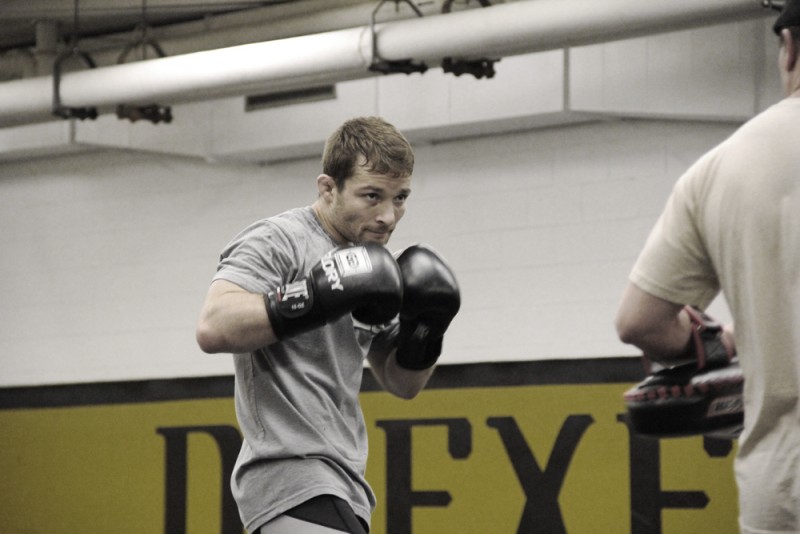
Under the low lights of Drexel University’s wrestling room, alumnus Zach Makovsky rat-a-tatted left hooks and thunderous right-footed kicks. The No. 9 flyweight in the Ultimate Fighting Championship let each meeting of flesh and leather linger, flexing his prowess.

A half-hour before his gym session in the wrestling room, the former Drexel wrestler and 2006 graduate wore a blue T-shirt, emblazoned with the words, “Smokin’ Joe Frazier,” an homage to the Philadelphia boxer. Makovsky’s father was a fan of Frazier’s longtime rival, Muhammad Ali.

Makovsky sported a black eye under his right socket, a byproduct of grappling practice three days earlier.

“It’s a pretty regular thing for me,” he said, grinning.

Standing a manageable 5-foot-4-inches, 125 pounds, Makovsky — nicknamed “Fun Size” — commands a room all the same. His steely jawline, closely-trimmed beard and sandy-blonde hair combine a boyish face with a physique not eagerly trifled with. He has won 19 fights in his mixed martial arts career, succumbing just five times.

* * *

Stomping Grounds

Makovsky spent the afternoon of May 14 talking to reporters and training with longtime friend Ricky Lee in the basement of his alma mater’s recreation center, where his former wrestling team trains. He still spends two to three days a week training on campus. After working four years as a strength and conditioning coach for the University upon graduation, his fellow Dragons keep him well-connected.

A biology major during his time in University City, Makovsky wasn’t sure what he wanted to do when he began college. He said he chose Drexel because of the city and because of the co-op program.

“I liked the idea of the co-op program,” Makovsky said. “[It’s] kind of, don’t go into college kind of blind, come out and then be like, ‘Oh, I don’t want to use this degree.’”

He was a five-year, three co-op student. He learned in his first co-op that he didn’t want to pursue anything related to pharmacy. For his second and third co-ops, he leaned more towards personal training positions.

“As I got more and more into athletics, I tried to learn more and more about that,” Makovsky explained. “I was close to having a nutrition minor but just couldn’t finish it on time.

“Most of the bio electives I got to take were anatomy and physiology, exercise physiology, so I kind of geared towards that stuff.”

Assistant wrestling coach at Drexel, Zach Sheaffer, said Makovsky has always defied the stereotypes of professional boxers and fighters.

“Such a smart guy,” Scheaffer said. “Boxing and fighting guys sometimes get this reputation, but he’s a real smart guy. He reads a ton of books, a lot about mental and physical stuff.”

Makovsky himself admitted he doesn’t have too many hobbies outside of the fighting world.

“Not as many as I should, probably,” he said, sheepishly. “I read. I’ve got my TV shows.”

Makovsky spars with friend and trainer Ricky Lee in his first session May 14. (Ajon Brodie - The Triangle)

Makovsky spars with friend and trainer Ricky Lee in his first session May 14. (Ajon Brodie – The Triangle)

* * *

Gearing Up

For the last month Makovsky has spent most of his time in Montreal, training at Tristar Gym.

“Firas Zahabi is one of the smartest guys,” Makovsky said. “He’s my main MMA coach. I was [in Montreal] getting the best work that I can.”

Makovsky spent the time in Montreal hitting every page in the training book: boxing, kickboxing, jiujitsu, wrestling and sparring, to name a few.

“And lots of sleeping,” he added, laughing.

He’s gearing up for UFC 187 on May 23, when he will face off against John Dodson in the premier flyweight preliminary card.

The fight, held at the same MGM Grand Garden Arena in Las Vegas that housed the recent bout between Floyd Mayweather Jr. and Manny Pacquiao, will be the biggest of Makovsky’s career. The winner, most likely, will earn the right to fight the flyweight world champion, Demetrious Johnson, who is 22-2-1.

After spending the first few years of his career thriving in Bellator MMA, before losing promotion and fighting just twice in a span of about a year, Makovsky’s time with UFC has seen his reputation and career take off. He’s 3-1 in just over a year in the promotion.

* * *

Full Circle

Makovsky’s UFC experience began with a little help from John Dodson, his next opponent.

After being dropped by Bellator following two straight losses, Makovsky floated between promotions.

In November of 2013, he defeated Matt Manzanares in Denver for the vacant Resurrection Fighting Alliance Flyweight Championship. It was his first and only fight for RFA.

Afterwards, he left and headed southwest.

“I went to Albuquerque, New Mexico, in November 2013 to use the altitude,” Makovsky explained. “I’m friends with [Dodson] and some other guys down there. I was training with him while he was getting ready for [his next] fight.”

But Dodson didn’t fight his next fight. Makovsky fought for him.

When Dodson suffered an injury in training, Makovsky stepped in, signed to UFC and took on Scott Jorgensen at UFC on Fox 9 December 14, 2013. He won in a unanimous decision.

A year and a half later, Makovsky is poised to fight the man who gave his mixed martial arts career a needed boost by suffering an injury.

Dodson is currently the top challenger in the flyweight division, ranked No. 2 with a career record of 16-6.

“I’ve spoken to [Dodson], about the fight [in 2013], making sure he knows it was nothing personal and it really wasn’t my idea,” Makovsky said. “But of course it was a great opportunity for me, and he knows that. He feels the same way.”

Makovsky said he and Dodson, who is going to be a father soon, have talked since that December. Dodson told Makovsky that, no matter what happens in their upcoming fight, the two are going to go out and celebrate his coming fatherhood.

* * *

The Quiet Competitor

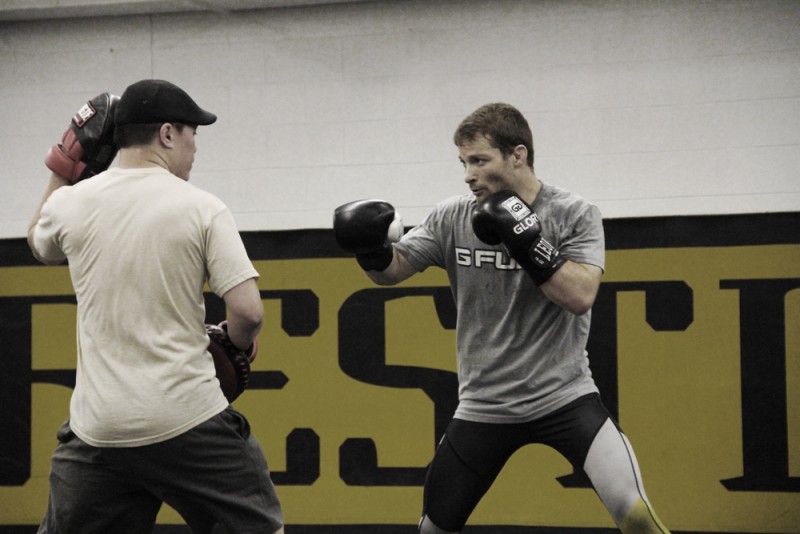
Makovsky spun and launched kick after kick in his second training session with longtime friend Ricky Lee. Each landing kick boomed, ricocheting off the blue mats and yellow-striped walls where Makovsky used to wrestle.

Lee has trained with Makovsky since 2002, when the two met in Philadelphia. They trained at Philadelphia Fight Factory, which closed down in 2013. Now the two live in Fishtown, Pennsylvania. Sometimes Makovsky trains in Lee’s basement.

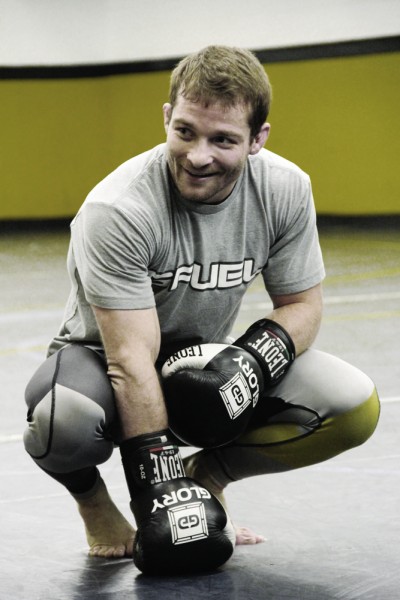
Makovsky crouches between his second and third sessions May 14. (Ajon Brodie - The Triangle)

Makovsky crouches between his second and third sessions May 14. (Ajon Brodie – The Triangle)

Lee said he thinks his good friend is ready for the challenge Dodson will pose.

“He’s good,” Lee said, nodding his head. “He feels healthy, he looks good, he looks sharp as ever. Definitely good.”

Before fights, Lee said, Makovsky is his normal self: soft-spoken, easy-going. When Makovsky cuts weight before fights, Lee said he’s the only fighter he knows who doesn’t get angry.

“Every fighter I’ve known is angry when they’re cutting weight, and he’s never angry,” Lee said. “I’ve only seen him angry one time, and that was when I beat him at wall ball in here when we were warming up. It was one of the funniest days of my life.”

Makovsky, Lee said, is competitive. Sometimes he can’t hold himself back.

The closest Lee’s ever come to being knocked out came when he and Makovsky were training.

“He missed, and he hit me in the face,” Lee said, laughing at the memory.

“Humble dude. Soft-spoken,” Lee continued. “You would never know that dude’s a fighter. But he loves it. He eats, sleeps and poops it. No lie.

“It’s exhausting. Every minute, he’s always watching fights. He loves it.”

* * *

As Makovsky crouched between sessions, Drexel head wrestling coach Matt Azevedo, hugging the wall of the wrestling room, shouted out to Makovsky.

“Are you left-handed?”

Makovsky nodded.

“Did you wrestle left-footed?” Azevedo questioned.

“Nope,” Makovsky replied. “I wrestled right-footed. I punch left-handed.”

He stood up and grinned.

“It all worked out,” he said.

___

The post Little Man, Big Fight appeared first on The Triangle.

Posted in UncategorizedComments Off on Little Man, Big Fight