
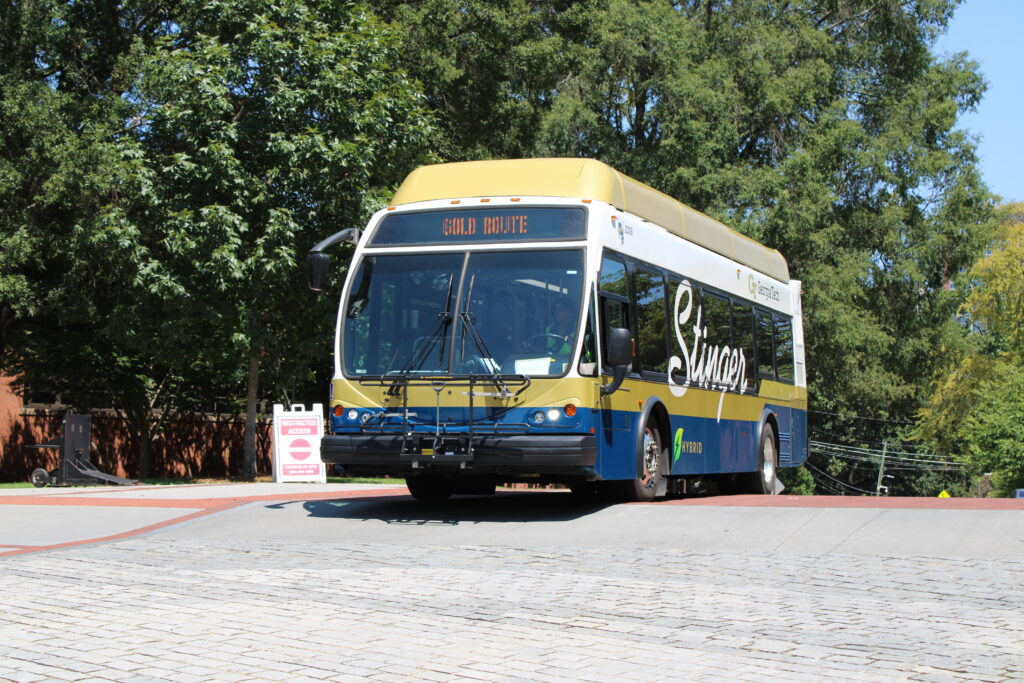
Parking and Transportation Services (PTS) announced last week that they are reverting some of the bus route changes implemented earlier this semester. The reversal comes after many students took to social media to express their dissatisfaction with the new bus routes and their desire for the old routes to be reinstated. PTS launched the new bus routing scheme on Aug. 11, but many users did not see the changes as positive.
The Aug. 11 redesign impacted a majority of weekday Stinger routes. The Gold replaced the Clough/Tech Square route and terminated at the Clough Undergraduate Learning Commons rather than circling campus to the Transit Hub. It also has a new stop at the intersection of Peachtree Place and Spring Street.
Another significant change was the conversion of the Red and Blue routes from opposing one-way loops into two bidirectional routes. The Blue route serves the Student Center and Campus Recreation Center, while the Red route serves Techwood Drive and the northern section of Ferst Drive.
The Gold, Red and Blue routes now operate from 7:00 a.m. to 2:45 a.m., replacing the Midnight Rambler, which operated between Clough, North Avenue Apartments and West Campus from 8:50 p.m. to 2:05 a.m. Nighttime Stingerette on-demand vans have also been changed to prioritize people leaving campus to nearby neighborhoods rather than those traveling within campus.
Routes serving off-campus destinations also changed in the Aug. 11 redesign. The Green route, which serves Home Park, Graduate and Family housing and Tech’s 14th St. facilities, was condensed to increase frequency. The North Avenue Research Area (NARA)/Science Square route no longer stops in front of the Engineering Science and Mechanics Building and Savant Building, instead taking a more direct route via State Street.
After all the changes to existing routes, two new weekday routes were created. The Circulator route operates counterclockwise around the core campus, and the Northside/Atlantic Station route connects the respective areas to West Campus.
The bus network redesign was a part of the Transit Master Plan, which PTS began developing with an external consulting firm in 2024. The plan includes an electrification transition plan for the bus fleet and an operational analysis aimed at optimizing the network and responding to new developments in and around campus. As part of the redesign process, PTS began collecting opinions from students during the 2024-2025 academic year by posting an online survey about the buses and soliciting suggestions for improvements. The survey included 25 questions ranging from what buildings riders visited the most to whether they preferred frequency or coverage.
“We wanted to look at some of the service issues that we were experiencing, look at how the demand has shifted and align that with our Comprehensive Campus Plan,” said Derrick Walker, Director of Transportation at PTS.
The consultant evaluation of the existing bus system, survey answers and suggestions found that the Gold route was overcrowded and unreliable due to bus bunching caused by the route’s length and congestion on Ferst Drive. It also recorded student support for improving transportation connections to off-campus housing. PTS hosted meetings with the Student Government Association (SGA) and faculty and staff interest groups to share their recommended changes and gather feedback.
“Once we got to a finalized point based on feedback … we started working this summer to move forward with the changes,” Walker said.
Abraham Werner, third-year CE & ALIS and Joint Vice President of Infrastructure and Sustainability for SGA, serves as a liaison between the student body and PTS. Werner has been involved in the redesign process, initially as a student assistant, and shared his thoughts about the Stinger redesign.
“On paper, if [the new routes] operated with the efficiency that a bus system should operate, they would have been incredible,” Werner said.
In his new position, Werner helped bring students’ and faculty’s opinions to PTS in the weeks following the Aug. 11 redesign launch.
“I’ve compiled close to 200 — maybe a little bit more — individual testimonials and comments about the new routes, which is an unprecedented level of engagement on any student issue,” Werner said.
One of the Aug. 11 changes that impacted students the most is the merging of the Gold route with the Clough/Tech Square route.
“It’s faster to come to campus because the Gold is shorter and they have more buses on it,” said Saleema Manzoor, second-year CHBE. “But it is less convenient because it only goes [to Clough].”
The shortened Gold route also limited the benefits of the new Northside/Atlantic Station route for students traveling to Tech Square.
“I’d probably have to take three buses to come to Scheller,” said Sindhu Panthangi, M.S. ANLT, who lives near Atlantic Station. “I just walked today, that’s better.”
Issues with the TransLoc app made the Aug. 11 route changes more disruptive. One of the two buses on the new Circulator route regularly failed to appear on the TransLoc app due to technical difficulties with the GPS transmitter. Students have expressed a desire for the app to provide more information about the status of buses, such as whether a bus is in service.
“Sometimes you don’t know if they are just stopped or in traffic, and you are just waiting,“ said Ethan Eccleston, first-year CS. “[TransLoc] needs to give more information about when the bus is coming over.”
Students reported that they saw more buses congregating at one end of the Gold route due to the redesign.
“Sometimes you’ll have three buses come one after another, and then someone at another bus stop has to wait like 30 minutes,” said Kenneth Wangsadarma, fifth-year BME.
PTS met with SGA and the Georgia Tech Staff Council in early September to discuss the planning process and gather input on the new routes
“We have also gotten good feedback from students, faculty and staff via email and our customer support online forms,” Walker said.
After gathering feedback and hearing students’ concerns, PTS announced adjustments to the new routes on Sept. 29, which will go into effect on Oct. 6. The old Gold route will be reinstated, and the new Gold route will be renamed to the Clough route. At night, eastbound Gold route buses will stop at the CULC. The new Circulator route will be eliminated, with buses being reallocated to the Gold route.
The westbound Blue route stop at the Weber Building will be relocated to the shelter on Ferst Drive to help riders determine whether buses are going to North Avenue Apartments or West Village. However, these adjustments will not affect Aug. 11 changes to the Blue, Red, and NARA/Science Square routes.
“I’m super thankful for how much PTS has engaged with the student body, SGA, plenty of student groups and faculty and staff,” Werner said.
PTS is also working on creating a more structured program for individuals who use micromobility solutions, such as bikes and scooters, and is exploring partnerships with operators like Bird and Lime. It hopes to improve safety and ADA accessibility on campus sidewalks by addressing scooter parking. SGA has also requested that PTS explore student discounts for micromobility rental services.
“We’re trying to service a campus with a lot of different demands from various groups. So we’re doing our best to try to meet the needs of everybody,” Walker said. “We really appreciate the feedback that [students] bring … because you guys are the riders on a day-to-day basis.”
The PTS press release is available at www.pts.gatech.edu/2025/09/29/stinger-route-update-oct-6-25/. Students can offer feedback to PTS through its annual commuter survey, which concludes on Oct. 24. Any additional feedback can be submitted via www.pts.gatech.edu/contact/, the TransLoc app, or SGA by emailing it@sga.gatech.edu.
The post PTS addresses Stinger network redesign feedback appeared first on Technique.