
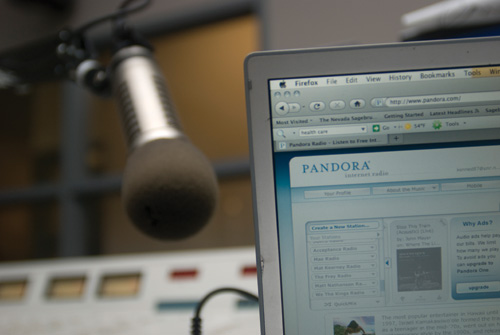
Just a few decades ago, the radio waves were filled with personable disc jockeys, cutting-edge music and news updates that couldn’t be found anywhere else. Since the introduction of the Internet and accompanying mp3 players, the radio industry, like many other media avenues, is changing drastically.
Fewer listeners — particularly in younger age groups — are actively tuning in to the radio. While students still listen to the radio in passing, primarily on car radios, most prefer to select their own music on an iPod.
About 40 million listeners use Pandora, a free, customizable online radio service. A survey conducted by Edison Research indicated that 20 percent of those aged 12 to 24 listened to Pandora at least once per month while only 6 percent said they listened to online streams of AM/FM stations.
The number of listeners who tuned in to an Internet stream of FM radio increased by 14.6 percent between 2008 and 2009, and the number of listeners who tuned in to an Internet stream of AM radio increased by 21.7 percent, according to Arbitron ratings. During the same time frame, the number of listeners who tuned in to broadcast FM stations increased by only 2.1 percent and listeners who tuned in to AM stations increased by only 0.7 percent. The study also revealed that more than 35 million listeners access satellite radio each week.
“Technology is definitely changing the game for radio,” said David Stipech, general manager of KUNR. “Certainly, for your generation, iPods, online music sharing and digital stuff is reshaping radio. More content is available in more places on more platforms on demand, and a lot of it is free, or people are able to get it illegally for free.”
Stipech said the low cost and availability of most music is a driving factor behind changes to the radio industry.
“User habits are also shaping radio,” Stipech said. “KUNR relies on financial contributions from listeners who tune in when you put the program on. Now people are used to programming at your convenience without a price tag involved. It’s a challenge for all radio stations, especially public radio.”
Jessica Reynolds, a 20-year-old math major at U. Nevada, Reno, said that she doesn’t regularly listen to the radio.
“I like to listen to music that I already have,” she said. “You already know that you like it. You can make your own playlist rather than listening to stuff that you might like and might not like.”
KUNR focuses its programming mostly on news and information and has transitioned away from most of its music programming as a way to deal with the changes to the industry.
For 40 years, KUNR was predominantly a classical music station with some NPR content. In 2008, the station decided to switch to more local news and information. The station has gone from broadcasting six hours of news to 14 hours of news and information each day.
In addition to competition from iTunes and users choosing to “be their own DJs,” radio stations also face competition from Internet and satellite radio stations, which can also be accessed in cars.
Wolf Pack Radio, the U. Nevada, Reno’s student-run radio station, focuses primarily on its online stream of music and hour-long radio shows hosted by student DJs.
Most large radio stations are run by corporations that use the same group of DJs to record voice pieces for multiple stations.
“That’s what sets us apart from other radio stations,” said Ray Eliot, general manager of Wolf Pack Radio. “There’s so much variety, and it’s very free-form. It lends a personal touch. It works because we’re such a small station. It’s logistically very hard to pull off — no big station can really do what we do.”
Though Wolf Pack Radio offers online content, it still faces competition from other available sources of music and talk. Websites such as Pandora offer users the ability to listen to a sort of radio with the ability to skip songs and avoid interjections from live DJs.
“People used to like to hear people talk on the radio,” Stipech said. “Now it’s less about personality and more about getting straight to the song. So, why not listen to your iPod? There’s been a shift in what people expect from the radio. The downside, I think, is that when you choose what to listen to, you miss out on the great exploration of things.”
For many students, radio serves as background noise while they are in the car rather than something they pay attention to.
“Radio has a more passive role in youth culture than it used to, especially on-air radio,” Eliot said. “You can get Pandora on your iPhone — what else do you need? The medium is definitely changing, but I think radio is still important. Stations need to establish more online content, and it’s not hard.”
Some radio stations multicast content, providing an online stream in addition to on-air programming. Others offer podcasts online or other incentives to get listeners to tune in.
“The group of people who seeks out Internet radio is probably pretty small,” Eliot said. “When you’re online, you can listen to whatever music you want, so it’s kind of weird to say, ‘I think I’ll listen to whatever these people are playing.’ Stations have to offer something other stations can’t, and that’s where the DJs’ hosting comes in.”
Stipech said he feels radio will easily remain relevant for the next decade, but the future of radio is very unclear.
“Radio has to find ways to provide value on a local level that you can’t get somewhere else,” he said. “It’s going so fast and changing so fast.”