
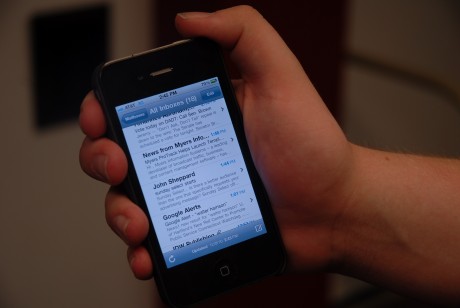
During any given class, my phone would buzz at least 20 times before I decided to take control of my attention span.
Text messages and e-mails would flood my inbox, with each subsequent alert distracting me away from the note taking at hand.
As a smart phone user getting e-mails pushed to my phone from five different accounts, I really thought it would be a boost for my productivity in general. Instead, the tedious nature that comes with reading and responding to e-mails did the opposite. I’m pulled away from the conversation every time my phone vibrates–I don’t even have to take out the phone to fall out of the loop sometimes.
In an article titled “The New Attention Deficit” in Entrepreneur Magazine, Chris Brogan highlights a few ways to keep focus on tasks. One of the solutions was to turn off audio/vibration notifications for e-mails.
It might be a bad thing that it took me until reading this article to realize why a phone user would ever need to turn alerts off. Perhaps, I thought, people who receive hundreds of e-mails a day wouldn’t want their phones to make noise all day long.
The simple fact about e-mail is that the people who send e-mail don’t expect it to be read and responded to right away. And it’s not like I’ll go more than a few hours without reading an e-mail–my phone constantly tells me how many messages I have waiting for me. So does my computer’s mail application, but I’m not a slave to it. Every time I heard the “Ding!” the computer makes, I’m compelled to read and respond.
As society is getting busier and busier devoting more time to their screens, human contact is getting to be a bit of an intermediary process. We’re resorting to texts, e-mails and even tweets to carry on conversations.
Wine and Web entrepreneur Gary Vaynerchuk recently said in a Twitter post, “The phone call is the new hand written letter.”
This could be misinterpreted–one might argue that people are far less likely to ignore a handwritten letter than they are to ignore a phone call. Rather, he’s implying that usage is in a downward trend (the data’s there as well–cell phone companies are definitely leveraging text messaging and data plans more than they are voice).
Vaynerchuk’s interpreting a trend that’s dominating college-aged adults–we’re carrying out conversations that used to be required on the phone. Some conversations I’ve had through text messages would have been downright easier to accomplish had it been over the telephone. In some cases, if it’s for a project I’m working on, and I’m being asked a series of questions, I might try and telegraph what the next few questions are to end the conversation.
Is it becoming rude to pick up the phone and call? I know if I’m carrying out a conversation in text message, I’m not about to call them with a response. In some ways I assume there’s a reason why someone is text messaging me instead of talking to me over the phone–they’re in a place where it would be rude to talk in the phone: the classroom, for example.
Picking up the phone and calling means devoting most of one’s attention to a person–a battle that’s being waged by the increasing number of screens in our lives.